EXPERMENTAL ANALYSIS OF PEANUT OIL AS BIO-DIESEL ON CI ENGINE

1,2,3,4 Students , B.Tech-Final year, Department of Mechanical Engineering
5Assistant professor ,Department of Mechanical Engineering Andhra Loyola Institute of Engineering and Technology, Vijayawada, India.
Abstract-In this study, we conducted experimental investigation on a IC engine using blends of methyl esters derived from peanut oil and diesel fuel. The process of transesterification is used to convert the peanut oil into methyl esters, which are then analyzed for various fuel properties including density, viscosity, flash point, fire point, and calorific value to determine their suitability for use as fuel.
In the next phase of the study, experimental investigations are conducted on a test engine using blends of biodiesel and diesel, ranging from B10 to B30, under the same operating conditions. The engine performance parameters such as brake power, brake specific fuel consumption, brake thermal efficiency, indicated power, indicated thermal efficiency, mechanical efficiency, and exhaust gas temperature are measured and compared to those of pure diesel operation.
Key Words: Biodiesel,peanutoil,Diesel
1.INTRODUCTION
India is heavily dependent on crude petroleum and petroleumproductsimportedfromgulfcountries,which as significant economic and environmental implications. To address this challenge, Indianscientists have been exploringalternativestodieselfuelthatcanbeproduced domestically while also preserving the global environment. India’s vast agro-forestry resources, bio fuels of agricultural and forest origin have emerged as a promisingrenewablefuelsourceforinternalcombustion engines. These bio fuels are considered to be ideal alternatives to conventional fossil fuels as they are renewable, sustainable, and can help reduce the green house gas emissions. By leveraging its abundant natural resources, India can significantly reduce its dependence on imported fossil fuels and transition to a more sustainableenergysystem.
The escalating demand for fuel coupled with the worsening climate conditions has raised concerns about environmental problems and energy crises. In light of this,biodieselhasemergedasapromisingalternativeto traditional diesel fuel.Biodiesel referstothemono-alkyl esters with long chains of fatty acids derived from
vegetableoils,animalfats,orwastecookingoil.Biodiesel is renewable, non-toxic, non-flammable, and readily available fuel source. It is also free from sulfur or aromatic compounds, which helps to reduce air pollution,includingcarbonmonoxide,hydrocarbons,and particulate matter. As a result, biodiesel is gaining worldwide attention and is considered an ideal fuel for thefuture.
The primary sources of commodities for biodiesel production are edible oils such as peanut oil, sunflower oil,soybeanoil,andothers.Althoughvegetableoilshave good ignition characteristics, their long-chain hydrocarbon structure can cause several issues when usedasfuelininternalcombustionengines.Theseissues include carbon deposits buildup, poor durability, high density, high viscosity, lower calorific value, high molecularweight,andpoorcombustionefficiency.
To address these issues and improve the thermal efficiency of vegetable oil in engines, various methods have been developed to reduce the viscosity of the oil. The most commonly used methods include transesterification,dilutionandcracking.
Transesterification involves converting the vegetable oil into biodiesel by reacting it with an alcohol in the presenceofacatalyst.Thisprocessreducestheviscosity oftheoilandimprovesitscombustionproperties.
Dilutioninvolvesblendingthevegetableoilwithalighter fuel, such as diesel, to reduce its viscosity and improve its flow properties. This method also helps to reduce carbon deposits and improve the combustion efficiency ofthefuel.
Cracking involves breaking down the long chain hydrocarbons in the vegetable oil into smaller, lighter moleculesusingheatandpressure.Thisprocessreduces the viscosity of the oil and improves its combustion properties.
By implementing these methods, the issues associated with using vegetable oil as fuel in internal combustion enginescanbeaddressed,leadingtoimprovedefficiency andreducedenvironmentimpact.
2. LITERTURE REVIEW
SANTHOSH SHIVAN D, et al [1] peanut is a potential oil cropasitcontainsthehighamountofoilascomparedto only about 15%-20% for soybean oil. Aside from engine testing,emissionassociatedwiththeuseofbiodieselalso needs to be evaluated to assess its cleanliness as a fuel. There are two main process are performed in the production of the peanut oil is a biodiesel. These were transesterification is the process of exchanging the alkoxygroupofanestercompoundbyanotheralcohol.
MAKASSON R. CLAND et al, [2] MATERIALS AND METHOD the materials for study comprises of conical flask,thermometer, water bath,beaker,freshgroundnut oil, KOH, methanol, reactor, and distilled water, sodium hydroxide,GC,FTIR.
WAILM.ADAIEHANDKHALEDS.AIQDAH.[3]Sunflower oil the performance of biodiesel and its blends (B5 to B20) were studied in comparison with diesel fuel. The biodiesel is mixing with the standard diesel in an external tank, according to the needed ratio which is in this case 5% biodiesel with 95% standard diesel, 20% biodiesel with 80% standard diesel. The compression ignition engine used for the study was a single cylinder, fourstroke,directinjection,aircooledengine.
J.M. MAKAVANA, et al,[4] flash point test the flash point of a volatile liquid is the lowest temperature at which it canvaporizedtoformanignitablemixtureinair.Penskymarten`s closed cup tester measures the lowest temperature at which the application of the test flame causes the vapor above the bio-biodiesel sample to ignite.
3.METHODOLOGY
The production of peanutoil biodiesel typicallyinvolves two main processes: transesterification and washing. Transesterification is the process of converting triglycerides, such as those found in peanut oil, into biodiesel by exchanging the alkoxy group of ester compoundwithanotheralcohol,typicallymethanol.This reactionisoftencatalyzedbyanacidorbasecatalyst.
After the transesterification reaction, the resulting biodiesel is typically washed with water to remove any remaining impurities. This is done because biodiesel produced by transesterification typically contain some methanol, glycerol, and other impurities that must be removed beforethe biodiesel can be used asfuel. Water washing is the most common method of cleaning biodiesel, and it works by soaking up the methanol and dissolvingimpurities, whicharethen washedawaywith water.Theresultispurebiodieselofpeanutoil.
4. METHODS AND PROCEDURE
4.1WORKING PROCESS
Two operations are performed these are transesterificationandwashingprocess
4.1.1 TRANSESTERIFICATION PROCESS
Transesterification reaction is the produce ester from groundnut oil using methanol-NAOH mixture as a catalyst.Thereactionwascarriedoutatatemperatureof 600C and allowed to settle for 48 hours to complete the reaction.
During the reaction, the methanol-NAOH mixture was added to the groundnut oil in a transesterification reaction occurred, resulting in the formation to ester. Themixturewasstirredrapidlytoensurepropermixing, and then allowed to settle for 48 hours to complete the reaction.
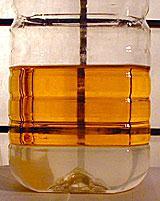
After the reaction was complete, the glycerol layer, whichistheheavierliquid,collectedatthebottom,while the ester product was at the top. The glycerol layer was drained off, and the ester layer remained as the final product.
4.1.2WASHING PROCESS
The Peterson et al. (1996) method for washing consists oftwosteps:
Step1:initialsettling
Allowthemixtureofglycerolandesterlayersto settle until a clear separation between the two layersisobserved.
Step2:washingprocess
Aftertheinitialsettling,re-mixtheglycerollayer withtheesterlayer.
Add 15% water to the mixture and stir for 10 minutes.
Allowthemixturetosettlefor48hourstoallow forcompleteseparationoftheglycerolandester layers.
Carefully remove the top layer of glycerol and bottomlayerofwater.
Repeat the washing process with fresh water untilthewaterlayerisfreeofimpurities.
To modify the method, you could try different percentages of water or adjust the settling time to optimize the washing process. Additionally, you could experiment with using different solvents or washing
agentstoimprovetheefficiencyoftheprocess.However, any modifications should be tested and evaluated to ensure that they do not negatively impact the quality or purityofthefinalproduct.
placed on top to create a closed system. A thermometer with a specified range is attached, and the apparatus is set up with all necessary accessories. To being testing, the test flame is first applied at least 170C below the expected flash point. Then, at every 1-30C increase in temperature, the test flame is reapplied until the flash point is reached. It`s important to note that stirring should be stopped during each test flame application. Once the flash point has been determined, testing continues until the fire point is reached. The same processingisapplying thetestflameatregularintervals is followed until the material ignites and continues to burn.
4.2.4 CALORIFIC VALUE
4.2TESTS CONDUCTED
Density
Viscosity
Flashandfirepointtest
Calorificvalue
4.2.1 DENSITY
Density is a physical property that represents the amount of mass per unit volume of a substance. It is commonly denoted by the greek letter (rho), although the latin letter D may also be used. The mathematical formulafordensityisgivenby;
=m/V
The SI units of density is kilogram per cubic meter(kg/m3). However the other units such as grams percubiccentimeter(g/cm3).
4.2.2 VISCOSITY
Viscosity is a physical property that characterizes a fluid`s resistance to deformation or flow due to internal friction between its molecule. In simpler terms, it is a measureof“thick”or“thin”afluidis.
A fluid with high viscosity, such as honey or molasses, such as water or gasoline, has a thin and runny consistency and flow easily. The viscosity of a fluid depends on its molecular composition and the forces betweenitsmolecules.
4.2.3 FLASH AND FIRE POINT TEST
It seems like you have described the procedure for determiningtheflashpoint andfirepointsofa material, aclosedcupapparatusisused.First,thematerialisfilled in the cup up to a designated filling mark, and a lid is
Calorific value is a measure of the amount of energy producedbythecompletecombustionofaunitquantity of substance, typically expressed in units of calories or joules. This value is determined using a bomb calorimeter, which ignites the substance in a sealed chamberand measures the resultingheat release. When it comes to the calorific value of coal, there are actually two different measures: the gross calorific value (GCV) and the net calorific value (NCV). The gross calorific value,alsoknownasthehighheatingvalue(HHV),takes intoaccountthelatentheatofwatervaporizationthatis released when the coal is burned. This means that it includestheenergyrequiredtoconvertwatervaporinto liquid water, which is produced during the combustion process.
BIO-DIESEL PROPERTIES
TABLE-1 Properties of the diesel and biodiesel
4.2.5 PERFORMANCE TEST
Thegivencontextdealswiththeperformanceanalysisof anengine.Themaximumloadthatcanbeappliedtothe engine can be determined by conducting a load test on the engine. The load test involves gradually increasing theloadontheengineandnothingtheenginespeedand fuel consumption at each load increment. The load is increased until the engine reaches its maximum load capacity.Beforeconductingtheloadtest,itisessentialto
ensure that the engine has sufficient fuel, lubricant, and cooling water supply. The engine should also be started in a no-load condition and allowed to run for a few minutes to attain the rated speed. During the load test, the time taken for the consumption of 10cc of fuel is notedateachloadincrement.Thespeedoftheengineis alsorecordedateachloadincrement.Thedata obtained from the load test is tabulated to calculate the specific fuel consumption, indicated power, brake power, brake thermal efficiency, indicated thermal efficiency, and mechanical efficiency. The maximum load that can be applied to the engine is determined by observing the load at which the engine reaches its maximum performancebasedontheparametersmentionedabove.
4.2.6 EMISSION TEST
Emissions testing are an important tool in the efforts to reduce air pollution from motor vehicles. The first emission testing was indeed conducted in California in 1966, and since then, many other states and countries have implemented similar testing requirements for all registered vehicles. When a vehicle undergoes an emissions test, the level of air pollutants emitted from theexhaustismeasured.Ifthevehiclefailstheemissions test, repairs must be done to bring it into compliance with the applicable standards, and the vehicle must be retested. To ensure consistent and comparable results across different engines and vehicles, emissions testing protocols include test cycles that specific conditions underwhichtheengineorvehicleisoperatedduringthe test. These test cycles are often based on the emissions standard established by national and international governments and working groups. There are many differenttestcyclesusedaroundtheworld,eachwithits own specific requirements and conditions. Some of the mostcommonlyusedtestcyclesincludetheUSEPAFTP75 and HFET cycles, the European NEDC and WLTP cycles, and the Japanese JC08 cycle. These test cycles take into account factors such as vehicle speed, acceleration, and driving conditions to provide a standardized method for measuring emissions. Overall, emissionstestingandtheuseoftestcyclesplayacrucial role in helping to reduce air pollution from motor vehicles and promoting cleaner, more sustainable transportation.
5. RESULTS AND DISCUSSIONS
5.1 PERFORMANCE TEST
TABLE2-Performance characteristics of diesel and biodiesel at halfkg load of 16:1 compression ratio
TABLE3- Performance parameters of diesel and biodiesel at half kg load of 18 compression ratio
5.2
TABLE4-Emission
FIG4-EMISSION
TABLE5-Emission
5.3 DISCUSSIONS
From the fig2 the performance characteristics of diesel andbiodieselB20athalfkgloadof16compressionratio isnearestvaluesofvariousperformancetests.
From the fig 3 the performance characteristics of B10 valuesishighascompared tothe B30andnearer tothe diesel at half kg load of 18 compression ratio of various performancetests.
From the fig 4 B20 emissions values is low as comparedtothepuredieselduetolowunburntcarbon gases.
From the fig 5 emissions values of B30 is low as compared to the B10 emission values and nearer to the purediesel.
6.CONCLUSION
It`s great to hear that there`s a simple and eco-friendly method for synthesizing biodiesel from peanut oil. Biodiesel is a renewable and sustainable alternative to fossil fuels, and using peanut oil as a source for its productioncanprovideseveraladvantages.
It`s good to know that the synthesized biodiesel was confirmed by flash and fire point tests. These tests measure the temperature at which the biodiesel ignites and burns, respectively, and are important indicators of itssafetyandperformance.
The emission test results are also encouraging, as they showthatthesynthesized biodiesel produced emissions that were similar to or better than standard emission tests. This is important because the emissions from transportation are a significant contributor to airpollution and dimatechange, and biodiesel can help reducethoseemissions.
Finally the synthesis of biodiesel from peanut oil has a lot of potential as a sustainable and environmentally friendlyenergysource.
REFERENCES
Santhosh Shivan D, et al. [2019]. Biodiesel from peanut oil and its emission and performance charecteristics in fourstrokeicengine.Irjet,volume:6,issue:6.
MakassonR.cland,etal.[2020].Productionofbiodiesel fromgroundnutcrudeoil.IJRIAS,VolumeV,IssueVIII.
Wail M. Adaileh , et al.[2012]. Performance of Diesel Engine Fuelled by a Biodiesel Extracted From A Waste cockingOil.EnergyProdcedia18(2012)1317
1334.




Mahendra Dulawat, et al. [2020]. Study On Biodiesel Production and Characterization for Used cooking Oil. International Research Journal of Pure and Applied Chemistry/2020/v21i2430337.
Demirbas A, et al. [2006] Biodiesel production via noncatalytic SCF method and biodiesel fuel characteristics. EnergyConversManage;47:2271–82.
YusufN.andSirajo,M.(2009).AnExperimentalStudyof Biodiesel Synthesis from Groundnut Oil, Aus. J. Applied Sci.,3:pp.1623-1629.
Sanchez, O.J. and Cardona, C.A. (2008). Trends in Biotechnical Production of Ethanol Fuel from Different Feedstocks,Bioresour.Technol.,37(2):133-140.
BIOGRAPHIES
DHANUNJAI G

B TECH Mechanical engineering
ALIET Vijayawada
SAI TARUN P
BTECH Mechanical Engineering
ALIET Vijayawada
ABDUL FAROOQ SK
BTECH Mechanical Engineering
ALIET Vijayawada
YUVA KIRAN BABU Y

BTECH Mechanical Engineering

ALIET Vijayawada
Prof. UDAY KIRAN K Assistant Professor


Department of Mechanical Engineering
ALIET Vijayawada