Decentralized Finance
Shreyansh Kumar Purwar1 , Dr. Supriya Lamba Sahdev211st Year PGDM Student at ISBR Bangalore, Karnataka, India
2HOD, Dept. of Marketing Management at ISBR Bangalore, Karnataka, India

Abstract - Decentralized finance, commonly referred to as DeFi, is a new paradigm in the financial system aimed at providing access to financial services and products through decentralized networks. We use blockchain technology to create a transparent and trustworthy system that works without intermediaries. DeFiis growinginpopularityasmore people realize the benefits of technology. DeFi may improve the financial industry which is more transparent, secure, and accessible alternative to traditional finance for all. This is a new and emerging field that is rapidly changing the way the financial system works. One of the most important contributions of blockchain technology to DeFi is the creation of decentralized networks. Instead, it is spread over many computers or nodes. This means there is no single point of failure, and the system is not vulnerable to cyberattacks or hacks.
Key Words: DeFi, Blockchain, Innovation, Finance, Decentralisation, Cryptography, DLT
1. INTRODUCTION
6Blockchaintechnologyalsoprovidesatransparentsystem for recording transactions. This technology creates an immutabledigitalledgerthatrecordsalltransactions.There can be no alteration to the transaction once done. This ensuressystemintegrityandpreventsfraud.
DeFi uses blockchain technology to create decentralized applications(DApps).Theyrunondecentralizednetworks and have scopes like lending, borrowing, trading, and investing. These DApps eliminate the need for intermediariessuchasbanks,brokers,andotherfinancial institutions.DeFiplatformsusesmartcontractstoautomate transactions, automatically executing when certain conditions are met. A smart contract operates on a blockchain network. For instance, a smart contract can executeatradewhenacertainassetreachesacertainprice level.
DeFi platforms also offer a high level of transparency and traceability.Alltransactionsontheblockchainarevisibleto everyoneanduserscantrackassetmovementsinrealtime. This creates trust for users and removes the need for intermediariestovalidatetransactions.
Theuseofcryptocurrenciesisanothermajorcontributionof blockchaintechnologytoDeFi.Cryptocurrenciesaredigital assets that operate on decentralized networks. They are
***
designed to provide a safe and transparent means of conductingtransactionswithouttheneedformiddlemen.
2. DeFi and its features
2.1 Decentralization
DeFisystemsaredecentralized.Thatis,itworksonpeer-topeernetworksthatarenotcontrolledbyacentralauthority. Thiseliminatestheneedforintermediariessuchasbanks, brokers,andotherfinancialinstitutions,reducingcostsand increasingaccessibility.
2.2 Transparency
DeFi platforms are transparent. This means that all transactions on the blockchain are visible, and users can track asset movements in real time. This creates trust for usersandremovestheneedforintermediariestovalidate transactions.
2.3 Smart contract
DeFiplatformsusesmartcontracts,whichareself-executing contracts that run on the blockchain network. Smart contractsenableautomatedandsecureexecutionoffinancial contracts, eliminating the need for intermediaries such as banksandlawyers.Smartcontractscanbeprogrammedto performspecificactionswhenspecificconditionsaremet.B. LoanPaymentswithPostedCollateral.
2.4 Cryptography
Blockchain technology uses cryptography to secure transactions and data on the network. Transactions are encryptedusingcomplexmathematicalalgorithms,making themextremelydifficulttohackortamperwith.
2.5 Safety
DeFi platforms use blockchain technology which gives improved security. Transactions are encrypted and the blockchain is immutable. It means issued or managed by DeFi services can't in proposition be unilaterally expropriatedormodifiedbythirdparties,indeedbythose furnishingintermediationandotherservices.Usersretain full control. Thus, centralized cryptocurrency exchanges that have custodianship over digital means are not DeFi businesses, but multitudinous are still developing DeFi offerings. 2
2.6 Access
DeFiplatformsprovidefinancialservicestoanyonewithan internet connection, regardless of location or economic situation. This creates more opportunities for those who cannotaccesstraditionalfinancialservices. Thereisbroad vacuityofthebolsteringsourcelawandapublicapplication programming interface (API). factors can be composed together and programmed to produce new financial instruments and services roundly. For instance, we have accesstothetransaction,anditcaneasilybeviewedbyonly contributingmembersandvalidatedsubsequently. 2
2.7 Interoperability
DeFiplatformscaninteractwitheachothertobuildamore connected financial system. This gives users access to a wider range of financial products and services, increasing choiceandcompetition.innovation:
DeFiisanewemergingfieldthatisrapidlychangingtheway the financial system works. As more people join the DeFi ecosystem,wecanexpectmoreinnovationandnewfinancial productsandservices.
3. The difference between DeFi and traditional finance 1
3.1 Traditional Finance:
Market-basedfinanceisbasedonintermediariesthatbring together a wide range of participants. The paradigmatic intermediariesaremonetaryinstitutionssuchasbanks,and market providers such as securities exchanges. Intermediaries in the financial market actas a connection betweenpartiespossessingfinancialresources,likesavers, lenders,andinvestors, with those who needthem to fund their ventures such as borrowers and entrepreneurs. We often think of the intermediary as the central point when separating market-based economic systems into their primarysectorsofmoney,payments,banking,securities,and insurance. In traditional finance, functions and financial resourcesarecentralizedthroughmajorintermediaries.This results in the hub-and-spoke conceptualization of finance andcentresoffinance.Atechnology-drivenandglobalized environmentcharacterizestraditionalfinancetoday.
3.2 Centralization for scale
If a patron possesses nearby proximity to key amenities, namely payment processing, automated teller machine access,savingsandinvestmentopportunities,orinsurance resources,theseconveniencesshallnotbeprofferedattheir exactpointofentry.Rather,financialmarketsandactivities traditionally cluster in local, regional, and super regional/globalaccesspoints(‘hubs’).Theseservicesarein substanceprovidedfromafinancialcentrewheresufficient concentrationoftransactionvolumesandnumbersineach
sector(s)orservice(s)allowthedevelopmentofexpertise andresources.Dependingonthesector(s)/service(s),the required volume and numbers may be developed locally, regionally,orglobally.
3.3 Regulation and traditional finance
Trust and trust are essential for these financial centres to function. Laws, rules, institutions, regulations, and courts underpincreditandcredit,aswellasthebasicfunctioningof the financial system. Many of these systems initially developed as private governance or self-regulatory frameworks, but because of the failures of private governance and self-regulation that frequently surfaced during economic crises, the state gradually evolved into a larger system. I started playing a role. Money acts as a sovereign action, linking finance and government. As the turmoil subsided after the 2008 financial crisis, it became clearthatdecisiveactionwasneededtopreventhistoryfrom repeatingitself.Anewregulatoryframework isneeded to mitigate future financial crises. Such measures have been implementedinvariousareasofthecommercialworldwith theexpresspurposeofsoothingpotentialcrises.Asaresult, market-based financial systems are often viewed as essentially unstable. Volatility and market collapse are addressedbyregulation,butitisnotalwaysappropriate.
3.4 DeFi: Answers and Challenges forConventional Mode
DeFichallengesthishublogic.Wheretechnologyislikelyto create scale. Hubs make little sense than bundling transactionsintoonehub.
3.5 Customer Disadvantages
1 They must adapt both linguistically and legally. High compliance standards that reflect concentration of risk acceptinformationcosts(e.g.,legaladvice)andpenaltiesfor non-compliancewithlawsenforcedathublevelbutnot(yet) atlocallevelmaybeimposed.Hubaccessisnotpossibledue to lack of equivalent regulation and oversight in many developingcountries.Itbecomesa problem.Customersin countrieswithweak
institutionalenvironments
In some cases, costly workarounds must be resorted to throughmultiplejurisdictionsactingasregionalhubs(asis oftenthecaseintheGulfStates).thatmeanscompaniesin developingcountriesoftenonlyhaveaccesstoservicesthat areavailableworldwide.Indirectaccesstofinancialcenters (butatalowercostthandirectaccess).Forexample,inthe emergingmarketcurrencyexample,thiscouldbeaservice. Tokenized and available to token holders, regardless of provider origin Bitcoin is a prominent example. Bitcoin holdersincludesSharedtechnologyinsteadoflargebalance sheetsinahighlyregulatedpaymentsenvironmenthub.
4. Core Components of DeFi
4.1 Blockchain
A distributed ledger that acts as an accounting layer for transactions.MostDeFiservicestodayutilizetheEthereum network due to its potentiality and acceptance by developers.DeFiactivityisexpandingonandbeyondother blockchains.
4.2 Digital assets
Atokenthatrepresentsvaluethatcanbetradedorconveyed within a blockchain structure. Bitcoin and other cryptocurrencies were the first blockchain-based digital assets. Others have various expected action apart from payment.
4.3 Wallet
Asoftwareinterfaceforuserstomanageassetsstoredonthe blockchain. An unmanaged wallet allows users to have absoluteauthorityovertheirfundsusingtheirownprivate keys. In depot wallets, private keys are handled by the serviceprovider.
4.4 Smart contract
Blockchain-basedprogramcodethatexecutes,commands, and extracts relevant events and actions according to definedconditionsandrules.
4.5 Decentralized Applications (DApps)
Softwareapplicationsbuiltfromsmartcontractsandoften combined.It has a user-centric interface using traditional webtechnologies.
4.6 Governance system
Asoftware-basedmechanismthatmanagesswitchtosmart contracts or alternative blockchain protocols, generally positioned on tokens that assign voting rights to collaborators.
4.7Decentralized Autonomous Organization (DAO)
Anentityforwhichrulesaredefinedandappliedintheform ofsmartcontracts.
4.8 Stablecoin
Digitalassetswhosevalueistiedtofiatcurrency,basketsof fiatcurrency,orotherassetsofstablevalue.
4.9 Oracle
A data feed that allows data from experts outside the blockchain. Current prices of stocks or fiat currencies for integrationintoDeFiservices.
5. Categories of DeFi services
5.1 Stablecoins pursuetocontinueaconsistentrateofthe tokenagainstanasset,mostordinarilytheUSdollarorother considerablefiatcurrency.Thenon-custodialstablecoinacts ashisDeFiserviceinitself.Custodystablecoinsarecentrally managedbutcanbeintegratedwithDeFiservices. 2
5.2 Exchanges grantuserstoexchangeonedigitalassetfor adistinct.DeFiexchangebypassescustody
Userassetsthroughadecentralizedorderbookorbypaired orders andkeepingprices algorithmically. DeFi exchanges polarizeimportantfunctionswithdiscrepancies.Theycanbe injectedeitheronapeer-to-peerbasisorprogrammatically with non-custodial retention of all transactions that are naturallyreusedbysmartcontractsagainstpoolsofcapital. While exchanges can run order books on or off the blockchain, the most prominent form of DeFi exchange, Automated Request Makers (AMMs), renders traditional orderbookscompletelyobsolete.Anydigitalfundownercan lock in finance as implicit trading liquidity and get the returns that traders pay. The price of each trade is algorithmically determined based on the liquidity rate availableonthetradedfunds.Thus,traderstradeonapool of liquidity provided by the referrer rather than on the implied counterparty's order book subject to shot-ask spreads.DifferentarchitecturechoicesforDeFiexchanges leadtovariationsinrevenue,quietness,security,scalability, andfareandslippage(theamountto whichbiggerorders changeprices). 2
5.3 Credit includestheformationoftime-limitedinterestbearingsecuritiesthatmustberefundedatmaturityandthe coordination of lenders and borrowers to issue these securities.
5.4 Derivatives arefabricatedmonetaryinstrumentswhose monetaryworthisbasedonthefunctionofahiddenassetor group of assets. Common illustrations are futures and optionsrelatedtofutureassetvalues. 2
5.5 Insurance provides protection against risk by exchanging the opportunity to receive large payments in case of covered scenarios for small assured premium payments.
5.6 Wealth administration attemptstomaximizethevalue ofaportfolioofassetsbasedonriskappetite,timehorizon, assortment, or other criteria. In DeFi, underlying investments can consist of commemorative coins, digital means of landing traditional engagement, synthetically structured commemorative coins, and interest-bearing accounts.DeFiwealthmanagementprotocolscombinethem into“vaults”or“pools”throughsmartcontractstoactasa diverseportfolioofdigitalassets.Theboundariesbetween asset classes and package types and the traditional commercialmodelforsuchservicesarestillevolving. 2
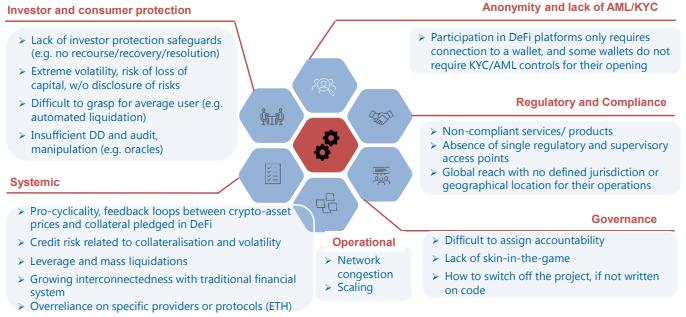
6.1 Compliance and Regulation 3
MultitudinousDeFioperations(orpartoftheirconditioning) areinvolvedinnon-compliantprovisionofregulated fiscal servicesandproducts,frequentlyreservedonlyforcertified realities. Controllers in utmost authorities with active tokenised requests have espoused a technology-neutral approach to programs around DLT- grounded fiscal exertion,withthesamerulesapplyingtothesametypesof conditioning and pitfalls, irrespective of the technological mediumthroughwhichtheproduct/serviceorexertionis handed(OECD,2021).Assimilar,theuseofDLTsorother technology doesn't affect the way these controllers assess whether the preceding fiscal product/ service or exertion fallswithinthenonsupervisoryborder,andbyconsequence, whetherit'sregulatedorlimited. presently,multitudinous DeFiplatformsdeliverfiscalservicesinanon-compliantway, exposing actors and the request to significant pitfalls. Despite their complexity, multitudinous DeFi operations, whenbrokendown,couldrepresentregulatedconditioning for which comprehensive fabrics are formerly in place aiming at conserving fiscal stability, guarding fiscal consumers, promoting investor protection and request integrity, and mollifying lawless finance pitfalls. NoncomplianceofDeFisystemswithbeing fabricsgivesriseto pronounced pitfalls for actors and the request. Inversely, other DeFi operations or conditioning presently falling outside of the regulated space in some authorities raise pitfalls that are left unaddressed by the being rules (indicatively,allocationofcrypto-meansthatdon'tqualify asfiscalinstrumentsorfinancesore-moneyintheEU)
6.2 Difficulties in governance of DeFi 3
ThedecentralisednatureofDeFigivesrisetomultitudinous challenges around governance of DeFi, with counteraccusationsforconsumerprotection,oversight,and enforcement. As mentioned over, the identification of decision-makingrealitiesactorsthatcanbeheldresponsible isdelicate,whileatthesametimeimpedingoversightand
enforcement action by controllers and administrators. Softwaredriversorprogrammerswhohavehandedthefirst cutoftheprotocoltothecommunityhavebeensuggestedin some cases as the responsible realities’ actors for the network. Could actors in a liquidity pool, or other knot driversbeheldresponsiblefortheoperationofthenetwork? Andwhataboutaggregatorsofoperations,driversorstoner interfaces or other realities actors easing deals? The provision of impulses for participation in the network, similarasgovernancecoinsissuedanddistributedforfree, could constitute security allocation depending on the governance.GiventhatDeFidependstoalargeextentonthe creation and materialisation of network goods, for illustrationfortheaccumulationofcapitalorliquidity,it's common practice for similar networks to distribute free community commemoratives to actors. utmost of these commemorativeshasgovernancerightsattachedto them; still,theygetupsidefromnetworkexpansionandcanthus not be considered as pure mileage commemoratives. The distribution of governance commemoratives could be considered as immolation of investment contracts, depending on the governance. Given the decentralised characterof the network,there's a threat ofmoral hazard and complete lack of responsibility for the people who launchanopenprotocolforaDeFidesign.Inutmostcases, similarsystemsaresetupbyindividualprogrammersand arealsoparticipatedasopenprotocolsforthecommunityto contribute to. What profitable impulses live for inventors and others as a protocol transition to being more decentralised?Inutmostcases,originalVCfunders,aswell ascoresoftwareinventors,maintainpartofthegovernance commemorativesastheircompensation.Thesizeofsimilar effectscanbeacriticalfactorintheoperationoftheprotocol after its launch, and importantly, similar effects aren't always known by druggies, nor by controllers and administrators.
6.3 Financial Consumers risks 3.
InDeFi,thelackoftraditionalnonsupervisorysafeguardsfor investorprotection,beingacrosstheboardoffiscalservices regulation, leaves investors and fiscal consumers more exposedtoformsoflossorcorrosionofvalue.addictshave no expedient in case of dereliction or failure of the DeFi protocol,andinutmostcasesit'salsodelicatetoidentifya responsiblepartyorcentral authoritytoturntoincaseof consumerenterprises.also,therearenorecoveryschemes orresolutionmechanisms,exposingactorstopitfallsoftotal lossofinvestmentincaseofdereliction.Relatedtothat,DeFi systems can go live with little or no due sedulity. Any software inventor can launch a new design with zero examination or testing, and indeed, there have been multitudinous cases where the actuality of bugs or other technologicalglitcheswerelinkedpost-launch.Thisreplied inthemalfunctionorindeedcollapseofthesystems,with actorsincurringsignificantfinanciallosses.Inaddition,the profitable impulses of furnishing liquidity to get awarded
withgovernancecommemoratives,encouragescompetitive and academic gets which leads back to a centralised governance structure, since commemoratives sluggishly concentrateinamultitudinoushand.Foranon-programmer, it'strulydelicatetointeractwiththeinterfacesofDeFiifone isn't familiar with blockchain technology, given the specializedcomplexityofDLTsandcomposableDeFifiscal services.Indeed,whenstoner-friendlywebinterfacesallow foraneasieraccesstoDeFiprotocols,theaverageconsumer ofDeFi- restedfiscalproductsisunfittocompletelygrasp theunderpinningcomplexityofadisintermediatedsystem. Investorsarethusexposedtotroubleoffulllossofcapital through mechanisms whose functioning they don't understand,whileit'salsodoubtfulthatactorsarealiveof thepitfallsoffulllossofcapital.also,theopen-sourcenature oftheprotocol’slawisuselesstothenon-expertinventor stoner who cannot read or review the law. Consumer protection and mindfulness of pitfalls involved in DeFi protocolsanddisintermediatedsurroundingsareimportant challengesforcontrollers,particularlyinalowinterestrate terrainthatmayhaveincentivisedahuntofyieldalsoamong retailinvestors.ActorsinsomeofthelendingDeFiprotocols may not realise that they need to manage their accounts analogoustoopenpositionsonborderline.Althoughthiscan beacomfortablesituationforadealer,retailinvestorsmay be ill equipped to understand and help the trouble of liquidation of their positions as the price of crypto- asset collateralfalls.Significantpricevolatilityofthecrypto-asset requestexacerbatesthischallengeandexposesconsumers to increased trouble of loss of capital. Importantly, actors aren'tnotifiedofsimilarpitfallsuponjoiningnumerousof theDeFicommerce.Pricedislocationsanddisruptionsare extremelyfrequentandunlikeotherfiscalrequests,where consumers may have had experience former to entering DeFi. What's further, the nonwage of the security of DeFi protocolsexposesactorstopitfallsofhacks.InAugust2021, the Poly network was addressed. USD 600m in colourful cryptocurrencies were stolen on top of USD 474m lost to hacks and fraud in DeFi before in 2021 before the Poly networkhack.
6.4 Technological risks 3
Analogous to all types of DLT- grounded operations, DeFi systems give rise to technology- driven and functional pitfallswithimplicitnegativeconsequencesfordruggiesand thebusiness.Technology-relatedpitfallsare substantially associated with protocol excrescencies, for illustration crimesinthelaw.Likeallnewtechnologies,DLTsarestill immatureintermsoftheirdesignandrobustness.check-ups and due industriousness processes are rare in DeFi requests given the way governance is defused across the network, with no clear responsibility anywhere in the system. functionalpitfallsalsoariseinrelationtothequality assurance of smart contracts that enable DeFi protocols. multitudinous exemplifications of bug exploits leading to theft of crypto- means show the impact of failures in this
regard.Thepositionofrobotizationanddependenceonthe functioningofsmartcontractsandtheirunderpinninglaw intensifiesthecorrespondingpitfallstodruggies.Theopensourceapproachthat'sseenasaqualityassurancefashion bytheproponentsofDeFihasnotprovedtobeeffectiveat icing quality. In addition, reliance on the effective functioning of the underpinning blockchain network (agreementsubcaste)isalsoexposingdruggiestofunctional pitfalls as any dislocation at this subcaste results in the dislocationofservices erectedontopofthis. pitfallsrelated totheunderpinningblockchainnetworkcomeintwoforms network traffic due to lack of scalability, or absence of critical mass. Blockchain systems are veritably much grounded on the creation of network goods, and the beginningnetworkispreciousifacriticalmassofbumpson the network is attained to reach agreement, trade, and distribute. Beforehand adopters take the threat of the networknotreaching similarcriticalmass.Lackofscalecan alsoimplicitallowforknotattentionandweakenedsecurity, making51attackspotentiallyeasiertoachieve.
7. DeFi Market Size:
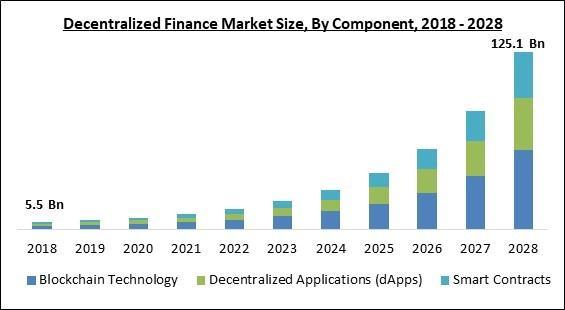
6TheCOVID-19pandemichasresultedinacleardominance ofDeFitrendsovertraditionalfinancialinstitutions.Assuch, 2021 has been a momentous year for the growth of decentralizedfinance.
Chart - 1: ThegrowthtrendofmarketsizeofDeFi(Year 2018–2028)
Accordingtothereport,thedecentralizedfinancialmarketis projected to grow to $125.1 billion globally by 2028 at a CAGR of 42.8%. Smart contract regulations apply, so the algorithmfocusesonmakingtransactionsconsistentlyand directly between his two parties. Moreover, the growing securitydevelopmentinthetrendofdecentralizedfinance hascertainlyincreasedthesizeoftheDeFimarketthisyear. DeFitrendsgrewexponentiallyin2020asTVOgrew14x.In fact,themomentumcontinuedin2021.TVLhasquadrupled his,reachingatotalof$112.07billion.AccordingtoElliptic,
DeFi is largely unregulated and with billions of dollars flowing into this market, there is no consumer protection fraud or money laundering going on through this market, makingitdangerousandvolatile.Morethan$10billionwas recently lost to DeFi fraud by 2022. DeFi is extremely dangerous,butit'sontherise.Despitethisrapidgrowthin the size of decentralized financial markets, the practice is stillinitsinfancyandholdsgreatpotentialforinnovation. YoumaybewonderingwhathislatestDeFitrendisworth watchingin2023.Don'tworry.Wehaveexploredsomeof themostpopularDeFitrendsthatwilldominatethemarket forthenextfewyears.Let'slookatthenextsegment.
8. CONCLUSIONS
5Insuccinct,theemergenceofblockchaintechnologyandits integrationintothedecentralizedfinance(DeFi)ecosystem hasopenednewopportunitiesforfinancialinnovation.The useofblockchaintechnologyensurestransparency,security, andefficiencyinfinancialtransactions,eliminatingtheneed for intermediaries. The DeFi space is growing rapidly and has the potential to transform the traditional financial systembymakingfinancialservicesaccessibletoeveryone, regardlessofgeographiclocation. However, therearestill someissuestoberesolved:B.Scalability,UserExperience, and Regulatory Compliance. Still, with continued development and adoption, his blockchain-based DeFi solutioncouldreshapethefinanciallandscapeandpavethe wayforamoreinclusiveandequitablefinancialfuture.
REFERENCES
[1] DirkA.Zetzsche,DouglasW.ArnerandRossP.Buckley “DecentralizedFinanceJournalofFinancialRegulation, 2020,6,172–203doi:10.1093/jfr/fjaa01.
[2] Wharton Blockchain and Digital Asset Project, in collaboration with the World Economic Forum “DeFi BeyondtheHypetheEmergingWorldofDecentralized Finance”May2021
[3] OECD (2022), “Why Decentralised Finance (DeFi) MattersandthePolicyImplications”,OECDParis
[4] Metelski, Dominik, and Janusz Sobieraj. 2022. “DecentralizedFinance(DeFi)Projects:AStudyofKey Performance Indicators in Terms of DeFi Protocols’ Valuations” International Journal of Financial Studies 10:108.
[5] Fabian Schär, “Decentralized Finance: On Blockchainand Smart Contract-Based Financial Markets” Federal ReserveBankofSt.LouisReview,SecondQuarter2021, 103(2),pp.153-74

[6] PetersonK.Ozili, “Decentralized fnance research anddevelopmentsaroundtheworld”JournalofBanking andFinancialTechnology(2022)6:117–133.
BIOGRAPHIES
ShreyanshKumarPurwar
“1st YearPGDMstudentinFinance &BusinessAnalytics”
Dr.SupriyaLambaSahdev
“Associate Professor and HOD, Department of Marketing Management, International ProgramManager”