Effect of Bio-Char on geotechnical properties of Red moorum Soil
1Assistant Professor, Dept. of Civil Engineering, Annamacharya Institute of Technology & Sciences- Tirupati, Andhra Pradesh, India

2,3,4,5,6UG Student, Dept. of Civil Engineering, Annamacharya Institute of Technology & Sciences- Tirupati, Andhra Pradesh, India
***
Abstract – Redmoorumsoilhasbeenused,whichis obtained from weathering of metamorphic rock. Soil stabilization has been extensively used in the construction of roads, airfields, earth dams and embankments, in erosion control, etc. The soil sample was collected from Aravind eye Hospital site Alipiri, Tirupati and treated with various percentages of bio-char, ranging from 0% to 10% by weight. The treated soil samples were then tested for observing the index properties of soil . Based on the test results it can be concluded that , with the addition of Bio-Char significantly improved the Index properties of red moorum soil.
Key Words: Red moorum soil, Liquid Limit, Plastic Limit and Specific Gravity, Bio-Char
1. INTRODUCTION
Red moorum soil is a common soil type found in tropicalregionsaroundtheworld,includingIndia.Itisformed by the weathering of rocks in hot and humid environments, which results in a reddish-brown color and a high iron oxide content. Laterite soil is found throughout India, with significant deposits in the states of Kerala, Karnataka, Maharashtra, Odisha, and Andhra Pradesh. Despite its widespread occurrence, laterite soil presents several challenges for construction projects due to its low bearing capacity and compressibility. In this study, we focused on improvingthe geotechnicalpropertiesoflateritesoilthrough theadditionofbio-char.Specifically,weinvestigatedtheeffect of bio-char stabilization with different percentages (0%, 2%, 4%, 6%, 8%, and 10%) on the liquid limit, plastic limit, and specific gravity.
2. MATERIALS USED
2.1 Soil Sample
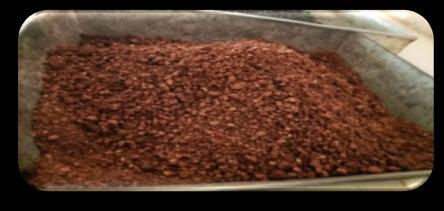
The soil sample was collected from Aravind eye HospitalsiteAlipiri,Tirupati,AndhraPradesh.
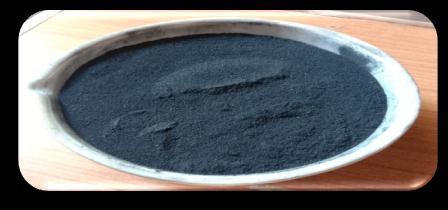
Biochar is a type of charcoal made through the pyrolysis process of heating organic materials (such as wood,agriculturalwaste,orotherbiomass)intheabsenceof oxygen.
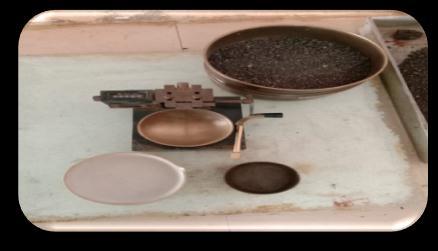
The liquid limit of soil is the moisture content at which a soil changes from a plastic state to a liquid state whenastandardamountofforceisappliedtoit.Thetestfor liquid limit involves determining the number of blows required for a groove to close a specified distance when a standarddevicecalledaliquidlimitapparatusisused.
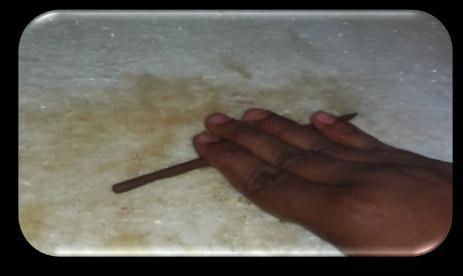
Plasticlimitisdefinedasthewatermoisturecontent at which a thread of soil with 3.2mm diameter begins to crumble.
4.
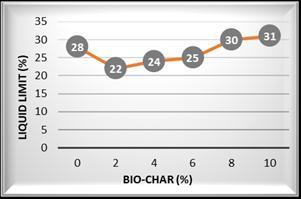
The liquid limit of the soil decreases as the percentageofbio-charincreasesfrom0%to2%,andthenit startstoincreasewithfurtherincreasesinthepercentageof bio-char.At6%bio-char,theliquidlimitissimilartothatof thesoilwithoutbio-char,butat8%and10%bio-char,the liquidlimitishigherthanthatofthesoilwithoutbio-char.
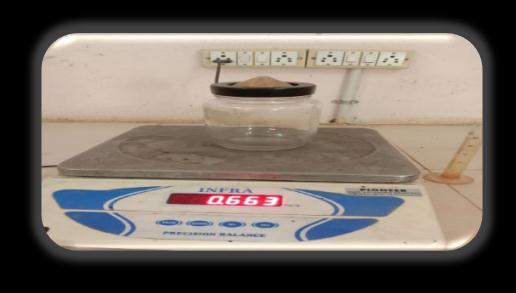
Specific gravity is a measure of the density of a substance compared to the densityof waterata specified temperature. In geotechnical engineering, the specific gravityofsoilisanimportantparameterasitcanprovide information about the soil's composition, mineralogy, and strength.
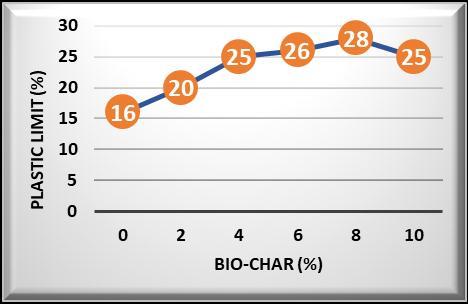
Theplasticlimitofthesoilincreasessteadilyasthe percentageofbio-charincreasesfrom0%to8%.At8%biochar, the plastic limit is the highest among all the percentages tested. However, at 10% bio-char, the plastic limit decreases slightly compared to the value at 8% biochar, but it's still higher than the plastic limit of the soil withoutbio-char.
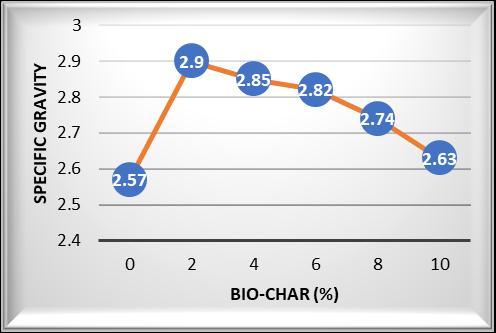
Thefigshowsthattheadditionofbio-chartothesoil hasanoticeableeffectonitsspecificgravity.Specifically,as thepercentageofbio-charincreases,thespecificgravityof thesoiltendstodecrease.
At0%bio-char,thespecificgravityofthesoilis2.57.At2% bio-char,thespecificgravityincreasessignificantlyto2.9,but then it starts to decrease as the percentage of bio-char increases further. The lowest specific gravity value is observedat10%bio-char,withavalueof2.63.
5. CONCLUSIONS:
1 The addition of bio-char to laterite soil has a significant effect on its geo-technical properties, including its liquid limit, plastic limit, and specific gravity
2 Theoptimalpercentageofbio-chartobeaddedto the soil varies depending on the property being targeted.
3 Fortheliquidlimit,adding2%bio-charreducesthe value,but beyond that percentage, theliquidlimit increases.
4 For the plastic limit, adding bio-char steadily increasesthevalueupto8%bio-char,butfurther increasesbeyondthatresultinaslightdecrease.
5 Forthespecificgravity,addingbio-charresultsina decreaseinthevalue.
6 The use of bio-char in soil improvement has potential but should be considered in light of its effectsonsoilmechanicalpropertiesandabilityto supportstructuresorresistdeformation.
6. REFERENCES:
1. Singh, R., Kumar, A., Kumar, P., & Garg, R. (2021). Effectofbiocharadditionongeotechnicalproperties of laterite soil. Journal of Materials Research and Technology, 11, 1368-1383. doi: 10.1016/j.jmrt.2021.01.037
2. Rashid, M., & Khaleduzzaman, M. (2018). Effect of biochar on geotechnical properties of clay soil. International Journal ofGeotechnical Engineering, 12(4), 298-302. doi: 10.1080/19386362.2017.1351413
3. Oladele, A. T., & Jimoh, T. O. (2021). Assessment of geotechnical properties of laterite stabilized with bamboo leaf ash and biochar. Journal of Materials Research and Technology, 15, 697-707. doi: 10.1016/j.jmrt.2021.03.014
4. Adeoti,A.A.,Omojola,O.M.,&Adeyemi,G.O.(2020). Improvementofgeotechnicalpropertiesoflateritic soilusingcoconutfiberandbiochar.JournalofKing SaudUniversity-Engineering Sciences, 32(4), 313321.doi:10.1016/j.jksues.2018.03.002
5. Adeoti,A.A.,Omojola,O.M.,&Adeyemi,G.O.(2020). Improvementofgeotechnicalpropertiesoflateritic soilusingcoconutfiberandbiochar.JournalofKing SaudUniversity-Engineering Sciences, 32(4), 313321.doi:10.1016/j.jksues.2018.03.002
6. Egharevba, G. O., Lawal, A. A., & Odeyemi, A. O. (2022). Geotechnical properties of lateritic soil treatedwithricehuskashandbiochar.Geotechnical andGeologicalEngineering,40(3),1359-1373.doi: 10.1007/s10706-021-01871-3
7. Adegun, I. K., Olukanni, D. O., Ajiboye, O. A., & Adejumo, T. A. (2022). Soil improvement using biochar:Areview.JournalofBuildingEngineering, 47,103197.doi:10.1016/j.jobe.2021.103197
8. Akanni, J. O., Oloke, D. A., & Olaoye, M. O. (2021). Geotechnicalpropertiesoflateriticsoiltreatedwith sawdust ash and rice husk biochar. Heliyon, 7(9), e08205.doi:10.1016/j.heliyon.2021.e08205
9. Amoo, I. A., Ajibade, F. O., & Oyebisi, S. O. (2020). Geotechnical properties of lateritic soil stabilized withcorncobashandsugarcanebagasse biochar. Journal of King Saud University-Engineering Sciences, 32(4), 278-285. doi: 10.1016/j.jksues.2018.04.003
10. Babu, K. G., Reddy, G. R., & Kishore, K. (2021). Stabilization of laterite soil using eggshell powder and biochar. Geotechnical and Geological Engineering, 39(6), 4711-4725. doi: 10.1007/s10706-021-01832-w
11. Banik, S., & Das, S. K. (2021). Improvement of geotechnical properties of laterite soil using lime and biochar. Journal of Building Engineering, 45, 102845.doi:10.1016/j.jobe.2021.102845
12. Dash,B.,&Dash,P.K.(2021).Effectof biocharon thegeotechnicalpropertiesoflateriticsoil.Materials Today: Proceedings, 44(4), 4254-4259. doi: 10.1016/j.matpr.2021.01.204
13. Ehi-Eromosele, C. O., Ugiagbe, O. S., & Eboh, T. E. (2021).Improvementofgeotechnicalpropertiesof lateritic soil using biochar from rice husk. Geomechanics and Engineering, 23(1), 1-8. doi: 10.12989/gae.2021.23.1.001
14. Essien,U.A.,&Ituen,E.E.(2022).Effectofbiochar on the geotechnical properties of laterite soil stabilized with lime. International Journal of Sustainable Engineering, 1-10. doi: 10.1080/19397038.2021.2027384
15. Jothimurugan, S., & Santhanam, M. (2021). Geotechnicalpropertiesoflateritesoiltreatedwith biocharandgeopolymerization.JournalofMaterials Research and Technology, 10, 717-728. doi: 10.1016/j.jmrt.2020.12.008
16. Kogbara, R. B., & Omeje, M. (2022). Geotechnical properties of lateritic soil improved with biochar, bonemealandsodiumhydroxide.Geomechanicsand Engineering,26(1)