ANALYSIS AND EXPERIMENTAL EVALUATION OF THE TRANSMISSION CONTROL PROTOCOL CONGESTION CONTROL ALGORITHMS IN A WIRELESS MULTIHOP ENVIRONMENT
1Professor, Dept. of ECE, Velalar College of Engineering and Technology, Thindal, Erode, Tamilnadu, India

2,3,4,5 B.E Final Year Students, Dept. of ECE, Velalar College of Engineering and Technology, Thindal, Erode, Tamilnadu, India. ***
Abstract - In today’s world wireless network plays a major important role because of their characteristics such as increased mobility, installation speed, reduced cost of ownership, and wider reach of the network. Hence the number of wireless network user increases which results in high internet traffic. In order to avoid this kind of traffic on the internet, Transmission control protocol (TCP) from the transport layer of network architecture is used. TCP provides various congestion control algorithms(TCP variants). Each of them has different features but their main objective is to provide maximum throughput. The purpose of this paper is to analyze and experimentally evaluate TCP variants such as TCP cubic, TCP hybla, TCP scalable, TCP Vegas, and TCP Westwood for their throughput versus the number of nodes. Therefore this analysis of TCP variants provides a solid foundation for a robust TCP that can adapt to a highly dynamic multi-hop wireless environment.
Key Words: Transmission Control Protocol (TCP), congestion control, TCP Cubic, TCP Hybla, TCP Scalable, TCPVegasandTCPWestwood
1. INTRODUCTION
Now days, demand for wireless communication system is increasing. But it becomes difficult to maintain the data rate because of multiple competing senders [14]. It may lead to degradation of throughput in case of congestion whichishighlypossibleinwirelessnetwork.[16]
TCPcongestioncontrolalgorithmfromthetransportlayer [4] is used to maintain high network utilization by preventing network congestion. It is done by monitoring the network for congestion and adjusts the data rate accordingly. When TCP detects congestion, it reduces transmission rate to prevent further congestion. Likewise increases transmission rate when congestion subsides. There are various kinds of TCP congestion control algorithms[1]havebeenevaluatedwhichisnamedasTCP variants.
The performance of some of the selected TCP variants suchasTCPcubic,TCPhybla,TCPscalable,TCPvegasand TCPwestwoodareanalyzedandexperimentallyevaluated
[2].ItprovidesastrongfoundationforcreatingrobustTCP that can adapt to highly dynamic multi-hop wireless environment[5].Thesimulationworkisdoneonnetwork simulator2.[3]
2. PROPOSED SYSTEM
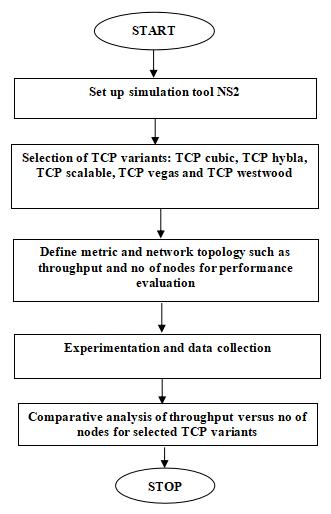
Theproposedsystem'sflow diagramisshowninFigure 1 below
Figure 1: FlowDiagramof ProposedSystem
In this proposed system, analysis and experimental evaluation of TCP variants [10] such as TCP cubic, TCP hybla, TCP scalable, TCP vegas and TCP westwood is presented. These variants are used to control congestion innetwork trafficforwirelessenvironment.All these TCP variants can be differentiated using the metrics such as throughput versus number of nodes. From this comparative analysis [13] we can understand their performance for multiple nodes in wireless environment. We also examine their better performance for different
number of nodes which is used to provide strong foundation for robust TCP that can adapt to dynamically multihopwirelessenvironment.
2.1 TCP congestion control algorithm
The Additive Increase Multiplicative Decrease (AIMD) congestion control strategy is used by TCP. The fundamentalprincipleofAIMDistograduallyandsteadily raise the sending rate of packets until congestion is identified. When congestion is identified it decreases the sendingrateofpackets.AIMDfunctionsasfollows:
Additive increase: Initially, TCP starts with a low sending rateandprogressivelyraisesitbygraduallyincreasingthe sending rate by a little amount for each successful transmission, until congestion is identified. Due to the little addition it makes to the transmitting rate, this incrementiscalledastheadditiveincrease.
Multiplicative Decrease: When congestion is found (for instance, as a result of packet loss), TCP decreases the sending rate by more than the current sending rate by multiplying it by a factor less than 1. As it lowers the transmission rate by a greater percentage, this reduction isknownasthemultiplicativedecrease.
Slow Start: When a new TCP connection is created, TCP begins by transferring data at a low value of congestion window(cwnd) to determine network’s available capacity and then exponentially raises it until congestion is detected. The congestion window is the maximum numbers of bytes that can be transmit at any given time. ThisinitialphaseoftheAIMDalgorithmiscalledtheslow start.
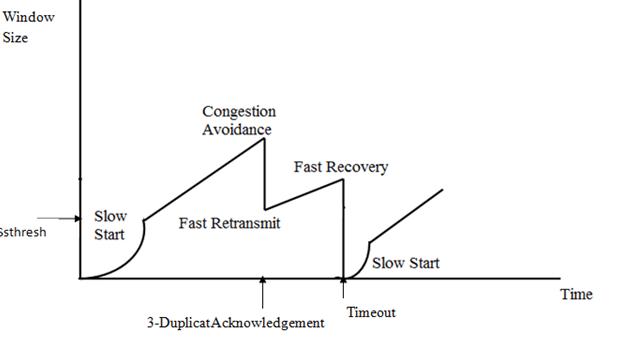
Congestion avoidance: once congestion window reaches a certain threshold, sender then enters the congestion avoidance phase. Here sender increases the congestion window value linearly instead of exponentially. This increase is very small to avoid causing congestion in network.
Fast Retransmit/Fast recovery: If TCP detects a lost transmission,itretransmitsthepacketwithoutwaitingfor a timeout (for instance, because of network congestion). Thistechnique,knownasfastretransmit,lessensthedelay brought on by timeouts. In addition sender enters fast recovery phase where the value of congestion window halved from its current value and then enters congestion avoidancemode.
Timeout:Ifnoacknowledgementisreceivedbythesender for the transmitted packet for certain period of time, it assumes packet has been lost and enters timeout phase. Herecongestionwindowvalueisreducedtooneandslow start phase gets restart. It ensures that sender is not overwhelmingthenetworkwithtoomuchtraffic.
2.2 TCP cubic
The performance of TCP on high-speed and long-distance networks is improved by using TCP cubic. It is used to estimate network’s available bandwidth and adaptively adjusts the sending rate of data packets for better utilization of network resources. It aims to increase the sending data rate aggressively when the available bandwidth is high, and reduces the sending rate more conservativelywhencongestionisdetected.
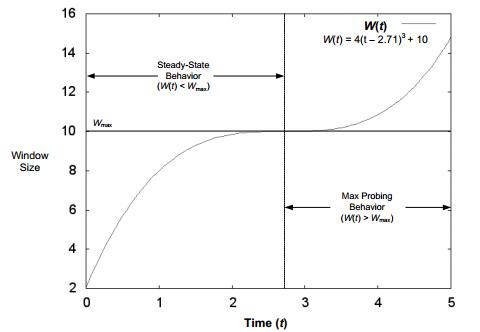
Cubic function [7] is used to determine the congestion window size, where high amount of data may be transferred as quickly as possible without having to wait for a response from the receiver. The following is the mathematicalformula:
Cw =C(t−K)3 +Wmax
Where Cw is congestion window size, C is constant that determines the rate of increase of the congestion window size,kisconstantthatrepresentstimeatwhichcongestion window size was last reduced, Wmax is the maximum windowsizeallowed.
Starting with a small initial congestion window size, the TCPCubicalgorithmgraduallyexpandsituntilcongestion is noticed. When congestion is noticed, the size of the congestion window is reduced, and the algorithm starts again from the reduced size. The value of the constants C and K are dynamically adjusted based on the network conditionstooptimizetheperformanceofthealgorithm.
2.3 TCP hybla
By optimizing the congestion window size based on network conditions, TCP Hybla is used to enhance TCP performance over high bandwidth and long latency networks. By dynamically modifying the congestion window size based on the current network conditions, it seeks to shorten the time needed for TCP flows to convergetoastableandfairbandwidthallocation.
Thecongestionwindowsizeisdecreasedtoalowvalueat the beginning of the TCP connection. Then it linearly increasesuntilthefirstcongestioneventisdetected.When congestionoccurs,Congestionwindowsizeishalvedfrom itspresentlevelandsizeofthenewcongestionwindow is calculatedusinghyblaequation,
2.4 TCP scalable
TCPscalablealgorithmusedtoenhancethesendersideof standard TCP congestion control algorithm. By using the traditional TCP it improves the performance such as high speed and wide area networks. Using fixed increase and decrease parameters, the congestion window in scalable TCP can be modified. There are two phases to update the congestionwindowinscalableTCP.
In slow start phase: Congestion window is raised by one packetforeachacknowledgementthatisreceived.
In congestion avoidance phase: When no congestion has been identified for at least one round trip time, then window replies to each received acknowledgement with theupdate.
Cw=Cw+α
WhereCwisacongestionwindow,αisconstantparameter between 0 and 1. In case if congestion occurs the congestionwindowismultiplicativelydecrease.
Cw=β.Cw
Whereβisalsoaconstantbetween0and1.Typicalvalues forα=0.01andβ=0.875.
2.5 TCP vegas
TCPvegas[8]isusedto decrease packetloss andimprove throughput. It provides more responsive and fair congestion control compared to standard additive increase and multiplicative decrease algorithm used by TCP. RTT (Round Trip Time) is used here to measure the stateofthenetwork.
Where Cc is current congestion window size, Cn is new congestion window size, α is a constant value between 0 and1thatdeterminestheweightofthenewsamplein the calculation,bwistheestimatedavailablebandwidth,rttis the estimated round trip time, ∆ is a constant value that determinestherateofwindowincrease.
Basedonavailablebwandnetwork’srtt,thisequationwill alter the congestion window size. It takes into account both the current congestion window size and estimated available bandwidth, and scales the increased rate based ontheestimatedroundtriptime.Ithelpstoavoidnetwork congestion while utilizing the available bandwidth effectively.
The size of the congestion window is then raised linearly until it experiences theoccurrence of congestion. The above steps were repeated for the duration of the TCP connection.
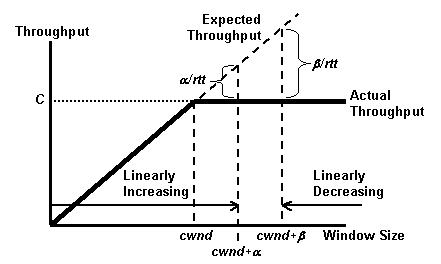
By using the slow start mechanism, current congestion window size is determined. Then actual and expected throughputiscalculatedasfollows.
when DIFF is less than the threshold value, then congestion window increases exponentially. Vegas enters the congestion avoidance phase when the DIFF exceeds the threshold value as a result of the slow start phase's queuebuilding.
When there is congestion, Vegas[9] determines the product of the DIFF and base RTT. A linear rise in cwnd sizeoccursiftheproductissmallerthanα.Alineardropin cwndoccursiftheproductisgreaterthanβ.
Otherwise, cwnd is maintained constant. If it receives a duplicate ACK, it will resend the segment without waiting for the three duplicate ACKs. As a result, segment loss is noticedsooner.
2.6 TCP westwood
The TCP standard algorithm has been enhanced on the sender side by TCP Westwood. It uses an alternative method to estimate available bandwidth. TCP westwood algorithm[11]initializesthecongestionwindow(cwnd)to maximum segment size (MSS), where MSS is the most information that may be delivered in a single TCP segment.
During slow start phase, TCP Westwood exponentially raises the transmission rate. It uses adaptive slow start mechanism that adjusts the rate of increase based on the estimated available bandwidth. It helps to prevent overshooting the available bandwidth and triggering congestioncontrolunnecessarily.
Once TCP westwood detects congestion, it switches to congestionavoidancephase,whereitreducesthesending rate using a multiplicative decrease mechanism. Unlike TCP reno it uses alternative method to estimate available bandwidthcalledwestwood+.
Westwood+ algorithm is used to estimate available bandwidth on the network based on the rate of acknowledge(ACK)packets.Thisprovidesfeedbackabout the actual throughput achieved by the sender, allowing TCP Westwood to adjust the sending rate more precisely andefficientlythanotherTCPvariants.Basedonthemost recent estimate of the available bandwidth, Westwood+
algorithm changes the transmission rate by calculating a congestionwindowreductionfactor.
TCP westwood uses the fast recovery mechanism to recover from losses due to congestion. When TCP Westwoodisrecovering,thecongestionwindowishalved and enters the state as "fast recovery". In this situation, TCP Westwood retransmits dropped packets and still sends new data, although very slowly. TCP Westwood quitsrapidrecoveryaftersuccessfullyretransmittingallof thelostpacketsandbeginsregularfunctioning.
3. RESULTS AND DISCUSSION
Table 1 simulationparameters
SIMULATIONPARAMETERS
MAC IEEE802.11
Routingprotocol AOMDV
Propagationmodel shadowing
Simulationarea 850mx850m
Interfacequeuetype Queue/DropTail/PriQueue
Queuelength 50
Abovetable1showsthelistofthesimulationparameters. Throughput values for TCP variants such as TCP cubic, TCPhybla,TCPscalable,TCPvegasandTCPwestwoodhas been calculated for number of nodes using network simulator2[NS2].
Thebelowtable2showsthevaluesforthroughputversus numberofnodes.
This comparative analysis technique is used to determine TCP performance in both crowded and scarce wireless environments. The simulation uses nodes that range in numberfrom50to150.
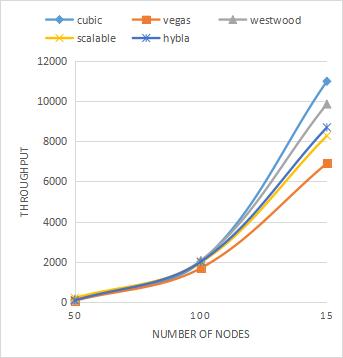
The above Figure 5 displays the image of graph between throughputversusnumberofnodes.Throughputnumbers riseinproportiontothenumberofnodes.
Fromthegraph,itshowswithminimumnumberofnodes scalableprovidesgoodthroughputfollowedbywestwood, cubic, hybla and vegas. However, when the number of nodes reaches upto 150, cubic provides good throughput followedby westwood,hybla,scalableandvegas.
4. CONCLUSION
In this paper successful analysis and experimentation evaluation of TCP congestion control algorithm has been demonstrated. This analysis was conducted to investigate how the congestion control algorithm behaves in a multihop environment. Here we investigate among TCP cubic, TCP hybla, TCP scalable, TCP vegas and TCP westwood in which scalable provides good throughput in sparse environmentandcubicprovidesgoodthroughputindense environmentamongtheothervariants.
The above analysis led to the following recommendations is that the feedback mechanism should be added to the standardqueuetonotifythesender.
REFERENCES
[1] Allman, V. Paxson and E. Blanton, “TCP Congestion Control”,RFC5681,2009.
[2] Adnan Majeed, Nael B. Abu-Ghazaleh, Saquib Razak and Khaled A. Harras (2012), Analysis of TCP performanceonmulti-hop wirelessnetworks:Across layerapproach,AdHocNetworks10,586–60.
[3] NSSimulator,http://www.isi.edu/nsnam/ns
[4] “Improving TCP/IP Performance over Wireless Network”, Hari Balakrishnan, Srinivasan Seshan, Elan Amir and Randy H. Katz (hari,ss,elan,randy}@CS.Berkeley.EDU Computer ScienceDivisionUniversityofCaliforniaatBerkeley.
[5] X. Zhang, J. Tang, H.-H. Chen, S. Ci, and M. Guizani, “Cross-Layer-Based Modeling for Quality of Service Guarantees in Mobile WirelessNetworks,” IEEECommunications Magazine, vol. 44, pp. 100
106,January2006.
[6] T. A. N. Nguyen, S. Gangadhar, and J. P. G. Sterbenz, “PerformanceEvaluation of TCP Congestion Control AlgorithmsinDataCenterNetworks,”pp.21–28,2016.
[7] M.Shivaranjani,R.Shanju,M.JosephAuxiliusJude,V. C. Diniesh, “ Analysis of TCP's Micro Level Behaviour inWirelessMulti-hopEnvironment”,2016
[8] Pooja Chaudhary, Sachin Kumar “Comparative Study of TCP Variants for CongestionControl in Wireless Network”International Conference on Computing, CommunicationandAutomation(ICCCA2017)
[9] Harjinder Kaur and Dr. Gurpreet Singh, “TCP Congestion Control and Its Variants”, Advances in Computational Sciences and Technology ISSN 09736107Volume10,Number6(2017)pp.1715-1723
[10] Pooja Patel; Nirali Sarang; Daizy Daruwala, “performance analysis of tcpvariants protocols forcongestion in wireless adhocnetwork”,International Journal of Software &HardwareResearchinEngineeringISSN-2347-4890
[11] Amol P. Pande and Dr. S. R. Devane, “Study and AnalysisofDifferentTCPVariants”,IEEE2018
[12] Girish Paliwal, Dr. Swapnesh Taterh, “Congestion ControlAlgorithmsReviewandAnalysisforStructured WirelessNetwork”,JETIROctober2018
[13] Patrick Michael Hughes, “A comparison of TCP congestioncontrolalgorithmsforvideostreamingover LTEinautonomousvehiclescenarios”
[14] Rajan S, Abinaya S, Dharanidevi V, Dharanitharan V, Dharani B, “Intelligent Shopping Cart with Online Payment for Futuristic Shopping Experience”, International Research Journal of Engineering and Technology,Vol.7,Issue5,May2020,pp:405-409.
[15] Girish Paliwal, Kanta Prasad Sharma, Swapnesh Taterh, Saiyam Varshney, “A New Effective TCP-CC Algorithm PerformanceAnalysis”, 2019 4th International Conference on Information Systemsand
ComputerNetworks(ISCON)GLAUniversity,Mathura, UP,India.Nov21-22,2019
[16] S.Jeneeth Subashini, D. Guna Shekar, C.Harinath Reddy, M. Manikanta , “Implementation of Wired and Wireless Networks, Analysis Simulation and Result Comparison Using Ns2”, International Journal of ElectricalandElectronicsResearchISSN2348-6988.