Design and Analysis of Cylindrical Arc Array Antenna
V. Venkata Jaya Sai1 , P. Hema Kumar Reddy2 , Y. Sruthilaya3, R. Balaji Naik41,2,3,4 Students, Dept. of Electronics & Communication Engineering, R.V.R. & J.C. College of Engineering, Guntur, Andhra Pradesh, India

Abstract – The microstrip patch antenna required for radio communications to be lightweight, ease in fabrication and smaller in size. The current plan aims to develop a microstrip antenna with a basic geometric shape that can provide improved directivity, gain, and high return loss. The article details the design and analysisof two microstrip antennas,one rectangular and the other square, both of whichusemicrostrip line for feeding. In our Proposed project, the conformal arc array antenna is designed at 2.0
2.4 GHz which provides its usefulness in many wideband utilities within the range of Sband applications. Various parameters such as return loss, radiation pattern, gain, VSWR, directivity, efficiency can be determined. The optimized antenna design and results are presented by using CST (Computer Simulation Technology) software.
Keywords: Microstrip patch Antenna, Return loss, VSWR, directivity.
1.INTRODUCTION
An antenna refers to a metallic construction that can receiveand/ortransmitradioelectromagneticwaves.These structuresareavailableinawiderangeofsizesandshapes, includingsmallonesplacedonroofsfortelevisionreception and larger ones that can capture signals from satellites locatedmillionsofmilesaway.
Planarantennasoftenhavealimitedrangeoffrequencies theycanoperateon,especiallywhenitcomestomicrostrip antennas.Thesetypesofantennasmaynotbeveryefficient atradiatingsignalsandmayhavelowgain.However,their performance can be improved by adding notches or using shorting pins in the radiating patch. Additionally, incorporatinggapsbetweenpatchesinplanarantennascan enhance their gain. This is why quad patch antennas with severalmid-sizedpatchesarepreferredoverantennaswitha single,largepatch.
On the other hand, conformal antennas are a type of antennathatcanovercomethelimitationsofbothplanarand circularantennas.
A conformal antenna or conformal array is a flat array antenna that is designed to fit a specific shape or mold, typicallyusedinradiocommunicationandavionics.Thistype ofantennacanbemoldedtoaprescribedshape,allowingitto be installed onto or incorporated within a curved surface, such as a flat or curved antenna on a curved surface. This
***
kindofantennaismadeupofnumerousindividualantennas that are mounted onto or within the curved surface and function as a single antenna to transmit or receive radio waves. Conformal antennas were initially created in the 1980s as a way to incorporate avionics antennas into the curved surface of military aircraft to reduce aerodynamic drag, replacing traditional antenna designs that stick out fromthesurfaceoftheaircraft.Whileconformalantennasare mostcommonlyusedinmilitaryaircraftandmissiles,they arealsoutilizedinsomecivilianaircraft,militaryships,and land vehicles. Due to a reduction in the cost of processing technology,conformalantennasarebeingcontemplatedfor useincivilianpurposes,includingtrainantennas,carradio antennas, and cellular base station antennas. The reason behindthisisthattheseantennasoccupylessspaceandcan beincorporatedintopre-existingobjects,thusreducingtheir visualimpact.
Conformal antennas belong to the category of phased arrayantennas.Theyconsistofamultitudeofidenticalsmall planar antenna elements, such as patch, horn, or dipole antennas, covering the surface. A phase shifter device is present at each antenna, which is controlled by a microprocessor.Byregulatingthephaseofthefeedcurrent, the nondirectional radio waves produced by the separate antennas can be made toconverge in front of the antenna through interference, generating a concentrated beam or beams of radio waves aimed in any desired direction. In a receivingantenna,theweakindividualradiosignalscollected by each antenna element are combined in the appropriate phasetoamplifysignalsoriginatingfromaspecificdirection. Thisallowstheantennatobesensitivetothesignalfroma specificstationandtodiscardinterferingsignalsoriginating fromotherdirections.
An array antenna, also known as an antenna array, consistsofnumerousinterconnectedantennasthatoperate togetherasaunifiedunitfortransmittingorreceivingradio waves.Theseantennas,referredtoaselements,aretypically linkedtoasinglereceiverortransmitterthroughfeedlines that provide power to the elements in a precise phase relationship.Eachantenna emits radio waves that overlap andcombine,resultinginconstructiveinterferenceindesired directions, amplifying the radiated power, and destructive interference in other directions, decreasing the radiated power. When used for reception, the individual radio frequencycurrentsfromeachantennaarecombinedinthe receiver with the appropriate phase relationship to boost signals received from the desired directions and suppress
signalsreceivedfromundesireddirections.Advancedarray antennas may include multiple transmitter or receiver modules,eachlinkedtoadistinctantennaelementorcluster ofelements.
A typical phased array consists of antenna elements arrangedonaflatsurface,whereasaconformalantennahas antennaelementsmountedonacurvedsurface.Toaccount for the varying path lengths of radio waves caused by the locationofindividualantennasonthecurvedsurface,phase shiftersareusedinconformalantennas.Conformalarraysare oftenrestrictedtohighfrequenciesintheUHFormicrowave rangebecausethesizeofindividualantennaelementsmust besmallenoughtofit,giventhatsmallantennascanonlybe utilizedwhenthewavelengthofthewavesissmall.
2. ANTENNA DESIGN AND ANALYSIS
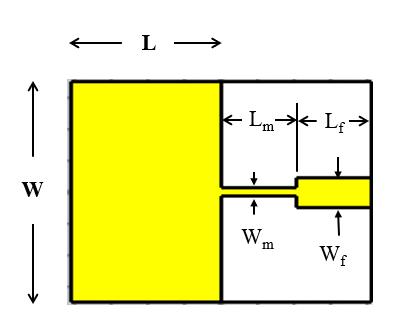
Tostartdesigningamicrostripantenna,thefirststepis toselecttheappropriateoperatingfrequencyandsubstrate. Itisimportanttochooseaworkingfrequencythatissuitable fortheintendeduseoftheantenna,andtoensurethatthe antenna will operate within the desired frequency range. Theworkingfrequencyinourdesignispickedtobe2–2.4 GHz,whichisinS-bandregion.Thesubsequentstageinthe antenna structuring is to pick appropriate substrate. The heightanddielectricofthesubstratesteadyreliesuponthe electromagneticfeaturesoftheantenna.Thechosenmaterial forthedesignisRogers-RO3003,whichhashighdielectric properties. This helps to decrease the size of the antenna sincethedimensionsareinverselyrelatedtothedielectric constant. The antenna is being fed using a microstrip feedline.
RogersCorporation'sRO3003isalaminatemadefrom PTFE that is filled with ceramic and suitable for RF and microwave applications up to 40 GHz. With a dielectric constantof3between8-40GHz,thislaminateoffersreliable plated through-hole connections, even in harsh thermal conditions.
Thelength,L,andwidth,W,oftheantennaarefoundoutby usingthefollowingequations.
2.1 DESIGNING EQUATIONS:
DielectricConstant(εr)i.e.,2.2≤εr ≤10


Height(h)i.e.,λ0 ≤h≤0.05λ0
Whereλ0=freespacewavelength
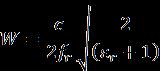
Widthofmicrostrippatchantenna
Where,c=velocityoflight
fr =Operatingfrequency
εr =Substratedielectricconstant
Effectivedielectricconstant
Lengthofpatch,L=Leff -2ΔL
Where, L 2ΔL
Forpracticallength,0.3333λ0 <L<0.5λ0
Here,εr isthedielectricconstantofthesubstrate Thechosensubstrate,isRogers-RO3003withεrof3,andthe workingfrequency,f,istakentobe2–2.4GHz.
The effectivelengthissubjectedto the correction factor, ΔL, and this correction factor is found to be nearly 0.07.

2.2 Proposed Antenna Design:
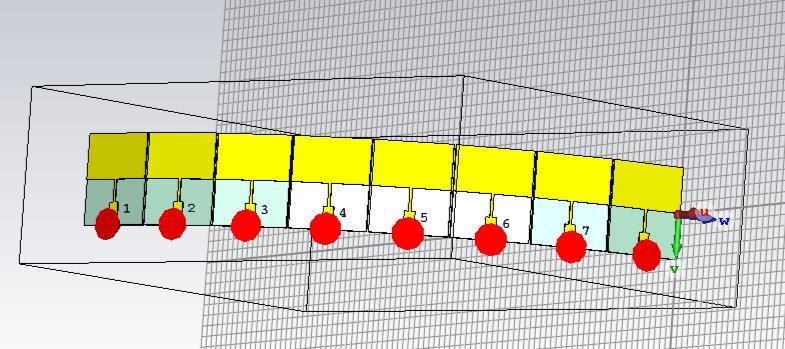
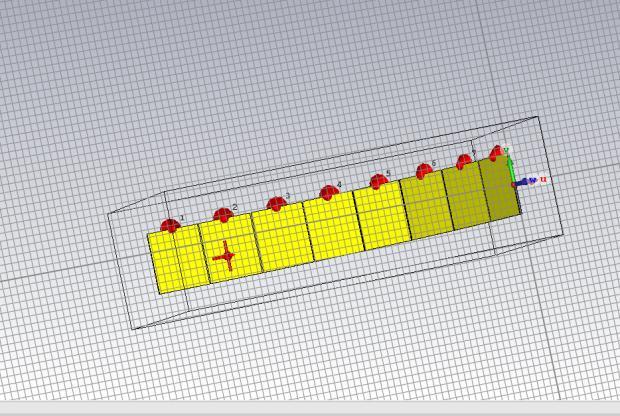
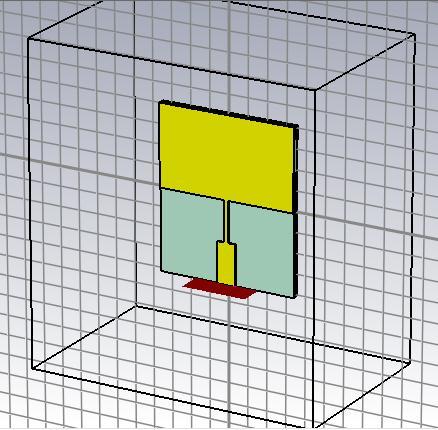
Similarly,byusingtheabovedesigntheCylindricalArc antennaarraypatchinFig:b(1)andb(2)isshown.Inthese weareusing8singlepatchantennaswhichareconformed intocylindricalarcshapeasshowninFig:b(1)andb(2).
Using an array of antennas can result in a more concentrateddirectionality,meaninganarrowerstreamof radio waves with higher gain, compared to using a single antenna element. As the quantity of antennas in an array grows,boththegainandthenarrownessofthebeamtendto increase. Large arrays, like those found in military phased arrayradars,maycontainthousandsofindividualantennas. Arrays serve various purposes, including boosting gain, providing path diversity (also known as MIMO) for better communication reliability, eliminating interference from particulardirections,electronicallysteeringtheradiobeam tovariousdirections,andfacilitatingradiodirectionfinding (RDF).
3.
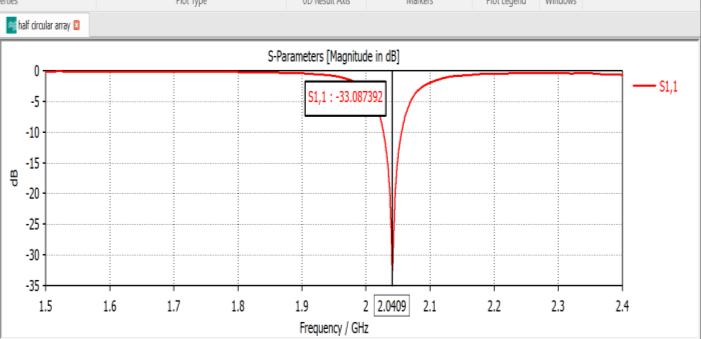
Theproposedantennahasbeendesignedandsimulation isdoneusingCSTsoftware.Ithasbeenobservedthatasthe substrate height is increase from 1.5 mm to 2 mm, the antennaresonantat2.04GHz.Withsubstrateheight2mm, maximum return loss of -33.08 dB is obtained which is showninFigc.
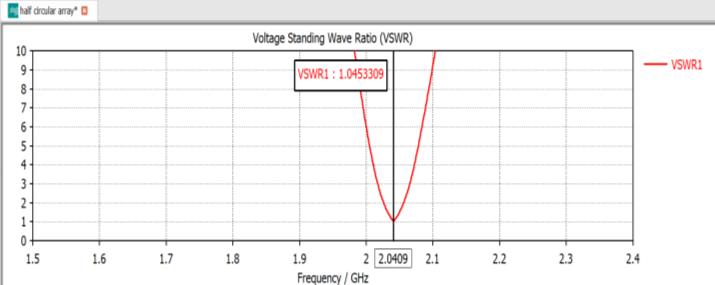
FortheSinglepatchantenna,wehadobtainedthevalueof VSWRof1.04asshowninFigd.
Far
Theproposedantennahasbeendesignedandsimulation is done using CST software. From Fig h, there are 8 single
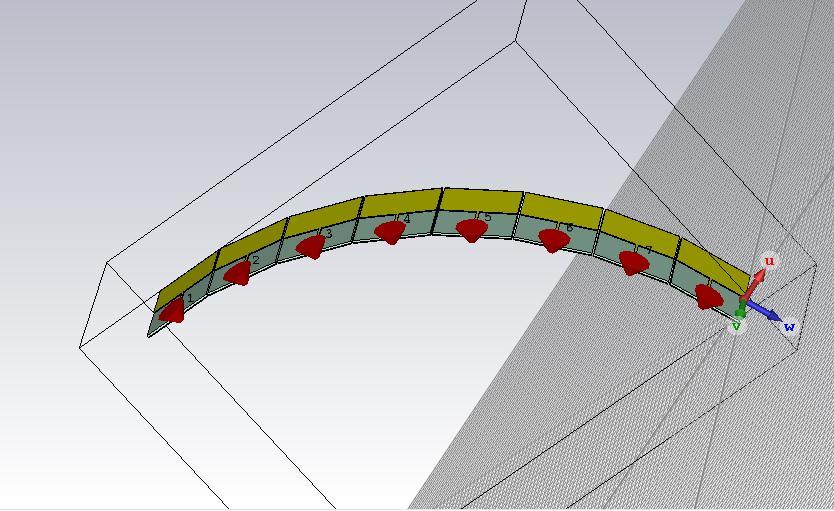
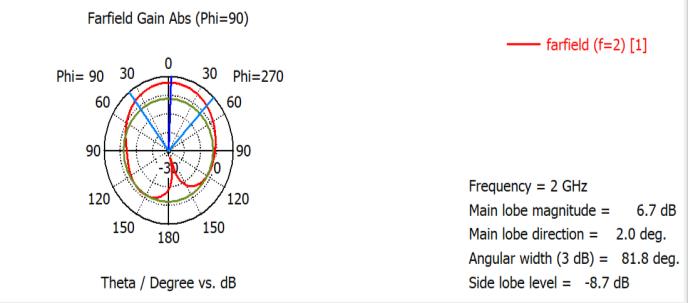
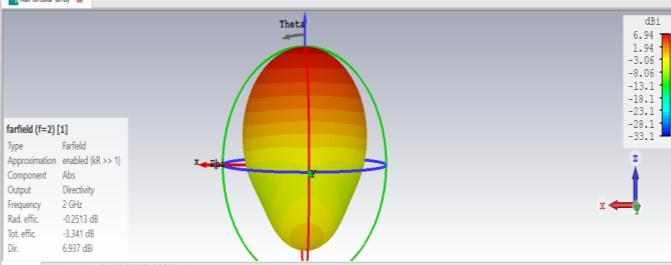
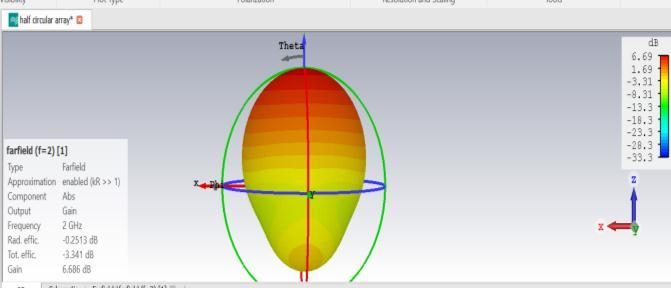
patchantennaelementswhicharecombinedlyformedasan array.All these elementsare used inorder to increase the gainanddirectivity.
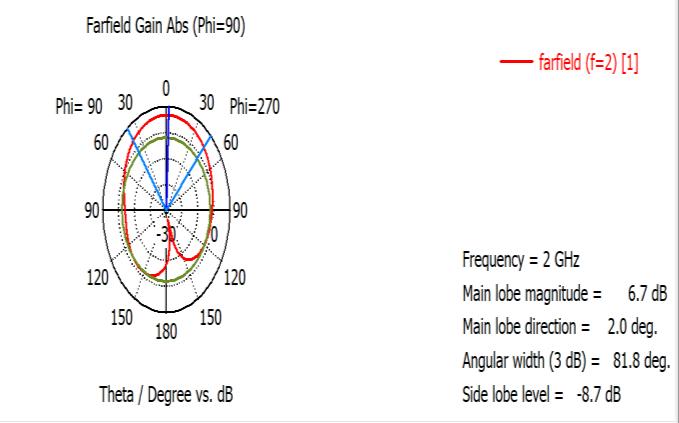
ResultsofCylindricalArcarrayAntennaisshowninbelow figures.
FortheSinglepatchantenna,wehadobtainedthevalueof VSWRof1.04asshowninFigj.
Theproposedmicrostrippatchantennawithstub feedline exhibits a high reflection coefficient of -33.08 dB withthesubstrateheightof2mm.Thisisvalidatinginallthe designedaspectsofthedifferentstructureoftheantenna. The broadening of the antenna is attained by the proper impedancematchingbystubfeedlineatthesourcepointof theantenna.Inthiswehaveimprovedvariousparameters like VSWR, gain, return loss, directivity which might be usefulformanycommunicationapplications.
REFERENCES
[1] Raj Gaurav Mishra, R. K. Chourasia, Amit Kumar Shrivastava, International Journal of Innovative Technology and Exploring Engineering (IJITEE) ISSN: 2278-3075,Volume-8Issue-7May,2019
[2] LarsandP.Petrik,ConformalArrayAntennaTheoryand Design,JohnWiley&Sons,Hoboken,NJ,USA,2006.
[3] ResearchArticleConformalArrayPatternSynthesisand ActivatedElementsSelectionStrategyBasedonPSOGSA Algorithm.
[4] BahareMohamadzade,RoyB.V.B.Simorangkir,Raheel M. Hashmi and Ali Lalbakhsh: “A Conformal UltrawidebandAntennawithMonopole-LikeRadiation Patterns”, IEEE Transactions on Antennas and Propagation,Volume:68,Issue:8,August2020,Pageno: 6383-6388.
[5] GiacomoMuntoni,GiorgioMontisci,GiovanniA.Casula, FrancescoP.Chietera,AndreaMichel,RiccardoColella, Luca Catarinucci, Giuseppe Mazzarella: “A Curved 3DPrintedMicrostripPatchAntennaLayoutforBandwidth EnhancementandSizeReduction”,IEEEAntennasand WirelessPropagationLetters,Volume:19,Issue:7,July 2020,Pageno:1118-1122.
[6] R. Garg,P. Bhartia,I.BahlandA. Ittipiboon,“Microstrip AntennaDesignHandbook”,ArtechHouse,2001.
[7] J.LarsandP.Patrik,ConformalArrayAntennaTheory andDesign,JohnWiley&Sons,Hoboken,NJ,USA,2006.
[8] O.M.Bucci,G.D.Elia,andG.Romito,“Powersynthesisof conformalarraysbyageneralizedprojectionmethod,” IEE Proceedings Microwaves, Antennas and Propagation,vol.142,no.6,pp.467–471,1995.
[9] L. I. Vaskelainen, “Iterative least-squares synthesis methodsforconformalarrayantennaswithoptimized polarization and frequency properties,” IEEE TransactionsonAntennasandPropagation,vol.45,no. 7,pp.1179–1185,1997
[10] C.A.Balanis.,“AntennaTheory–AnalysisandDesign”, Wiley-Interscience,2012.