Snake Detection in Agricultural Fields using IoT
S Nagini1 , K Teja Kumar2 , T Venkata Nikhil3 , A Karthik 4 , J Venkat5 , M Sunishchal61Professor & HOD, Dept. Of Computer Science and Engineering, VNR Vignana Jyothi Institute of Engineering and Technology, Hyderabad, India

2,3,4,5,6Student, Dept. Of Computer Science and Engineering, VNR Vignana Jyothi Institute of Engineering and Technology, Hyderabad, India ***
Abstract - Snakebites have been a major problem among the farmers, especially in rural areas. According to a recent survey, 58,000 Indians die from snake bites annually, which is more than 50% of the world's total snake bite deaths. Almost 1.2 million Indians have lost their lives since 2000 in this manner. "Time" is the most valuable asset in these types of cases. We can save the people if they can get quick medical help. If there is a delay in this, the snake bite may cause serious damage to the organs, or in the worst cases, the person may die. Today, the IoT technology using different sensors in the field and deep learning techniques using convolutional neural networks allow us to detect these snakes, particularly in the agricultural fields, so that the farmers can be alerted using a buzzer and take precautionary measures against these dangerous reptiles. Identification of the species of the snake can also be accomplished with this system, ensuring the anti-venom is found as quickly as possible. This system also indirectly helps to conserve snakes in the area.
Key Words: Agriculture, Convolutional neural networks, DeepLearning,IoTsensors.
1. INTRODUCTION
India is a very diverse country and home to many snake species.Ofall thosespecies, someareverypoisonous and deadly.Indiaisalandthatdependsalotonagriculturefor economic growth. Farmers are always in grave danger because they spend most of their time in the field, where the snake may be present. Thus, snake bites become a major problem that must be solved as human lives are in danger
According to the World Health Organization (WHO), although the precise count of snake bites is unclear, it is believedthat5.4millionindividualsarebitteneveryyear, withcloseto2.7millionofthosebitesresultinginpoison. Every year, between 81,000 and 138,000 individuals pass away due to snake bites. In India, it is estimated that 58,000 people are dying due to snake bites annually, which is higher than any other country in the world. Venomous snake bites can result in a variety of medical conditions, including breathing difficulties, bleeding abnormalities that can result in tissue injury and deadly haemorrhage, and irreparable kidney failure that can
cause long-term incapacity and loss of limbs. The most impacted groups are kids and farm laborers. Due to their smaller body mass than adults, children frequently have moresevereimpacts.
Sometimes, farmers do not actually recognize the snake species, and if they are lucky enough, they will kill them right away so that they do not get hurt. The fact that snakesareacrucialcomponentofthefoodchainandthat their widespread extinction might upset the balance makesthisa potential issue aswell.Ifsnakesarekilledin large numbers, this could disrupt the food chain. Therefore, we must reduce the harm humans do to them toprotectthemaswell.
Forthisreason,theremustbeasystemwherethesensors placed on the borders of the field can detect the snake movements and capture an image, which is then analysed andprocessedbyvariousdeeplearningtechniquestofind out if it’s a venomous snake or not. If it’s venomous, the farmersarealertedimmediatelywiththehelpofanalarm so that he will take some precautionary measures to quickly get out of trouble. The alerts will also be sent to membersnearthefarm.
2. RELATED WORK
In this section we discuss the work done previously by otherauthors/peopleallovertheworld.
As per the paper [1], to accomplish the stated goal, the authors suggested a system that makes use of image analysis, CNN-based networks, and deep learning strategies. The automated image categorization system heavily utilizes CNN. Typically, characteristics are extracted and used for categorization. The researchers employeda database of 3050 RGB photos, divided into28 species and of varied sizes. Images are subjected to the GrabCut method for pre-processing data, and data augmentation is carried out and trained using DenseNet 161
In the paper [2], the growing monkey threat on Indian farming fields is causing a huge problem for farmers. The enormous fruit and vegetable harvests, worth tens of thousands of rupees, were completely ravaged and ruined by the monkeys. Infrasound, seismic interaction, and light
and photo options are just a few of the present detection methodsthatarebothextremelycostlyandineffective.So, they suggested a detection system consisting of wireless sensor nodes connected to a noise producer that emits ultrasonic waves to scare away monkeys. The wireless nodes consist of sink nodes and sensor nodes. The sensor nodesareinstalledalongagriculturalfields'borders,where they are used for the detection of monkey movement. Whenadetectionismade,thesensorsendsanalert,which is subsequently sent from the sensor nodes to the sink node. The ultrasonic sound producer is then activated by the sink node, producing ultrasonic sounds at a rate of 20 kHz that annoy the monkeys and finally cause them to leavethefield.
In the paper [3], the authors state that in today's society, surveillance serves as one of the most crucial security systemssinceitshieldshomesfromrobberies,killings,and other crimes that have become common in major cities. Governments and police departments use surveillance to preserve social order and look into illegal activity. Conventional monitoring systems use more electricity sincetheycannotbeshutoffintheeventofanattackerand also require more space for storing the captured images. To resolve this issue, a PIR-based embedded home monitoring system has been created. These sensors are usually installed at residential windows and doors to prevent intrusion. For the purpose of recognizing human body movement, PIR sensors employ infrared radiation. Hardware requirements of this system are a PIR (pyroelectric infrared sensor), an ATMEGA328 microcontroller, RS-232, GSM (global system for mobile communication), and a webcam. PIR sensors, which are usedtoidentifyhumanbodies,candetectmovementupto 6 meters away and generate a pulse that is read by the MCU (microcontroller unit). Therefore, embedded monitoring systems evaluate the sensor's data and decide whethertoactivatethewebcamtocaptureapicture.When an invader is present, the sensor alerts a resting MCU to startpoweringaninteriorsensorandtransmittingasignal to the GPIO network. The system activates an alarm and delivers an SMS when it determines that an unauthorized person or invader is present. Following this MCU's transmission of sensor signals to embedded systems, a cameraisusedtotakeapicture.
Asperthepaper[4],theauthorsofthisresearchexamined theprimaryissuesthatarisefromhuman-animalconflictin theagriculturalsector,suchasresourcelossandthethreat to human life. As a result, people lose their property, livestock,crops,andfrequentlyeventheirlives.Therefore, to stop the entry of wild animals, the boundaries of the farmfieldsmustberegularlymaintained.Topreventthese problems, the authors designed a system that consists of PIR (passive infrared sensors), a microcontroller, and a webcam. PIR and a camera serve as the initial layer of security.Thecameracapturesphotographsofthetriggered
moving objects and sends those images to the microcontroller once the PIR identifies the movements of the wild animals. The microcontroller categorizes the photographsaccordingtowhetherornotananimaliswild. It yields 1 if the animal is wild and 0 otherwise. If the animalisclassifiedaswild,thePCwilltransmitasignalto an animal repellent system that makes a loud noise, produces brilliant light, and sends an SMS message to the landowners.
Inthepaper[5],dangerousanimalsenteringthevicinityof neighborhoods or populated places has become very common now-a-days. In this paper, they have proposed a system that alerts people if a wild animal steps out of the forest. Cheap motion sensors and computers with less computing power are utilized to achieve this. A control center is set up for computations. We also suggest a repellent that can stop wild creatures from fleeing the forest, such as producing a lot of noise via speakers. The fundamental tenet of IOT is to link various sensors, facilitate contact, and offer services. In this paper, we develop an alarm system using a number of IOT devices placedaroundanaturereserve.Smugglersaswellasother people breakingthelawbyentering theforestcanalsobe caught using this approach. The place is surrounded by many sensor towers, and some of them are connected to the control center. They are placed at the boundaries to detect animal movement. The Raspberry Pi is used. Camerasare alsoconnectedto it. It uses verylittle power. The computations performed here are transmitted to the service center. PIR sensors are used to detect motion. Additionally, the sensor tower incorporates a GPRS/3G module for communication with the control room. Since they are nearer to people, the forest's borders have GPRS connectivity. This facilitates communication and makes it easier. The PIR sensor detects motion; when it does, we snapaphotooftheareaandtransferitbacktothecontrol center. We sent a further SMS to the relevant official. In order to prevent wildlife from entering the forest border, the control center may transmit a signal to the relevant tower to generate a loud noise. Each tower has a defined position, so we are aware of it. The authorities can promptlytraveltotheareaifnecessaryandtakeadditional action.Solarpoweriswidelyusedatsensormodulestocut down on costs. As mentioned earlier, the main computing power,whichistheRaspberryPi,isconnectedtoacamera, which is going to take photos whenever it detects some movementandthentransmitthemtothemainserverover theinternet.Infuturework,muchmoreefficientandhighperforming sensors will need to be used because they perform better in movement recognition. Night visioncapable cameras make a perfect fit. Electrical fences may bereplacedwithsomethingsafer.
Thepaper[6]presentsseveralexamplesofhowdangerous animals pose a threat to farmers in agricultural fields. In particular, it focuses on the harmful impact of snakes,
whichcausethedeathsofmanyfarmersintheagerangeof 20to50everyyear.Additionally,theseanimalsalsocause significant losses in productivity for farmers. To address these issues, the authors propose a solution involving the useofanalgorithmandIoTsystemstodetectthepresence of dangerous animals in agricultural fields. The algorithm employsfeatureextractionandclassificationtechniquesto identify the unique characteristics of snakes and other harmfulinsects.Itthengeneratesabuzzertoalertfarmers of the animal's location, which is determined using GPS. TheRaspberryPiisused(forcomputationandprocessing) as the main platform for the system. The existing system only detects the presence of animals but does not provide anypreventivemeasures.Therefore,theauthorsproposea new system that not only detects snakes but also alerts farmers through a buzzer to protect themselves and their land.Thepapersuggestsusingafeatureextractionmethod to identify moving objects and creating a database of unique features belonging to each snake and dangerous insecttotraintheclassifier.Differenttechnologies,suchas ultrasonic sensors, light-dependent resistors, GPS, and buzzers,areusedtoachievethisgoal.
Inthepaper[7],theauthorscite"SriLanka"asanexample for implementing the project of identification of particular species occurring most frequently there. The paper highlights the problem of snake bite deaths among Sri Lankan farmers, specifically how the current system is inadequate and leads to delays in treatment. The authors propose a solution using a convolutional neural network with 2000 images of the six predominant snake species foundinSriLanka.Fivemodelsweredeveloped,including one fromscratch,and the best model in termsofaccuracy was determined for automatic snake identification. The authorscollectedimagesandvideosofsnakesusingGoogle Images. These videos were augmented to create a large numberofimagestoworkwith,andthebackgroundswere removed. Of the 2,000 images collected, 1,200 were used fortrainingneuralnetworkmodels,400forvalidation,and 400 for testing. Batches of size 32 were created for input. Adjustments were automatically made to the weights before the next iteration of the convolutional neural network (CNN) began. Models like InceptionV3, VGG16, ResNet50, MobileNet with ImageNet, and a new model were trained using TensorFlow as the backend and Keras asthefrontend.Various measuresweretakentoimprove accuracy, such as inputting cropped images of different dimensions and trying raw images. This training was performed on a Core i7 machine. After training, a testing datasetwasusedtoevaluatethemodels.
Inpaper(8),theauthorsdiscussthedifficultyofidentifying snakes and the use of computer vision technology to improve accuracy. It illustrates that extraction of features and classification are the two steps involved in machine learning-based image categorization. The classes are preset,andtheprocedurecomprisescategorizingthetestdata
usingthetrainedmodelafteratrainingstagethatusesthe training data. They point out that snakes' flexible and elongated bodies cause fluctuations in their posture and deformation, making it challenging to identify characteristics from dorsal body arrangements. Additionally, they note that a lack of specialized image datasets for snakes makes it difficult to train deep convolutional neural networks for this task. Additionally, they suggest that museum samples, which lack original color and position, are useless for including in full body imagecollections.Thisstudyaimstocomparetheaccuracy ofseveralmachinelearningmethodsintheclassificationof snake images. Out of 594 photographs, six different snake speciescouldbedistinguished;onlythoseshowingatleast 50% of the snake's body were used. A method for extracting features was combined with conventional classification methods, and transfer learning was used to improvetheperformanceofa deepneural network model on the small dataset. The results of this study will help identify the most effective machine learning methods for snakeimageclassification.
As per the paper [9], researchers developed a computer method to recognize several snake species from pictures. The system performed noticeably better than arbitrary guessingwhenitwascomparedwithhumanperformance. Some species were easily identified by both the algorithm and humans, while others were more difficult to distinguish. The researchers discovered that when detecting photographs with visual artifacts or of low quality, human beings had an edge over the software. Future research on snakebite epidemiology may benefit from computer vision technologies, particularly when paired with location data and expert advice. The development of a computer vision method for classifying snake species was indeed the aim of this project. The algorithm was tested and compared with human performance in identifying snake species. The algorithm was found to be better than randomly guessing but had difficulty identifying certain groups of species. The algorithm could potentially be used by healthcare providers to quickly identify snakes involved in snakebite cases. The algorithm was developed using a collaborative approach with input from data science experts and enthusiasts. For picture categorization, it used massive, deepCNNs(convolutionalneuralnetworks).
The paper [10] provides a summary of the most recent methods for locating moving objects in footage shot by moving cameras. Model-based background subtraction, trajectory classification, decomposition of low-rank and sparse matrices, and object decomposition are the four categories into which the approaches may be classified. This study provides a thorough analysis of the available approachesformovingcameras,despitethefactthatthere have been several research studies and reviews on object recognition and background reduction for stationary
cameras.Computervisioncandetectmovingobjectsandis used in various applications such as action recognition, traffic control, industrial inspection, human behavior identification, and intelligent video surveillance. But it mightbedifficulttoidentifyamovingiteminavideoseries becauseofthingslikeocclusionandchanginglighting.
As per the paper [11], it has become a crucial tool for wildlife protection and management worldwide to eradicate invading vertebrate species from ever-larger islands. Past mainland exclusion attempts have frequently failed as a result of weak or shoddy barriers against pest reintroduction. In order to create technology that effectively excludes pests, they have carried out extensive trials over the past ten years. A large number of problematic vertebrate species that can be discovered in New Zealand and some other areas of the world have had their behavior and physical capabilities identified. They havetesteddifferentpestspeciesagainstdifferentdefense systems in order to develop a 100% effective defense system.Thedesignexcludedalmostallthevertebratesthat are found ontheisland.Inregionsupto 3,400 hectaresin size, more than 20 exclusion fence structures have been built, enabling efforts at multispecies eradication. Many initiatives are currently carrying out extensive restoration efforts, including the return of vulnerable species and habitats to mainland areas as a result of the effective eradicationofvertebratepests.
As per the paper [12], incorrect snake identification is the major cause of human deaths resulting from snake bites. For the two main types of snakes, Elapidae and Viperidae, no automated classification approach has yet been presented to classify snakes by understanding the taxonomic aspects of snakes. So, they provided an automated categorization system for many snakes that is based on inter-feature product similarity fusion and identified 31various elements fromsnake photosthatare taxonomicallysignificantforautomatic detectionresearch. Through a GPU-enabled parallel computing system, the classifier's adaptability and real-time development are examined. The designed systems are used in snake count management, bite analysis, and investigations of wild animals.
In their paper [13], the authors proposed a system whose goalistodeterminethespeciesofthesedangerousreptiles usingtheirunusualtraitssothattheappropriatecourseof action may be taken to prevent deaths from snake bites. The authors of this system employed deep learning techniqueslikeCNNandimageanalysistoobtainthesame results. CNN was heavily utilized for picture classification by machine. Feature extraction, a technique used for classification, is used to extract the significant and distinctiveaspectsofsnakes.Inorderfornecessaryfollowup steps to be performed, it is expected that this system will accurately categorize snakes and report their species.
Duetothesimilarityinthespecies'traits,includingtexture, color,andheadform,automatedsnakespeciesdetectionis a difficult undertaking. Rapid snake species identification canbeaidedbydeeplearningandtransferlearning.Oneof the writers hassuggested amethodin which MobileNetv2 is used for identification. The categorization of snakes is based on a pre-trained fish classification model that was utilized by another author. Over 3000 images of different snake species are included in the suggested technique. Theyaredividedinto28distincttypes.Onlyafewofthese factorsare veryhelpful andare used to increaseaccuracy. Pre-processing, training, classification, testing and verification, and accuracy check are the five main aspects of this system. For augmentation, a program named GrabCutisemployed.Themostcrucialstageofthisprocess is testing, when random photos ofthe snakesare takento confirmandthendeterminetheircorrectness.Additionally, the system's overall algorithm is explained. Firstly, the snake dataset, which already includes 3000 images, is dividedintotwosections,onefortrainingandtheotherfor validation.Thisisdoneasitwaswithallpreviousdatasets. The GrabCutmethod was employed for featureextraction, as was previously indicated. Enhancement aids in minimizingorpreventingoverfitting.DenseNet161isused during training. There were 28 classifications of snake speciescreatedasa result.Theaccuracyisexamined,asit is with every machine learning activity, to determine whether it can be made more accurate. The document thoroughlyillustratesthearchitectureandflowchartofthe entire procedure. Each step is well explained, along with particular algorithmic information. The authors concluded that the transfer learning approach is particularly advantageoussinceitgivesgreatperformancewhilesaving time. They assert that this approach is easily adaptable to new species that are found in the future. They advise creatingandusinglargerdatasetswithavarietyofspecies for future studies. Additionally, this huge dataset should makeuseofmoreeffectivemachinelearningmethods.
Asperthepaper[14],theauthorsintroducedanumberof methodsforseismicactivity,ultrasonic,andacousticdatabased person detection. Footstep recognition and formant analysisareperformedontheauditorydata.Whenhuman audio is not available, auditory data are also utilized to distinguishbetweenhumansandanimalsandtodetermine the walking rhythm of animals. Human and animal categorization is done using seismic analysis. They classified the objects and estimated their presence using ultrasonic data. Using all three system methods, the authors got a high proportion of accurate categorization. Eachalgorithm tried toidentifyandcategorize individuals using the specific phenomenology of the detector. The given methods are computationally effective, use less energy, and are therefore suitable for implementation on sensornodeslikenetworkedUGS.
As per the paper [15], the least researched group of animals inside the archipelago are indeed the snakes, mostly in the Galápagos. Only 4 of the 9 known species havehadtheirconservationstatusfullyassessed,andearly data indicates that most of the species may have totally vanished on a few islands. Moreover, considering that the systemofclassificationofthesereptilesinthearchipelago has only recently been resolved, practically all claims of Galápagos snakes made by park rangers and resident photographic identifiers of them are false. The idea is to offerparkrangersandvisitorsprogramsthataresimpleto use and that can quickly identify different species using automated detection and recognition. They created an artificialintelligenceplatform applicationsoftware that can identify a species of snake from an uploaded user photograph using deep learning techniques on a database of photos of various snake species. The program for the application functions as follows: after a user uploads a picture of something like a snake into the program, a method processes it, assigns it to one of the nine snake species,providesthecategoryoftheexpectedspecies,and informs users by giving them details on the dispersion, natural course, preservation, and derivations of the snake. Inception V2, ResNet, and VGG16 were among the R-CNN architectures that were successfully built for the study, withanaccuracyrateof75%.
3. PROPOSED SYSTEM
The primary goal of the “Snake Detection" system is to provide a solution to the problem of deaths caused by snakes in agricultural fields. IoT sensors like PIR sensor, vibration sensor etc., can be used to monitor, sense unusualactivityinthefarmfieldandtriggerthecamerato captureasnapshotandsendittothedeeplearningmodel forprediction.Thesesensorsandcamerascanbeplacedin specificpositionstocoverlargeareas.Arrangingthemlike this can bring down the costs too After detection, the farmers can be given a notification in the form of an SMS This can be easily implemented and operated in isolated places or backward regions, as there is not much of a learning curve. Both the IoT part and the deep learning part of the project need to be integrated for detection without any human intervention. This project focuses on mounting the sensors and cameras in the field, building a deeplearningmodelwhichclassifiessnakes,aswellasthe interaction of the system with the mobile phones of the farmers.
The system consists of many sensors, a microcontroller, and a camera to identify the unique features of snakes in some specific areas (like Telangana and Andhra Pradesh) and send an alert message to the owner of the fields. The Arduino microcontroller is used for computational purposes andCNNs are usedfor prediction Imagesofthe different snakes should be collected to train the deep learningmodel.Theimagesareaugmentedtoincreasethe
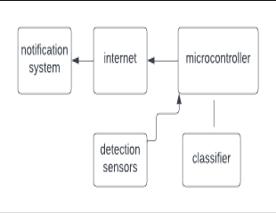
accuracy of the model. TensorFlow models such as MobileNetV2 and EfficientNetB7 can be used to train the model.Trainingandtuningmustbedoneonmanymodels forgoodresults.
Fig3.1:SystemArchitecture
Thissystemhasthreeparts:
1. Movement recognition: Detection of the snakes’ movements in the field using sensors like vibration sensors and passive infrared sensors, etc.
2. Snake and species detection: Afterdetectingthe movement, an image is captured using a camera, and that image is sent to the classifier. The classifierwilldetectwhetherasnakeispresentin theimageornot.Thesnakesintheimagemustbe classified as venomous or non-venomous. If they are venomous, the snake species are detected using the models we have already trained, and theyareusedforfurtheroperations.
3. Alarm system and prevention mechanisms: Afterdetectingwhetherthesnakeisvenomousor notandfindingitsspecies,thefarmersinthearea arequicklyalertedusinganalarmsothattheycan take quick action. Also, an SMS alert is sent detailingthespeciesofsnakefound,whichcanbe usedifthesnakecausesharmtohumans.
4. CONCLUSIONS
Inthissurveypaper,wehavedonealotofresearchonthe topic"DetectionofsnakesusingIoT."Asapartofthis,we have collected numerous previous research papers by variousauthorsinordertounderstandtheexistingsystem and possible future ideas. The ideas proposed in these papers had some limitations, and we hope that some of these can be eliminated using the system we are proposing. We came to know that performance, accuracy, anddatasetsarethemajorhurdlesforthiskindofsystem. Some of these systems are difficult to install, and others need only high-quality images to work with. A major
drawbackseemstobethedelayinsendingthealerttothe farmersandotherpeoplesurroundingthefarm.So,major drawbacksliketheseneedtobeovercome,whichrequires a lot of work. We understood that various deep learning techniques needed to be used in a way to improve the performance of the system in classifying the snakes as venomousornotandalsoreportingthespeciesofthemto the farmers. We have studied most of the proposed systems, which will help our system perform tasks as expected
ACKNOWLEDGEMENT
We are grateful to have Dr. S. Nagini as our mentor who gave invaluable feedback at each stage of the project The ideas and suggestions put forward by her made a huge impact while implementing the project. We sincerely thank her for giving us her valuable time to help us understandthedifferentIoTandMLconcepts.
REFERENCES
[1] M. Vasmatkar, I. Zare, P. Kumbla, S. Pimpalkar and A. Sharma, "Snake Species Identification and Recognition," 2020 IEEE Bombay Section Signature Conference (IBSSC), 2020,pp.1-5,doi:10.1109/IBSSC51096.2020.9332218.
[2] R. Radha, "K. Kathiravan, V. Vineeth, J. Sanjay and S. Venkatesh, "Prevention of monkey trespassing in agricultural field using application agricultural specific floodingapproachinwirelesssensornetwork,"2015IEEE Technological Innovation in ICT for Agriculture and Rural Development (TIAR), 2015, pp. 106-111, doi: 10.1109/TIAR.2015.7358540.
[3] R. R. Ragade, "Embedded home surveillance system with pyroelectric infrared sensor using GSM," 2017 1st International Conference on Intelligent Systems and InformationManagement(ICISIM),2017,pp.321-324,doi: 10.1109/ICISIM.2017.8122192.
[4] Pragna.P, Soujanya B.S, Mrs. Divya, “IOT- based wild Animal Intrusion detection System”, International Journal ofEngineeringResearchandTechnology,ISSN:2278-0181, ICRTT-2018conferenceproceedings
[5] Sheela.S, Shivaram. K. R, Chaitra. U, Kshama. P, Sneha. K.G, Supriya. K.S,” Low-Cost Alert System for Monitoring the Wildlife from Entering the Human Populated Areas Using IOT Devices”, International Journal of Innovative Research in Science, Engineering and Technology, Vol. 5, SpecialIssue10,May2016.
[6] J.Suganthi , Mrs.V.Suganthi , Mr.S.Giridharan, “Detection and Prevention Mechanism of Snakes and Insects Biting from Farmers using IOT Monitoring System”,AsianJournal ofApplied Scienceand Technology (AJAST),Volume2,Issue1,Pages298-304,2018
[7] S. B Abayaratne , W. M. K. S. Ilmini and T. G. I Fernando,” Identification of Snake Species in Sri Lanka Using Convolutional Neural Networks”, Sri Lanka AssociationforArtificialIntelligence(SLAAI),15thAnnual Sessions-2019.
[8]MahdiRajabizadeh&MansoorRezghi,“Acomparative studyonimage basedsnakeidentificationusingmachine learning”,scientificreports(2021)11:19142.
[9] Andrew M. Durso, Gokula Krishnan Moorthy, Sharada P.Mohanty,IsabelleBolon,MarcelSalathéandRafaelRuiz de Castañeda, “Supervised Learning Computer Vision Benchmark for Snake Species Identification from Photographs: Implications for Herpetology and Global Health”, ORIGINAL RESEARCH article Front. Artif. Intell., 20April2021
[10] Mehran Yazdi, Thierry Bouwmans,” New trends on moving object detection in video images captured by a moving camera: A survey”, Elsevier Inc. 2018, Computer ScienceReview28(2018)157-177.
[11]Day,TimandMacGibbon,Roger,"MULTIPLE-SPECIES EXCLUSIONFENCINGANDTECHNOLOGYFORMAINLAND SITES" (2007). Managing Vertebrate Invasive Species. 8. https://digitalcommons.unl.edu/nwrcinvasive/8
[12] James A. 2017. “Snake classification from images”. PeerJ Preprints 5: e2867v1 https://doi.org/10.7287/peerj.preprints.2867v1
[13] Mr. Mrugendra Vasmatkar, Ishwari Zare, Prachi Kumbla, Shantanu Pimpalkar & Aditya Sharma. “Snake Species Identification and Recognition”, 2020 IEEE BombaySectionSignature Conference,2020,978-1-72818993-2/20/.
[14] James Sabatier, Thyagaraju Damarla and Asif Mehmood, “Detection of people and animals using nonimaging sensors”, 14th International Conference on InformationFusion,Chicago,Illinois,USA,July5-8,2011
[15] Anika Patel, Lisa Cheung, Nandini Khatod, Irina Matijosaitiene, Alejandro Arteaga and Joseph W. Gilkey Jr. “Revealing the Unknown: Real-Time Recognition of Galápagos Snake Species Using Deep Learning”, Animals 2020,10,806;doi:10.3390/ani10050806.