A Novel Three-Cut Circle Tri-Band Flexible Antenna for Wireless Application
Aditya Tiwari1, Kanchan Cecil2 ,
1 ME (Master of Engineering) Department of Electronics and Telecommunication, Jabalpur Engineering College, 482011, Jabalpur M.P, India.
2 Professor of Electronics and Telecommunication Department, Jabalpur Engineering College, 482011, Jabalpur M.P, India.

***
Abstract - Due to their smart features of low profile, small size, ease to use, flexible, affordable, and portable wearable antenna have gained a lot of interest in recent years .when applied to various body parts of a human such antennas must conform, hence they must be implemented with flexible materials, a low profile design.
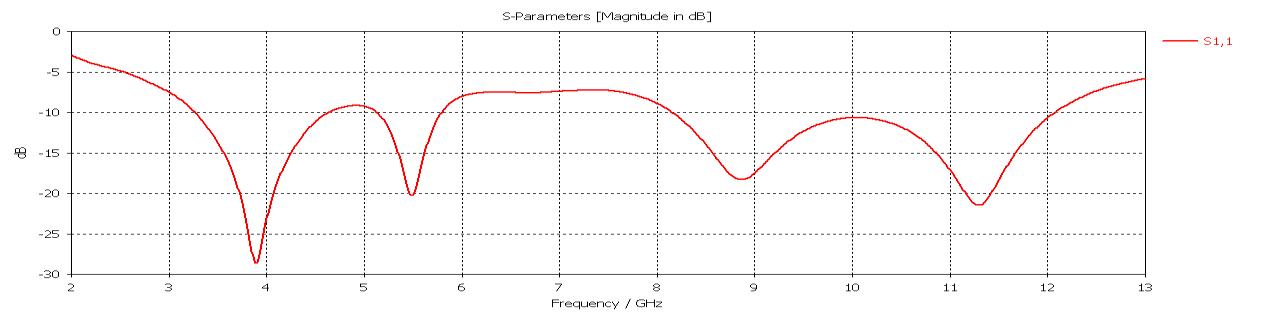
A Novel three-cut circle tri-band flexible antenna for wireless application is designed to be simulated in CST software to achieve a body area network for three bands of frequencies with better bandwidth operating at 3 resonant frequencies 3.892 GHz, 5.477 GHz, and 11.296 GHz. Material of substrate of the antenna is denim jeans with a dielectric constant of 1.7 and a conductive element such as copper tape. The board size is 43*43mm2. The bandwidths for the proposed design are 34.4% 12.05% 39.05% for a frequency spectrum of 3.2677 GHz to 12.12 GHz which is considered to be the optimal bandwidths for the antenna. The presented tri-band antenna can be used in wearable devices in wireless body area networks (WBANs).
Key Words: CST software, rectangular ground, wearable antenna, wireless application, planar micro-strip antenna.
1. INTRODUCTION
Inrecentyears,wirelessbodyareanetworkshavebeenwidelydeployedinavarietyofindustries,includingthemilitary, business,entertainment,andhealth[1,2].Thewearableantenna,acrucialcomponentofWBANs,istypicallywornonthebody, appliedtoclothes,ahelmet,orthewrist,forinstance[3-5].Thehighdielectricconstantsandimperfectionsthatarepresentin humantissuesoftenhaveanegativeinfluenceonwearableantennaperformance.Similartohowwearableantennasaffectthe humanbody,theymustadheretoestablishedsafetyregulationsandaretypicallyassessedintermsofSARvalues.
Recently,meta-material (MTM) structureshaveproven to be successful atloweringantenna radiation, SAR valuesto the humanbody.Examplesincludeartificialmagneticconductor(AMC)structures[6,7],EBGstructures[8,9],andmeta-material surface(MS)surfaces[10].Reference[10]providesanantennawithanMSstructure,whereassources[6,7],[8,9],and[10] addresswearableantennaswithsingle-bandAMCstructuresanddual-bandEBGstructures,respectively.Yet,thesemetamaterialconstructionsdon'temployseveraloperatingfrequencyranges.Aswirelessbodyareanetworksadvance,functional requirementsforwearableelectronicsrise.Multi-bandantennashavemorecompactconstructionthancombinationsofsinglebandantennas,andtheserequirementscanbesatisfied.Severalwearabledual-bandantennashavebeendevelopedasoflate [8,9,11,and12].Inreference[11],adual-bandwearableantennawithoutloadingmeta-materialswasproposed.
Thereferences[8,9,and12]providearangeofdual-bandwearableantennaswithmeta-materialconstructions.Therehave alsobeensomesuggestionsformulti-bandandtriple-bandwearableantennas[13–18],whichwouldincreasethenumberof bandsevenmore.Yet,thesafetyforthehumanbodyhasnotbeendetermined.Atriple-bandantennawithaHilbert-shaped array for the radiating layer and a periodic square groove on the ground was depicted in reference [13]. For off-body communication,atiny,low-profilebuttonantennawithoperatingfrequencybandsof0.867,2.38,and5.85GHzwasincluded [14].ForwearableWiMAX,military,andISMapplications,atriple-bandopen-ringantennawasproposedin[15].Atri-band dual-polarizedmultiple-inputmultiple-outputbelt-strapantennafortheintelligentInternetofMedicalThingswasachievedin [16].
In [17], a wearable multi-band CPW-fed slot dipole antenna for WBAN applications was also incorporated. This antenna supports2.4/5.2/5.8GHzWLAN,3.5GHzWiMAX,and4.4GHzC-bands.Usingaslottedradiatoranda7by7arrayofperiodic squarepatches,Reference[18]developedahepta-bandantenna.Byemployinganinductivegroundplane,thisantenna'sSAR value is reduced. As can be seen, most recent research on wearable antennas using meta-material structures focuses on constructingsingle-bandordual-bandantennas,withtriple-bandormulti-bandantennasbeingutilisedfarlessfrequently.The useofmultibandortriple-bandmeta-materialstructureshasn'timprovedtheperformanceofwearableantennaseither.
ANovelthree-cutcircletri-bandflexibleantennaforwirelessapplicationisdesignedandsimulatedinCSTsoftwaretoachieve abodyareanetworkforthreebandsoffrequencieswithbetterbandwidthoperatingatthreeresonantfrequencies3.892GHz, 5.477GHz,and11.296GHz.Thematerialusedforthesubstrateoftheantennaisdenimjeanswithadielectricconstantof1.7 andaconductiveelementsuchascoppertape.Theboardsizeis43*43mm2.Thebandwidthsfortheproposeddesignare 34.4% 12.05%39.05%forafrequencyrangeof3.2677GHzto12.12GHzwhichisconsideredtobetheoptimalbandwidths fortheantenna.Theproposedtriple-bandantennacanbeusedinwearabledevicesinwirelessbodyareanetworks(WBANs).
2. Wearable Antenna
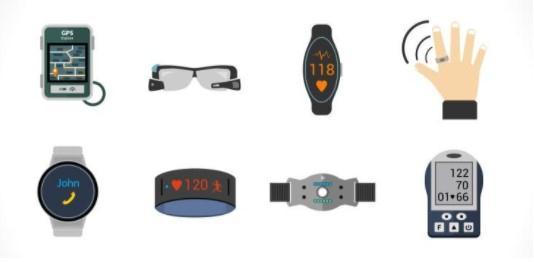
Antennasthatmaybewornareknownaswearables.WearableantennasarefrequentlyusedinbiomedicalRFsystemsand wearablewirelesscommunication.Theyarealsoutilisedinwirelessbodyareanetworks.AnantennaisacrucialpartofaWBAN thatfacilitateswirelesscommunication,whichincludesoff-body,on-body,andin-bodycommunication.Wearableantennascan beusedinvarioussectorsincludinghealthmonitoring,entertainment,business,securitydefensemilitaryapplications,and variousotherfields. Theantennaisoneofthemostimportantcomponentsofwearabletechnologysinceitimprovestheoverall effectivenessofawearablewirelesssystem.Wearableshavenumerousapplicationsineverydaylife.Inadditiontowristwatches, fitness bands, and augmented reality glasses, they feature a variety of medical uses. In the healthcare industry, wearable technologyisusedtomonitorpatients'crucialhealthconditions.Aglucosemonitoringsystemforassessingthepatient'sblood sugarlevels,acapsuleendoscopetoinvestigatethegastrointestinaltract,athermometertocheckthebody'stemperature,blood pressure, and heart rate, and a glucose monitoring system are also included.Examples of these include touchscreen smartwatchesandaugmentedrealityeyewear.Avisualrepresentationofnumerouswearablesutilizedintheentertainment industryisshowninFig.1.
Fig -1:Differenttypesof wearablesusedbyhumansforhealthtrackingandleisurepurposeareshowninthefigure.
Inaddition,rescueandemergencyresponsesystemscanincludewearabletechnologyinhelmets,shoes,raincoats,andjackets.
Field Applications
MedicalCare Endoscopy,oximetry,wearablethermometers,GPStrackers,breastcancerdetection devices,andglucosemonitoring.
Entertainment Smartshoes,radiojackets,LEDoutfits,andtrackers.
Safety&Rescue Lifejackets,tracker,fitnesstrackers,e-shoes,raincoats,andprotectivegear.
Thewordreferstothetwoprincipalapplicationsofwearableantennas:communicationandpositiondetection.Wearable antennasrequireincreasedbandwidthtofunctionproperlyandtobewidelyadopted.
3. Simulation of A Novel Three Cut Circle Tri-Band Flexible Antenna
3.1 Planar Antenna
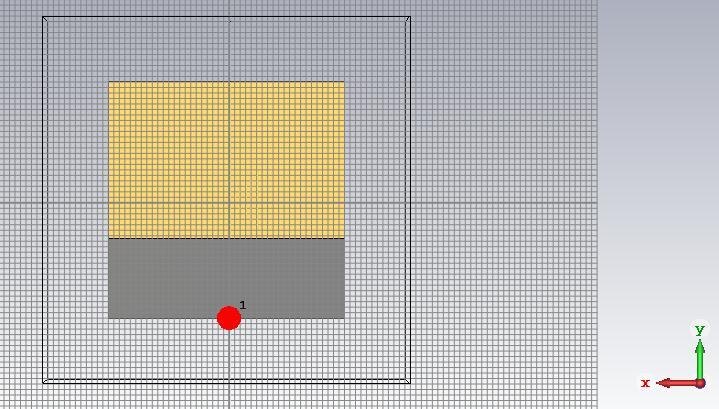
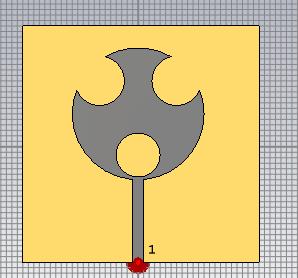
Tosimulateantennas,tri-cutcircledesignshavebeenproposedtoimprovebandwidthandgain.Fig.(5)Showsanew tri-cutcircle-shapedportableantennaoperatingatresonantfrequenciesof3.892GHz,5.477GHz,and11.296GHz.A43
x43mmrectangularantennaboardisused.Apatchiscreatedonthesubstrateintheshapeofatri-cutcircle,witha21 mmx-axislengthanda22mmy-axislength.
Themainshapeofthepatchdesignishavingaradiusof12mmwithcoordinates(0,6)havingathicknessof0.038mm.
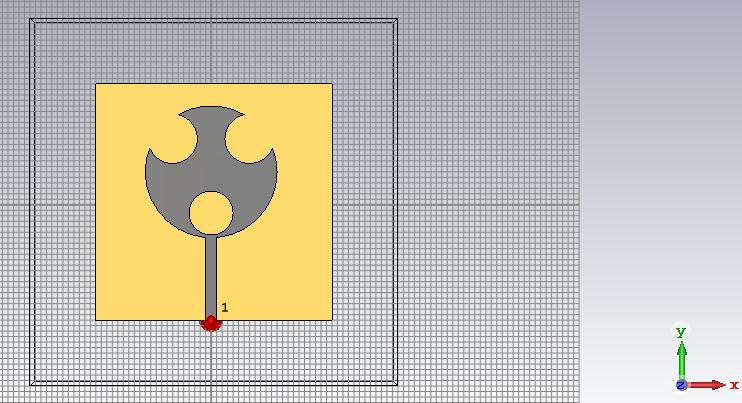
The Strip line has breadthat the x-axis (-1, 1) mm andheight fromy-axiscoordinates (6,-21) with a thickness of 0.038mmofmaterialPEC.
Threeshapesarecutfromthedesignwithsegmentvalue30with2shapeshavingcoordinatesas1stshape(-7,12)2nd shape(7,12)bothhavingaradiusof4.5mmandthe3rdshapehavingaradiusof4mmhavingcoordinates(0,-1.5)with alltheshapeshavingsamethicknessof0.038mm.
Alloftheessentialparametersaregivenintable.2.
Table
3.2
Jeans:Thistextilewaschosensinceitiswearable,washable,inexpensive,anddoesnotrequiremaintaining.
Epsilonr=1.7forJeans.
4. Proposed Design Structure
Theproposedantenna’sfrontandbacksidesareshowninfigures2and3.
5. Radiation Pattern
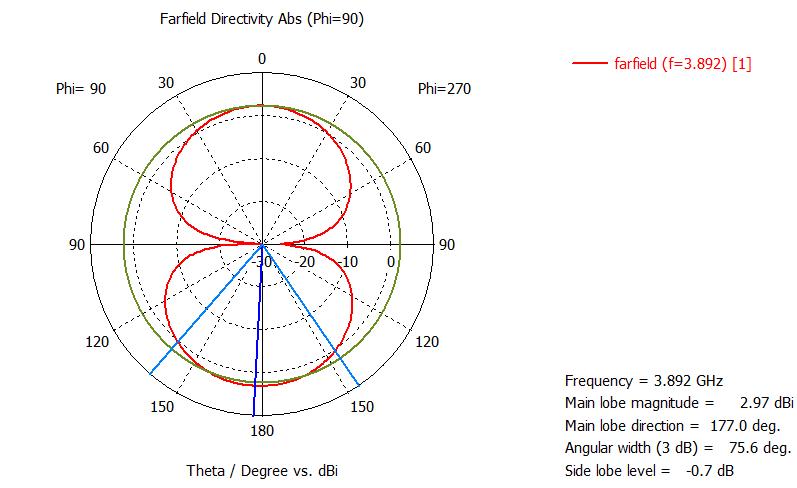
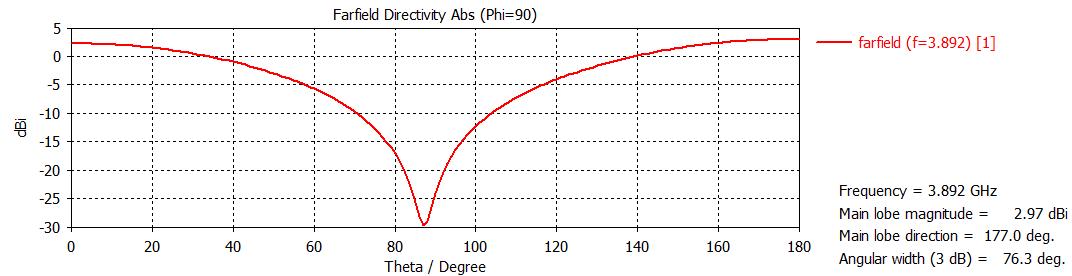
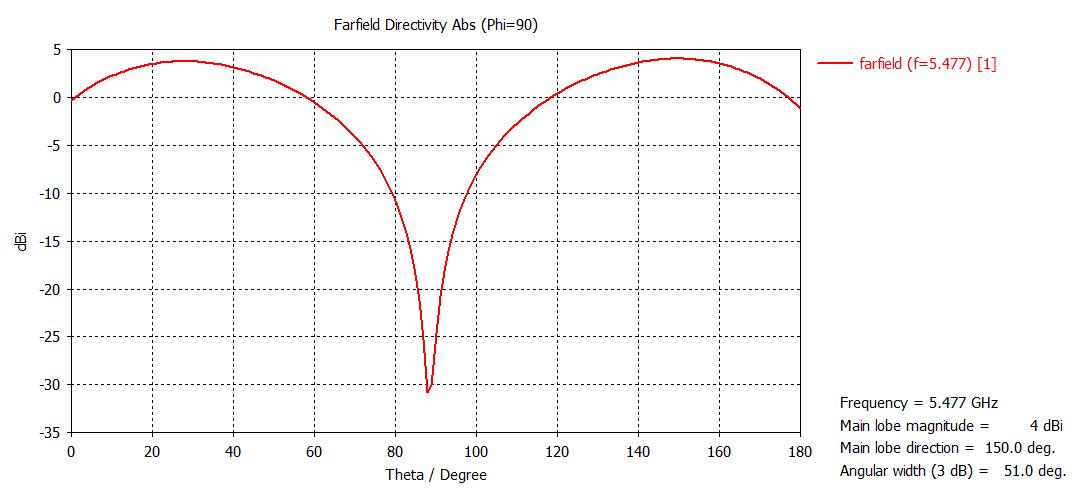
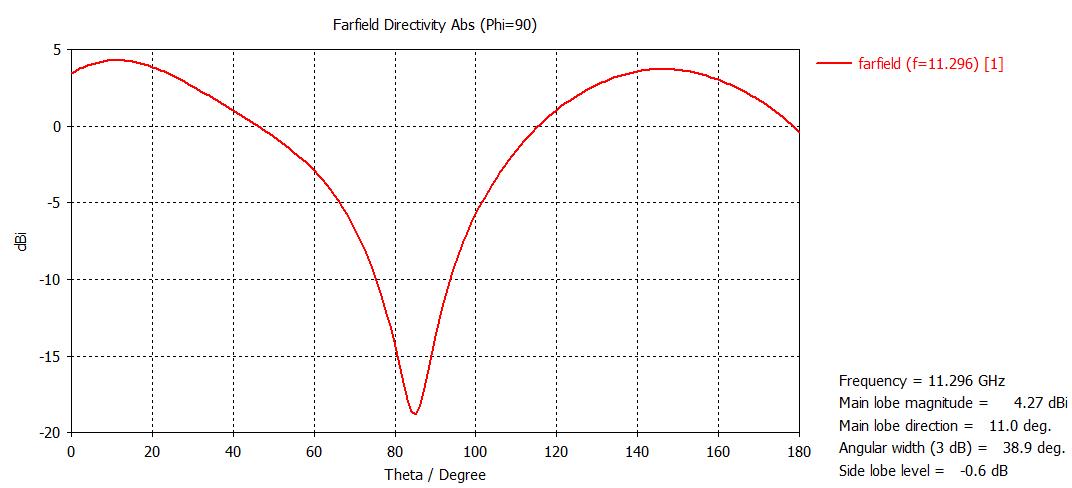
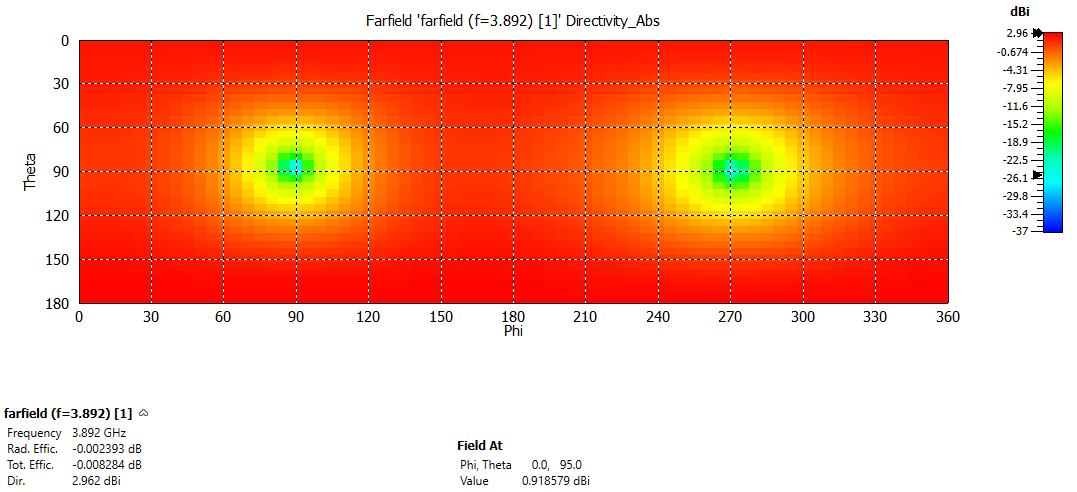
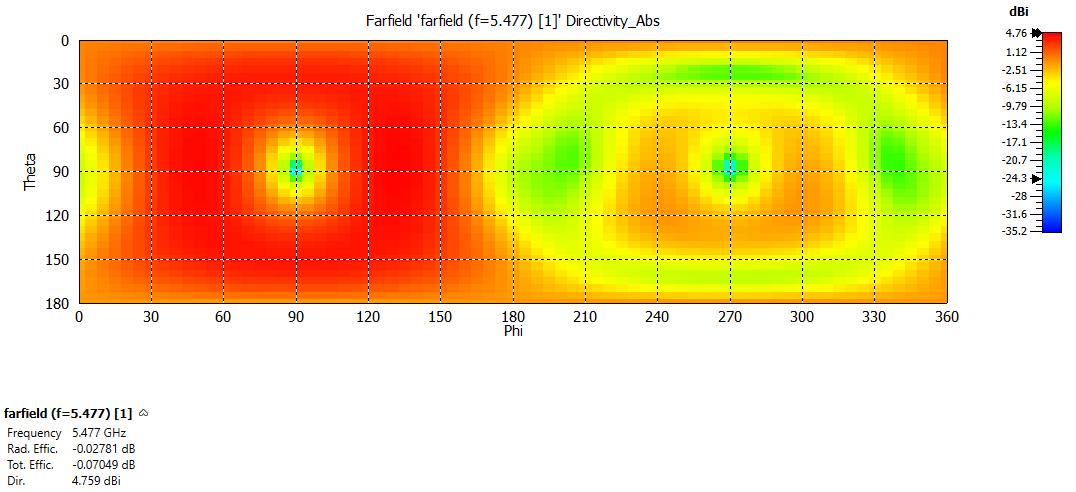
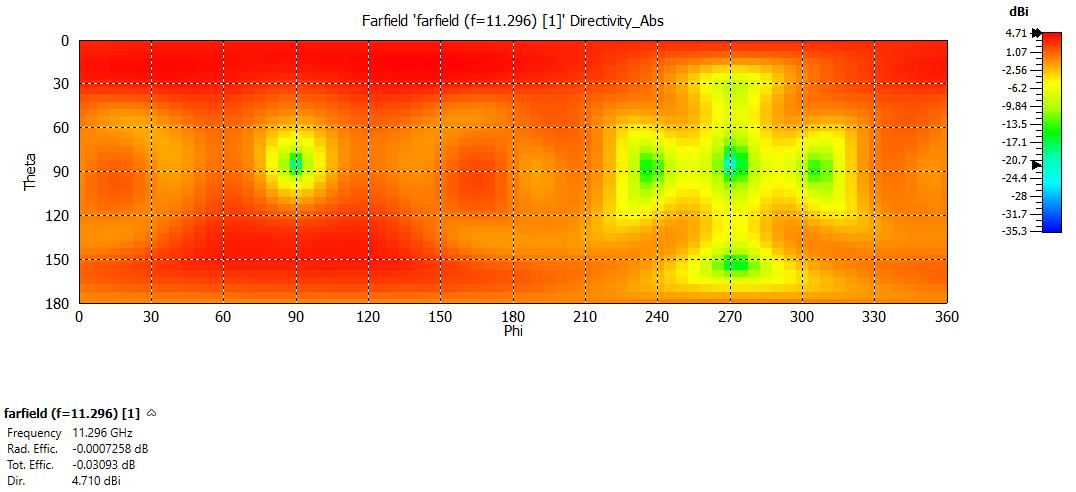
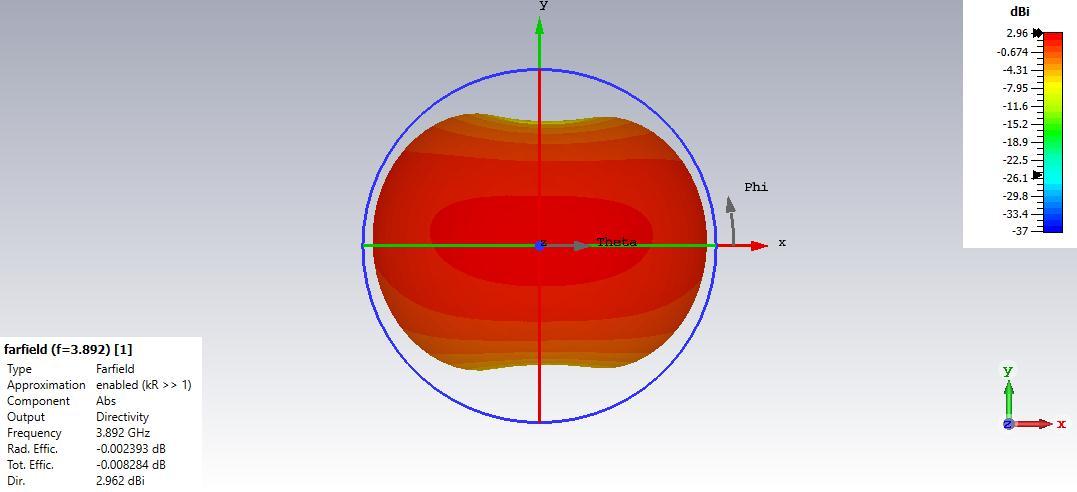
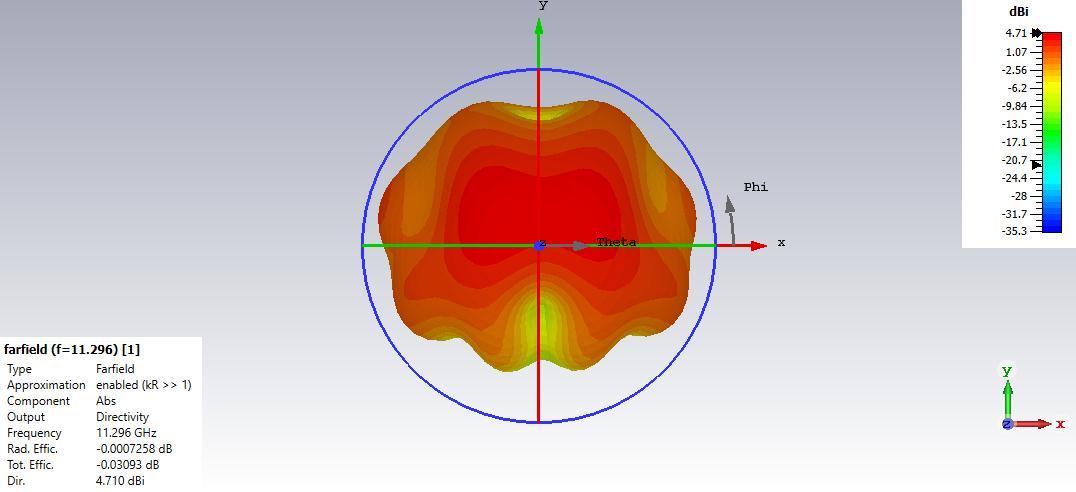
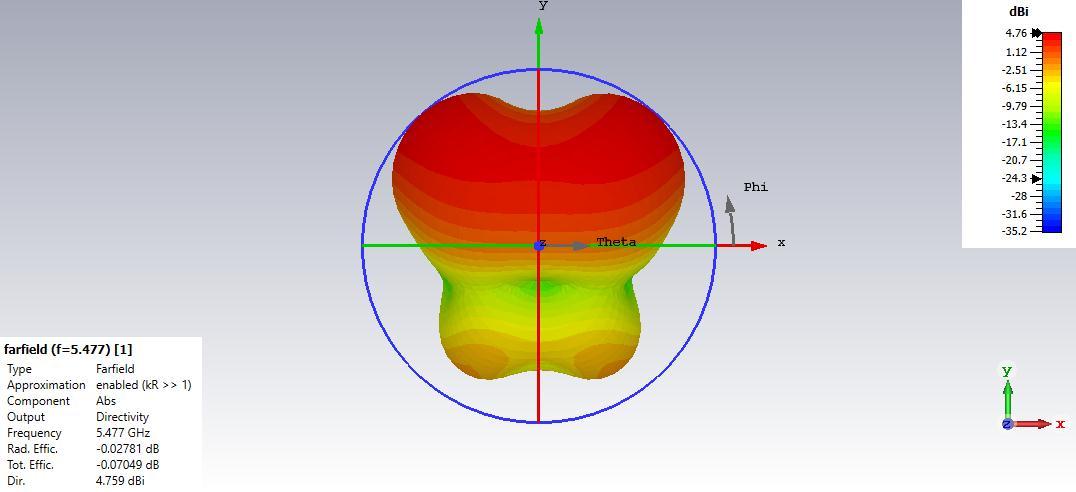
Figure4depictstheradiationpatternofthepolarplotforresonantfrequenciesof3.892GHz,5.477GHz,and11.296GHzforthe proposedtextilemicrostripantenna.Figure5depictsthetwo-dimensionalCartesianradiationpatternat3.892GHz,5.477GHz, and11.296GHz.Figures6and7depictthetwo-dimensionalandthree-dimensionalradiationpatternsatresonantfrequencies 3.892GHz,5.477GHz,and11.296GHzarethefrequencies.Theradiationpatternindicatesthemajorlobe'sorientation=177.0 degrees,150.0degrees,and11.0degrees.Anangularwidth(3dB)of75.6degrees,51.0degrees,and47.4degrees,withamajor lobemagnitudeof2.97dBiataresonantfrequencyof3.892GHz,4dBiataresonantfrequencyof5.477GHz,and4.27dBiata resonantfrequencyof11.296GHz.Witharadiationefficiencyofalmost0.002393dBfor3.892GHz,0.02781dBfor5.477GHz,and 0.0007258dBfor11.296GHz,directivityis2.962dBi,4.759dBi,and4.710dBi.
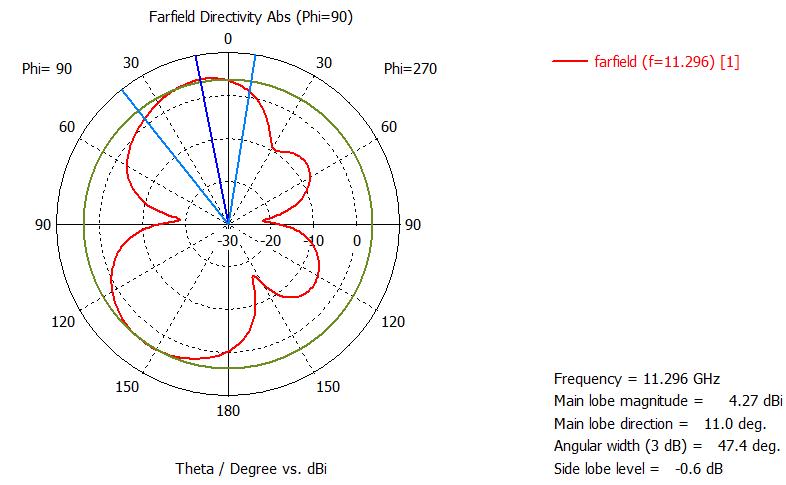
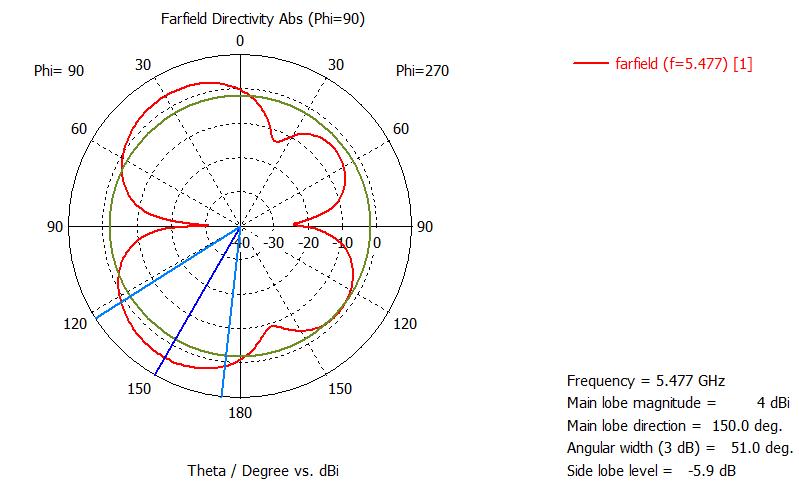
Theterm"radiation"referstoboththeemissionorabsorptionofawavefrontatanantennaandtheintensityofthewavefront. Theradiationpatternofanantennaisshownbythecontourusedtodepictitsradiationineachfigure.Theradiationpattern mighthelpyouunderstandantennaoperationanddirectivity.Thepowergeneratedbytheantennaaffectsboththenearand distantfields.
6. Results and Discussion
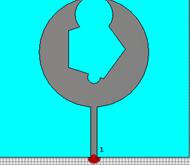
Thefirstdesignworksonlyonasingleresonantfrequencyof3.224GHzandissuitableonlyforsingle-bandapplications. whiletheseconddesignworksonthreebandsoffrequencyfor3.892GHz,5.477GHz,and11.296GHzresonantfrequencieshence suitableformultibandapplications.
Multibandandtriplefrequenciesmaketheseconddesignpreferableoverthefirstdesign.
Firstdesign. Seconddesign.
Theseconddesignischosenoverthefirstdesignbecauseithasamultibandapplicationandishavingmultiplefrequenciesof varioususessuchasIoT,satellitecommunication,and5G.
TheformulausedforthecalculationofbandwidthisgiveninEq.1.where,F1=2.6GHzandF2=12.2GHz.
Bandwidth
=(F2-F1/{(F1+F2)/2}) (1)
ANovelthreecutcircletri-bandflexibleantennaforwirelessapplicationisdesignedandsimulatedinCSTsoftwaretoachievea bodyareanetworkforthreebandsoffrequencieswithbetterbandwidthoperatingattriresonantfrequenciesof 3.892GHz, 5.477GHz,and11.296GHz.Thematerialusedforthesubstrateoftheantennaisdenimjeanswithadielectricconstantof1.7 andaconductiveelementsuchascoppertape.Theboardsizeis43*43mm2.Thebandwidthsfortheproposeddesignare34.4% 12.05%and39.05%forafrequencyrangeof3.2677GHzto12.12GHzwhichisconsideredtobetheoptimalbandwidthsforthe antenna.Thesuggestedtriple-bandantennaissuitableformultibandandwearableapplicationsinwirelessbodyareanetworks (WBANs).
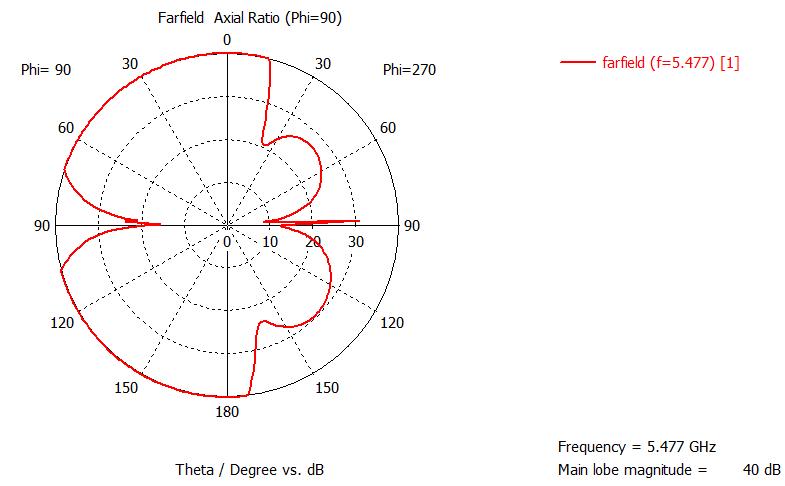
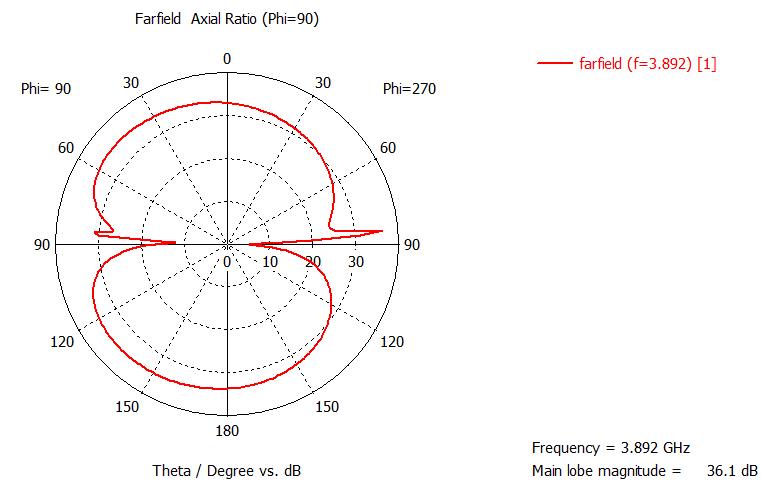
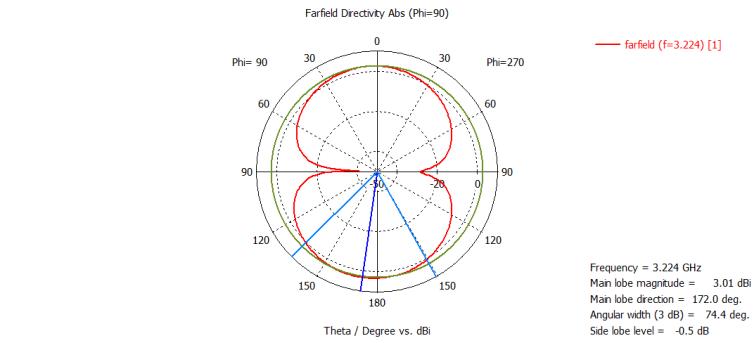
(a)Axialratiofor3.224GHzresonantfrequencyforfirstdesign.
(b)3.892GHz
(c)5.477GHz
(d)11.296GHz
Fig-8. Axialratiofor3.892GHz,5.477GHz,and11.296GHzresonantfrequencies.
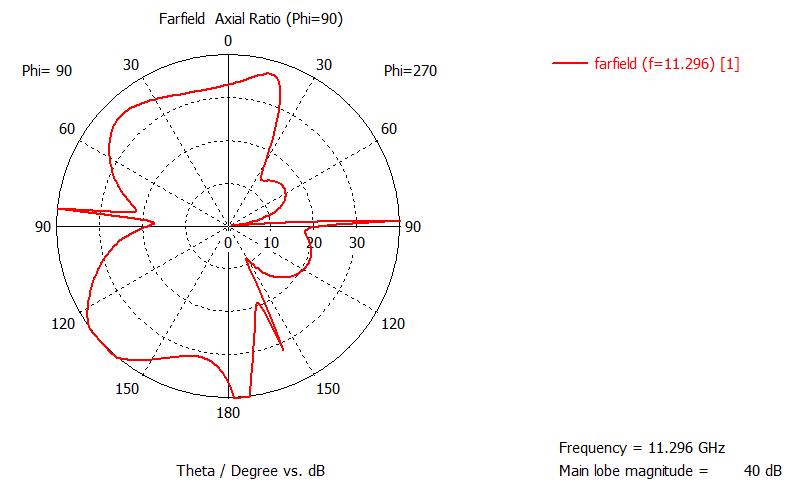
AxialRatio: Itisacircularlypolarizedantennapatternmajortominoraxisratio.
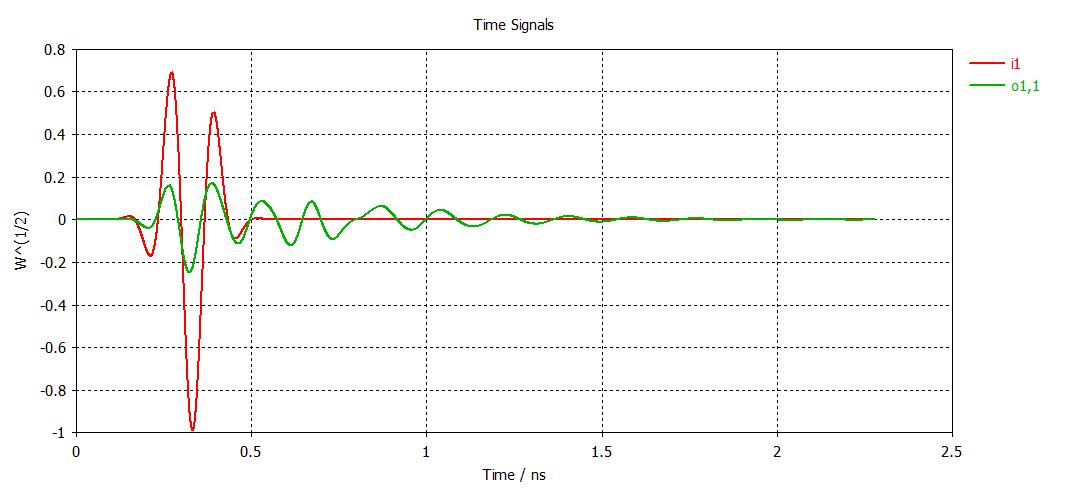
Port Signal: It shows how strong the resonance is of the antenna it always starts at 0 and after some resonance tends towardszero.
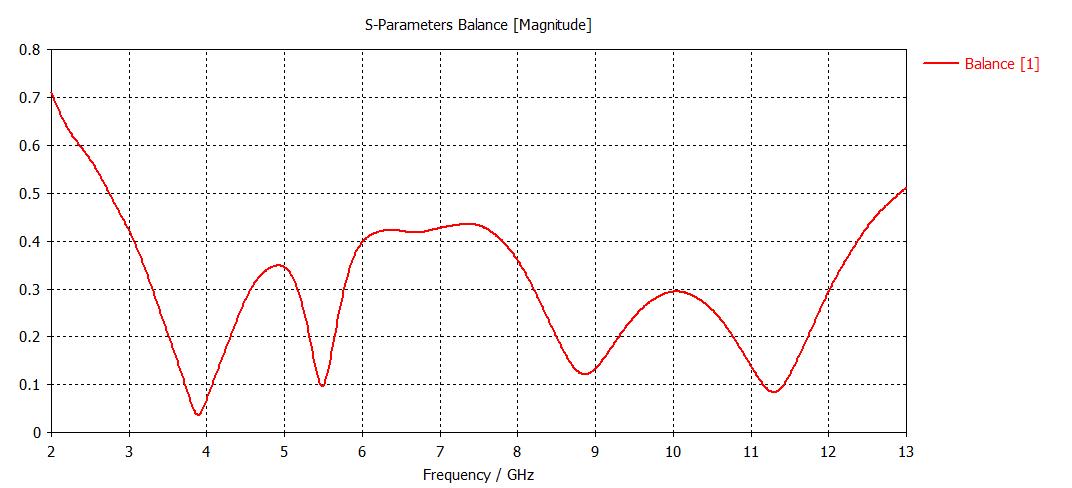
S-Parameter:Itisthereflectioncoefficientbetweentheportimpedanceinadditiontotheinputimpedanceofthecircuit.
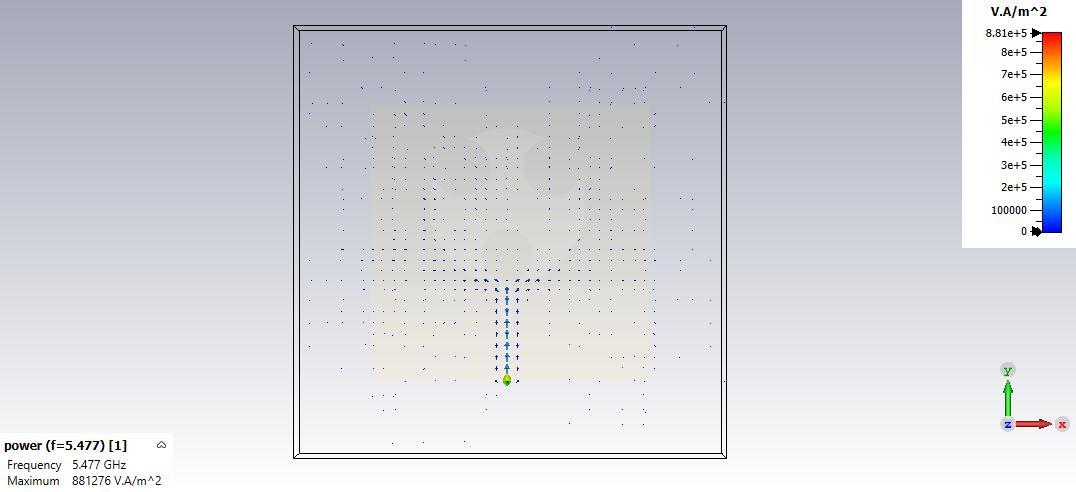
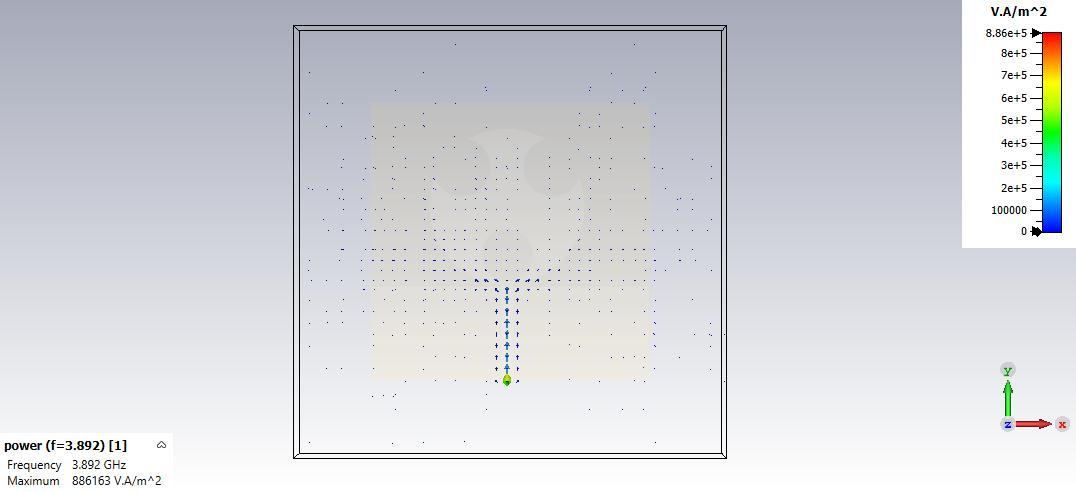
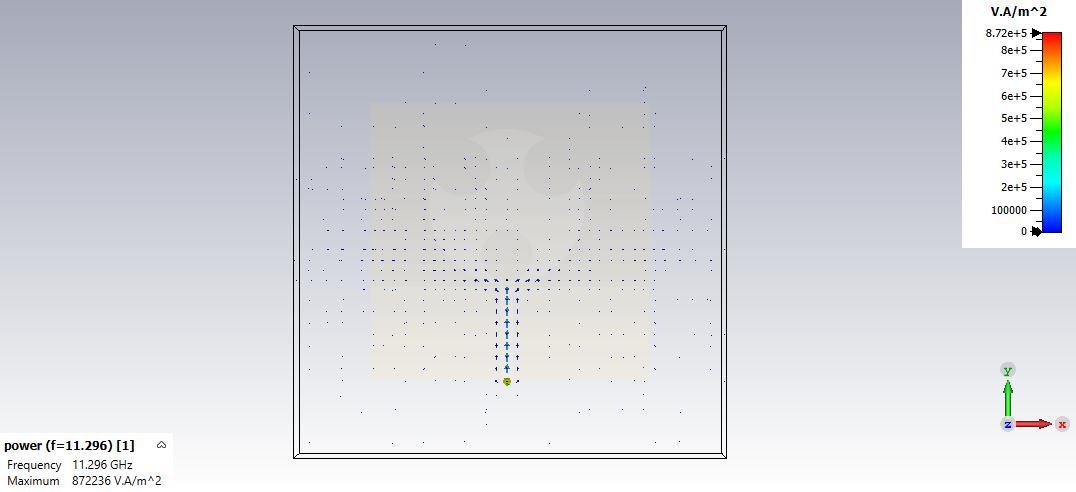
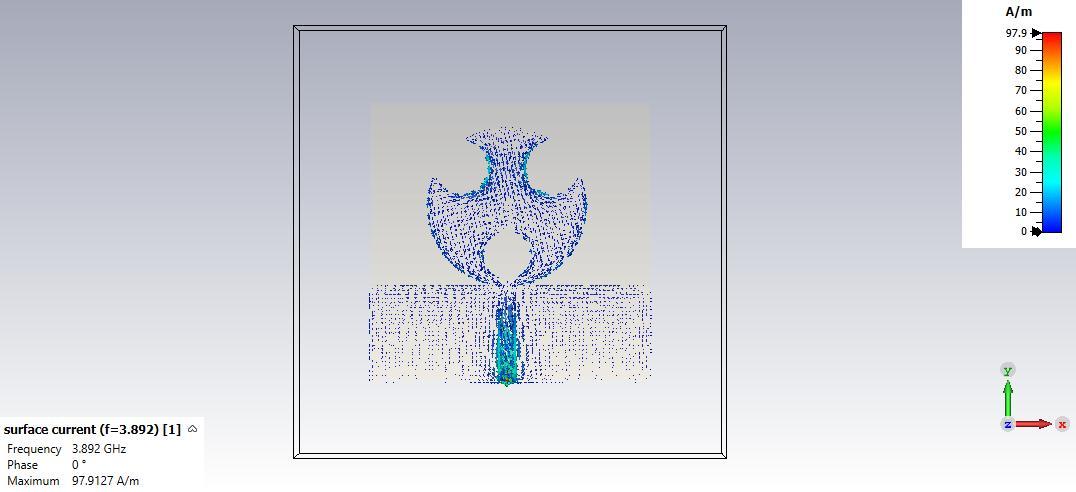
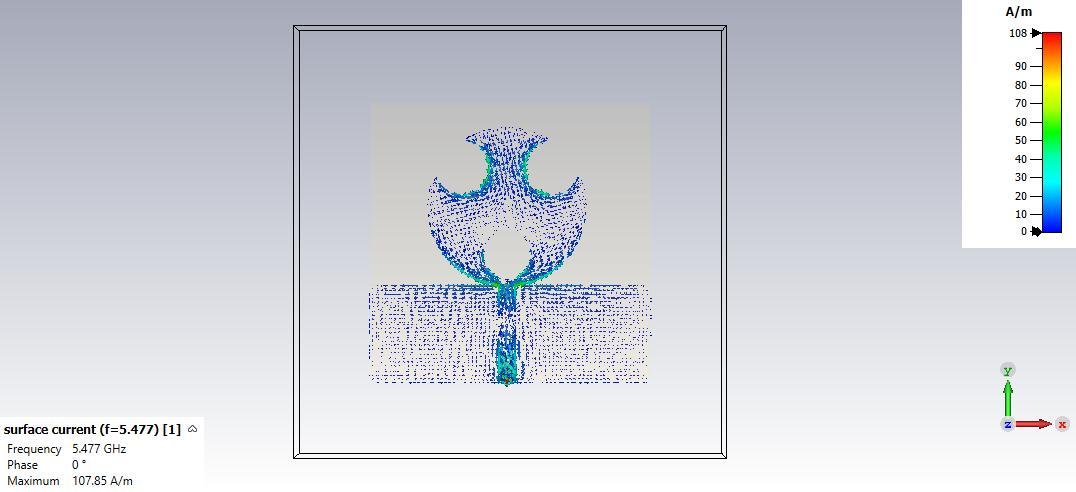
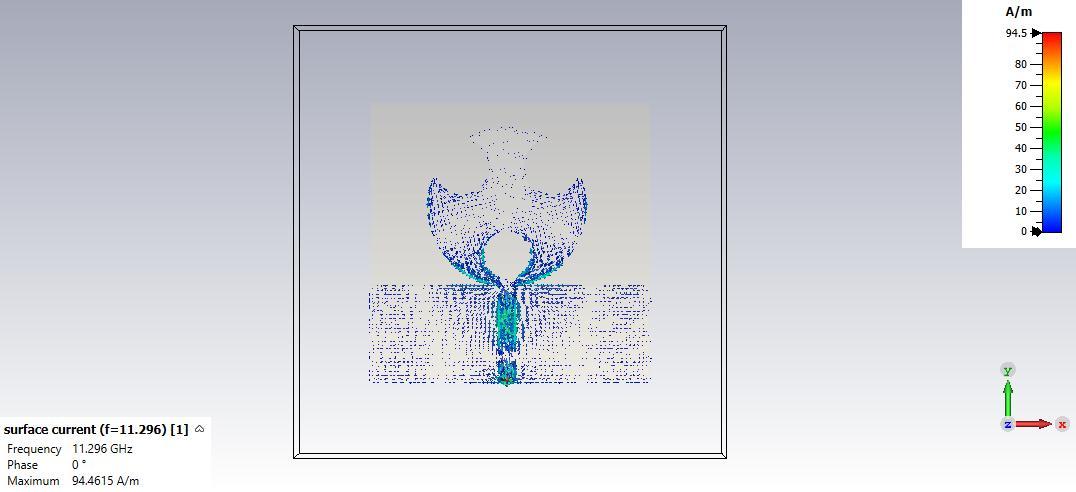
Surfacecurrent:Anelectromagneticfieldisusedtoinducetheactualelectriccurrent.
7. CONCLUSION
Inthisstudy,atri-bandmicrostripantennahasbeenproposedwithtribandfrequencieswhichoperatein3.892GHz,5.477GHz, 11.296GHzresonantwhichworksinthe3.5GHzWiMAXbandfor5Gpurposeforlongerrangebutlessspeed.Theradiation performancesofthemicrostripantennawerestudied.Theperformanceindicatesthattheantennahadagreatergain,abetter front-to-backratio,andgoodbandwidth.Thesuggestedantenna,inadditiontotriple-bandantennas,hasasufficientbandwidth, high gain, and better bandwidth and it works with wearable technology and wireless body area networks. for multiband applicationsandcanbeusedforsatellitecommunication,5G,andradarapplicationfortargetidentificationanddiscrimination.
8. FUTURE SCOPE
Inthefuture,thisdesigncanbefabricatedandtestedonahumanphantomtoknowitsSARvalueandeffectsonthehuman bodysothatitcanbeusedforwearableapplicationsandalsoonotherapplications.Thedesigncanbefurtherusedforthe exchangeofinformationbetweendifferentdevicesoveracloudnetworkandsatelliteconnectivitycanbeachievedfromit, tracking,navigationfetchingofdata,andcommunication.
REFERENCES
[1] Seyedi,M.;Kibret,B.;Lai,D.T.H.;Faulkner,M.Asurveyonintrabodycommunicationsforbodyareanetworkapplications. IEEETrans.Biomed.Eng.2013,60,2067–2079.[CrossRef][PubMed]
[2] Seneviratne,S.Asurveyofwearabledevicesandchallenges.IEEECommun.Surv.Tutor.2017,19,2573–2620.[CrossRef]
[3] Ashyap,A.Y.I.;BinDahlan,S.H.;Abidin,Z.Z.;Abbasi,M.I.; Kamarudin,M.R.;Majid,H.A.;Dahri,M.H.;Jamaluddin, M.H.; Alomainy,A.Anoverviewofelectromagneticband-gapintegratedwearableantennas.IEEEAccess.2020,8,7641–7658. [CrossRef]
[4] Song, L.N.; Rahmat-Samii, Y. A systematic investigation of rectangular patch antenna bending effects for wearable applications.IEEETrans.AntennasPropag.2018,66,2219–2228.[CrossRef]
[5] Singh,R.K.;Michel,A.;Nepa,P.;Salvatore,A.;Terraroli,M.;Perego,P.Compactandwearableyagi-liketextileantennasfor near-fieldUHF-RFIDreaders.IEEETrans.AntennasPropag.2021,69,1324–1333.[CrossRef]
[6] Agarwal, K.; Guo, Y.-X.; Salam, B. Wearable AMC backed near-endfire antenna for on-body communications on latex substrate.IEEETrans.Compon.,Packag.Manuf.Technol.2016,6,1113–1124.[CrossRef]
[7] Alemaryeen,A.;Noghanian,S.On-bodylow-profiletextileantennawithartificialmagneticconductor.IEEETrans.Antennas Propag.2019,67,3649–3655.[CrossRef]Micromachines2022,13,193812of12
[8] Velan,S.;Sundarsingh,E.F.;Kanagasabai,M.;Sarma,A.K.;Raviteja,C.;Sivasamy,R.;Pakkathillam,J.K.Dual-bandEBG integratedmonopoleantennadeployingfractalgeometryforwearableapplications.IEEEAntennasWirel.Propag.Lett. 2015,14,249–252.[CrossRef]
[9] Gao, G.P.; Hu, B.; Wang, S.F.; Yang, C. Wearable planar inverted-F antenna with stable characteristic and low specific absorptionrate.Microw.Opt.Technol.Lett.2018,60,876–882.[CrossRef]
[10] Jiang,Z.H.;Brocker,D.E.;Sieber,P.E.;Werner,D.H.Acompact,low-profilemetasurface-enabledantennaforwearable medicalbody-areanetworkdevices.IEEETrans.AntennasPropag.2014,62,4021
4030.[CrossRef]
[11] Le,T.T.;Yun,T.-Y.Miniaturizationofadual-bandwearableantennaforwbanapplications.IEEEAntennasWirel.Propag. Lett.2020,19,1452–1456.[CrossRef]
[12] Atrash,M.E.;Abdalla,M.A.;Elhennawy,H.M.Awearabledual-bandlowprofilehighgainlowSARantennaAMC-backedfor WBANapplications.IEEETrans.AntennasPropag.2019,67,6378–6388.[CrossRef]
[13] AlSabbagh, H.M.A.; Elwi, T.A.; Al-Naiemy, Y.; Al-Rizzo, H.M. A compact triple-band metamaterial-inspired antenna for wearableapplications.Microw.Opt.Technol.Lett.2019,62,763–777.[CrossRef]
[14] Sambandam,P.;Kanagasabai,M.;Natarajan,R.;Alsath,M.G.N.;Palaniswamy,S.Miniaturizedbutton-likeWBANantennafor off-bodycommunication.IEEETrans.AntennasPropag.2020,68,5228
5235.[CrossRef]
[15] Le,T.T.;Kim,Y.-D.;Yun,T.-Y.Atriple-banddual-open-ringhigh-gainhigh-efficiencyantennaforwearableapplications. IEEEAntennasWirel.Propag.Lett.2021,9,118435–118442.[CrossRef]
[16] Yang,S.H.;Zhang,L.Y.;Wang,W.S.;Zheng,Y.J.Flexibletri-banddual-polarizedMIMObeltstrapantennatowardwearable applicationsinintelligentinternetofmedicalthings.IEEETrans.AntennasPropag.2022,70,197–208.[CrossRef]
[17] Dey,A.B.;Mitra,D.;Arif,W.DesignofCPWfedmultibandantennaforwearablewirelessbodyareanetworkapplications. Int.J.RFMicrow.Comput.AidedEng.2020,30,e22459.[CrossRef]
[18] Alam,M.;Siddique,M.;Kanaujia,B.K.;Beg,M.T.;Kumar,S.;Rambabu,K.Meta-surfaceenabledhepta-bandcompactantenna forwearableapplications.IETMicrow.AntennaPropag.2019,13,2372–2379.[CrossRef]
[19] Langley,R.J.;Parker,E.A.Double-squarefrequency-selectivesurfacesandtheirequivalentcircuit.Electron.Lett.1983,19, 675–677.[CrossRef]