4
Student University Network

2
3
Abstract - “Student University Project” is a project aimed to create an online platform which can be used by students to interact with their university/education institution. This isaplatformconsistingofanandroidapplicationandaweb application where all students, teachers and other faculty members can login and use it to manage activities like course material management, timetable management, automatic attendance recording and many more. This project is developed to be the most easy, standard and effortless way of interacting with students by automating andsimplifyingworkasmuchaspossible.
Key Words: Online platform, automation, integrated, academicactivities,datamanagement.
1.INTRODUCTION
The "Student University Network" project is an online platform which has been specifically developed for students, with the primary goal of streamlining the interaction between students and their educational institutions. This platform has been designed to facilitate twomaintypesofinteraction.Firstly,itallowsteachersto make announcements, provide private comments, and respondtoqueriesanddoubtsfromstudents. Secondly, it enables academic activities such as managing course materials,creatingandupdatingtimetables,andrecording student attendance. One of the most important aspects of this project is its ability to automate as many tasks as possible. By integrating related activities with each other, this platform creates a seamless workflow that makes it easy for students to stay on top of their academic commitments. This automation not only makes life easier for students, but also helps educational institutions to reduce administrative overheads and improve efficiency. To ensure that the platform is accessible to as many students as possible, the "Student University Network" project includes an android application as its primary platform. This application has been designed to be userfriendly and intuitive, making it easy for students and teachers to use. In addition to the android application, a web application has been developed that can be used by adminusersforadministrativepurposes.
1.1 Need
Despite having the technology currently there isn’t any system which integrates and automates various academic activities for students and teachers. Still students need to use a bunch of applications for different purposes which have no correlation between them. Everyday for every lecturestudentsneedtolookintheirtimetablepaper,they havetosearchthroughhundredsofmessagesinwhatsapp groupstofindanyrelevantmessage.Coursematerialsare scattered everywhere from whatsapp forwards to anonymous cloud drive links. Teachers have to take attendance manually on papers or excel sheets and then compile all information into the university's internal system. Both students and teachers waste a lot of their precious time and effort in working through these small and sometimes trivial tasks. Hence due to above mentioned problems a need to create this project was arised.
2. APPLICATION
The proposed system has been designed to be highly flexibleandadaptable,andcanbeusedbyawiderangeof educational institutions, including schools, colleges, and universities.Thesystemhasbeendevelopedtoseamlessly integrate with existing internal administrative systems, which means that educational institutions can use it alongside their current processes. Each university will havetheirownlocalversionoftheapplication,whichthey can customise and configure according to their specific needs. This customization allows educational institutions tomodifyorcompletelychangethefeaturesandfunctions of the system, making it ideal for institutions with unique requirements. Furthermore, the proposed system offers several benefits to educational institutions. By using this platform, institutions can improve their operational efficiencyandreducetheiradministrativeoverheads.They can automate many of the tasks that would otherwise require manual intervention, freeing up time and resourcestofocusonotherimportanttasks.
International Research Journal of Engineering and Technology (IRJET) e-ISSN:2395-0056 Volume: 10 Issue: 03 | Mar 2023 www.irjet.net p-ISSN:2395-0072 © 2023, IRJET | Impact Factor value: 8.226 | ISO 9001:2008 Certified Journal | Page523
Yash Sawant1 , Manas Raut2, Ajay Kanki3, Prof. Anuradha Kapoor4
1Yash Sawant, Dept of Information Technology Engineering, Atharva College of Engineering,
Manas Raut, Dept of Information Technology Engineering, Atharva College of Engineering,
Ajay Kanki, Dept of Information Technology Engineering, Atharva College of Engineering,
Prof. Anuradha Kapoor, Dept of Information Technology Engineering, Atharva College of Engineering, Maharashtra, India
***
3. LITERATURE SURVEY
Numerous articles have been reviewed and their conclusions are summarised in this section. Documents that were looked at both before and during project developmentarepresentedinthissection.Thedocuments provided a better understanding of existing solutions and how the system architecture can be designed for optimal quality.
Table -1: StudentArticles
Title Publisher& Author Description
Developmentof CloudLearning Management Systemsfor Higher Education Institutions
Modelsof Behaviorof Agentsinthe Learning Management System
SmartMobile Attendance using bluetooth technology
IEEE,2019 Panita
Wannapiroon, Nutthapat
Kaewrattanapat, Jakkrit
Premsmith
IEEE,2019
OlegBisikalo, Olena
Kovalenko, Yevgen Palamarchuk
Ankit B Dubey, Nitesh Gupta, AnkitMDubey, NilimaNikam
Developmentofof CLMSforHigher EducationSystem
Architecturedesign ofCLMSandstudy ontheresultsof usingCLMS
Explainsthe behaviourofagents ascomponentsofa learning managementsystem todevelopmodelsof behaviourofagents ofthesystem
Explainsabout bluetooth technologyand trackingemployees inthepremises
The first paper we will examine is titled "Development of Cloud Learning Management Systems for Higher EducationInstitutions,"publishedintheIEEEjournal.This paper explores the benefits of using a Cloud Learning Management System (CLMS) to enhance the learning experienceofstudents.Theauthorsproposeasystemthat is specifically designed to take advantage of the unique featuresofferedbyaCLMS.
Moving on to the second paper, "Models of Behavior of Agents in the Learning Management System" is another study published in the IEEE journal. This paper examines thebehaviourofagentsina learningmanagementsystem and explains how to develop these agents for an effective LMS system. The authors provide a detailed analysis of various models of agent behaviour and evaluate their effectiveness in improving the performance of LMS systems.
Finally, the third research paper we will review is titled "Smart Mobile Attendance Using Bluetooth Technology." ThispaperfocusesontheuseofBluetoothtechnologyand itsapplications.Theauthorspresentasystemdesignedto track the presence of employees within the premises of a building,showcasingthepotentialofBluetoothtechnology inattendancetracking.
4. EXISTING SYSTEM
● Googleclassroom
TheGoogleclassroomisagoogleworkspaceservicewhich provides features like creating classrooms per course where course materials, assignments and announcements canbeposted.Italsocontainsintegrationforgoogle meet forthepurposeofonlinelectures.
● Whatsappgroups
Various universities use a common whatsapp group for their students' batches for the purpose of communicating announcements, important information and sometimes evensharingcoursematerialsandresources.
● Manualattendanceandtimetable
Most universities still use pen and paper for attendance records.Laterthisattendancerecordismanuallyanalysed and data is manually entered into the organisation's internal system. Same goes to timetables where it is sharedasjustapieceofpaperoronlinedocument.
5. PROPOSED SYSTEM
The "Student University Network" system that is being proposed will have the following features: First feature is the ability for admin users to create new users for students and other faculty members and manage their access and permissions in the system. Next feature is the ability to create programs, semesters and courses for studentsandassignprofessorstocourses.Thirdfeatureis theabilitytoDividestudentsinbatches.Nextistheability to create timetables for batches which will automatically notify students with information like lecture subject, professorandlocationbefore10minutesofeverylecture. NextfeatureistheabilitytoAutomatedattendancewhere 10 minutes before the end of a lecture attendance of all present students will be automatically recorded. The last feature is communication groups for batches and private messagingforteachersaswell.
6.
SOFTWARE
REQUIREMENTS
6.1 Backend API
● NodeJS
● NPM
● PostgreSQL
International Research Journal of Engineering and Technology (IRJET) e-ISSN:2395-0056 Volume: 10 Issue: 03 | Mar 2023 www.irjet.net p-ISSN:2395-0072 © 2023, IRJET | Impact Factor value: 8.226 | ISO 9001:2008 Certified Journal | Page524
Android Application
Thearchitecturehas3maincomponents:
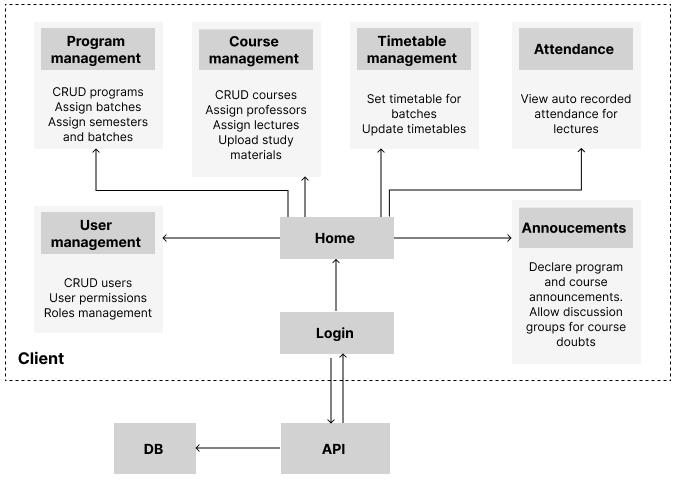
● BackendAPI
● Androidapplication
● Webapplication
Theprojectisdividedinto6mainmodules:
● Usermanagement
This module controls user creation, deletion, permission management. It will be mostly used by adminusers.
● Programmanagement
This module manages academic segregation of students based on enrolled program, semesters and courses in syllabus. It will be mostly used by teacher users.
● Coursemanagement
This module will be a part of a program management modulewhereteacherswilluploadcoursematerials.
● Timetablemanagement
In this module an assigned timetable coordinator will periodically update timetables which will automaticallynotifystudentsasneeded.
● Attendancemanagement
This module will automatically take attendance of students
● Announcements
This module will contain discussion groups and programbasedannouncements.
8. METHODOLOGY
8.1 User management
The system divides users into 3 categories: STUDENT, TEACHER and ADMIN. The user management system enables the admin users to create new users for students and other faculty members and manage their access and permissionsinthesystembyusingtheabove3categories. It ensures that each user has the appropriate level of access to the system, depending on their role and responsibilities. The system also ensures that each user has a distinct login ID and password that is specific to them. Forinstance,studentsmayonlyhaveaccesstotheir course material and assignments, while faculty members mayhaveaccesstogradingandattendancerecords.Italso managesusers'accesstoapplicationfeatureseg:updating the timetable can only be done by the TEACHER not by student.
8.2 Program management
Eachstudentistypicallyenrolledinonlyoneprogramata time. A program is an educational course that contains details such as the duration of the program in counts of semesters, the subjects/courses that are included, and their syllabus. To simplify program management, each streamorspecialisationtypicallyhasitsownprogram.For example, in an engineering degree, the IT stream and computer science stream will have different programs instead of being combined into a single program. This approach enables the institution to create records of existing students, which can be reused for enrolling new students in the same program. This not only saves time but also ensures that students are enrolled in the correct program.TheADMIN userisresponsibleforcreatingnew programsandupdatingexistingones.
8.3 Course management
Acourse containsinformationsuchasthecoursesyllabus, course materials and resources, and information sharing
International Research Journal of Engineering and Technology (IRJET) e-ISSN:2395-0056 Volume: 10 Issue: 03 | Mar 2023 www.irjet.net p-ISSN:2395-0072 © 2023, IRJET | Impact Factor value: 8.226 | ISO 9001:2008 Certified Journal | Page525
6.2 Web Application
1. InternetBrowser
2. NextJS
6.3
1. Jetpackcompose
2. Gradle
3. Androidemulator
7. ARCHITECTURE
Fig - 1:Architecture
platforms. These resources are essential in helping students understand the course content, keep track of assignments,andcollaboratewithotherstudents.Another important aspect of courses is the management of attendance records. Each course is required to maintain accurate attendance records for all enrolled students. It helps to ensure that they meet the minimum attendance requirements. To ensure effective course management, eachcourseisassignedaTEACHERuserasprofessor who is responsible for managing the course. They are responsibleforcreatingand updatingthecoursesyllabus, preparinganddeliveringlectures,providingexamresults, and maintaining accurate attendance records. The TEACHER user is also responsible for providing feedback to students, answering their questions, and facilitating discussionsinthecourse.
8.4 Automated attendance Fig - 2: Attendancealgorithm
In this system, an attendance algorithm has been developed that streamlines the entire process, making it more efficient and accurate. The algorithm consists of six essential steps that ensure that the attendance procedure isexecutedcorrectly.Thefirststepistheschedulingofthe attendance algorithm, which is set to run ten minutes
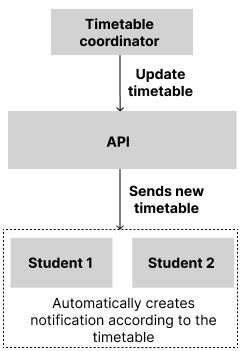
before the end of each lecture. This ensures that the teacherhasenoughtimetocompletethelectureandmark the attendance of students. The second step involves the teacher requesting the API to start the attendance procedure.
The API generates a new unique token for the ongoing lecture and sends it to the teacher as a response. In the third step, the teacher uses Bluetooth services such as BluetoothLEAdvertiser or Nearby API to broadcast the token to the students. The fourth step involves the students receiving the token and sending it to the API for verification of attendance for the ongoing lecture. In the fifth step, the API verifies the token and checks if the student is enrolled for that lecture. If all conditions are satisfied, the student's attendance is marked. Finally, in thesixthstep,afterthelectureends,theattendancetoken expires, preventing students from marking proxy attendance. The attendance algorithm streamlines the entire attendance process, making it more efficient and accurate, ensuring that students attend their classes regularlyandontime.
8.5 Announcements
Anannouncementwill beof twotypes:first typeisglobal or program announcements. Global announcements are intended for all users of the institution and are used to share information that is relevant to everyone. Announcements like holidays, event organisation or emergency notifications, etc. can be announced as global announcements. Next are program announcements which will be only shared to students of a particular program. These announcements will be shared by the TEACHER user for purposes like course notes, exam notices and otherimportantnoticesrelatedtothecourse
8.6 Timetable notifier
International Research Journal of Engineering and Technology (IRJET) e-ISSN:2395-0056 Volume: 10 Issue: 03 | Mar 2023 www.irjet.net p-ISSN:2395-0072 © 2023, IRJET | Impact Factor value: 8.226 | ISO 9001:2008 Certified Journal | Page526
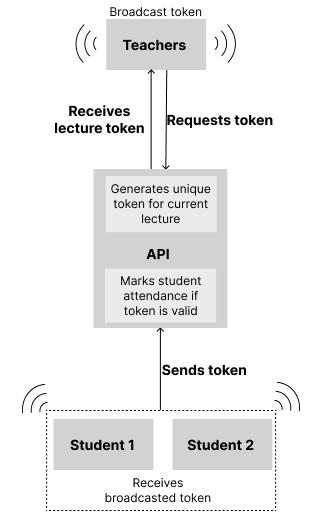
Fig - 3: Timetablenotifieralgorithm
The timetable notifier streamlines the entire process of schedule management, ensuring that students are always up-to-date with their schedules and never miss a class. It eliminates the need for manual reminders and ensures that the students are well-prepared for their classes, ultimately enhancing their academic performance. The timetable notifier consists of three essential steps that ensure the students receive the latest timetable updates and notifications. The first step involves the timetable coordinator updating the timetable and sending it to the API.Inthesecondstep,theAPIsendsthenewtimetableto thestudentsaspertheprogramtheyareenrolledin.This ensures that the students receive the timetable for their specific program. The third step involves the client automating the notifications ten minutes prior to the lectureasperthelocaltimeandsendingittothestudents specific to the particular lecture with details of it. This ensures that students receive timely reminders before their classes,enablingthem toprepare adequatelyfor the lecture.
9. FUTURE SCOPE
Theprojectinthefuturecanbeextendedtoincludeonline courses and lectures, with live lectures sessions or recorded videos which removes any dependence of university on external meeting conference tools and adds more to the integration of the application. Cloud storage facilities can be added so that various materials files and mediacanbestoredandsharedontheplatform.Students' performancecanbemeasuredbyusingstatisticalanalysis onstudentstrackeddata.
10. CONCLUSION
Thus the proposed application "Student University Network" is an innovative system that has been designed to simplify academic activities and make the learning experiencemoreenjoyable.Itisanall-in-oneplatformthat covers all the basic academic activities necessary for students and teachers' interaction. With automation and integration features that enhance the system's workflow, it is expected to become the most convenient and easy wayforstudentsandteacherstointeractwitheachother. This means that users can easily connect with their peers and professors on the platform without the need for complicatedprocedures.
11. REFERENCES
[1] O.Bisikalo,O.KovalenkoandY.Palamarchuk,"Models of Behavior of Agents in the Learning Management System," 2019 IEEE 14th International Conference on Computer Sciences and Information Technologies
(CSIT), Lviv, Ukraine, 2019, pp. 222-227, doi: 10.1109/STC-CSIT.2019.8929751.
[2] P.Wannapiroon,N.KaewrattanapatandJ.Premsmith, "Development of Cloud Learning Management Systems for Higher Education Institutions," 2019 Research, Invention, and Innovation Congress (RI2C), Bangkok, Thailand, 2019, pp. 1-6, doi: 10.1109/RI2C48728.2019.8999877.
[3] Ankit B Dubey, Nitesh Gupta, Ankit M Dubey3, Nilima Nikam “Smart Mobile Attendance System using Bluetooth technology”, 2019,International Research Journal of Engineering and Technology (IRJET) ISSN: 2395-0056
[4] Apoorv, Raghav, and Puja Mathur. "Smart attendance management using bluetooth low energy and android." 2016 IEEE Region 10 Conference (TENCON) IEEE,2016.
[5] Baharin, Siti Khadijah, Zalikha Zulkifli, and Samsiah Binti Ahmad. "Student absenteeism monitoring system using Bluetooth smart location-based technique." 2020 International Conference on ComputationalIntelligence(ICCI).IEEE,2020.
[6] Burke, E., Jackson, K., Kingston, J.H. and Weare, R., 1997. Automated university timetabling: The state of theart. Thecomputerjournal, 40(9),pp.565-571.
[7] Mokhtari,Mozhgan,etal."Developingamodelforthe university course timetabling problem: a case study." Complexity 2021(2021):1-12.
[8] Weaver, D., Spratt, C. and Nair, C.S., 2008. Academic and student use of a learning management system: Implications for quality. Australasian journal of educationaltechnology, 24(1).
[9] Bharamagoudar,S.R.,Geeta,R.B.andTotad,S.G.,2013. Web based student information management system. International Journal of Advanced Research in Computer and Communication Engineering, 2(6), pp.2342-2348.
[10] Liu, Z., Wang, H. and Zan, H., 2010, October. Design and implementation of student information managementsystem.In 2010 International symposium on intelligence information processing and trusted computing (pp.607-610).IEEE.
[11] Naveh,G.,Tubin,D.andPliskin,N.,2010.StudentLMS use and satisfaction in academic institutions: The organisational perspective. The internet and higher education, 13(3),pp.127-133.
International Research Journal of Engineering and Technology (IRJET) e-ISSN:2395-0056 Volume: 10 Issue: 03 | Mar 2023 www.irjet.net p-ISSN:2395-0072 © 2023, IRJET | Impact Factor value: 8.226 | ISO 9001:2008 Certified Journal | Page527
[12] Sanmorino, A. and Fajri, R.M., 2018. The Design of Notification System on Android Smartphone for Academic Announcement. International Journal of InteractiveMobileTechnologies, 12(3).
[13] Gentner,C.,Günther,D.andKindt,P.H.,2022. IdentifyingtheBLEadvertisingchannelforreliable distanceestimationonsmartphones. IEEEAccess, 10, pp.9563-9575.
[14] Radhakrishnan, M., Misra, A., Balan, R.K. and Lee, Y., 2015, October. Smartphones and ble services: Empirical insights. In 2015 IEEE 12th International Conference on Mobile Ad Hoc and Sensor Systems (pp. 226-234).IEEE.
[15] Gentner, C., Günther, D. and Kindt, P.H., 2022. Identifying the BLE advertising channel for reliable distance estimation on smartphones. IEEE Access, 10, pp.9563-9575.
International Research Journal of Engineering and Technology (IRJET) e-ISSN:2395-0056 Volume: 10 Issue: 03 | Mar 2023 www.irjet.net p-ISSN:2395-0072 © 2023, IRJET | Impact Factor value: 8.226 | ISO 9001:2008 Certified Journal | Page528