PREDICT THE QUALITY OF FRESHWATER USING MACHINE LEARNING
R.K. Gayathridevi1 , S. Akalya2 , V.Kowsalya3
1UG Scholar Dept of CSE Bannari Amman Institue of Technology Sathyamangalam
2UG Scholar Dept of IT Bannari Amman Institue of Technology Sathyamangalam

3UG Scholar Dept of IT Bannari Amman Institue of Technology Sathyamangalam ***
Abstract - The purity of the water has recently been threatened by a number of contaminants. As a result, it is now crucial for the management of water pollution to model and anticipate water quality. This work develops cutting-edge artificial intelligence (AI) techniques to forecast the water quality index (WQI) and water quality categorization (WQC). Today, many people are afflicted with severe illnesses brought on by tainted water. We are examining a water quality monitoring system in our study since it gives information on water quality. We are about to identify forecasts for water quality using a machine learning system. The depletion of natural water resources including lakes, streams, and estuaries is one of the most significant and alarming issues facing humanity. The effects of dirty water are widespread and have an impact on several people. Water resource management is therefore essential for maximising water quality. If data are analysed and water quality is foreseen, the effects of water contamination can be effectively addressed. Even though this subject has been covered in a large number of earlier research, more has to be done to boost the effectiveness, dependability, accuracy, and utility of the current techniques to managing water quality. The goal of this study is to develop an Artificial Neural Network (ANN) and time-series analysis-based water quality prediction model. The historical water quality data used in this study has a 6-minute time period and is from the year 2014. The National Water Information System, a website operated by the United States Geological Survey (USGS), is where the data comes from (NWIS).
Keywords: water quality, machine learning,
prediction and modelling, predictive algorithms, water resources.
I.INTRODUCTION
The most precious natural resource, water is required for the survival of most living things, including humans.Water ofappropriatepurity isnecessaryforall living things to live. Certain degrees of pollution are tolerableforaquaticanimals.Thesespecies' existenceis impacted and their lives are in danger when certain limitsareexceeded.Rivers,lakes,andstreamsareonlya few examples of ambient water bodies with quality standards that match their caliber. Also, there are
standards specific to each application's or usage's water needs. For instance, irrigation water must not be too salinized or include dangerous substances that could be absorbed by plants or soil and destroy ecosystems. Depending on the specific industrial processes, water qualityforindustrial applicationsmusthavea varietyof attributes.Some of the most accessible sources of fresh water, such ground and surface water, are found in natural water resources. Yet, such resources can get contaminated by human/industrial activity and other natural processes. As a result of rapid industrial expansion, the quality of the water is rapidly declining. Moreover,facilitieswithpoorhygienicqualitiesandlow publicawarenesshaveasignificantimpactonthequality ofdrinkingwater.
Furthermore, the repercussions of contaminated drinkingwaterarehighlydetrimental,havinga negative influence on infrastructure, the environment, and public health. An estimate from the United Nations (UN) states that 1.5 million people each year pass away from illnesses brought on by contaminated water. According to estimates, 80% of health issues in developing countries are related to contaminated water. 2.5 billion illnesses and five million fatalities are reported each year. It is suggested that the temporal component be included when predicting WQ trends to ensure that the seasonal shift of the WQ is tracked. On the other hand, utilising multiple models in combination to predict the WQ produces better results than using just one model. For WQ prediction and modelling, several strategies have been put forth. Examples of these methods include statistical techniques, visual modelling, analytical algorithms, and predictive algorithms. In order to ascertain the correlation and association between various indices of water quality, multivariate statistical methods were employed. Geostatistical techniques were used for regression analysis, multivariate interpolation, andtransitionalprobability.
A. PREDICTION
Traditionally, machine learning models did not provide information on why or how they arrived at a result.Thismakesobjectivelyexplainingjudgementsand actions based on these theories challenging. Explanations for prediction avoid the "black box" phenomenon by clarifying which qualities, or feature variables, have the most influence on the results of a model. When the explanations for a model's results are
as essential as the results themselves, Prediction Explanationscanrevealtheaspectsthatmostcontribute tothoseresults.Banks,forexample,thatemploymodels to assess whether or not to grant a loan can utilize PredictionExplanationstolearnwhyanapplicationwas accepted or refused. With this knowledge, they can create models that are compliant with laws, readily
communicatemodelresultstostakeholders,anduncover high-impact aspects to help concentrate their business goals.
In statistics, prediction is a form of statistical inference. Although the prediction can be made using any of the numerous statistical inference methods, predictiveinferenceisonemethodforsuchinference.In fact, one way to explain statistics is that it offers a method of extrapolating data from a population sample to the full population and other populations that are linked, which isn't always the same as prediction over time. Transferring knowledge over time, typically to specifictimeperiods,istheactofforecasting.Prediction is commonly carried out using cross-sectional data, whereas forecasting typically requires the use of time seriesmethodologies.
B. MACHINE LEARNING
Machine learning (ML) that gets better on its own. It is regarded as a division of artificial intelligence. Withoutbeing expresslytrainedtodoso,AIcalculations create a model based on example data, or "preparing information,"tomakejudgementsorexpectations.When it is difficult or impossible to develop regular calculations to complete the necessary tasks, artificial intelligence(AI)calculationsareutilisedinawiderange of applications, such as email sorting and computer vision. Whilst a portion of AI is closely related to computational insights and concentrates on utilising computers to make predictions, not all AI is factual learning.Thestudyofnumericalimprovementoffersthe field of artificial intelligence tools, theories, and application domains. Information mining is a similar area of study with a focus on unassisted learning for exploratory information evaluation. In artificial intelligence, computers learn how to do tasks without explicit programming. It comprises using available knowledge to teach PCs how to carry out specific tasks. For simple tasks assigned to PCs, it is possible to write calculations instructing the machine how to execute all procedures required to address the present issue; no learning is required on the PC's side. For more complex tasks, it is sometimes difficult for a human to physically dotherequisitecomputations.Inthelongrun,itmaybe more powerful to let the computer to construct its own computation rather than having human developers identifyeachessentialstep.TheorderofAImakesuseof several approaches to guide PCs to execute tasks if no totally acceptable calculation is available. In circumstances when there are a large number of viable
responses, one way is to label a fraction of the correct answers as significant. This might then be used to prepareinformationforthePCtoenhancethealgorithm.
II LITERATURE REVIEW
A. A COMPARATIVE STUDY OF HYBRID AUTOREGRESSIVE NEURAL NETWORKS
TugbaTaskaya-Temizel and associates made a suggestion. This project calls for Many researchers contend that combining several forecasting models producesmoreaccurateresultsthanusingjustonetime series model. It has recently been demonstrated that a well-known technique called a hybrid architecture, whichcombinesaneuralnetworkandanautoregressive integrated moving average model (ARIMA), can forecast events more accurately than either model alone. However, this assumption runs the danger of underestimating the connection between the model's linear and non-linear components by presuming that individual forecasting methodologies are appropriate, say, for modelling the residuals. In this work, we demonstrate that such combinations don't always perform better than individual estimates.We demonstrate, however, that when compared to the performance of its constituent parts, the aggregate forecastmaysignificantlyunderperform.Autoregressive linearandtime-delayneuralnetworkmodels,alongwith nine data sets, are used to demonstrate this. Seasonal differencingconditionalonthestochasticvarianceinthe data can be used to eliminate cyclic patterns if they are not immediately relevant. Pre-whitening techniques are utilised to get rid of seasonality and fashion trends. Seasonal models can be utilised if cyclic patterns are of relevance. However, a time series with multiplicative seasonality can be transformed into additive form using functional transformations such logarithms. Linear AR model variants may be utilised for symmetric cycles. Rhythmic oscillations are known as cyclic patterns.Seasonality is thought of as a subset of cycles with definite dates on the calendar. Economic statistics are showing more and more evidence that business cycles are not symmetric (Chatfield, 2004). Asymmetric cyclical behaviour in the economy is explained by the factthattherateofchangeduringarecessionisdifferent from the rate of change as an economy emerges from one.Well-knowndatasetslikethesunspotandCanadian lynxseries(Rao&Sabr,1984)containasymmetriccycles that are difficult to anticipate using linear methods. The mean and best fit of the TDNN, best fit of the AR neural network hybrid, and AR single models all increased relative to the hybrid architecture's mean. In four of the ninedatasets,themeanhybridperformsbetterthanthe single model. Yet, in five of the data sets, the TDNN or linear AR model outperforms the hybrid. Three of these improved single models perform significantly better thanthehybrid.Theseimprovementsseemtoberelated to model configuration, and choosing for generalisation performanceyieldsbetteroutcomes.[1]
B. FORECASTING TIME SERIES WITH HYBRID ARIMA AND ANN MODELS BASED ON DWT DECOMPOSITION
Ina Khandelwa and associates suggested. This project calls for Several scientific and technical sectors haverecentlyseenasharpincreaseintheuseofdiscrete wavelet transforms (DWT). In this study, we demonstrate how DWT might improve the accuracy of time series forecasting. This study suggests a novel methodforforecastingthatdividesatimeseriesdataset into linear and nonlinear components using DWT. The linear (detailed) and non-linear (approximate) components of the time series' in-sample training datasetarefirstseparatedusingDWT.Thereconstructed detailed and approximation components are then distinguished and forecast using the Autoregressive Integrated Moving Average (ARIMA) and Artificial Neural Network (ANN) models.In order to improve forecasting accuracy, the proposed method strategically makesuseoftheuniquepropertiesofDWT,ARIMA,and ANN. Four real-world time series are used to test our hybrid approach, and its predictive abilities are contrasted with those of ARIMA, ANN, and Zhang's hybridmodels.Thefindingsunequivocallyshowthatfor eachseries,thesuggestedtechniqueyieldsthemaximum forecastingaccuracy.
It is important but challenging to obtain reasonablyaccurateforecastsofatimeseries.Twowellknown and effective forecasting models are ANN and ARIMA.While ANN is more suited for nonlinearly produced time series, ARIMA is more effective for linearly produced time series. However, identifying a series' exact type is practically impossible, because time series from the actual world usually contain both linear and nonlinear correlation patterns. As a result, after utilising DWT to separate the series into low and high frequency signals, we show in this research a hybrid forecasting technique that uses ARIMA and ANN separatelytosimulatelinearandnonlinearcomponents. The averages of the forecasts obtained using the harr, db2, and db4 wavelets make up the final combined predictions. The empirical results utilising four realworld time series demonstrate that the proposed method outperforms ARIMA, ANN, and Zhang's hybrid modelintermsofforecastaccuracy.[2]
C. EFFECTIVE STRUCTURAL HEALTH MONITORING SIGNAL RECOVERY BASED ON KRONECKER COMPRESSIVE SENSING
Sandeep Reddy Surakarta and others have proposed. Sensors periodically monitor the structure and transfer data to a remote server for further processing in structural health monitoring (SHM). Because of the massiveamountsofsensordataproducedbymonitoring sensors, data compression may be utilized to minimize storagerequirementsandmakebetteruseofconnection
bandwidth. Compressive sampling (CS) was recently presented as an efficient, rapid, and linear technique of data sampling. The length of the compressed signal is proportional to the complexity of the compression system and the quality of the recovered system. The length of the signal was set empirically in classic CS techniques. If we compress the signal, the compression system will be more efficient in terms of computing complexity and compression time. On the other hand, if we shorten the signal too much, the quality of the reconstructed signal suffers. To compensate for the loss of precision, the Kroenke approach in CS recovery was recently established. We study the applicability ofKroenke-based CS recovery for seismic signals in this paper. The simulation results demonstrate that this recovery approach may significantly increase quality while sensors can compress the data to a small size. We were able to recover the original seismic signal with great precision up to 7 dB by using the Kroenke approachinrecovery.Thisanalysistookintoaccountthe vibration data from the MIT green building. The simulation results demonstrate that the CS compression method may be utilized to compress vibration data. For the sensing procedure, two types of measurement matriceswereexamined.Witheachofthemeasurement matrices,twodifferentscarifyingbasesweretested.Two compression ratios were tested: 50% and 75%. The simple deterministic matrix DBBD outperforms the Gaussian measurement matrix, according to the results. DCT dictionary gives improved quality for the DBBD matrix. The Kroenke-based approach was employed to increase reconstruction quality. All simulations demonstratedthatCSmaybeimplementedinextremely tiny sizes and that the quality of recovery using the Kroenke approach can be much enhanced. Sensing in a smaller size is advantageous in terms of power consumption and elapsed time for the sensing process, particularly for constructing sensors that sense the construction'sactivitysporadically.[3]
D. AN INTERDISCIPLINARY APPROACH TO DETERMINING HUMAN HEALTH RISKS AS A RESULT OF LONG-TERM EXPOSURE TO CONTAMINATED GROUNDWATER NEAR A CHEMICAL COMPLEX
It was recommended by Marina M. S. Cabral Pinto and others. PTEs (potentially toxic elements) used in this experiment are known to be harmful to human health when ingested through contaminated groundwater. Long-termexposuretosomeofthesePTEsmayresultin both cancerous and non-cancerous health issues. The Estarreja Chemical Complex (ECC) in NW Portugal has experienced intense industrial activity since the early 1950s, which has led to high levels of soil and groundwater pollution. The local population has historically utilised groundwater for both human and agricultural needs. Groundwater pollution levels for
several PTEs remain high, with concentrations several orders of magnitude greater than human intake, despite rehabilitation methods having been in place for the last 20 years.Two groundwater sampling campaigns were conducted to show the temporal evolution of groundwater quality and to determine the non-cancer and cancer risks associated with PTE exposure for the population living around the ECC, taking into account dermal contact and ingestion of groundwater as exposure pathways. During the second groundwater sample campaign, PTEs were found in hair and urine, whichwerethenusedasbiomarkerstoconfirmthatthe localpeoplehadbeenexposedtoPTEs.Accordingtothe data,Asisthepollutantthatposesthemostriskstoboth non-cancer and cancer health for the exposed population, with concentrations that are especially high inVeiros,Bedudo,andPardilhó.Localitieswiththemost contaminated groundwater also had residents with higher PTE levels in their hair and urine. Urine tests revealed heightened amounts of Al, As, Cd, Hg, Pb, Ni, and Zn in locations close to the ECC, while hair samples show higher levels of As, Hg, and Ni. It was discovered that urine and hair are reliable indicators of both shortand long-term PTE exposure and are closely related to groundwaterPTEconcentrations.[4]
E.SIMULATION OF NON-POINT SOURCE (NPS) IN A TROPICAL COMPLEX CATCHMENT
J.H. Abdulkareem and others have proposed This project involves Non-point source (NPS) contamination has recently received international attention as a possible concern in environmental water management. Agriculture and urbanization have long been identified as important contributors of NPS pollution. NPS is frequently induced by rainfall runoff, atmospheric deposition, seepage, drainage issues, or hydrologic changes in a watershed. NPS pollution originates from a variety of sources, as opposed to industrial and sewage treatment plants, which emanate from the samesources. Runofffrom rainfall andmelting snowtransportimpuritiesknownasNPSpollutantsfrom several sources. These contaminants range from natural to man-made pollutants and are often deposited in bodies of water via runoff water. The project aimed to simulate NPS pollutant loads in the Kelantan river basin by combining a geographic information system (GIS), databases, and pollution loads in the area. TSS, TP, TN, and AN pollutant loads were detected on various land uses. Agricultural activities appear to be the major land use in most of the four catchments, with the largest pollution burdens. Because phosphorus is not particularly mobile in soil, the large amount of TP discovered in the watershed is related to considerable soil erosion in the area, which releases phosphorus boundtothesoilintowaterbodies.[5]
III.EXISTING SYSTEM
Water quality straightforwardly affects both human wellbeing and the climate. Water is utilized for some reasons, including drinking, horticulture, and industry. The water quality file (WQI) is a significant pointer for compelling water the board. Disintegrated oxygen (DO), complete coliform (TC), organic oxygen interest (Body), nitrate, pH, and electric conductivity are factors that impactwaterquality(EC).Theseattributesaremanaged in five stages: information pre-handling with min-max standardization and missing information the executives utilizing RF, highlight relationship, applied AI arrangement, and model component importance. The disclosures with the best exactness Kappa, Precision Lower, and Precision Upper. The model stacking approach was utilized on three separate sea shores encompassing eastern Lake Erie in New York, USA, and contrastedwitheveryoneofthefivebasemodels.
Followingexamination,themodelstackingstrategybeat the fundamental models in general. Stacking model precision evaluations were reliably at or close to the highest point of the rankings many years, with year-onyearexactnessmidpointsof78%,81%,and82.3%atthe threeanalyzedseashores.Torecognizethewaternature of the Chao Phraya Stream, an AI based procedure consolidating property acknowledgment (AR) and backing vector machine (SVM) calculations was created. Utilizing the straight capability, the AR found the main components for further developing the waterway's quality. For this situation, the best info blends fluctuate betweencalculations,inspiteofthefactthatfactorswith low connections fared inadequately. A few performance models' forecast capacity has been expanded by the Crossbreedcalculations.Atroupelearningmethodology that works via preparing countless DT for relapse, grouping,anddifferenttroubles.Itproduceschoicetrees from information and performs characterization and relapse utilizing larger part vote. Arbitrary woodlands arefasterthanchoicetreessincetheymanagesubsetsof information.
IV.PROPOSED SYSTEM
SVM may be used to categories water samples into unmistakable gatherings in light of their quality criteria in a water quality prediction challenge. SVM is a directedlearningstrategythatmightbeutilizedtosettle relapse as well as order issues. It operates by locating the hyperplane in high-dimensional space that maximizes the margin between classes or, in the case of regression, best fits the data. Support Vector Machines (SVM) and Decision Trees are two common machine learning techniques for predicting water quality. Both SVM and Decision Trees have advantages and disadvantages. SVM is well-known for its capacity to
handlehigh-dimensionaldataanditsresistancetonoise, although it can be sensitive to kernel function selection and computationally costly. Decision trees are simple to read, simple to apply, and need little data preparation; nonetheless,theyarepronetooverfitting.
A. PRE-PROCESSINGOFDATA
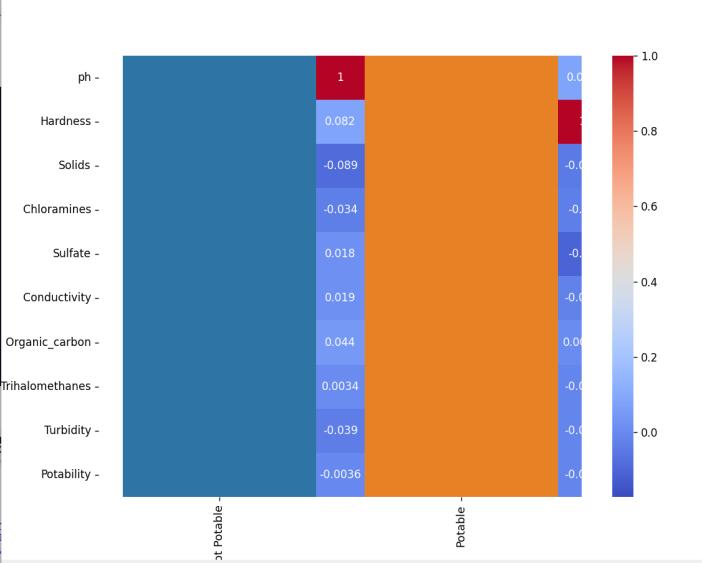
Data pre-processing is a key stage in the machinelearningpipelineandiscriticaltotheprediction task'sperformance.Herearesomecommonprocessesin data pre-processing for SVM or Decision Trees water qualityprediction:
B MODEL OF PREDICTION




Data collection and pre-processing: Collect and pre-process data on water quality factors, for example pH, temperature, dissolved oxygen, and so on, as mentioned in the preceding response. Select an Algorithm:Basedontheunique needs ofthetask,select either SVM or Decision Trees, or any other acceptable machinelearningtechnique. ModelTraining:Useproper hyper parameters to train the selected algorithm on the training data. In the case of SVM, this would entail picking the kernel function, the regularization parameter,andthemargin.InthecaseofDecisionTrees, this would entail deciding on the maximum tree depth and the smallest sample split size.Validation of the Model: Validate the model using the validation data and makeanyrequiredadjustmentstothehyperparameters toachievetheoptimumperformance.
V.RESULT AND DISCUSSION
The assessment of results is a critical stage in deciding the presentation of a water quality expectation model. MeasurementsofExecution:Toexaminationsthemodel, select adequate presentation measures. Exactness, accuracy, review, F1 score, and beneficiary working trademark (ROC) bend are a few famous measures for characterization issues. Mean squared blunder (MSE), root mean squared mistake (RMSE), mean outright blunder (MAE), and R squared (R2) are standard measurementsforrelapseissues.NetworkofDisarray:A disarray framework can be utilized to show the dispersion of genuine positive, genuine negative, bogus positive, and misleading negative forecasts in grouping undertakings.
VI. OUTPUT
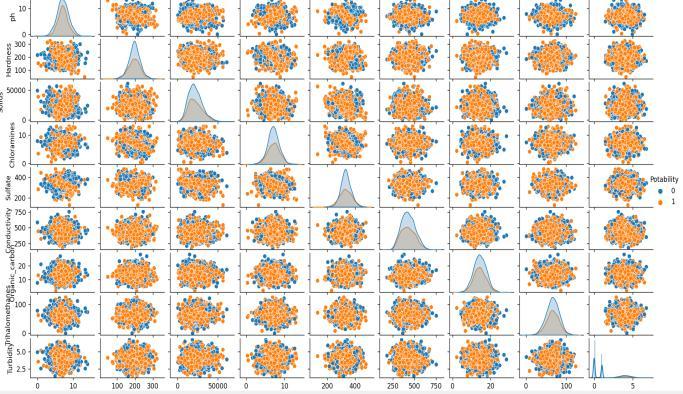
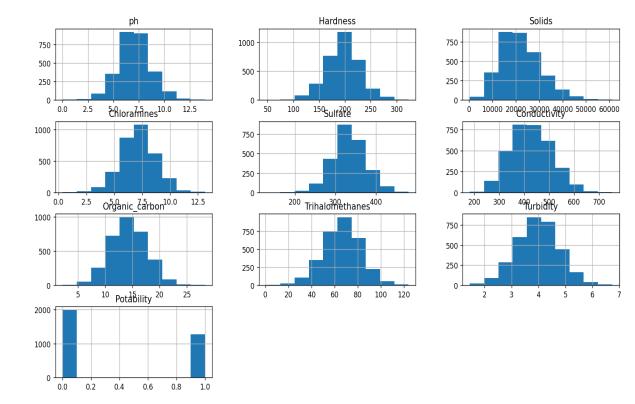
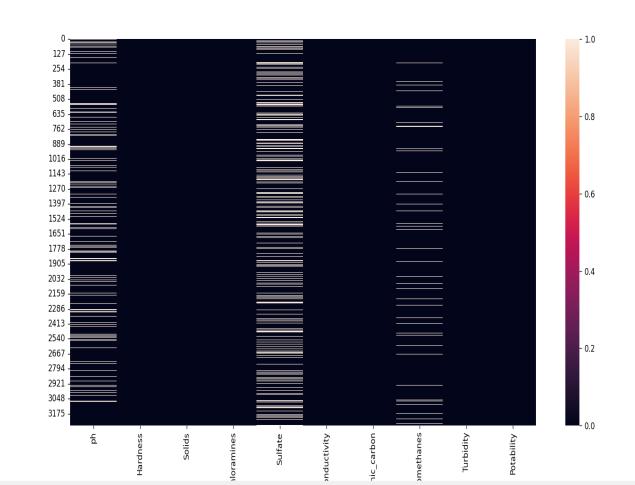
Data Cleaning is examining the data for missing orinaccuratevaluesandupdatingoreliminatingthemas needed. Data transformation entails turning data into a formatappropriateformachinelearningalgorithms.For example, utilising one-hot encoding to convert categorical data to numerical data or normalizing numerical data to have a zero mean and unit variance. DataReductionentailsshrinkingthequantityofthedata, either by deleting unnecessary characteristics or by lowering the number of samples in the data. This step can help to shorten the calculation time of machine learningalgorithms.
VII.CONCLUSION
To summarize, water quality forecast is a fundamental partofwaterassettheboard anddecisionmaking. DBSCAN has numerous prediction models that may be used to forecast water quality. The prediction modelchosenwillbedeterminedbythespecificdataand the aims of the investigation. To achieve accurate and dependablefindings,itiscriticaltocarefullypre-process thewaterqualityinformationanddecidetheboundaries of the expectation model. The prediction model's outcomes should be reviewed using result analysis, which entails analyzing performance metrics, displaying theresults,comparingwithothermodels,correctingany flaws, and repeating the process until the model can forecast water quality accurately and reliably. Decisionmakers and resource managers may make educated decisions to safeguard and manage water resources, ensuring that water is safe and available for all, by properlyforecastingwaterquality.
VIII.REFERENCES
[1]."A comparative analysis of autoregressive neural network hybrids," T. Taskaya-Temizel and M. C. Casey, NeuralNetworks,vol.18,no.5-6,pp.781-789,2005.
[2]. C. N. Babu and B. E. Reddy, "A hybrid ARIMA-ANN model based on a moving-average filter for predicting time series data," Applied Soft Computing, vol. 23, pp. 27-38,2014.
[3].M.M.S.CabralPinto,C.M.Ordens,M.T.Condessode Melo, and colleagues, "An inter-disciplinary approach to assessing human health risks from long-term exposure to polluted groundwater near a chemical complex," ExposureandHealth,vol.12,no.2,pp.199-214,2020.
International Research Journal of Engineering and Technology (IRJET) e-ISSN: 2395-0056
Volume: 10 Issue: 03 | Mar 2023 www.irjet.net
[4]. "Human susceptibility to cognitive impairment and its association with environmental exposure to potentiallyharmfulmaterials,"M.M.S.CabralPinto,A.P. Marinho-Reis, A. Almeida, et al., Environmental Geochemistry and Health, vol. 40, no. 5, pp. 1767-1784, 2018.
[5]. Y. C. Lai, C. P. Yang, C. Y. Hsieh, C. Y. Wu, and C. M. Kao,"Evaluationof non-pointsource pollution and river water quality using a multimedia two-model system," JournalofHydrology,409,no.3-4,pp.583-595,2011.
[6] Z.M.Fadlullah,F.Tang,B.Mao,J.Liu,andN.Kato,“On intelligent traffic control for large-scale heterogeneous networks:avaluematrix-baseddeeplearningapproach,” IEEE Communications Letters, vol. 22, no. 12, pp. 2479–2482,2018.
[7] R. Das Kangabam, S. D. Bhoominathan, S.Kanagaraj, and M. Govindaraju, “Development of a water quality index(WQI)fortheLoktakLakeinIndia,”Applied Water Science,vol.7,no.6,pp.2907–2918,2017.
[8]. A. A. Al-Othman, “Evaluation of the suitability of surface water from Riyadh Mainstream Saudi Arabia for a variety of uses,” Arabian Journal of Chemistry, vol. 12, no.8,pp.2104–2110,2019.
[9] T. H. H. Aldhyani, M. Alrasheedi, A. A. Alqarni, M. Y. Alzahrani,andA.M.Bamhdi,“Intelligenthybridmodelto enhance time series models for predicting network traffic,”IEEEAccess,vol.8,pp.130431–130451,2020.
[10].M.M.S.CabralPinto,A.P.Marinho-Reis,A.Almeida et al., “Humanpredisposition to cognitive impairment and its relation with environmental exposure to potentiallytoxicelements,”EnvironmentalGeochemistry andHealth,vol.40,no.5,pp.1767–1784,2018.
[11]. J. Huang, N. Liu, M. Wang, and K. Yan, “Application WASP model on validation of reservoir-drinking water source protection areas delineation,” in 2010 3rdInternational Conference on Biomedical Engineering and Informatics, pp. 3031–3035, Yantai, China, October 2010.
[12].P. Zeilhofer, “GIS applications for mapping and spatialmodelingofurban-usewaterquality:acasestudy in District of Cuiabá, Mato Grosso, Brazil,” Cad. Saúde…, vol.23,no.4,pp.875–884,2007.
[13] UN water, “Clean water for a healthy world,” Development,pp.1–16,2010.
[14] T.Taskaya-TemizelandM.C.Casey,“Acomparative studyofautoregressive neural network hybrids,”Neural Networks,vol.18,no.5–6,pp.781–789,2005.
p-ISSN: 2395-0072
[15] Y. Park, K. H. Cho, J. Park, S. M. Cha, and J. H. Kim, “Development of early-warning protocol for predicting chlorophyll-a concentration using machine learning models in freshwater and estuarine reservoirs, Korea.,” Sci.TotalEnviron.,vol.502,pp.31–41,Jan.2015.