DETECTION OF KIDNEY STONE USING DEEP LEARNING TECHNIQUES
Preethi Nisha N [1], Mrs. Sasikala G.M.E. (Ph.D) [2]Student [1], Dept of Computer science and engineering, Vivekananda college of Engineering for Women, Namakkal, Tamil Nadu, India
Professor [2] , Dept of Computer science and engineering, Vivekananda college of Engineering for Women, Namakkal, Tamil Nadu, India.
Abstract - One of the most serious and potentially fatal diseases that still exists today is kidney stone disease. A kidney stone, which is also called a renal calculus, is a solid piece of material that forms in the kidneys from the minerals in the urine. A small stone may pass without causing symptoms, and kidney stones typically leave the body in the urine. The early stages of the stone diseases go unnoticed, causing damage to the kidney as they progress. Using CT images, a comprehensive examination of image processing techniques forkidney stonedetection was conducted. Patients' information was gathered from the hospital using a CT scannertodiagnosekidney stones. Image preprocessing with a median filter, segmentation with deep learning algorithms, and kidney stone detection were examinedin stages. Kidney stones arenow a major issue, and if they are not caught early, they can lead to complications and sometimes necessitatesurgery to remove the stones. Therefore, the precise stone detection paves the way for image processing because image processing tends to produce precise results and is an automatic stone detection method. Due to their low contrast and speckle noise, ultrasound imaging makes it extremely difficult to identify kidney stones. Utilizing appropriate image processingstrategies is thesolution to this problem. Using the image restoration procedure, the ultrasound image is first pre-processed to eliminate speckle noise. One of the filtering methods is used to smooth out the restored image. Image segmentation is used to locate the stone region in thepreprocessedimage. The segmented image is then processed using CNN classification and wavelet transformation.
Key Words: image restoration, Image segmentation and medianfilter
I.INTRODUCTION
Kidneystonesarethesubjectofoneofthemostsignificant studies ever conducted. Calcium is the mineral that most frequently results in kidney stones. Kidney stones are thoughttoaffectmanypeople.Themajorityofkidneystone sufferersareunawareoftheircondition.Exceptforextreme abdominalpainandchangesinthecoloroftheirurine,the patientsareunawareoftheproblemduetointernaldamage. It is essential to monitor the issue and carry out tests to
prevent further harm to the body in order to receive the appropriatemedicaltreatment.Kidneystonediseaseisstill oneofthemostseriousandpotentiallyfataldiseases.Asolid pieceofmaterialthatformsinthekidneysfromtheminerals in the urine is known as a kidney stone or renal calculus. Small stones can pass through the body without causing symptoms,andkidneystonestypicallyleavethebodyinthe form of urine. The kidney is damaged as the disease progresses,andtheearlystagesofthediseasegounnoticed. Themajorityofpeopleexperiencekidneyfailureasaresult of a number of conditions, including hypertension, glomerulonephritis,anddiabetesmellitus.Becauseitcanbe dangerous,earlydiagnosisofkidneydysfunctionisadvised. Ultrasound (US) is one of the non-invasive, low-cost, and widely used imaging methods currently available for examiningkidneydiseases.Digitalimageprocessinginvolves usingadigitalcomputertoprocessdigitalimages.Wecould also say that it is the use of computer algorithms to get a betterimageortogetsomeusefulinformationoutofit.The manipulation of digital images by means of a digital computer is the subject of digital image processing. It's a subfield of signals and systems that focuses on images in particular.Thedevelopmentofacomputersystemthatcan processimagesistheprimaryfocusofDIP.Adigitalimageis the system's input, which it processes using effective algorithmstoproduceanimageasanoutput.
II. PROBLEM STATEMENT
Utilizing appropriate image processing methods is the solution to this problem. To get rid of speckle noise, the ultrasound image is first pre-processed using image restoration.Oneofthefilteringmethodsisusedtosmooth outtherestoredimage.Imagesegmentationisusedtolocate thestoneareaintheimagethathasbeenpre-processed.The image is processed using CNN classification and wavelet transformation following segmentation. The primary objective of deduplication is to provide security on social mediawebsitesbypreventing multiplecopiesofthesame datasothatanyissuescanberesolvedbyremovingthecopy ofthedata.Thekidneybreakingdowncanadailyexistence scare. Consequently, early discovery of kidney stone is fundamentalandthisshouldbepossiblebypicturehandling methods. One of the strategies to recognize stones is by takingultrasoundpicturesasaninformation.TheIDofstone

in kidney utilizing ultrasound pictures contain dot clamor also, are of low difference. Thus, we utilize a channel to smoothenthepictureandCNNcalculationisappliedforthe exactconsequencesofkidneystonerecognizableproof
III. EXISTING SYSTEM
The fact that level set techniques require a great deal of thoughttoconstructtheappropriatevelocitiesforadvancing the level set function is one of the disadvantages we encounteredasaresultofouruseoflevelsetsegmentation. Therefore,theremustbealotofdataavailabletoobtainthe accuracyrate,whichmaynotalwaysbethecase.Thecurrent kidney stone detection system includes level set segmentation and a smoothing Gabor filter. The fact that level set techniques require a lot of thought to construct appropriate velocities is one of the disadvantages we encounteredasaresultofusinglevelsetsegmentation.After that,CNNclassificationandwavelettransformationareused toprocessthedata.Priortoreappropriation,theinformation hasbeenscrambledusingthemergedencryptionmethod. This framework officially addresses the problem of authorized information de-duplication to increase the likelihoodofdatasecurity.Inaddition,copycheckdocument name characteristic the information itself takes into consideration distinct filenames based on the distinct benefitsofclients.Italsoshowssomenewdevelopmentsin de-duplication that support approved copy. Cloud-based information management features a dynamic and unpredictable leveled administration chain. In typical circumstances,thisisnotthecase.Webadministrationsare usedforsolicitationandresponsesintraditionalwebdesign
3.1 Disadvantages
Theinitialcostcanbequitehigh,dependingonthe systemused.
Ifthesystemisdamaged,theimagewillvanish.If thesamedocumentnameisusedagain,itmightnot work
4.1 Advantages of Proposed System
Eliminatenoises.
Accuratecontrastanddensityintheimage.
Facilitatescomputerstorageandretrieval.
The image can be made available in any desired format, including negative and black-and-white versions.
V. RELATED WORK
5.1 Pre-processing of Images
The Deep Learning Algorithm is utilized to improve the accuracyandsensitivityofthedetectionrate,andanimage isusedtoefficientlyidentifykidneystoneissues.Alloverthe world,theproblemofkidneystonesisbecomingmoreand more common. The kidneys resemble beans in shape. On bothsidesofthespine,theyarebelowtheribsandbehind thebelly.Similarinsizetothelargestfististhekidney.We usedthecleveredgedetectionmethodbecauseitrevealsthe presenceofaGaussianfilter,whichremovesnoisefroman image.Thiscanbeimprovedintermsofthenoiseratioby usinga non-maximasuppressiontechniquethatresultsin outputridgesthatareonepixelwide.
Pre-processingisrequiredbecausetheultrasoundhaslow contrast and speckle noise. Image restoration, smoothing andsharpening,andincreasingcontrastareallpartofpreprocessing. Operations with images at the lowest level of abstraction, where both the input and the output are intensity images, are referred to as pre-processing. An intensityimageistypicallyrepresentedbyamatrixofimage functionvalues(brightness),andtheseiconicimagesareof thesamekindastheoriginaldatathatwascapturedbythe sensor.Pre-processingaimstoimprovetheimagedata by suppressing unintentional distortions or enhancing some importantimagefeaturesforsubsequentprocessing,despite imagegeometrictransformations Pre-handlingisrequired onthegroundsthattheultrasoundhaslowdifferenceand spotclamor.Picturereclamation,smoothingandhoning,and expanding contrast are all essential for pre-handling. Activities with pictures at the least degree of reflection, whereboththeinfoandtheresultarepowerpictures,are alluded to as pre-handling. A force picture is ordinarily addressedbyalatticeofpicturecapabilityvalues(splendor), andthesenotoriouspicturesareoftheverykindasthefirst information that was caught by the sensor. Albeit mathematical changes of pictures, like revolution, scaling, and interpretation, are delegated pre-handling strategies here because of the utilization of comparative techniques, the objective of pre-handling is an improvement of the pictureinformationthatsmothersreluctantmutilationsor upgradessomepicturehighlightssignificantforadditional handling. This utilizations Gaussian separating, which is a techniqueforimprovingorchangingapicture.Youcan,for example,channelapicturetoeitherstressafewhighlights oreliminateothers.Smoothing,honing,andimprovingedges are only a couple of the picture handling tasks that can performedwithchannel.Theworthofsomerandompixelin the result notsetinstone byapplyinga calculationto the upsides of the pixels nearby the comparing input pixel Separatingisalocalactivity.
5.2 IMAGE SEGMENTATION
Segmentation is an important part of medical imaging. It makesiteasiertodiagnosediseasesandseemedicaldata. Thekidneystoneandonelevelsetsegmentationtechnique known as "canny edge detection" are used to identify and sharpen the kidney's edge. Image segmentation is the process of dividinga digital image intomultiplesegments (sets of pixels, also known as image objects). In medical imaging, segmentation is an essential component. It facilitatesdiseasediagnosticsandvisualizationofmedical data. One level set segmentation technique called "canny edgedetection"isusedtoidentifyandsharpenthekidney's edgeaswellasthekidneystone.Theprocessofdividinga digital image into multiple segments (sets of pixels, also known as image objects) is called image segmentation. Segmentation aims to simplify or transform an image's representationintosomethingmoremeaningfulandsimpler toanalyse.Typically,imagesegmentationisusedtolocate boundaries(lines,curves,etc.)andobjects.inpictures.Tobe morespecific,imagesegmentationistheprocessofgiving eachpixelinanimagealabelsothatpixelswiththesame labelhavethesamecharacteristics.Acollectionofsegments that collectively cover the entire image, or a collection of contoursextractedfromtheimage,istheoutcomeofimage segmentation (see edge detection). In terms of a characteristic or computed property, such as colour, intensity,ortexture,eachofthepixelsinaregionisidentical.
5.3 Wavelet Processing
Whenthefrequencyofasignalchangesovertime,wavelet transforms are a mathematical method for analyzing it. Waveletanalysisoutperformsothersignalanalysismethods inprovidingmorepreciseinformationaboutsignaldatafor particular classes of images and signals. Due to their high contrastofneighboringpixelintensityvalues,waveletsare frequently utilized in image processing for the purpose of detecting and filtering white Gaussian noise. The twodimensional image undergoes a wavelet transformation thanks to these wavelets. Inorder to obtain a compressed image, this project applies the wavelet transform to the segmentedinputimage.Theimagecanbe"cleanedup"inthis waywithoutmuddleorblurringthedetails.
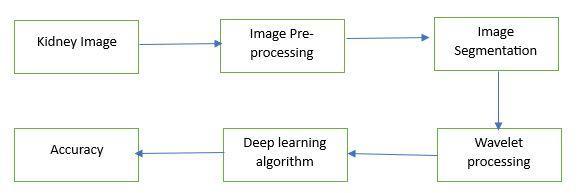
VI. SYSTEM ARCHITECTURE
VII CONVOLUTIONAL NEURAL NETWORK
Convolutional neural network is produced by performing convolutiononartificialneuralnetworks(ANNs).ACNNis madeupofneuronalweightsandbiasesthatcanbelearned. Thearchitectureofconvolutionalneuralnetworksismade upofthreemainlayers:theconvolutionallayer,thepooling layer, and the fully connected layer. Because it has one or moreconvolutionallayers,aconvolutionalneuralnetwork (CNN) gets its name from them. Convolutional layers are used to identify certain local features in the input images. Everysinglenodeinaconvolutionallayerisconnectedtoa subset of spatially connected neurons. This aids in the detection of local forms (structures) in the input image's channels.Inordertolookforasimilarlocaltraitintheinput channels,theconvolutionallayer'snodessharetheweights on the connections. A kernel (convolution kernel) is the namegiventoeachsharedweightset.Convolutionallayer kernels learn the local features to be detected across the inputimages,whosestrengthcanbeseeninthefeaturemap. InCNN,thepooling layeris thelayerthatcomes afterthe convolutionlayerandwhoseprimarygoalistoreducethe size of the representation. Deep learning neural networks fallundertheconvolutionalneuralnetwork(CNN)category. CNNsareasignificantadvanceinimagerecognition.They are frequently employed in the background of image classificationandaremostfrequentlyusedtoanalyzevisual imagery. They are at the heart of everything, from selfdrivingcarstoFacebook'sphototaggingsystem.Theyare putting in a lot of effort behind the scenes to improve securityandhealthcare.Theprocessofassigningaclassto aninput(suchasapicture)oraprobabilitythattheinput belongs to a particular class (such as "there's a 90% probabilitythatthisinputisapicture")isknownasimage classification. CNNs can be thought of as automatic image featureextractors.Iteffectivelydown-samplestheimageby makinguseofinformationfromadjacentpixels.Convolution units can be found in one or more layers on a CNN. A proximityiscreatedwhenmultipleunitsfromthepreceding layer provide input to a convolution unit. As a result, the weights of the input units, which make up a small neighborhood,areshared.
VIII CONCLUSION
The survey of various algorithms and classifications is examinedinthisproject,followedbythedetectionofkidney stones.Asaresultofthisimplementation,thelimitationsof the current system are deduced, and a new design is suggested to overcome them. For instance, level set techniquesnecessitatealotofthoughtinordertoconstruct velocities in order to produce an ideal advanced level set function.Thisimpliesthatalotofdatashouldbeavailableto determinetheaccuracyrate,whichmaynotalwaysbethe case.
REFERENCES
[
1] Viswanath, R.Gunasundari, “Design and Analysis Performance of Kidney Stone Detection from Ultrasound Image by Level Set Segmentation and ANN Classification.”,2014.
[2]Koushalkumar,Abhishek“ArtificialNeuralNetworksfor DiagnosisofKidneyStonesDisease”,2012.
[3]K.DivyaKrishna,V.Akkala,R.Bharath,P.Rajalakshmi, A.M.Mohammed,S.N.Merchant,U.B.Desai“ComputerAided Abnormality Detection for Kidney on FPGA Based IoT EnabledPortableUltrasoundImagingSystem”,2016.
[4] Nur Farhana Rosli,Musab Sahrim1,Wan Zakian Wan Ismail1,Irneza Ismail,JulizaJamaludin,Sharma Rao Balakrishnan,”AutomatedFeatureDescriptionofRenalSize UsingImageprocessing”,2018.
[5]Bomanaraja“AnalysisofUltrasoundkidneyImageusing content description multiple features for disorder identification”,2007.