PORTAL APPLICATION USING SAP
Sakthiya Ram S1 , Brindha S2 , Dasaprakash C3
1 Assistant Professor level II, Department of Electrical and Instrumentation Engineering, Bannari Amman Institute of and Technology, Erode, Tamil Nadu, India

2 Student, Department of Mechanical Engineering, Bannari Amman Institute of technology, Erode, Tamil Nadu, India
3 Student, Department of Electrical and Instrumentation Engineering, Bannari Amman Institute of technology, Erode, Tamil Nadu, India ***
Abstract - In this modern world, industries like MNCs are managing complex business processes& it is difficultforthose big companies to manage different sectors of one in a centralized mannerlike, various aspects of HR management including recruitment, employee performance, payroll and learning activities. This is where the need of SAP (System, Applications & Products) arises which helps by providing control over different business processes. SAPERPisenterprise resourceplanning software developed by the company SAP SE. ERP, or enterprise resource planning, software is modular software made to integrate the main functions of an organization's core business processes into a unified system. It is designed in a way to facilitate flawless development and management of business processes and solutionsthat allow data processing & information flow across an organization to be seamlessly integrated. SAP ERP provides multiple business solutions and functions, with a single view of truth, by centralizing data management of the differentsectors. SAP provides solutions over a wide range of areas such as ERP, CRM, HR Management, Finance management. In this project we aredevelopingportalsthat manage&processfromdifferent sectors of the company.
Key Words: ERP – SAP – Centralizing
1.INTRODUCTION
TheEnterpriseResourcePlanning(ERP)systemisapieceof softwaredesignedtomanageallfunctionalareasacrossall departments' informationsystems in a single, integrated system. Finance and cost accounting, production and planning, sales and marketing, materials management, human resource management, distribution, and transportationareafewexamplesofbusiness-relatedareas. It is regarded as the foundation of an organization's informationsystemsandsupportseveryaspectofbusiness processes by facilitating information flow between all businessdepartmentsatallorganizationallevels.According to Abd Elmonem "Sharing data and information between companydepartmentshelpinmanyaspectsandstrivesto achieve diverse objectives". ERP systems provide a competitive edge, especially in terms of the valueof the information. The ERP system was one of the major information technologies (IT) innovations during the
1990s.Thedevelopmentofinventorymanagementsystemsin the1960s,MRPsystemsinthe1970s,andMRPIIsystemsin the 1980s served as the foundation for the idea of ERP systems.Nonetheless,theworldofERPsystemshasseena lot of changes. According to the Panorama consulting solutionsstudyfrom2017,67%ofbusinessescontinueto choosetraditional ERP, an increase of 11% over 2016. In contrast, just 27% and 6% of businesses, respectively, choose newer ERP innovations from vendors like SaaS or CloudERP.
2.LITERATURE REVIEW
The research paper by Justin Goldston on theEvolutionof ERP Systems. Complex architecturesknown as enterprise applications let executives oforganizations make tactical andstrategicbusinesschoices. Numerousstudiesin the literaturereview examined the development of enterprise resource planning (ERP) systems, the prospects for businessapplications,thesuccessofimplementations, ERP implementationsinsmallandmedium-sizedbusinesses,and managerialstrategiesfortimesoforganizational change. In theresearchpaperonImplementationandManagementof ERP Systems by Mohamed-Iliasse Mahraz, we understood thatinreality,anERPsystemisregardedasthefoundation of themajority of enterprises across all industries. If the system is configured properly, it will typically cover all businessfunctionsacrossallmanagementlevels,supportthe majorityorallfunctional areasintheday-to-dayoperations of the firm, and be viewed as a source of competitive advantagebycertainorganizations.Nonetheless,there has alwaysbeenasubstantiallikelihoodoffailure..Duetotheir disregardforsomemanagementandimplementation-related factors,manybusinessestodayareunabletofullyprofitfrom ERPsystems.TheresearchpaperLiteraturereviewonERP implementation challenges by Shree Ranjan, Vijay Kumar Jha, Pralay Pal describes ERP deploymentisadifficultand expensivetaskthatdemandsnotjustdiligenteffortsbutalso a thoroughexaminationofthevariablesthatareessentialto itsadoptionorimplementation.Theconclusionofourwork's literature study focuses on the problems of ERP adoption from four different angles, includingtechnology selection, change management, knowledge management, and new technologies.
3.SCOPE OF SAP
“At SAP, we see a dream for a simpler world, for a simpler SAP and a simpler customer experience” - Bill
McDermottMNCs in India, like TCS, IBM India, HCL Technologies, Deloitte, HP, WIPRO, etc., use SAPERP to manage their business process. By centralizing data management. SAP provides multiple business functions & solutions with a singleviewofthetruth.SAPprovidessolutionsoverwide rangeofareassuchasERP,CRM,HRManagement,Finance management. Customers and vendors have completely different opinions about SAP, despite the fact that it is a veryeffectiveERPsystemforinnovation,providingusers withinnovativeideasandbringingthemclosertothereality ofareal-timeERP.TheinnovativefeaturesthatSAPmakes possible as the next-generation digital business platform, such as instantaneous information to support decisionmaking, increased order and mechanization, effective alliance and next-gen user experience, improvements in businessprocesses,andITcostreductionsinthelandscape, areexhilaratingfordevelopersandsystemintegrators.
4.SAP MODULES
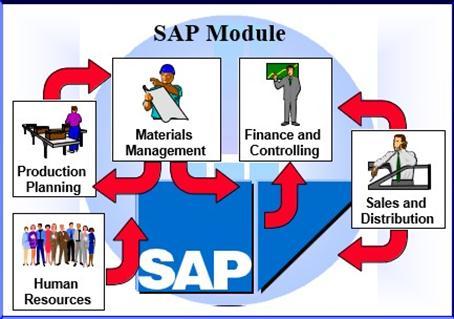
All systems are integrated into one system through SAP modules.Itmakesitpossiblefordataorinformationtoflow between an organization's many departments. Generally speaking,eachdepartmentrepresentsasingleSAPModule. The integration of each Module allows for the sharing of commondata.ThenumerousmodulesofferedbySystems Analysis and Program Development (SAP) are tailored precisely to the requirements of its customers. Several operations, including as sales and services, sales and distribution, financial management, business intelligence, human resources, and more, are the focus of various SAP modules.
4.1.SAP FUNCTIONAL MODULES
Businessfunctionsincludingprocessingorders,turningraw dataintointelligence,andmanaginghumanresourcesareall providedbySAPfunctionalmodules.
4.1.1. Sales and Distribution (SAP SD): The business operationsforselling,shipping,andinvoicingaproductare allincludedintheSAPSDmodule.
4.1.2.MaterialsManagement(SAPMM):Becauseit offers capabilities for material, inventory, and warehouse management, materials management (MM) is crucial to a manufacturer's supplychain.
4.1.3. Financial Accounting (SAP FI): The crucialSAP ERP moduleknownasSAPFIisusedto storeandanalyzethe financialdataofafirm.
4.1.4.Controlling(SAPCO):Businessdecision-makerscan better understand and optimize how their company's moneyisspentwiththehelpofinformationfromSAPCO.
4.1.5.ProductionPlanning(SAPPP):Productionplanning, whichisasubsetofSAPProductionPlanning,addressesthe PlantoProduceprocess.
4.1.6.PlantMaintenance(SAPPM):TheSAPPMmoduleisa piece of software that handles inspection, preventative maintenance, and technical system repairs to streamline totalmaintenancemanagement.
4.1.7.Quality Management(SAP QM): TheQMmodule works with sales, procurement,planning, manufacturing, inspection,notification, audit management, control, and otherareastohelpfirmsmanagequalityoutput.
4.1.8. Human Resource Management (SAP HCM): The Human Resources module offers help with managing salariesandpayrollinaddition toworkschedulemodels.
4.2.SAP TECHNICAL MODULES
TheprimarygoalofSAPtechnicalmodulesistomaintain theefficiencyoftheSAPlandscape.
4.2.1.SAPBasis:SAPBasis,alsoreferredtoasSAPsystem administration,providesthetechnicalframeworkneeded forSAPapplicationstooperatewithoutinterruption.
4.2.2. SAP Security: Within SAP systems, a technological ElementknownasSAPsecuritycontrolsaccessbyallowing accesswhereitisnecessaryandprohibitingaccesswhereit is not. establishing efficient internal security and access controls.
ThetwomaincategoriesofSAPmodulesarefunctionaland technical.
4.2.3.SAPSolutionManager:WithSAPSolutionManager, clients may consolidate, expand, automate, and improve the management of their whole system environment, whichdecreasestotalownershipcosts.
4.2.4.SAPNetWeaver:SAPNetWeaverconnectsbusiness userstoSAPsoftwareinreal-timeregardlessoftheiraccess point (social media platforms, mobile devices or web applications). Many processes, including business intelligence, exchange infrastructure, and enterprise portals,mayallbetrackedinoneplacewithNetWeaver.
4.2.5. Middleware I Exchange Infrastructure (SAP XI): Implementing cross-system procedures from various manufacturersandversions ismadepossiblebyexchange architecture.Non-SAPapplicationsinsideandoutsidethe firm may be smoothly connected using this strong middlewarefromSAP.
4.2.6. Advanced Business Application Programming(SAP ABAP): With the help of this module,SAP customers can enhancetheapplication'sbuilt-infeaturesoraddnewones toencouragethecreationofspecializedsolutions.

5.METHODOLOGY PROPOSED
SAP uses different portals to manage & control different business processes in an MNC. Each portal has separate functionalitythatisspecifictoonebusinessprocessofafirm, which maintains data management. The portals are to be developedare
1. CustomerPortal=Sales&Distribution+Finance

2. VendorPortal=MaterialManagement+Finance
3. EmployeePortal=HumanResource+Finance
4. MaintenancePortal=PlantMaintenance
5. ShopFloorPortal=ProductionPlanning
6. EHSM-SafetyTicket=EnvironmentHealth& SafetyManagement
7. QualityCheck=QualityManagement
6.SOFTWARES
Fronted:
portal contains a login page and dashboard page that containsinquirydata,saleorderdata,listofdelivery,invoice detail, payment and credit/debit memo. Development TechnologyStacktobeused Angular, SAP RFC Webservice, SAP Database.
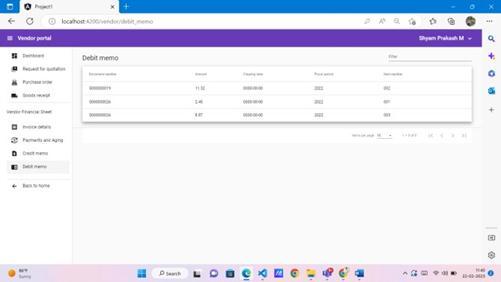
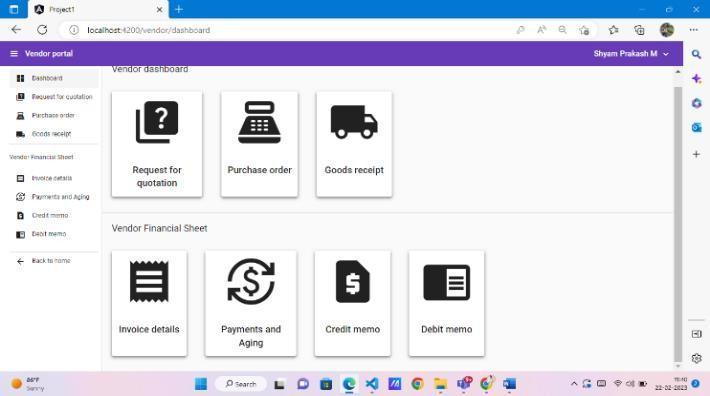
7.2. VENDOR PORTAL: The data of all the vendors doing businesswiththeorganizationwouldbemaintainedonthis platform.Toaccessandviewtheentiretransactionbetween thecompany andthevendor, a vendorportal is required. Thisportalcontainsaloginanddashboardpage(Fig.3)that contains invoice, profile, credit/debit memo (Fig.6), purchaseorder.DevelopmentTechnologyStacktobeused: Angular, SAP PI/PO, SAP Database.
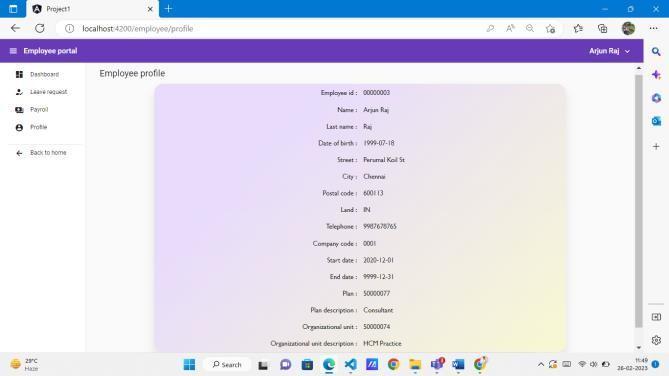
7.3.EMPLOYEEPORTAL:Thissiteisintendedtobeusedfor givinginformationabout thecompany andits employees, printing out pay stubs, checking leave balances, and submittingleaverequests.Employeeportalsarerequiredin order to provide rapid and simple access to HR- related services and transactions. This contains a login and dashboardwithpayslip, profile(Fig.4)andleaverequest. Development Technology Stack tobeused: Angular, SAP PI/PO, SAP Database.
7.4. MAINTENANCE PORTAL: A maintenanceportal that containsthefollowingfeaturesneedstobecreatedinorder to enable simple, everywhere access using our mobile phones. The organization's maintenance department or maintenanceengineerwillaccessthemaintenanceportal.A maintenanceportalisnecessarytoaccessandviewallofthe organization's maintenance-related activities. This portal contains a login and dashboard with notification and
workorder. Development Technology Stack to be used: Flutter, PIPO, SAP Database.
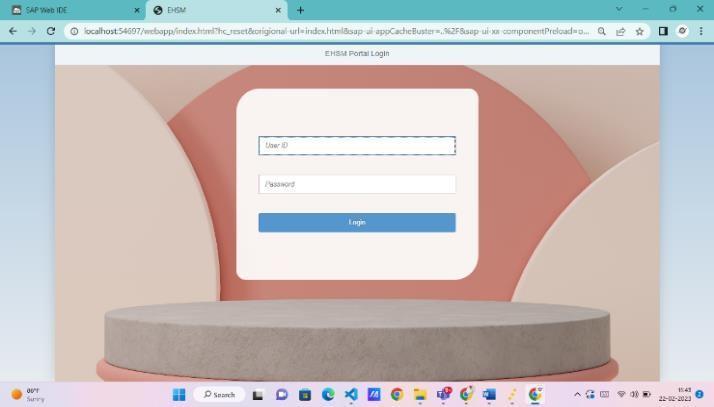
7.5 SHOP FLOOR PORTAL: This portal will be created to keep track of all production ordersandplannedorders processed on an enterprise's shop floor. This shop floor portal's major goal isto give the production shop floor engineer and the staff information about the entire transactionofsuppliesanditems.Thiscontainsaloginpage (Fig.2)andadashboardwithplannedorderandproduction order.DevelopmentTechnologyStacktobeused: SAP Ui5, OData, SAP Database.
Middleware:
Backend:
7.PORTALS USING SAP
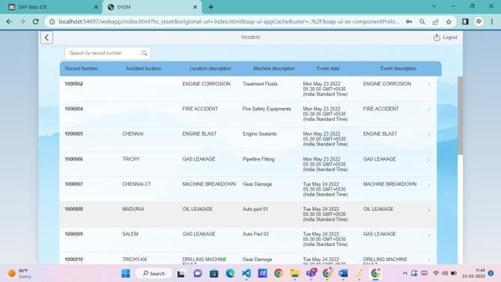
7.6. EHSM PORTAL: The SAP S4 HANA system must be integratedviaSAPODATAfortheSafetyEngineerPortalto have the following functions. The organization's safety engineer will have access to the EHSM portal. Using the EHSM portal is necessary in order to view incidents occurringintheplantandimplementthenecessarysafety actions. This a login page and a dashboard with incident (Fig.5)andriskdetails.DevelopmentTechnologyStacktobe used: SAP Ui5, OData, SAP Database.
7.1.CUSTOMERPORTAL:Thepurposeofthissite
istokeep trackofalloftheclient’sdoingbusinesswiththecompany. To access and view the entire transaction between the companyandtheclient,acustomerportalisrequired.This
7.7.QUALITYPORTAL:Understandingtheworkflowofthe QualityManagementModuleisthegoaloftheQualityPortal. Itmustbecreatedandbuiltinorderforthequalityengineer
of anorganization to keep the data of the inspection lots, record the results, and decide how to use the lot. The organization's Quality Engineerwill have access to the quality check portal. This contains a login page and a dashboard with inspection lot, usage decision and result record.DevelopmentTechnologyStacktobeused:SAP Ui5, OData, SAP Database.
8.SAMPLE OUTPUTS
9.CONCLUSIONS
FromtheseportalswecanconcludethatSAPERPefficiently helpsinovercomingthedifficultiesofmaintainingmultiple complexbusinessprocesses.PortalscreatedusingSAP,each have specific functionalities of its own are interconnected through the modules of SAP which highly helps in managing&controllingdifferentfunctionsofasinglebusiness process.Sothiscanbeconcludedwiththeadvantages that SAP provides to businesses & that are Total visibility, Improved report & planning, Complete customization, ImprovedefficiencyandDatasecurity&Quality.
REFERENCES
[1] Abdelmoniem,EsmatM."Thecriticalsuccessfactorsand the effect of ERP system implementation on business performance (Case study in Egyptian environment)” International Journal of Computer Science and Information Security 14(2016).
[2] Dantes, Gede Rasben, and Zainal Arifin Hasibuan. "The impact of enterprise resource planning (ERP) system implementation on organization: case study ERP implementationinIndonesia." IBIMA Business Review 2011 (2011):1-10.
[3] Chofreh, Abdoulmohammad Gholamzadeh, et al. "A masterplanfortheimplementationofsustainableenterprise resource planning systems (part I): concept and methodology." JournalofCleanerProduction 136(2016):176182.
[4] Elbardan, Hany, et al. "ERP, internal auditing and corporate governance." Enterprise resource planning, corporate governance and internal auditing: an institutional perspective (2017):13-54.
[5]Madapusi,Arun,andDerrickD'Souza."Theinfluenceof ERPsystemimplementationontheoperationalperformance of an organization." International journal of information management 32.1(2012):24-34.
[6]Reddi,KrishnaR.,andYoungB.Moon."Aframeworkfor engineering change management in enterprise resource planningusingservice-orientedarchitecture." International Journal of Business Information Systems 8.1(2011):46-65.
[7]Moon,YoungB."EnterpriseResourcePlanning(ERP):a reviewoftheliterature." Internationaljournalofmanagement and enterprise development 4.3(2007):235-264.