Identification of Bird Species using Automation Tool
2,3,4,5 Students, Department of Computer Science & Engineering, T John Institute of Technology, Bengaluru, India
1Asst. Professor, Department of Computer Science & Engineering, T John Institute of Technology, Bengaluru, India

ABSTRACT - Now a days bird population is changing drastically because lots of reasons such as human intervention, climate change, global warming, forest fires or deforestation, etc., With the help of automatic bird species detection using machine learning algorithms, it is now possible to keep a watch on the population of birds as well as theirbehavior.Becausemanualidentificationofdifferentbird species takes a lot of time and effort, an automatic bird identification system that does not require physical intervention is developed in this work. To achieve this objective, Convolutional Neural Network is used as compared to traditionally used classifiers such as SVM, Random Forest, SMACPY. The foremost goal is to identify the bird species using the dataset including vocals of the different birds. The input dataset will be pre-processed, which will comprise framing, silence removal, reconstruction, and then a spectrogram will be constructed, which will be sent to a convolutional neural network as an input, followed by CNN modification, testing, and classification. The result is compared with pre-trained data and output is generated and birds are classified according to their features (size, colour, species,etc.)
Key Words: Deep Learning, Automatic Identification, Artificialneural network, Pre-process, Spectrogram, Classification
1. INTRODUCTION
The ecosystem of birds is incredibly diverse in terms of behaviour,size,andshape, butthisbiologicaldiversity may beindangerduetohumaninterferenceintheirhabitatsand complete habitat destruction, which are also accompanied by environmental catastrophes like global warming, forest fires, and other natural disasters. Due to their limited and shrinking ranges, 1,481 bird species, or 13.5% of all data sufficientspecies,areworldwidethreatenedwithextinction asof2020.
One of the most essential justifications for bird monitoring is controlling and evaluating the environment. Certain bird species are impacted by water and air pollution. Hence, spotting and avoiding environmental issues can be done through bird species identification. Since they react quickly to environmental changes, birds can also help us find different types of life in the environment. It is, however, prohibitive because it takes a lot of human labour and is
more expensive to gather and compile information about birdspecies.Inthiscase,areliablesystemwillofferalotof information about birds and act as an essential tool for scientistsandgovernmentofficials.
We propose a deep learning method to identify the species of bird based onaudio recordings to address this issue and support ecologists. To achieve this, we want to employ the mostrecent Artificial Neural Networksmodel (ANN model) forautomatic birdspeciesidentificationusingaudioinputs. We wanted to improve the current bird species classifier's classification accuracy in this work. The accuracy for training was 100%, and the accuracy for validation was 97%,accordingtothisdata.Asaconsequence,wecanassert that ANN can successfully identify the bird species and easilydefeattheexistingimplementationmodel.
Themethodincludesthefollowingsteps:
1)recordingbirdsingingoutdoors;
2)using audio pre-processing techniques to enhance signal quality since these recordings are frequently made in loudlocations.
3)extractingelementsfromtheaudioinputandtraining
4)Model:ANN
5)Predictthetypeusingproposedalgorithm
1.1 PROBLEM STATEMENT
The vocal expression of birds is used to communicate a variety of information. Birds use their vocalizations to communicate a variety of threats and warnings about approaching danger, to recognize certain birds or insects within a flock, and to demarcate and delimit territory. The call specialization suggests that they are more immediate andeffectivevocalemotions.
The problem of recognizing birds using an automated system with the usage of bird sounds can be defined as the challenge of differentiating several bird species from their recordedsongs.Expertsclaimthatbirdsongs,asopposedto the bird sounds used here, are more melodious and better able to identify different species. The entire signal is preprocessedinordertoidentifythemostpertinentportionof thesignalandextractcharacteristics.
International Research Journal of Engineering and Technology
www.irjet.net
(IRJET)
1.2 LITERATURE SURVEY
Many research papers have been written and published on the subject of automated bird species recognition over the course of the preceding few years. Several of them have been successful in classifying certain species, and each has advantagesanddrawbacksoftheirown
[1]Speedy Image Crowd Counting by Light Weight
Convolutional Neural Network AUTHORS: Vivekanandam,B.
In image/video analysis, crowds are actively researched, and their numbers are counted. In the last two decades, manycrowdcountingalgorithmshavebeendevelopedfora wide range of applications in crisis management systems, largescale events, workplace safety, and other areas. The precision of neural network research for estimating points is outstanding in computer vision domain. However, the degree of uncertainty in the estimate is rarely indicated. Point estimateis beneficial for measuring uncertainty since itcanimprovethequalityofdecisionsand predictions. The proposedframeworkintegratesLightweightCNN(LWCNN) for implementing crowd computing in any public place for delivering higher accuracy in counting. Further, the proposed framework has been trained through various sceneanalysissuchasthefullandpartialvisionofheadsin counting. Based on the various scaling sets in the proposed neural network framework, it can easily categorize the partial vision of heads count and it is being counted accuratelythanotherpre-trainedneuralnetworkmodels.
[2]Study of Variants of Extreme Learning Machine (ELM) BrandsanditsPerformanceMeasureonClassification
Algorithm
AUTHORS:
Manoharan,J.SamuelRecently, the feed-forward neural network is functioning withslowcomputationtimeandincreasedgain.Theweight vectorandbiasesintheneuralnetworkcanbetunedbased onperformingintelligentassignmentforsimplegeneralized operation.ThisdrawbackofFFNNissolvedbyusingvarious ELM algorithms based on the applications issues. ELM algorithms have redesigned the existing neural networks with network components such as hidden nodes, weights, and biases. The selection of hidden nodes is randomly determined and leverages good accuracy than conservative methods.The mainaim of this researcharticleisto explain variants of ELM advances for different applications. This procedure can be improved and optimized by using the neural network with novel feed-forward algorithm. The nodes will mainly perform due to the above factors, which aretuningforinverseoperation.TheELMessenceshouldbe incorporated to reach a faster learning speed and less computation time with minimum human intervention. This
research article consists of the real essence of ELM and a briefly explained algorithm for classification purpose. This research article provides clear information on the variants of ELM for different classification tasks. Finally, this research article has discussed the future extension of ELM for several applications based on the function approximation.
[3]AutomatedBirdSpeciesIdentificationusingAudio
AUTHORS: ChanduB,A.M
In this paper, an automatic bird species recognition system hasbeendevelopedandmethodsfortheiridentificationhas been investigated. Automatic identification of bird sounds without physical intervention has been a formidable and onerousendeavourforsignificantresearchonthetaxonomy and various other sub fields of ornithology. In this paper, a two-stageidentificationprocessisemployed.Thefirststage involved construction of an ideal dataset which incorporated all the sound recordings of different bird species. Subsequently, the sound clips were subjected to varioussoundpre-processingtechniqueslikepre-emphasis, framing, silence removal and reconstruction. Spectrograms were generated for each reconstructed sound clip. The secondstageinvolveddeployinga neuralnetwork towhich the spectrograms were provided as input. Based on the input features, the Convolutional Neural Network (CNN) classifies the sound clip and recognizes the bird species. A Real time implementation model was also designed and executedfortheabove-describedsystem.
[4]Bird Sound Identification based on Artificial Neural Network
AUTHORS: M. M. M. Sukri, U. Fadlilah, S. Saon, A. K. Mahamad,M.M.SomandA.Sidek
International Research Journal of Engineering and Technology (IRJET) e-ISSN: 2395-0056
Volume: 10 Issue: 03 | Mar 2023 www.irjet.net p-ISSN: 2395-0072
[5]Deep Learning Based Audio Classifier for Bird Species AUTHORS:
AartiMadhavi,R.P.
The effect of human activities on the environment has reachedapointwhereithasbecomenecessarytotrackthe effects before it causes irreparable damage to the environment. One of the ways to track such effects is to monitor the breeding behaviour, biodiversity and population dynamics of animals. Birds are one of the best speciestotrackastheydotendtobethemostreactiveones for any change in the environment e.g., deforestation or forestfires.
Till now, the tracking of the birds was done manually by experts, which is very tedious at the same time consuming and non-viable method. As a result, to alleviate this issue and provide assistance to the ecologists we proposing a machine learning method to recognize the bird's species based on the audio recordings. To achieve this goal, we intend to use the state of art convolutional neural network architecture called the deep residual neural networks as compared to the traditionally used classifiers like SMACPY, SVM and other relatively less sophisticated methods. We leverage methods like data augmentation and the existing carefully crafted datasets from Neural Information Processing Scaled for Bioacoustics to showcase the effectivenessofourmethod.
2. PROPOSED METHODLOGY
The discussion's main goal is to anticipate bird species based on their voice/audio. The suggested framework containsfivemajorphases,asdepictedinFigure1:
4. Modeloutputisdisplayedonthescreen.
A. Dataset
The first step of implementation is gathering data from dataset which is obtained from XENO-canto/Kaggle. The audiorecordingsofthebirdsinMP3formatareincludedin this resource. This dataset contains audio recordings of the birdsinMP3format.XENO-canto/Kaggleareopenwebsites dedicated for dataset where users upload their own recordings.Incaseofoursurvey,birdaudiorelateddataset is required. Genus, species, subspecies, locality, type, color, size, and bird sound quality are all labelled in this dataset (from A to E, Where A is the best quality). Since many features are defined in dataset, combination of them are used to define class (like genus and species, etc.) and classifybirdsaccordingtothem.
Fig–1Flowchartofmethodology
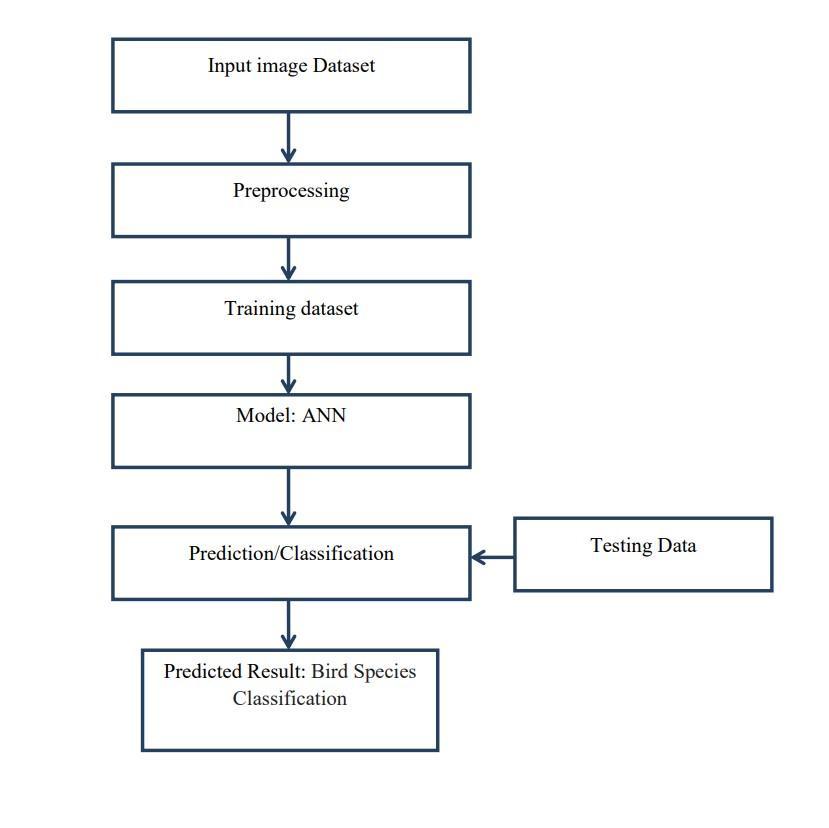
1. Dataiscollectedfromrespecteddataset.
2. Onthedataset,datapre-processingtechniquessuch asframingandnoiseremovalareused.
3. The data is processed using the Convolutional NeuralNetworkapproach.
B. Data/Sound pre-processing
Following data collecting, sound recordings are preprocessed. The WAV format is used to convert the MP3 files obtained from the dataset. These Wav files are normalized after being separated into equal-length segments. Threshold filtering is used to create chunks/segments with a high amplitude and no noise or disruption.Thewaveformwascreatedusingpowerspectral density (PSD). The PSD was a metric that measured the amountofpowerperunitoffrequency.
C. Classification with Neural Network
An Artificial Neural Network (ANN) classification algorithm is a popular method for analyzing and recognizing
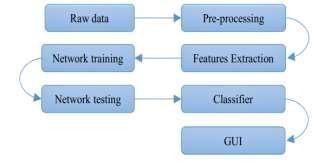
bioacousticssignals.Asaclassificationmodel,themultilayer perceptron (MLP) is used. The MLP takes a set of predetermined attributes as input and produces a unique outcomeforeachbirdspeciestobeidentified.Trainingand testingarethetwostepsinthisidentifyingprocedure.Inthe training process, syllables of specified bird sounds were utilized to train the multilayer perceptron, resulting in the right MLP output being triggered. The training process is carried out by repeatedly delivering known sounds to the network and then iteratively adjusting the network's weighting. The goal of this training is to lower the total between the supplied and expected resultstill a predefined errorrequirementisaccomplished.
D. Output
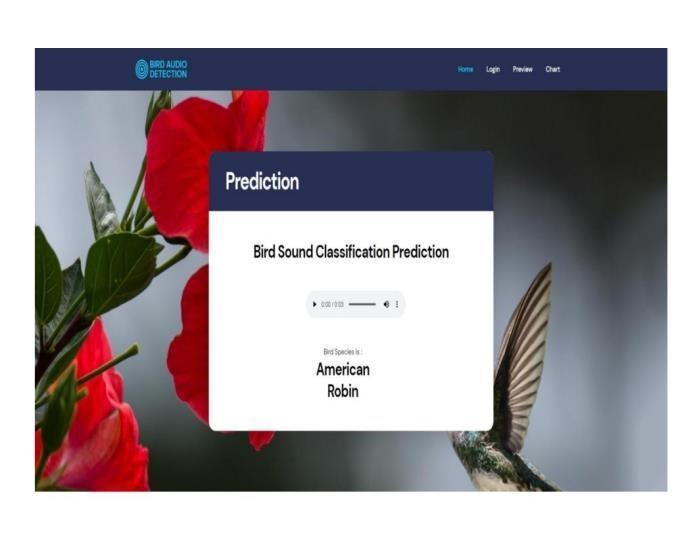
Fortheoutput,usercanuseGUIi.e.,GraphicalUser
Interfacetoanalyzethespeciesofthebird.Withthehelpof GUIusercanrecord,processandshowtheoutcome.
3. RESULT
The waveform of a bird's voice can be obtained using MATLAB software. Dataset can be individually captured in mp3format,whichmustbeconvertedtoa.wavfile,anditis evident that each bird has a distinctive voice. Through a process of training, an ANN is tuned for a specific purpose, suchaspatternclassification.
recordings have become one of the most effective techniques to do study on them. Biological sounds of birds can give detailed and standardized data on the dynamics and distribution of wildlife habitats. Audio research and surveys are a good tool to analyze the species' density, abundance, and occupancy because many bird species produce distinct and consistent sounds. Furthermore, picturized monitoring is problematic for many small and sensitive birds, enigmatic species, and species living in environments that environmentalists find difficult to reach. Bird audio tracking is also useful for other environmental operations, such as assessing the impact of wildfires and determiningtheextentofforestregeneration.
5. LIMITATION
Audiosignalsprovide much more information about a bird, asitcanbefurtherclassifiedintosongs,calls,andsoundsso noise in these various types of audios can be an issue. Having this kind of extra set of properties and classifications, also makes identification of birds little difficult.
6. FEASIBILITY STUDY
AnartificialintelligencesystemcalledtheConvolutional NeuralNetwork(CNN)hasbeenusedtoclassifybirdnoises. Other scholars have tested a range of methods for identifying bird songs. The following list offers some applicationsforautomatedsystems:-
1. Continuous ambient recordings that use automatic bird sound recognition would significantly advance ornithology and biology studies. This technology will be helpful to government organization and investigators becauseittakesalotoftimeandmoneytomanuallyidentify differentbirdspecies.
2. Since birding is a popular activity in many nations, such systems have a great deal of potential for profit. Hardware like the Raspberry Pi can be used to operate the CNN. These technological advancements can benefit animal sanctuaries,preservationparks,andenvironmentalparks.
3.Users may utilize their smartphones as tools for bird sound identification and assessment by designing and publishing an android application for a variety of mobile devices.
4. ADVANTAGES
Systematic recordings of outdoor noises are now possible thanks to automated audio recorders, which have recently opened up new opportunities for environmental conservationandrestoration.Duetothefactthatmanybird species have extraordinarily high vocal frequency, audio
4. Both a local hard disc and the cloud can be used to store the collected data. The information acquired will be very helpful in studies of the demographics, variety, and migrationpatternsofbirdsinacertainarea.
7. FUTURE SCOPE
Thismethodenablestheidentificationandclassificationofa larger number of bird species, leading to more precise results.
If this programming is used well, it may be a very helpful toolfordeterminingthesizeofbirdpopulations,identifying naturalhabitats,andmonitoringavarietyofotherspecies.A user-friendly application can also be advantageous to environmentalists and wildlife enthusiasts. Additionally, by employing RNN for classification, accuracy may be increasedbecauseithasinternalstoragetorecallitsinput.
8. CONCLUSIONS
In this study, an artificial neural network model (ANN model) for automatic bird species recognition is provided. Numerous researchers suggested an animal species recognition system to aid them in conducting particular research because of the impact of climate change and the numberof endangeredspecies.Inthis research,wecreated asystem torecognizebirdsoundsusinganartificialneural network (ANN). Each bird makes noises with a distinctive tonality. Python is used to use ANN to categorize and identifythebirdnoises.Inordertogetdataforeachspecies of bird, the necessary information on the power spectral density of birds is first employed. The next step is to teach ANN to recognize the different bird species. A bird can just identify at a time. Finally, a graphical user interface (GUI) for bird sound identification has been created, requiring audio input from the user to identify the species of bird. Successful completion of this project allows for the identificationofseveralbirdspecies.
1) Develop an iOS or Android app rather than a websiteforuserconvenience.
2) Thesystemmightbebuiltutilizingthecloud,which offers great computational power for processing (in this case of neural networks) and can store a lot of data for comparison.
ACKNOWLEDGEMENT
For their support in this work, we would like to thank the Department of Computer Engineering at the MESCOE (Wadia Campus) in Pune. We would also like to extend our thanks to Prof. Rose Priyanka for sharing her insightful observationstherethroughoutthequalitativeresearch.
REFERENCES
[1]Vivekanandam, B. "Speedy Image Crowd Counting by Light Weight Convolutional Neural Network." Journal of InnovativeImageProcessing3,no.3(2021):208-222.
[2]Manoharan, J. Samuel. "Study of Variants of Extreme Learning Machine (ELM) Brands and its Performance Measure on Classification Algorithm." Journal of Soft ComputingParadigm(JSCP)3,no.02(2021):83-95
[3]Chandu B, A. M. (2020). Automated Bird Species Identification using Audio. 2020 International Conference on Artificial Intelligence and Signal Processing(AISP).
[4]M.M.M.Sukri,U.Fadlilah,S.Saon,A.K.Mahamad,M.M. Som and A. Sidek, "Bird Sound Identification based on Artificial Neural," IEEE 2020 IEEE Student Conference on Research and Development (SCOReD), pp. 342-345, 2020.
[5]Aarti Madhavi, R. P. (2018). Deep Learning Based Audio ClassifierforBirdSpecies.IJSDR
[6]Incze,A.,Jancso,H.-B.,Szilagyi,Z.,Farkas,A.,&Sulyok,C. (2018). Bird Sound Recognition Using Convolutional Neural Network.IEEE16thInternationalSymposiumon IntelligentSystemsandInformatics,000295–000300.
[7]Narasimhan, R., Fern, X. Z., & Raich, R. (2017). Simultaneous Segmentation And Classification Of Bird SongUsingCnn.IEEEConference,146-150.
[8]Indian Birds [Online] https://play.google.com /store /apps/details?id=com.kokanes.birdsinfo&hl=en
[9]Bird Watching Apps: Five Useful Apps to Get Started With Birding [Online] https://gadgets.ndtv.com/apps/features/birdwatchingapps-five-useful-apps-to-get-started-withbirding-1640679
[10] Transfer learning using Alex Net [Online] https://in.mathworks.com /help /nnet /examples / transferlearning-usingalexnet.html
[11] Feature extraction using AlexNet [Online] https://in.mathworks.com /help /nnet /examples / featureextractionusing-alexnet.html#d119e4167
[12] U.D.Nadimpalli,R.R.Price,S.G.Hall,andP.Bomma,”A Comparison of image processing techniques for bird recognition”, Biotechnology Progress, Vol. 22, no. 1,pp. 913,2006.
[13] Toth, B.P. and Czeba, B.,2016, September. Convolutional Neural Networks for Large-Scale Bird Song Classification in Noisy Environment. In CLEF (WorkingNotes)(pp.560-568).
[14] Elias Sprengel, Martin Jaggi, Yannic Kilcher, and Thomas Hofmann. Audio Based Bird Species IdentificationusingDeepLearningTechniques.2016.
[15] S. Hacker, MP3: The Definitive Guide, O’Reilly Publishers,2000.
[16] B.P. Lathi, Signal Processing and Linear Systems, 2nd.ed.OxfordUniversityPress,2004.[17]C-H.Lee,C-C Han and C-C. Chuang, “Automatic Classification of Bird Species from their Sounds using Two-Dimensional Cepstral Coefficients”, IEEE Trans. Audio, Speech, Lang. Process.,Vol.16,No.8,pp.1541–1550,2008.