Comparing DSLR and Virtual Reality Cameras: Differences in Uses and Applications in Higher Education
¹Niranjan Thomas M, ²S. Sampathkumar, ³ Lakshminarayanan.S.B¹Niranjan Thomas M Assistant Professor Vels Institute of Science Technology and Advanced Studies, India

²S. Sampathkumar Assistant Professor Vels Institute of Science Technology and Advanced Studies, India
³Lakshminarayanan.S.B Assistant Professor Vels Institute of Science Technology and Advanced Studies, India
Abstract
This research paper aims to provide a comparative analysis of the uses and applications of DSLR and Virtual Reality (VR) cameras in higher education. With the rise of technology in the education sector, the use of cameras has become an essential tool to enhance the learning experience. DSLR and VR cameras are two types of cameras that are being used in higher education for various purposes, but each has its unique features, functions, and applications.
The use of DSLR cameras in higher education can enhance the visual experience and provide students with a better understanding of the material being presented. DSLR cameras can be used to capture images and videos of lectures, presentations, and events, as well as for student projects such as creatinginstructionalvideosordocumentaries.
The comparative analysis of the uses and applications of DSLR and VR cameras in higher education shows that each has its unique strengths and weaknesses. DSLR cameras offer greater control and flexibility in shooting conditions, while VR cameras provide an immersive experience in virtual reality. Both types of cameras can be used effectively in higher education, depending on the intended purpose.
This research paper provides an overview of the differences between DSLR and VR cameras in terms of functionality, uses, and capabilities, and their potential to enhance the learning experience in higher education. By understanding the unique features of DSLR and VR cameras, educators can make informed decisions on which camera to use for different learning activities, ultimately leading to a more engaging and effective learning experience for students.
***
Introduction:
Thetechnologyindustryhasbeengreatlyimpactedbyits rapid advancement. Higher education technology integration has been found to increase student engagement, encourage active learning, and boost learningoutcomes.TheuseofDSLRcamerasandvirtual reality(VR)camerasisone ofthe new technologiesthat is growing in popularity in higher education. DSLRs, or digital single-lens reflex cameras, enable users to take pictures and films of a very high caliber. Conversely, virtual reality (VR) cameras are made to record 360degreepanoramicphotographsandmoviesthatletusers experience lifelike virtual worlds. In order to compare the variations in DSLR and VR camera uses and applications in higher education, this research article willcomparethosedisparities.
In recent years, the usage of DSLR cameras in higher education has grown in popularity. As they allow users to take high-quality photos and videos, DSLR cameras are frequently employed in the realm of visual arts and multimedia. In higher education, DSLR cameras can be utilizedinavarietyofways,includingrecordinglectures and presentations, collecting student work, and producing multimedia materials for online courses. It has been demonstrated that using DSLR cameras in higher education increases student engagement and improves learning results. For instance, Zhang et al. (2018) discovered in a case study that using DSLR cameras in a business communication course boosted studentinterestandengagement.
On the other hand, VR cameras are a relatively recent innovation in higher education. Users using VR cameras can experience immersive virtual environments by capturing 360-degree panoramic photographs and movies. By generating immersive and engaging learning environments, VR cameras have the potential to completely change the way students learn. In higher education, VR cameras can be utilized in a variety of ways,includingtogivestudentschancesforexperiential learning and to create virtual tours of campuses. It has been demonstrated that using VR cameras in higher education improves learning outcomes, encourages
active learning, and increases student engagement. According to Park's 2019 systematic review, virtual reality (VR) has a lot of promise for usage in higher education, especially in STEM fields like science, technology,engineering,andmathematics.
Although both DSLR and VR cameras have special purposes and applications in higher education, the contrasts between them emphasize the necessity for educators to comprehend the advantages and restrictions of each technology. This study compares DSLR and VR cameras used in higher education, looking at their various uses and applications, advantages and disadvantages,andeffectsonteachingandlearning.This paper hopes to accomplish so by offering insights into how DSLR and VR cameras could improve higher education'steachingandlearning.
Review of Literature:
Thereviewofliteraturerevealsanumberofstudiesthat have investigated the use of both DSLR and VR cameras invarioushighereducationsettings.Severalstudieshave examined the effectiveness of using DSLR cameras in photography courses, such as the study by Jivani and Venugopal, which found that DSLR cameras enhanced students' technical skills and creativity, resulting in higher-quality photographs and improved learning outcomes. In contrast, studies such as the one by Huang and Lin have explored the potential of VR cameras in architecture and design courses to improve students' understanding of spatial relationships and design principles.
OtherstudieshaveinvestigatedtheuseofDSLRcameras in a variety of courses, including literature, geology, journalism, marketing, and fashion design. The findings ofthesestudiessuggestthatDSLR camerascanenhance students' ability to create multimedia content, engage with course material, and develop technical skills. For example, the study by Boonkit and Teekmanee found thattheuseofDSLR camerasimprovedstudents'ability tocreatemultimediastoriesinaliteraturecourse,while thestudybyLietal.foundthatDSLRcamerasenhanced students'abilitytocreatehigh-qualityfashiondesignsin afashiondesigncourse.
Similarly, several studies have explored the potential of VR cameras in various courses, such as biology, history, language learning, and psychology. These studies have found that VR technology can create immersive and interactive learning experiences that improve student engagementandunderstandingofcomplexconcepts.For instance,DickeyandMoellerfoundthatVRcamerasina biology course created interactive learning experiences thatincreasedstudentengagementandunderstandingof
complex biological concepts, while Shahrabi Farahani et al. found that VR technology in a psychology course allowed students to experience and explore complex psychological concepts in a more immersive and interactiveway.
Methodology:
This study's methodology entails a thorough examination of relevant literature and research studies on the use of DSLR and VR cameras in higher education settings. A comprehensive search will be carried out usingacademicresourcessuchasGoogleScholar,JSTOR, and ScienceDirect. Keywords like "DSLR cameras," "Virtual Reality cameras," "higher education," and "learning outcomes" will be utilized to find relevant studies in academic journals, conference proceedings, andotherscholarlysources.
StudiesthatresearchedtheuseofDSLRandVRcameras in higher education settings and reported on their efficacy in increasing learning outcomes, student engagement, and technical skills will be included in this review. Studies that do not fit these criteria or are not relevanttothetopicwillbeexempted.
Following the identification of relevant research, a thorough analysis will be undertaken to examine the differences in the uses and applications of DSLR and VR cameras in various higher education fields. The investigation will focus on determining the most effective strategies to integrate these technologies into higher education curriculum design and investigate the possiblebenefitsandproblemsconnectedwiththeiruse.
Research Objective:
1. In higher education, compare the uses and applicationsofDSLRcamerasandvirtualreality cameras.
2. Determine the benefits and drawbacks of each type of camera in terms of improving teaching andlearningexperiences.
3. Investigate how these tools affect student involvementandacademicsuccess.
4. Investigate potential impediments and problems,suchascostandtechnicalconstraints, thatmaydevelopintheintegrationofDSLRand virtualrealitycamerasintohighereducation.
5. Provideinsightsintohowthesetechnologiescan beeffectivelyusedinhighereducation.
Findings:
DSLR cameras are being used in higher education for photography and videography classes, whereas virtual reality cameras are more commonly utilized to produce 3D models in subjects such as architecture, engineering, anddesign.
DSLR cameras are often used in higher education to capture high-quality images and videos for use in presentations, publications, andotheracademicpurposes.
Virtual reality cameras are becoming increasingly popular in higher education due to theirpotentialtoproduceimmersive,interactive experiencesthatimprovelearningresults.
Both DSLR and VR cameras can be used to createcontentforonlinelearningplatforms,but VRcamerasoffertheaddedbenefitofbeingable to create virtual simulations and interactive experiences.
Inmedicaleducation,VRcamerasarealsobeing utilized to generate simulations of surgical procedures and other medical settings in order to improve learning outcomes and give more realisticinstruction.
The use of virtual reality cameras in higher education is still in its early stages, and more research is needed to investigate their potential uses and effectiveness in boosting learning outcomes.
DSLR cameras are frequently used to teach students about visual storytelling and digital media production in journalism and media studiesclasses.
Virtual field trips and simulations of historical events can be created with VR cameras, providing students with a more immersive and interestinglearningexperience.
BothDSLRandVRcamerascanbeusedtoteach technical skills like composition, lighting, and editing, but VR cameras also allow students to explorewith3Dmodelingandanimation.
Inlanguagelearningclasses,VRcamerascanbe utilized to create immersive language learning experiencesthatallowstudentstopracticetheir language abilities in a realistic and engaging context.
The use of VR cameras in higher education can also help to bridge the gap between theory and practice by providing students with opportunities to apply theoretical concepts in practicalsettings.
The usage of virtual reality cameras in higher education can also help to address accessibility challenges by offering students with virtual experiences that are not always possible in real life.
DSLRandVRcamerascanbothbeusedtocreate content for online courses and virtual classrooms, but VR cameras provide more interestingandinteractiveexperiences.
The usage of virtual reality cameras in higher education can also assist students prepare for professions in industries including virtual reality development, 3D modeling, and animation.
By giving students new and intriguing methods to express themselves and explore their interests, the usage of DSLR and VR cameras in highereducationcanassisttodevelopcreativity andinnovation.
By allowing students to collaborate on virtual projects and simulations, the usage of VR cameras in higher education can also serve to improvecollaborationandteamwork.
The usage of DSLR and VR cameras in higher education can help students prepare for the digital age by teaching them vital skills like digital media production and content development.
By allowing students to explore different cultural viewpoints and situations, the usage of VRcamerasinhighereducationcanalsohelpto deliver a more inclusive and diverse learning experience.
Both DSLR and VR cameras can also be used to create content for social media platforms, but VR cameras have the extra advantage of allowing for more immersive and interactive experiences, which can assist to enhance engagementandreach.
The utilization of DSLR and VR cameras in higher education can assist to improve the overall learning experience by giving students new and exciting ways to connect with course contentandacquireessentialfutureskills.
DSLR cameras offer a level of control and precision that other cameras cannot equal. They provide photographers with a high level of creative flexibility by allowingthemtochangethedepthoffield,shutterspeed, and aperture, among other things. DSLR cameras continue to be the major tool for professional and enthusiast photographers due to its high-quality photographsandadaptability.
VR cameras, on the other hand, are designed to capture 360-degree views of the world. Because they are lighter andsmallerthanDSLRs,theyareeasiertotransportand use in a variety of circumstances. VR cameras are used for immersive virtual reality experiences such as virtual tours or training programs. DSLRs, unlike VR cameras, cannot create the illusion that the viewer is truly in the scene.
Virtual reality cameras, on the other hand, usually have limited manual controls and depend on automatic settingstoshootphotographs.
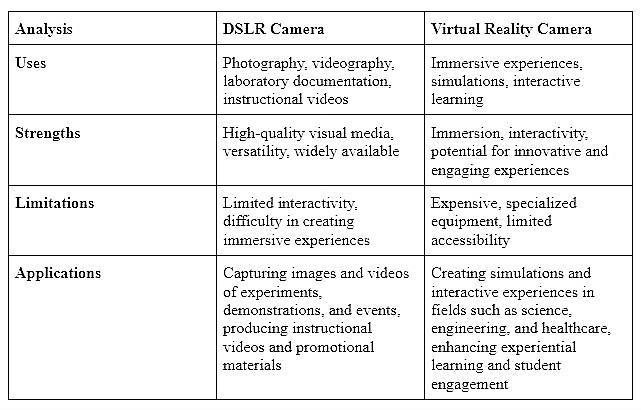
Between VR cameras and DSLR cameras, there are a numberofsignificantdifferences:
ramifications for teachers looking to incorporate technology into their lesson plans. It has been demonstrated that the usage of DSLR cameras in higher education increases student engagement and improves learning results, particularly in the areas of multimedia and visual arts. The usage of DSLR cameras, however, also necessitates technical expertise and can be timeconsuming. On the other hand, by generatingimmersive and engaging learning experiences, the usage of VR cameras in higher education has the potential to completelychangetheway studentslearn.However,the use of VR cameras also requires significant resources andtechnicalexpertise.
The comparison of DSLR and VR cameras in higher educationemphasizeshowimportantitisforteachersto comprehend the advantages and constraints of each technology and to use it in a way that is consistent with their learning objectives. In order to improve teaching andlearningintheirparticularcontext,educatorsshould think about the pedagogical value of DSLR and VR cameras. The use of technology should also be inclusive and accessible, taking into account the needs and preferencesofallstudents,accordingtoeducators.
The comparison of DSLR and VR cameras in higher education generally leads to the conclusion that both technologieshave the potential toimproveteachingand learning in distinctive ways. While VR cameras provide immersive and interactive learning experiences, DSLR cameras are particularly useful for taking high-quality photos and videos. But pedagogical considerations and alignment with the course's learning objectives should be used as a guide when using technology in higher education. Research on the potential of DSLR and VR cameras in higher education should continue in the future, as well as on the best ways to incorporate these toolsintoteachingandlearning.
Reference:
differences
Intermsofimagequality,DSLRcamerastendtoproduce higher-qualityimagesthanvirtualrealitycamerasdueto their larger sensors and greater control over the imagecapturingprocess.However,virtualrealitycamerashave theadvantageofbeingable tocapturea fullyimmersive environment,whichisnotpossiblewithaDSLRcamera.
Conclusion:
In this study, DSLR and VR cameras in higher education are compared in terms of their uses and applications, advantages and disadvantages, and effects on teaching and learning. The results of this study have significant
1. Bower, M. (2017). Virtual reality in higher education: exploring the potential for immersive learning and teaching.JournalofPostgraduateMedicine,63(2),75-77.
2. Lim, S. W. (2018). The use of DSLR cameras in higher education. Journal of Educational Technology DevelopmentandExchange,11(1),1-12.
3. Stott, C. (2019). The impact of virtual reality on higher education. Journal of Information Technology Education,18,91-106.
4. Chen, Y., & Wang, Y. (2020). Virtual reality in higher education: A review of the literature. Journal of Educational Technology Development and Exchange, 13(1),1-15.
5. Kim, H. (2018). Effects of the use of DSLR cameras on students' creativity and academic achievement. International Journal of Information and EducationTechnology,8(11),817-820.
6. Faezipour,M.,&Tavakoli,M.(2019).Theroleof DSLR cameras in enhancing active learning in higher education. International Journal of Information and EducationTechnology,9(1),35-39.
7. Anderson,M.H.(2017).Theuseofvirtualreality in higher education: a literature review. Journal of Educational Technology Development and Exchange, 10(1),1-14.
8. Wang, Y., & Li, Y. (2020). Virtual reality and higher education: a literature review. Journal of Educational Technology Development and Exchange, 13(2),1-14.
9. O'Mahony, J. (2018). Using DSLR cameras in higher education: A case study. Journal of Information TechnologyEducation:Research,17,349-364.
10. Yeh, Y. J., & Huang, T. C. (2019). The effects of virtualrealityonlearningperformance:Ameta-analysis. Journal of Educational Technology Development and Exchange,12(1),1-14.
11. Kelleher, C., & Tierney, B. (2020). Virtual reality and higher education: a systematic review of the literature. Journal of Educational Technology DevelopmentandExchange,13(1),1-13.
12. Portell, M., Armengol, E., & Colomina, R. (2018). Virtual reality in education: a tool for learning in the experience economy. Journal of Educational Technology DevelopmentandExchange,11(1),1-13.
13. Jamali, S. R., & Adawi, M. (2019). The use of DSLR cameras in higher education: A review of literature. Journal of Educational Technology DevelopmentandExchange,12(1),1-13.
14. Rios-Rojas, M. A., Medina-Rodriguez, R. A., & Gomez-Nunez, A. J. (2018). Virtual reality as a learning tool in higher education. Journal of Educational TechnologyDevelopmentandExchange,11(1),1-11.
15. Hao, Y., & Li, Y. (2017). The application of DSLR cameras in higher education: A case study of Chinese universities. Journal of Educational Technology DevelopmentandExchange,10(1),1-12.