SECURING AND STRENGTHENING 5G BASED INFRASTRUCTURE USING ML
1,2,3Students of B.Tech in Electronics & Communication Engineering, Vellore Institute of Technology, Vellore, India, 4Student of M.Tech in Software Engineering, Vellore Institute of Technology, Amaravathi, India, ***
Abstract - A disconnected system currently poses a significant problem for IoT technologies. The potential of 5G to send data faster and allow more links can address the current difficulty while also simplifying connected device control. 5G, on the other hand, will be able to process data swiftly using 4G/LTE networks, which has been a barrier for IoT solutions. As a result, there have been substantial delays between sending data and receiving it. By utilizing the 5G network, more users would be able to send more data without the risk of overcrowding the network, which has previously resulted in delays. Everyone would be able to see the benefits of IoT technology thanks to 5G connectivity. The IoT's potential is enormous right now, but 5G technology will bring it to full.
The fifth-generation (5G) networks are being developed and prepared for deployment by the mobile industry. The rise of IoT and other intelligent automation applications is being significantly fueled by the burgeoning 5G networks, which are becoming more widely accessible. All rely on 5G's superfast connectivity and low latency, including the Internet of Things (IoT), artificial intelligence (AI), driverless cars, virtual reality (VR), blockchain, and future innovations we haven't even thought of yet. The introduction of 5G represents more than just a generational change for the IT sector as a whole.
Key Words: Artificial Intelligence, 5th Generation, Blockchain, Latency, IOT
1. INTRODUCTION
The Internet of Things, or IoT, is becoming more wellknown. The number of connected devices will have increasedfrom700millionto3.2billionbytheyear2023. The upcoming launch of 5G, or the fifth generation of cellular mobile communications, is fantastic news for the Internet of Things industry. While there are several factors behind this increase, the development of 5G networks will be one of the most important. This is because 5G networks will greatly boost the functionality and dependability of these connected gadgets. The anticipated successor to the 4G networks that link the majority of current mobile phones is 5G, or fifth generation, which cellular phone carriers started constructinginternationallyin2019.
TheperformanceofanyIoT,whichisultimatelydefinedby how quickly it can communicate with other IoT devices, smartphones and tablets, software in the form of an app or a website, and other elements, is what determines if it will be profitable. Data transfer speeds will considerably rise with 5G. Compared to existing LTE networks, 5G is expected to be ten times quicker.Because of this increase in speed, IoT devices will be able to communicate and exchange data more swiftly than previously. After all of this,wehaveageneralconceptofhow5Gmaybeusedfor IoTconnection.However,weshouldn'tgettooexcitedtoo soon because adopting 5G in IOT has some significant disadvantages as well. This component is the primary emphasis of the project. appreciating what 5G can accomplishintermsofpotential
Identifying the problems in 5G IoT
The 5G IOT is not without flaws. Here are a few of the issues we discovered during our investigation. There are difficultieslikesecurity,bandwidth,andlatency.
RESOURCE MANAGEMENT

Incontrastto 4GLTE, whichoperates oncurrentlyinuse frequency bands below 6GHz, 5G requires frequencies between 300GHz and 600GHz. Some go by the name mmWave more frequently. They can create ultra-fast speeds that are 20 times faster than the theoretical maximumthroughputofLTEandcantransportalotmore data.
SECURITY
Thischallengewouldapplytoanydata-driventechnology, but the 5G deployment would be targeted by both simple and complex cybersecurity threats. Although the Authentication and Key Agreement (AKA), a method for building trust across networks, covers 5G, it is now feasible to track individuals using their phones. They mightevenlisteninonactualphonecalls.
Volume: 10 Issue: 03 | Mar 2023 www.irjet.net
REGULATIONS AND STANDARDS
Given the increased infrastructure required to spread the network out,governmentagencieswill be involvedinthe installation of 5G. There will be a need for new antennas, basestations,andrepeatersfromserviceproviders.
In addition, 5G services across several vertical industries will be introduced to authorities in waves. Examples include spectrum availability, EMF radiation restrictions, infrastructure sharing, and cybersecurity. The many elements and challenges of getting there are explored in researchfromResearchandMarkets.
Because the third issue is up to lawmakers, we'll just talk aboutthefirsttwoissueshere.Although manyacademics areworkingonthese,theremaybedrawbackstousing5G forIoT.
RESOURCE MANAGEMENT
As previously said, there is a great deal of traffic on the network as a result of the rise in devices. As a result, an efficientresourcemanagementsystemiscritical.
TheprimarygoaloftheIoTdevicenetworkistogenerate data that is then translated into meaningful information through the data analysis process, as well as to give relevantresourcestoendusers.
The management of IoT resources is a major difficulty in ensuring the quality of the end-user experience is employedinthecreationofIoTnetworks.
INTUITION
The capacity to create virtual networks is one of 5G's finest features. Subnets with various traffic priorities will subsequentlybeformed.
In a hospital, for instance, the network may be configured to give priority to a connection between a surgeon and a robot rather than, say, patient contacts. Even if the network is at capacity, emergency broadcasts can continue.
1.1 Existing Method
SDN is becoming more and more popular among engineers due to its disruptive nature when compared to the conventional network. SDN is a networking strategy that allows for programming-based network node management as opposed to more conventional system administrationtechniques.
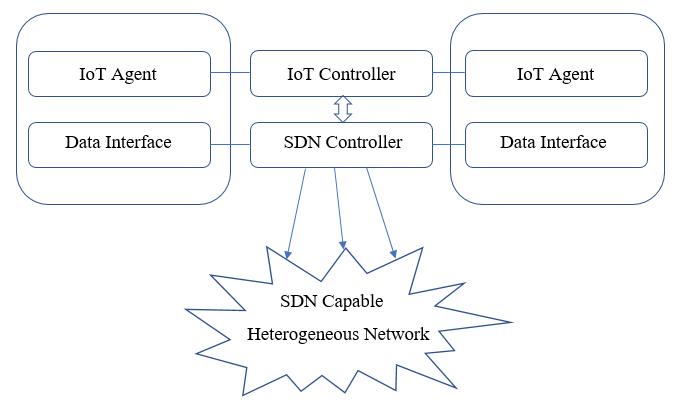
Software-defined networking technology is a method of network administration that makes it more similar to cloudcomputingthantraditionalnetworkmanagementby enabling dynamic, programmatically effective network setuptoincreasenetworkperformanceandmonitoring.
1.1 PROPOSED METHOD
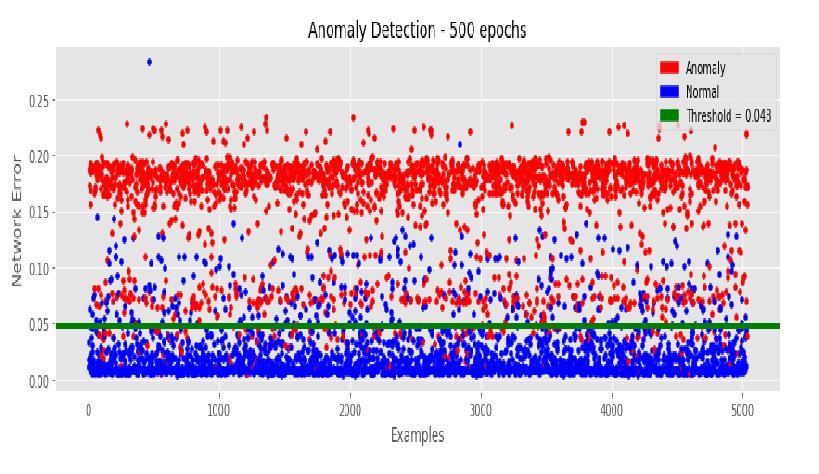
Using a very effective anomaly detection in Machine learning powered by autoencoder, we can detect hackers orirregularities.Thesystemwecreatealsokeepstrackof the hackers, preventing them from moving forward. The network error is measured against the systems in this project.
Any mechanism that creates unfavorable results is classifiedasananomaly.
1. Tracking every IP address in the network's consumption and distributing network resources basedontheintensityofusage.
2. Creating a parameter to determine the greatest intensity, which is given priority when the networkiscongested.
3. Creating virtual subnets and ensuring that the ones with higher priorities aredistributedacross multiple subnets to avoid congestion in a single subnet.
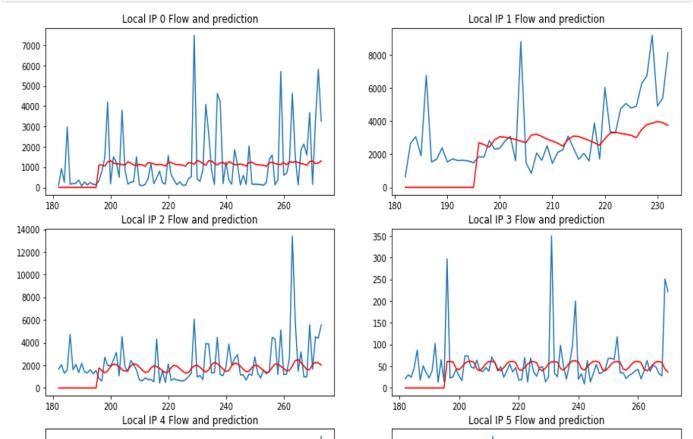
4. After completing the above steps, we utilize a recurrent neural network to anticipate network utilization for specific usage and, as a result, allocateresourcesbasedonthisinformation.
International Research Journal of Engineering and Technology (IRJET) e-ISSN:2395-0056
Volume: 10 Issue: 03 | Mar 2023 www.irjet.net
Raw Data:
Eachrowconsistsoffourcolumns:
● date:yyyy-mm-dd(from2006-07-01through 2006-09-30).
● l_ipn:localIP(codedasanintegerfrom0-9).
● r_asn: remote ASN (an integer that identifies the remoteISP).
● f:flows(countofconnectionsforthatday).
Reportsof"odd"activityorsuspicions
Date:IP
:1
Real network traffic data
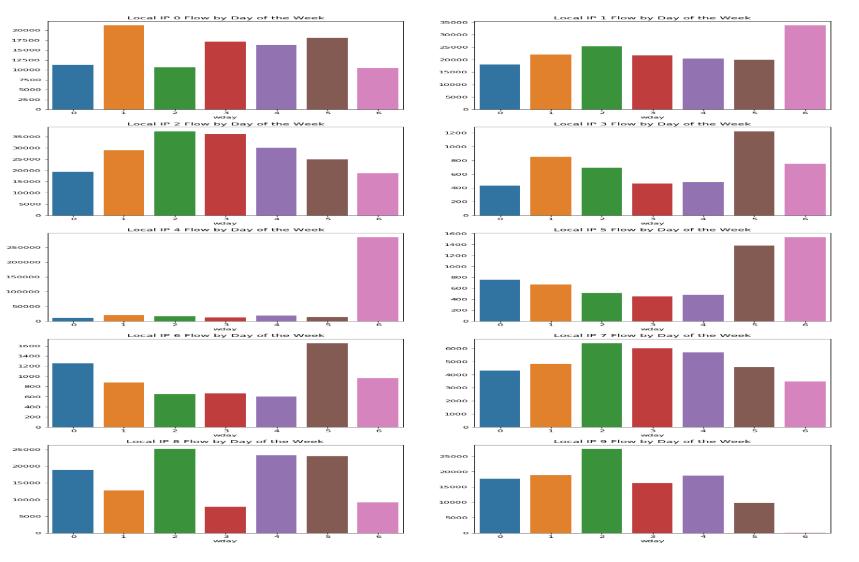
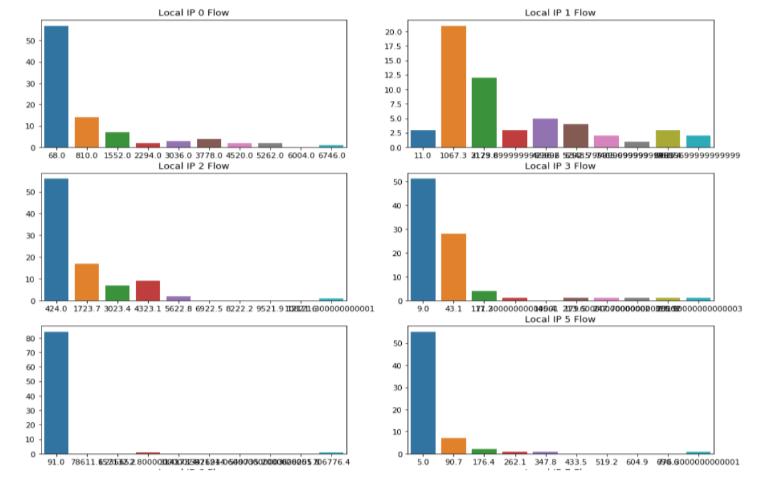
The data set has ~21K rows and comprises 10 local workstationInternetProtocol(IPs)overaperiodofthree months.
DDoS attacks in a 5G network built on SDN
SDNbasedtrafficaffectedby DDoSattackers.Todetect DDoS attacks
Collectedflowinputsatthe SDNcontrollersat predeterminedtimes
Switchmemoryusesabloom filtertocontrolDDoStraffic.
Reducetheworkloadonthe dataandcontrolplanes.
Semi-supervised to detect anomaliesinSDN
ML methods
Neuralnetworkmodel,SOM
2395-0072
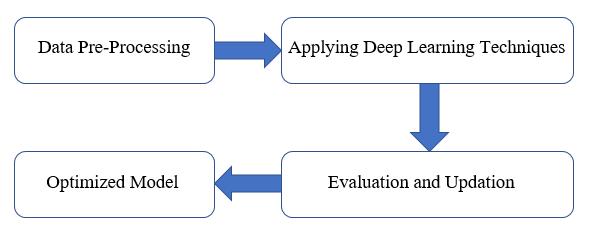
● ML for network management: use various deep learning techniques for classifying the traffic into normalormaliciousclasses.
● ML for threat detection: We observe the anomalies present in the network using machine learningalgorithms.
Periodicflow-baseddetection
3. METHODOLOGY
We consider the data of New York city and predict the amount of usage by an individual. We apply machine learning algorithms and then allot the bandwidth accordingtothepredictedoutput.
Hereisthedatasetwehaveused:
Table
set
Loadbalancing,Bloomfilter
Interfacemitigation.
SVManomalydetection
2. IMPROVING THE SOLUTION USING DEEP LEARNING
● We use various algorithms of machine learning and improve the software-defined network and thusbetteringitsperformance.
4. RESULTS
Security Provision For 5G IOT:
Therearemanydifferenttypesofassaultsthatcanexploit cyber security flaws. Some of the known cyber threats includeBotnetattacksthatcontrolanetworkofconnected devices to puppeteer a massive cyber- attack. Distributed denial-of-service (DDoS) overloads a network or website to take it offline.The DDoS assaults place a lot of demand on the target resources, making it difficult to balance protectionmethodperformanceandresourceusage.
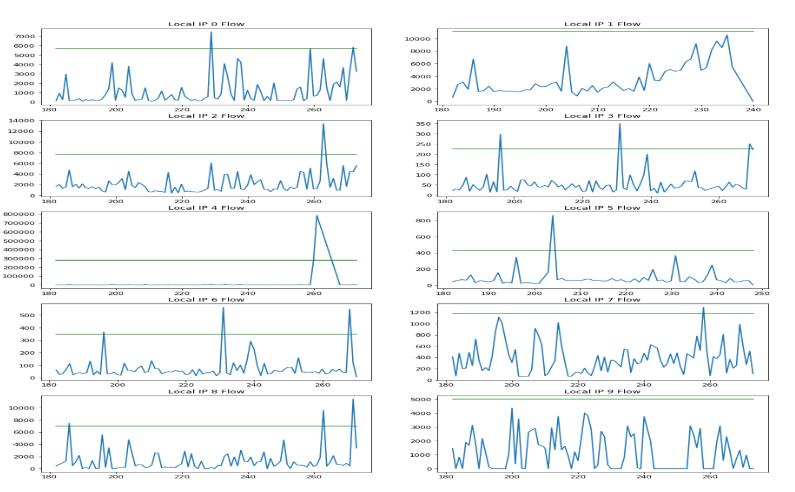
As a result, it's crucial to make sure the defensive mechanismusesaslittleofthetargetedsystemresources asfeasiblewhilepreventingDDoSassaults.Wehavefound an efficient solution for the detection of abnormalities in thenetwork.ThisisdoneusingMachinelearning.
5. CONCLUSIONS
Our model is built in a way to find out any sort of abnormalities by the user based on the number of requests on a particular day. We trained our model using the RNN model unlike the CNN model, As it has internal memoryassociatedwithit.SowetrainedourMLmodelto remember the past information of the user. This helps us toblocktheintruderinthefuture.
We analyzed our data set and performed mathematical operations on the past 3 months of the data set, and we set a threshold value such that if the user crosses the threshold value, our model considers the intruder as a hackeranditwillblocktheintruderconnection.
Future Scope
This model efficiently solves the two major problems in 5GIOT. Here are some ways to expand the scope of the idea:
1) Deploy the model in the local college server like Universityservers.
2) This can be directly embedded in softwaredefinednetworks.
3) Thiscanbeusedforidentifyingsecuritythreatsin areasofgreaterconcern.
REFERENCES
[1] Adou,Yves.“ML-Based5G Network SlicingSecurity:A Comprehensive Survey.” IDEAS/RePEc, https://ideas.repec.org/a/gam/jftint/v14y2022i4p11 6-d789792.html.
[2] Rajalakshmi, P., et al. “Performance Analysis of CSMA/CA and PCA for Time Critical ...” ScienceGate, https://www.sciencegate.app/document/10.1109/tii. 2018.2802497.
[3] Thayanathan, Vijay, et al. “Machine Learning for Securing SDN based 5G Network.” ResearchGate, https://www.researchgate.net/publication/3485352 26_Machine_Learning_for_Securing_SDN_based_5G_Ne twork.
[4] Sharma,Parjanay,etal.“Roleofmachinelearningand deep learning in securing 5G-driven industrial IoT applications.” ScienceDirect, https://www.sciencedirect.com/science/article/abs/ pii/S1570870521001906

[5] Rahman,Ashikur,etal.``FeasibilityandChallengesof 5G Network Deployment in Least Developed
Countries.” Scientific Research, https://www.scirp.org/journal/paperabs.aspx?paperi d=106943.
[6] Mateus Cruz, Samuel Mafra, et al. “SmartStrawberry Farming Using Edge Computing and IoT.” NCBI, 5 August 2022, https://www.ncbi.nlm.nih.gov/pmc/articles/PMC937 1401/.
[7] Nicolas-Alin Stoian, “(2020) Machine Learning for anomalydetectioninIoTnetworks:Malwareanalysis on the IoT-23 data set.” University of Twente Student Theses,https://essay.utwente.nl/81979/.
[8] S. Arumuga Devi, “5G wireless network technology: The evolution of 5G and technological developments towardsthesuccessorof5G|Internationaljournalof health sciences.” ScienceScholar, https://sciencescholar.us/journal/index.php/ijhs/art icle/view/13465.
[9] Afaq, Amir, et al. “Machine learning for 5G security: Architecture, recent advances, and challenges.” ScienceDirect, https://www.sciencedirect.com/science/article/abs/ pii/S1570870521001785.
[10] Alsharif, Mohammad H., and Peerapong Uthansakul. “A Novel Method for Improved Network Traffic Prediction Using Enhanced Deep Reinforcement Learning Algorithm.” National Library of Medicine, https://www.ncbi.nlm.nih.gov/pmc/articles/PMC926 9698/.
BIOGRAPHIES
GaliJeevanSai, Currently Studying at VIT University, Vellore, School of Electronics and Communication Engineering(SENSE).
Venkata Siddharth Dhara, Currently Studying at VIT University, Vellore, School of Electronics and Communication Engineering(SENSE).

Jayakrishna Reddy Puttur, Currently Studying at VIT University, Vellore, School of Electronics and Communication Engineering(SENSE).
GaliDharani, Currently Studying at VIT University, AP , School of Computer Science Engineering(SCOPE).