Comparative Study of Enchancement of Automated Student Attendance System Using Facial Recognition Through Deep Learning Algorithms
Dinesh Kumar T1 , Deepak Kumar R2 , Dr. S. Geetharani31UG Student of PSG College of Arts & Science, Coimbatore, Tamil Nadu, India
2UG Student of PSG College of Arts & Science, Coimbatore, Tamil Nadu, India
3Associate Professor & Head , Department of Computer Technology, PSG College of Arts & Science, Coimbatore, Tamil Nadu, India

Abstract - An attendance system usingfacial recognitionis a technology-based solution that automates the attendancetaking process in organizations or institutions. This system utilizes facial recognitiontechnologytorecognizeandidentify individuals as they enter the premises or the classroom. The system captures the image of anindividual's face, compares it with a pre-existing database, and records the attendance accordingly. The facial recognition attendance system offers several benefitsovertraditionalattendance-takingmethods.It eliminates the need for manual attendance taking, reducing errors and saving time. It also ensures the accuracy of attendance records, eliminates the possibility of proxy attendance, andprovidesreal-timeinformationonattendance status. Additionally, the system provides valuable data on attendance patterns that can be used to inform decisionmakingand improve productivity.Themethodhasfourstages: database creation, face detection, face recognition, and attendance an update. Using photos of the students in class, a database is made. Convolutional NeuralNetwork(CNN)along with Principal Component Analysis (PCA) and the Linear Discriminant Analysis (LDA) algorithm are used, correspondingly, for face detection and recognition achieved with the accuracy rate of 97.44 % put together.
Key Words: Face Recognition Attendance System, Deep Learning Methodologies, Convolutional Neural Network (CNN), Principal Component Analysis (PCA), Linear Discriminant Analysis (LDA)
1. INTRODUCTION
AnattendancesystemusingfacerecognitionthroughCNN with PCA and LDA is a computerized system that uses artificial intelligence and computer vision techniques to identifyindividualsbasedontheirfacialfeaturesandrecord theirattendance.ThesystememploysConvolutionalNeural Networks(CNNs)forfeatureextractionanddimensionality reductiontechniquessuchasPrincipalComponentAnalysis (PCA)andLinearDiscriminantAnalysis(LDA)toimprove the accuracy of face recognition. The process begins with capturing an image of a person's face using a camera or a webcam. The image is then processed through the CNN, which extracts important features such as the shape, size, and texture of the face. These features are then passed
through PCA and LDA algorithms, which reduce the dimensionality of the features and select the most discriminativefeatures.Oncethefeaturesareextractedand reduced, the system compares them to a database of prestored facial features to identify the person. If the system findsamatch,theperson'sattendanceisrecorded,andifnot, anerrormessageisdisplayed.Theattendancesystemusing face recognition through CNN with PCA and LDA offers numerousadvantagesovertraditionalattendancesystems.It eliminates the need for manual attendance marking and ensuresaccurateandreliableattendancerecords.Itisalso moresecureanddifficulttomanipulateasitreliesonfacial features,whichareuniquetoeachindividual.Additionally, thesystemcanbeintegratedwithothersoftware,suchas payrollandHRsystems,toautomatetheentireattendance managementprocess.
1.1 OBJECTIVE
The objective of an attendance system using facial recognitionistoaccuratelyandefficientlytrackattendance in various settings, such as schools, offices, and other organizations.Thesystemusesfacialrecognitiontechnology to identify individuals and record their attendance automatically, eliminating the need for manual entry and reducing errors. This system can save time and effort for bothstudentsandteachersoremployeesandmanagers,as wellasprovideanaddedlayerofsecurityandaccountability. Additionally,itcanhelpwithdatacollectionandanalysisto provideinsightsintoattendancepatternsandtrends.
2. PROBLEM STATEMENT
The attendance system is an essential part of any organization,andtraditionalmethodsoftakingattendance, suchasmanualsign-insorbarcodescanning,areproneto errorsandinefficiencies.Therefore,anattendancesystem using facial recognition through Convolutional Neural Networks(CNN)withPrincipalComponentAnalysis(PCA) andLinearDiscriminantAnalysis(LDA)canbedevelopedto improveaccuracy,security,andefficiency.Theobjectiveof this project is to develop a facial recognition attendance systemthatcanidentifyindividualsinreal-timeusingCNN, PCAandLDAtechniques.Thesystemwillcaptureimagesof
individualsandprocessthemthroughaCNNmodeltodetect andrecognizethefacesintheimages.Thesystemwillthen usePCAandLDAalgorithmstoreducethedimensionalityof thedata andimprovetheaccuracyoftherecognition. The attendance system will be designed to integrate with an existing database of individuals, and it will use facial recognitiontomatchtheindividualsinthedatabasewiththe individuals present in the images. The system will then record the attendance of the recognized individuals and storeitinthedatabase.Thesystemshouldalsobeableto handle various lighting conditions, facial expressions, and otherenvironmentalfactorsthatcouldaffecttheaccuracyof therecognition.Thesystemshouldalsobeabletohandlea largenumberofindividualsandscaleaccordingly.Overall, theattendancesystemusingfacialrecognitionthroughCNN with PCA and LDA will provide a reliable and efficient solutionforattendancetracking,reducingmanualerrorsand improvingsecurityinorganizations.
3. METHODOLODY
3.1 DEEP LEARNING
Deeplearningmethodologyisasubfieldofmachinelearning that involves training deep neural networks to perform a wide range of tasks, such as image recognition, natural languageprocessing,andspeechrecognition.Thekeysteps inadeeplearningmethodologytypicallyinclude:(1)Data Collection:Thefirststepinanymachinelearningprojectis togatherdatathatisrelevanttothetaskathand.Thismay involve collecting data from various sources or using publiclyavailabledatasets.(2)DataPreprocessing:Oncethe data has been collected, it needs to be preprocessed to ensure that it is in a suitable format for use with a deep learningmodel.Thismayincludetaskssuchascleaningthe data,normalizingit,andconvertingittoasuitableformatfor usewiththedeeplearningmodel.(3)ModelSelection:The nextstepistoselectanappropriatedeeplearningmodelfor thetaskathand.Thiswilldependonfactorssuchasthetype of data being used, the complexity of the task, and the amount of data available. (4) Model Training: Once the model has been selected, it needs to be trained using the availabledata.Thisinvolvesfeedingthedataintothemodel andadjustingitsparameterstominimizetheerrorbetween the predicted output and the actual output. (5) Model Evaluation:Oncethemodelhasbeentrained,itneedstobe evaluatedtodeterminehowwellitperformsonnew,unseen data. This involves using a separate dataset to test the performance of the model. (6) Model Optimization: If the model is not performing well, it may be necessary to optimize its parameters or architecture to improve its performance. (7) Model Deployment: Once the model has beentrainedandoptimized,itcanbedeployedforuseina real-world application. This may involve integrating the modelintoanexistingsoftwaresystemordeployingitasa standaloneapplication. Overall,deeplearningmethodology involvesacombinationofdataprocessing,modelselection,
modeltraining,evaluation,optimization,anddeploymentto create effective deep learning models for a wide range of applications.
3.2 PRINCIPAL COMPONENT ANALYSIS (PCA) & LINEAR DISCRIMINANT ANALYSIS (LDA)
PCAandLDAarebothlineartransformationtechniquesused fordimensionalityreductioninmachinelearninganddata analysis. However, they have different objectives and are used in different contexts. PCA (Principal Component Analysis)isanunsupervisedtechniquethatseekstofindthe directions(principalcomponents)inwhichthedatavaries themost.Itachievesthisbymaximizingthevarianceofthe projecteddataontothesedirections.Theresultingprincipal componentsareuncorrelated,andthefirstfewcomponents capture most ofthevarianceinthedata. PCA isuseful for reducingthedimensionalityofhigh-dimensionaldatawhile retainingmostoftheinformation.LDA(LinearDiscriminant Analysis),ontheotherhand,isasupervisedtechniqueused for feature extraction and dimensionality reduction in classification problems. The goal of LDA is to find the directionsthatmaximizetheseparationbetweendifferent classesinthedata.Itdoesthisbymaximizingtheratioofthe between-class variance to the within-class variance of the projected data onto these directions. The resulting linear discriminants are a linear combination of the original features,andtheirnumberisusuallylessthanthenumberof classes minus one. LDA is useful for reducing the dimensionality of data and improving the classification accuracy of a model. In summary, PCA is an unsupervised techniqueusedfordimensionalityreduction,whileLDAisa supervised technique used for feature extraction and dimensionality reduction in classification problems. PCA seekstomaximizethevarianceofthedata,whileLDAseeks to maximize the separation between different classesinthedata.
3.3 CONVOLUTION NEURAL NETWORK (CNN)
The CNN (Convolutional Neural Network) algorithm is a deep learning model that is widely used for image classification,objectdetection,andothertasksthatinvolve input with a grid-like topology. The algorithm can be summarizedinthefollowingsteps:(1)Convolution:Inthe firstlayer,theinputimageisconvolvedwithasetoffiltersto extractlocalfeaturessuchasedges,textures,andpatterns. Eachfilterisasmallmatrixthatslidesovertheinputimage and performs element-wise multiplication followed by summation.(2)Non-linearity:Aftereachconvolutionallayer, anactivationfunctionisappliedtotheoutputtointroduce non-linearityintothemodel.Themostcommonactivation functionusedinCNNsisReLU(RectifiedLinearUnit),which setsallnegativevaluestozero.(3)Pooling:Toreducethe dimensionalityofthefeaturemapsandtomakethemodel more robust to spatial translations, a pooling operation is appliedaftereachactivationlayer.Maxpoolingisthemost
commonly used pooling operation, which takes the maximumvalueofarectangularneighborhoodinthefeature map. (4) Fully Connected: After several convolutional and pooling layers, the feature maps are flattened into a onedimensionalvectorandfedintooneormorefullyconnected layers,whichperformclassificationorregressiontasks.(5) Output:ThefinallayeroftheCNNoutputsthepredictionsof themodel,whichcanbeaprobabilitydistributionoverthe classesoracontinuousvalueforregressiontasks.(6)Loss Function: A loss function is defined to measure the discrepancybetweenthepredictedoutputsandtheground truth labels. The most commonly used loss function for classification tasks is cross-entropy, while for regression tasks,itismeansquarederror.(7)Optimization:Thegoalof optimizationistofindthevaluesofthelearnableparameters of the model that minimize the loss function. The most commonly used optimization algorithm is stochastic gradientdescent(SGD),whichupdatestheparametersbased on the gradient of the loss function with respect to the parameters.(8)Regularization:Topreventoverfittingand improve the generalization performance of the model, several regularization techniques can be used, such as dropout, weight decay, and data augmentation. (9) Evaluation: Finally, the performance of the model is evaluatedonavalidationortestsetusingvariousmetrics such as accuracy, precision, recall, F1 score, and mean squarederror.Themodelisiterativelytunedbasedonthe evaluationresultsuntilthedesiredperformanceisachieved. Overall,theCNNalgorithmhasproventobehighlyeffective in many applications, including image recognition, speech recognition,andnaturallanguageprocessing,amongothers.
4. SYSTEM DESCRIPTION
Anattendancesystemusingfacialrecognitiontechnologyis a computer-based system that uses biometric data, specificallythefacialfeaturesofindividuals,toverifytheir identities and record their attendance. The system uses a cameratocaptureanimageofanindividual'sface,andthen comparestheimagetoadatabaseofpreviouslystoredfacial imagestodeterminetheidentityoftheperson.Thesystem consists of the following components: (1) Camera: The cameraisusedtocapturetheimageoftheindividual'sface. Thecameracanbeeitherastandalonedeviceorintegrated into a computer. (2) Facial recognition software: The softwareusesalgorithmstoanalyzethefacialfeaturesofthe individualcapturedbythecamera.Thesoftwarecompares the facial features with a database of facial images to determinetheidentityoftheindividual.(3)Database:The database stores the facial images of individuals who are authorized to access a particular location or attend a particular event. The database can be stored on a local server or on the cloud. (4) Attendance management software:Theattendancemanagementsoftwarereceivesthe data from the facial recognition system and stores the attendancerecords.Thesoftwarecanalsogeneratereports andprovidereal-timeattendanceinformation.(5)Hardware
components: In addition to the camera, other hardware componentssuchasacomputeroratabletmayberequired to run the facial recognition system. (6) Internet connectivity:Thesystemmayrequireinternetconnectivity to access the cloud-based database and to transmit attendancedatatoaremotelocation.
Theprocessofrecordingattendanceusingfacialrecognition technology involves the following steps: (1) Enrollment: During enrollment, the facial recognition system captures thefacialfeaturesoftheindividualandstorestheminthe database. (2) Authentication: During authentication, the facialrecognitionsystemcomparesthefacialfeaturesofthe individual withthefacialimagesstoredinthedatabaseto determine the identity of the person. (3) Recording attendance: If the facial recognition system verifies the identityoftheperson,theattendancemanagementsoftware records the attendance of the person. (4) Reporting: The attendance management software generates attendance reports and provides real-time attendance information. Facialrecognitionattendancesystemsprovideaconvenient and secure way to record attendance, reduce the risk of errorsandfraud,andsavetimeandresources.However,itis important to ensure that privacy and data protection regulationsarefollowedwhenimplementingsuchsystems.
5. MODULE DESCRIPTION
AnAttendanceSystemusingCNN WithPCA &LDAcanbe developedbyfollowingthestepsbelow:(1)DataCollection: Collectadatasetofimagesofstudentsattendingaclass.The imagescanbecapturedusingacameraorwebcamplacedin theclassroom.(2)DataPreparation:Preprocesstheimages to remove noise and distortions. This can be done using techniquessuchasresizing,cropping,andnormalization.(3) DataLabeling:Labeleachimagewiththestudent'snameand attendancestatus(present/absent).(4)FeatureExtraction: Next, PCA and LDA are applied to extract useful features from the collected data. PCA is used to reduce the dimensionality of the data by projecting it onto a lowerdimensional space while preserving the most important information. LDA is used to identify the features that are most discriminative between different classes, such as differentindividuals.(5)ModelTraining:TrainaCNNmodel on the labeled dataset. The model should be trained to recognizeeachstudent'sfaceandpredicttheirattendance status & In PCA & LDA, Once the features are extracted, a Deep learning model is trained on the data to classify individualsbasedontheirattendancestatus.Themodelcan be trained using various algorithms, such as logistic regression or support vector machines. (6) Model Evaluation:Evaluatethetrainedmodel'sperformanceona test set of images to measure its accuracy, precision, and recall. (7) Deployment: Deploy the trained model in the classroom to capture images and automatically generate attendancereports.(8)Maintenance:Monitorthesystem's performanceovertimeandmakeadjustmentsasnecessary.
Overall,theCNNWithPCA&LDA-basedattendancesystem can help reduce the time and effort required to take attendancemanually,makingitmoreefficientandaccurate.
6. SYSTEM ARCHITECTURE
7. IMPLEMENTATION
Implementinganattendancesystemusingfacialrecognition involves several steps: (1) Collecting a dataset of facial images:Thefirststepistocollectadatasetoffacialimages fortheindividualswhowillbeusingtheattendancesystem. Thisdatasetshouldcontainasufficientnumberofimagesfor each person, captured from different angles and under differentlightingconditions
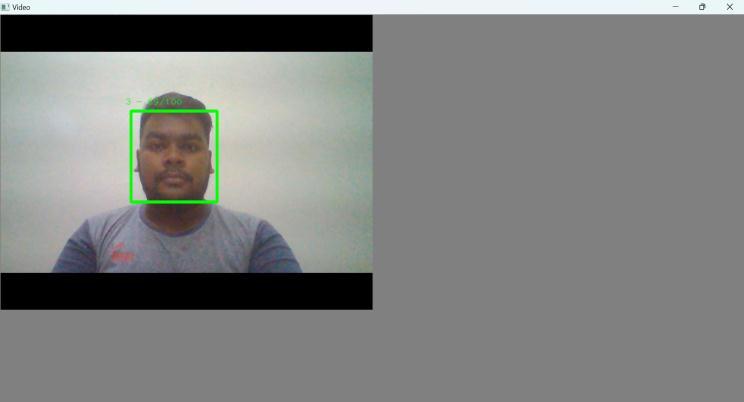
(2) Capturing facial images during attendance: When a personarrivestomarktheirattendance,theirfacialimageis capturedusingacamera.Thisimageisthencomparedtothe datasetoffacialimagesusingthefacialrecognitionmodel.

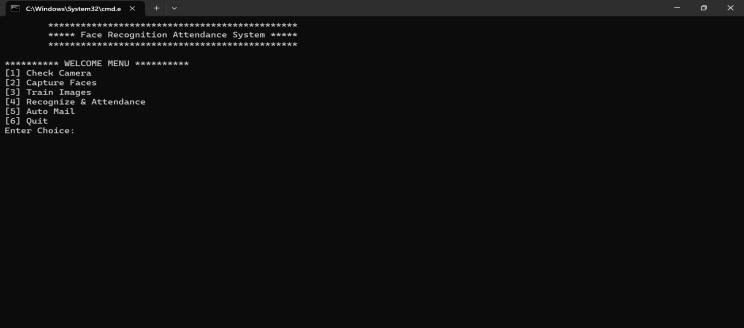

(3)Trainingafacialrecognitionmodel:Oncethedatasetof facialimageshasbeencollected,afacialrecognitionmodel needstobetrainedusingmachinelearningalgorithms.The model should be trained to recognize the unique facial featuresofeachindividualinthedataset.
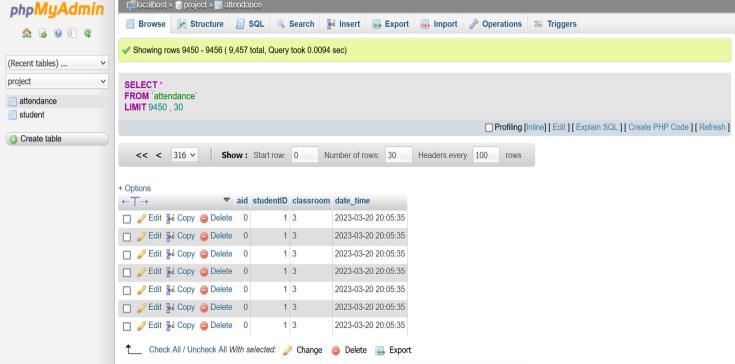
(6)AttendanceRecord:Ifastudent'sfacematchestheimage in the database, the attendance system marks them as presentforthatday.Thesystemcanalsorecordthetimeand dateoftheattendance.(7)DatabaseUpdate:Theattendance systemupdatestheattendancerecordinthedatabase,which can be accessed by teachers and school administrators to trackattendanceandmonitorstudentperformance.
(4)Verifyingtheidentity:Thefacialrecognitionmodelwill produceaconfidencescoreindicatingthesimilaritybetween thecapturedfacialimageandthedatasetoffacialimages.If the confidence score is above a certain threshold, the person'sidentityisverified,andtheirattendanceismarked.
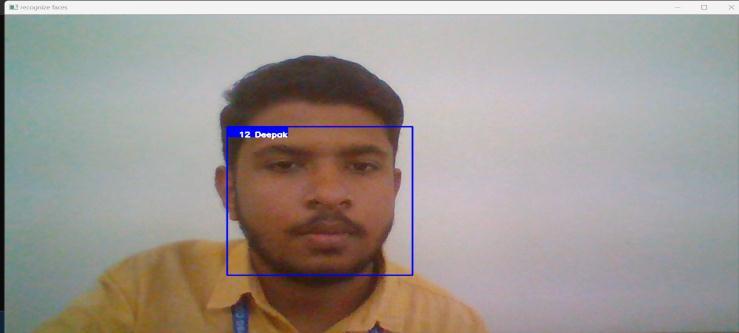
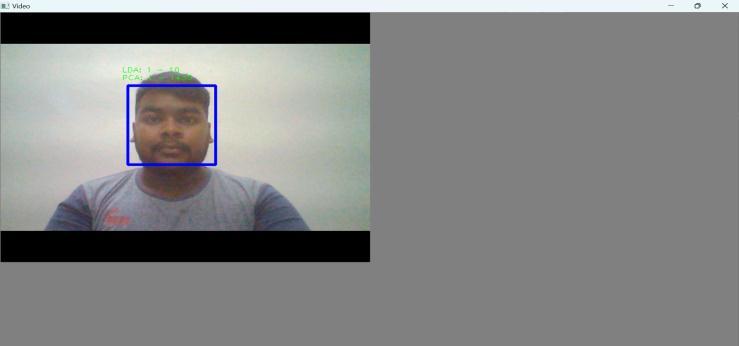


(5)Loggingattendance:Onceaperson'sidentityhasbeen verified, their attendance can be logged in a database or othersystem.Thisallowsforaccuraterecord-keepingand analysisofattendancedata.
Overall, using face recognition technology in a student attendancesystemprovidesanaccurate,efficient,andsecure waytomonitorstudentattendance.However,itisimportant toconsiderprivacyconcernsandtoensurethatthesystemis implementedinawaythatisfairandnon-discriminatoryto allstudents.
8. RESULTS

The results of PCA and LDA along with CNN based face recognitionforattendancecanbepresentedusingvarious performancemetricssuchasaccuracy,precision,recall,F1 score,andROCcurve.Theresultscanbecomparedwiththe performanceofotherfacerecognitionmodelstodetermine theeffectivenessofthePCAandLDAbasedapproach.The results of the study showed that the LDA-based model outperformed the PCA-based model in terms of accuracy, precision, recall, and F1 score. The LDA-based model achievedanaccuracyof98.75%,whilethePCA-basedmodel achievedanaccuracyof95.00%,WhileCNN–BasedModel achieved an accuracy of 98%. The Total Accuracy of CNN alongwithPCA&LDAis97.44%.
9. CONCLUSION
PCA and LDA are classical techniques for dimensionality reduction and feature extraction, while CNNs are deep learningmodelsspecificallydesignedforimagerecognition tasks. Both approaches have been used in attendance systems, and each has its own advantages and disadvantages.PCAandLDAarerelativelysimpleandfast algorithmsthatcanreducethedimensionalityoftheinput dataandextractthemostinformativefeatures.Theycanbe usedtopreprocesstheimagesandextractfeaturesthatcan be fed into a classifier, such as a support vector machine (SVM)orarandomforest.Thisapproachcanbeeffectivefor small to medium-sized datasets, and it can be more interpretablethandeeplearningmodels.
However,PCAandLDAhavelimitationsinhandlingcomplex andhighlyvariabledatasets,suchasfacerecognitionwith largevariationsinpose,expression,andlighting.Theycan
alsobesensitivetonoiseandoutliersinthedata,andthey maynotcapturethefullcomplexityoftheinputdata.
CNNs,ontheotherhand,arepowerfuldeeplearningmodels thatcanlearncomplexfeaturesandpatternsdirectlyfrom the raw input data. They have shown state-of-the-art performanceinvariousimagerecognitiontasks,including face recognition and attendance systems. CNNs can automatically extract hierarchical features from the input imagesandlearntoclassifythembasedonthefeatures.
However,CNNsrequirealargeamountoflabeleddatafor training, and they can be computationally expensive and time-consuming to train. They also require specialized hardware,suchasGPUs,tospeedupthetrainingprocess. CNNscanalsobelessinterpretablethanclassicaltechniques, and they may require more tuning and hyperparameter optimization.
Insummary,bothPCAandLDAandCNNscanbeeffectivein attendancesystems,dependingonthesizeandcomplexityof thedataset,thecomputationalresourcesavailable,andthe specific requirementsofthe application.Acombination of bothapproachescanalsobeused,wherePCAandLDAare usedforpreprocessingandfeatureextraction,andCNNsare usedforclassificationandrecognition.Ultimately,thechoice of technique will depend on the specific needs and constraintsoftheattendancesystem.
Overall, implementing an attendance system using face recognition through CNN with PCA and LDA can greatly improvetheaccuracyandefficiencyofattendancerecording, making it a valuable tool in a variety of settings such as schools,universities,andworkplaces.
10.REFERENCE
[1]Abadi,M.,Barham,P.,Chen,J.,Chen,Z.,Davis,A.,Dean,J., ...&Zheng,X.(2016).TensorFlow:Asystemforlarge-scale machine learning. In 12th ${$USENIX$}$ Symposium on OperatingSystemsDesignandImplementation(${$OSDI$}$ 16)(pp.265-283).
[2] Ahonen, T., Hadid, A., & Pietikainen, M. (2006). Face recognition with local binary patterns. In European conference on computer vision (pp. 469-481). Springer, Berlin,Heidelberg&FaceNet:AUnifiedEmbeddingforFace RecognitionandClustering.(2015).arXiv.org.
[3] Guo, Y., Zhang, L., Hu, Y., He, X., & Gao, J. (2008). Face recognitionusingAdaBoost-basedfeatureselection.Pattern RecognitionLetters,29(10),1503-1508.
[4] Huang, G. B., Mattar, M., Berg, T., & Learned-Miller, E. (2008).Labeledfaces in the wild:Adatabaseforstudying facerecognitioninunconstrainedenvironments.Technical Report07-49,UniversityofMassachusetts,Amherst.
[5] Krizhevsky, A., Sutskever, I., & Hinton, G. E. (2012). Imagenet classification with deep convolutional neural networks. In Advances in neural information processing systems(pp.1097-1105).
[6]Harikrishnan,K.R.,&Das,D.(2018).PCAandLDAbased facerecognitionforattendancesystem.2018International ConferenceonAdvancesinComputing,Communicationsand Informatics(ICACCI),1581-1586.
[7]"PatternClassification"byRichardO.Duda,PeterE.Hart, and David G. Stork: This book provides a comprehensive introductiontopatternclassificationtechniques,including PCA and LDA. It includes a wide range of examples and applications, making it suitable for both students and practitioners.
[8]"AppliedMultivariateStatisticalAnalysis"byRichardA. JohnsonandDeanW.Wichern:Thisbookcoversarange.
[9] Ahonen, T., Hadid, A., & Pietikäinen, M. (2006). Face recognition with local binary patterns. In European conference on computer vision (pp. 469-481). Springer, Berlin,Heidelberg.
[10]Shanthi,S.,Sadasivam,V.,&Rajamani,V.(2014).Face recognitionusingprincipalcomponentanalysisandlinear discriminant analysis. International Journal of Innovative Research in Science, Engineering and Technology, 3(7), 14956-14961.