“BEHAVIOUR OF MULTI-STOREY TWIN STRUCTURE CONNECTION OF THE BEAMS AT DIFFERENT LEVEL: A MINI REVIEW”
 Thakor Vishalkumar Sureshbhai1, Jenil Thakkar2
Abstract - Two tall structures connected to one another to form a group known as a Twin Tower Structure. Generally, Analysis of Single tower type structure is easily done by structuralengineers, butwith thetwintypestructure,somany minute things need to be taken care of. Unusual building structuralsystemswithaconnectionbeamisnewapproachof building seen in both residential and commercial complexes, and many of them include a shared parking space on one, several, or lower floors or basements.
There are ambiguities related with Height, Width, Geometry, Connection, etc. Behavioral aspect of Twin tower type structureistobeanalyzedthoroughlyfortheEarthquakeand Windloadingscenarios. Thispapersummarizestheworkdone upon the Twin tower type structures, although very few researchers have published the detailed analysis. For precise location of bridging the connection between towers parameters like storey displacement, storey shear and storey drift under seismic and wind conditions have been summarized here.
Key Words: Twin tower, Connecting beams, Response Spectrum Analysis, Base shear, Storey displacement, Storey drift, ETABS.
1. INTRODUCTION
In recent years, high-rise buildings architectural designshavebecomemoreinnovativeandstriking,which has contributed to the variety of their exteriors and their dynamicbehavior.Duetoalackofavailablelandinpopulous places, especially in large cities, an increasing number of high-risebuildingsarealsobeingconstructedinrelatively closeproximity.Thestandarddefinitionofatallstructureis onewhosestructuralstudyanddesignhavebeenimpacted bylateralloads,specificallyswaybroughtonbysuchloads [5].
A complex structure known as a Twin tower connected building consists of two single towers that are joined by beams as the main structural elements [3]. The bottom,middle,andtopofthetwoadjacentbuildingsserve asastructurallink,makingthestructuresstrongenoughto supportthistypeofstructureandresistseismicandwind loads [3]. When one tower experiences tragedies like fire, theconnectionfacilitatescommunicationbetweenseveral
towersandservesasacrucialrouteofescape[4].High-rise linked structures have simple and proven static performance.Thesafetyofabuildingsstructuralandnonstructuralcomponentsmustbeguaranteedbyaneffective design,whichalsomentionstheloadindependently.
Thelateralloadscausedbyseismicaregreaterthan deadorlive(imposed)loadsforverytallbuildingsbecause windpressureriseswithheight.Theamountofside sway between two adjacent stories of a building brought on by lateral(windandseismic)loadisknownaslateral(storey) drift[1].Whenawallexperienceswindorearthquakeloads, itshorizontaldisplacementbetweensupportsisreferredto as deflection. The amount of sag caused by gravity or another vertical loading is known as a structural member verticaldeflection.Windresistanceisoneofthemainissues in design practice since they are typically constructed to considerableheightsinordertoachieveagrandappearance [7].In finite-element models, several researchers have evaluatedthedynamicresponsebehaviorsoftallbuildings underwindandearthquakeloadings.Seismologicalresearch has been done on the Taipei Financial Center, one of the tallest buildings in the world. In that study, a mega-frame systeminafinite-elementmodelwasusedtoconstructthe toweringbuilding[8].
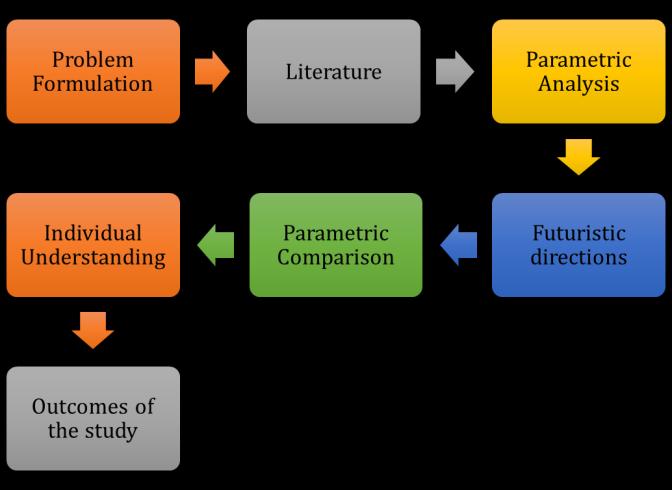
2. METHODOLOGY FOR REVIEW
3. BEHAVIOUR ANALYSIS OF STRUCTURE UNDER SEISMIC LOAD
3.1 Base shear in twin tower
1) Themaximumbaseshearisreducedby17%when thetwinstructureis54mtall[1].
2) Time-history analysis (2001 Bhuj earthquake) yieldsthemaximumbaseshearvalueat0.4H+0.6H of structure and width of 0.6B in a 40-storey structurewith3.5-meterfloorheight[3].
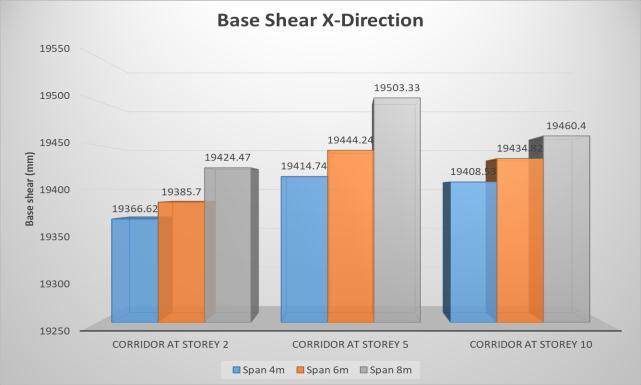
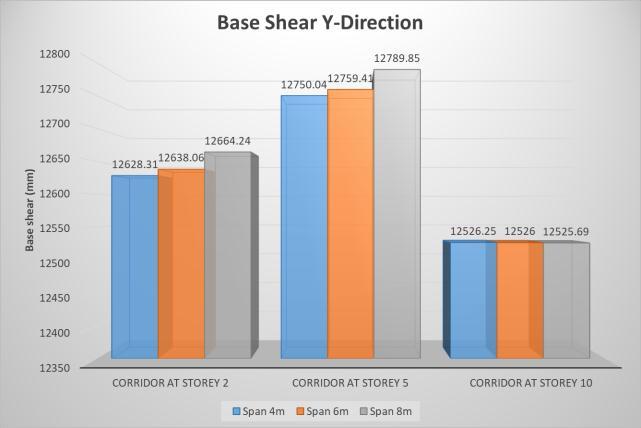
3) Getthemaximumvalueofthebaseshearatthe5th storeyconnectionbeamwithan8-meterspanina 10-storeystructure[4].
4) When analyzing the structure, it was discovered that there are incrementally five stories (16 m in height) in both towers and two stories (8 m in depth) in the common basement. Its effect on the baseshearhasbeenincreasingbyanaverageof12–14%and18–20%,respectively[5].
3.2 Storey Displacement
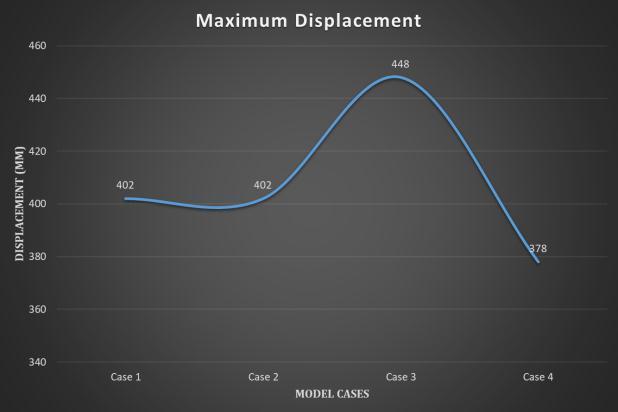
1) In static earthquake conditions, the maximum storeydisplacementiswithinthepermissiblelimit in all cases, whereas in earthquake dynamic conditions, the maximum storey displacement is onlywithinthepermissiblelimitincases5to8[1].
2) In the case of a 160-meter-high structure, connectingthetoptwofloorsreducesdisplacement by6%comparedtothecasewithoutthestructure [2].
3) Inthecaseof1.0B,thedisplacementreducesupto 5.65%,1.66%,and6.74%intheresponsespectrum, timehistory,andwindanalysis,respectively,fora 40-storeyStoreyBuilding[3].
4) Ina10-storeystructure,theconnectionatthetop storeyhasaminimumvalueof4mandamaximum valueof6m[4].
5) However, reducing the number of basements by four reduced displacement by 25-28% in the ydirection in an earthquake by 16-20% when reducingthenumberofbasementsbytwoand2530% when reducing the number of basements by five[5].
3.3
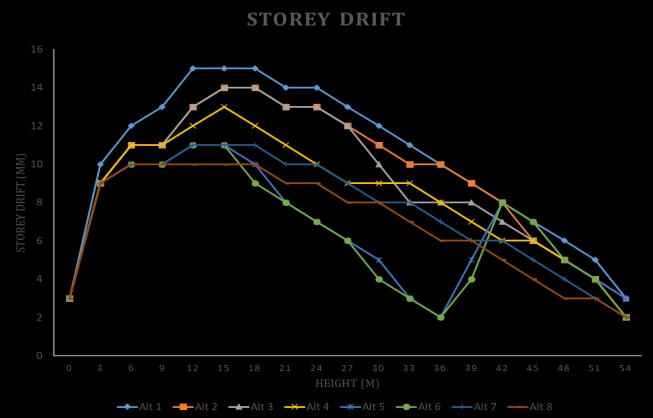
1) Understaticanalysis,themaximumstoreydriftin an earthquake is within the allowable limit in all eightcases.However,themaximumstoreydriftin anearthquakeunderdynamicanalysisiswithinthe allowablelimitonlyincases5,6,7,and8,whileitis exceededincases1,2,3,and4[1].
2) Ina10-storeystructure,theconnectionofstoriesat the 5th floor and 4m span results in the least amountofstoreydrift[4].
3) It is clearly observed that when decreasing the numberofstories,thetimeperiodhasdecreasedby 30
34%,andindecreasingthebasement,thetime periodhasdecreasedby2-4%,respectively[5].
4. BEHAVIOUR ANALYSIS OF STRUCTURE UNDER WIND LOAD
4.1 Base shear in wind condition of twin tower
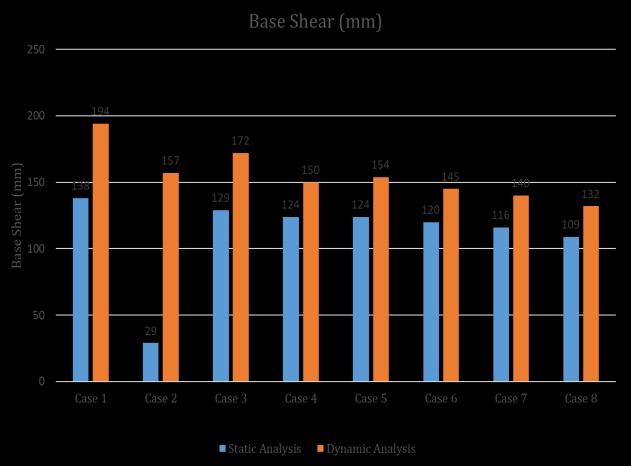
1) Themaximumbaseshear(X-direction)iswithinthe permissible limit only in static wind case 8, as found. However, it was exceeded by about 18% when compared to the allowable value under dynamicwind[1].
2) Whentheseismicforcesandthewindforcesacton thetower,theseconnectionsserveasthe"stiffener" forbothtowers[6].
3) Themaximumbaseshearincreasesupto0.35%in response spectrum analysis and decreases up to 4.87%intimehistoryanalysisinthecaseofa1.0B fora40-storeyStoreyBuilding[3].
4) TheshortestdistanceoccurredinModel1,where the corridor is on the second storey and spans 4 meters[4].
Fig. 5:Baseshearunderwindcondition
4.2 Storey displacement in wind condition
1) TheMSDisobservedtobebetween13–15mmand 13–14mmfordynamicanalysiswithoriginalwidth of column and increased width of column, respectively[1].
2) Inthecaseof0.2B,thedisplacementreducesupto 2.36%,3.05%,and2.67%intheresponsespectrum, timehistory,andwindanalysis,respectively.Inthe response spectrum and wind analysis for a 40storey building, and in the case of 1.0B, displacement decreases by up to 6.94% and 8%, respectively, but increases by 1.36% in the time historyanalysisfora50-storeybuilding[3].
3) Themaximumdisplacement isdetermined bythe lengthofthecorridorandbecomeslessvariableas the corridor location changes. The minimum displacement is obtained when the corridor is locatedonthetenthfloor[4].
4) The storey displacements and storey shears decreasedastheconnectionlevelwasraised,asthe stiffnessbetweentheframesincreasedandgreater stabilitywasprovidedtothemulti-towerstructure [6].
condition
4.3 Storey drift in wind condition
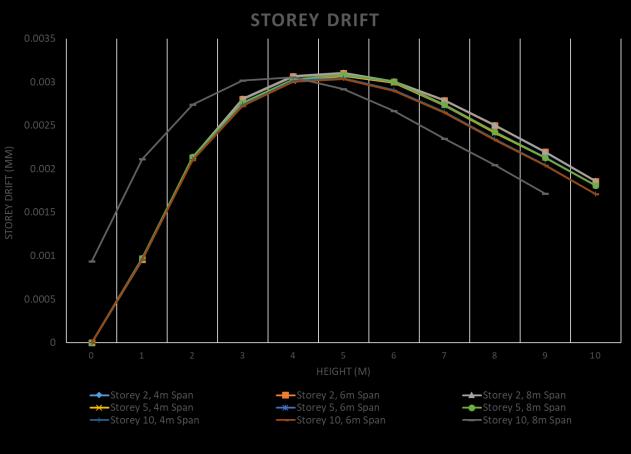
1) The storey drift follows a smooth curve in both directions and varies slightly along the corridors spanandlevelofconnection[4].
5. FUTURE SCOPE
Wind dynamic analysis can be used to properly understandhowtheskybridgebehavesinthewind andoverthestructure.
Theshapeofthebuildingmayalsobechangedfor thesamereason.
6. CONCLUSION
Thestudyshowedthatwhenimplementedon the last floor, the link was more effective in strengthening the system and reducing responses.
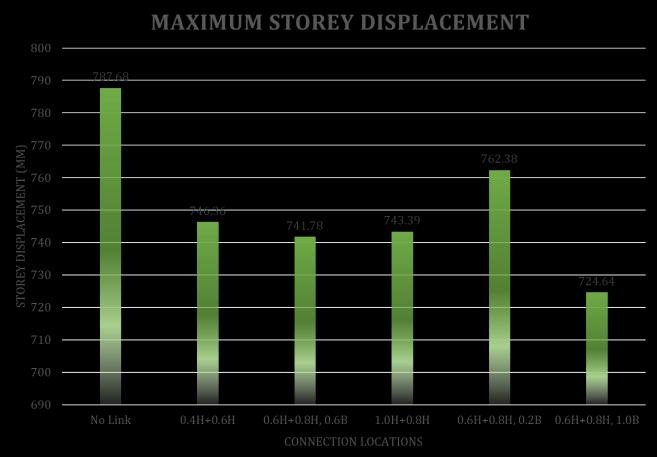
Investigation and analysis were done in both longitudinal and transverse directions to determine the impact of beam connections at different height on the induced dynamic responsesoftwinconnectedtallbuildings.
The findings that the link stiffens structures most effectively when put at about 0.8 of the buildingheightaresupportedbythisoutcome.
Themostundesirablelocationoftheconnected beams is at the top of the building structure when considering the induced dynamic responses of twin tall buildings that are horizontallyconnectedatvariousheightsunder earthquakeloads.
These results confirm the need for careful consideration in the design of interconnected buildingsystems.
According to the findings, the horizontal displacement and drift under seismic loading aregreaterinthelongerdirectionthantheyare intheshorterdirection.
Theresultsmayvaryinalltheconditionswhen thepositionofconnectionsarechanged.
Iftheconnectionprovidedatlowerheightthan nomajorchangesinresults.
Variationsinresultsarealsobasedonthetype ofmaterialslikeRCCmembers,Steelmembers.
7. REFERENCES
Fig. 7:Storeydriftunderwindcondition
Alteringearthquakeandwindparameters,suchas zone, soil type, terrain category, etc., can also be usedtoconductstudies.
Itispossibletoconductadditionalstudyonother typesofstructures,includingsteel-framedbuildings andshearwall-plateslabstructures.
[1] Penumatcha,K.R.,Vipparthy,R.,&Yadav,A.(2020). A Study on effect of Connecting Beams in a Twin Tower Structure. Journal of the Institution of Engineers (India): Series A, 101(4),847-856.
[2] Abbood,I.S.,Mahmod,M.,Hanoon,A.N.,Jaafar,M. S.,&Mussa,M.H.(2018).Seismicresponseanalysis of linked twin tall buildings with structural coupling. International Journal of Civil Engineering and Technology, 9(11),208-219.
[3] Bhinde, V. N., Parekh, P.A., Pokar, N.R. (2020). Dynamic Analysis of Regular Twin Tall RCC
Structure with Various Sizes of Links at Most EffectiveLocation. JournalofEmergingTechnologies and Innovative Research (JETIR).
[4] Afiya,V.N.ParametricAnalysisonBuildingswith Connecting Corridors. International Journal of Engineering Research & Science (IJOER)
[5] Bhanajibhai, J. B., Umravia, N. B. (2020). Dynamic Analysis of the Twin-Tower High-Rise Structure with Basement. International Advanced Research Journal in Science, Engineering and Technology (IARJSET).
[6] SISODIA, R., Kiran, N. T., & Reddy, K. S. S. (2019). Analysis of a Multi-Tower Frame Structure connectedatdifferentlevelsusingETABS.
[7] Hu, G., Tse, K. T., Song, J., & Liang, S. (2017). Performance of wind-excited linked building systems considering the link-induced structural coupling. Engineering Structures, 138,91-104.
[8] Mahmoud,S.(2019).Horizontallyconnectedhighrisebuildingsunderearthquakeloadings. AinShams Engineering Journal, 10(1),227-241.
[9] IS-875-1987 (Part -3), Indian standard Code of Practice for Design loads, Bureau of Indian Standards,NewDelhi.
[10] IS-1893(Part1):2016,IndianstandardCriteriafor Earthquake design Structure, Bureau of Indian Standards,NewDelhi.
[11] IS-456-2000,PlainandReinforcedconcreteforcode ofPractice,BureauofIndianStandards,NewDelhi.