Spinesense: Advanced Pain Detection System for Spinal Cord
Abstract: The diagnosis and treatment of pain depend on an accurateassessmentofthepain. Whilepain can beasubjective experience, the patient's account is what determines the pain's length and intensity. An alternate approach for situations where self-reports are not possible is automated pain behavior assessment. The goal of this research is to improve pain detection using MRI and continuously monitored galvanic skin responses (GSR) by making it more resistant to variations in pain intensity and sensitivity[1]. This study evaluates explainableAI (XAI), whereautomaticpainassessmentreceives increased emphasis, to demonstrate the future breadth and significance of AI in the therapeutic field. Random Forest classifiers were trained on 8,600 pieces of data with 440 different parameters.[2] The Data Exploration, Principle Component Analysis, and Time Series Analysis are done on the Spinal Cord Dataset for Future Prediction.

Keywords: Pain assessment, Multimodal fusion, Pain sensitivity, Neural networks, Machine Learning, SupervisedLearning,prediction,Imbalance data,etc.
1. Introduction:
Duetoitsnumeroususes,automaticchronicpainevaluation and pain intensity estimation has been drawing increasing attention.Therearecurrentlynoneurorestorativetreatments forthecatastrophicillnessknownasspinalcordinjury(SCI). The lack of useful diagnostic and prognostic markers of damageseverityandneurologicrecoveryhasimpededclinical investigations.Noveltreatmentsandobjectivebiomarkersfor SCIarecriticalunmettherapeuticneeds.Physicaltherapists today are moving away from physical rehabilitation and towards self-management, where ubiquitous technologybasedsolutionsareatremendoushelp.The"self-care"based therapyismostlycenteredonpatientshavingabettergrasp oftheirpainthreshold,whichmayhelpthemmanagetheir painmoresuccessfully.[2]Ontheotherhand,thepatientlacks the knowledge necessary to choose the right workouts or activitiesforthem.Thephysiotherapistsofferthemadvicein thisway.Theautonomousmonitoringofchronicpainpatients inarehabilitationcenterisgainingattentionasaresultof
developments in deep learning and ubiquitous computing. Theissueswithautomaticpainevaluationandpainintensity estimation have been addressed in these works. Protective behavior,likepain,canresultinlesssocialinteraction,which exacerbates depression. There are five different forms of protective behaviors, according to a study. (hesitation, guarding, stiffness, bracing, and support). The EmoPain ChallengedatasetisusedtoassessPLAAN'sperformance.All oftheaforementionedbehaviorsareconsideredasa single classinthisdataset(protectivebehavior).Anesthesiologists utilizegeneralanesthesiaduringsurgerytorenderpatients unconsciousandsuppresstheirperceptionofpaintofacilitate theprocedure.[3]Yet,painisastrongsensationthatnotonly exists during surgery but also can exist at any point in our lives. In addition to being uncomfortable for everyone, it serves as a helpful reminder to prevent injuries or tissue damageinthefuture.So,researchonpainfocusesonmore thanjusthowtomanageit;italsoconsiderswhattheissueis thatthisexperienceissubtlysignaling.
Frequently,radiologistsmanuallyinterpretcervicalspineMRI data that are obtained in a primary care or emergency hospital context. The use of computer models to aid in the initial interpretation of medical imaging investigations and quicklyidentifystudieswithpathologicfindingsisbecoming more widely accepted. 5,6,7,8,9. Deep learning techniques such as deep convolutional neural networks have shown potential in this field and have been evaluated in several pathological categories like CT-assisted intracranial bleed identificationandpulmonarynodulerecognition.
Ourgoalinthecurrentworkwastousethe41distinctfactors tocreateauniquemachine-learningmodeltoidentifycervical spinal cord compression in patients. We set out to create a modelwhoseperformancewouldbecomparableinpatients with different demographics and disease characteristics becausetheParametersareheterogeneousconditions.After creating a model, we tried to use analytical tools to understandhowitworked.Toanalyzethedeathratio,atime seriesanalysisutilizingFBProphettheFuturePredictionis conducted.[4]
2. Related Work:
literature provides many publications dealing with health monitoring,ExplainableAI(XAI)AppliedinMachineLearning forPainModeling-[2022]examinestheexplainableAI(XAI) whilepayingcloseattentiontoanautomatedpainassessment usingRandomForestAlgorithm,SupportVectorMachine.
InMachineLearning-BasedPainIntensityEstimator-[2022] thegeneralremarkismadebasedtotallyontheexperimental consequences concerningtheinstabilityofdesiretree(DT) classifiers using the Decision Tree and Support Vector Machine
In Personalized and Adaptive Neural Network for Pain DetectionfromMulti-ModelPhysiologicalFeatures–[2021] the pain detection framework improved by an Eighteen percentF1scoreinadurationvariantpaindatasetusingthe ArtificialNeuralNetworkandRecurrentNeuralNetwork.
InMachineLearningMethodforAutomaticPainAssessment–[2021]Suggestionofprotocolforasystematicassessmentand ameta-analysisonmachinestudyingstrategiesinautomated painevaluationfromfacialexpressionisdiscussedusingthe Artificial Neural Network and the Deep Learning Neural Network.
InAdeeplearningmodelfordetectionofcervicalspinalcord compression in MRI scans. -[2021] the deep learning algorithmisusedtoidentifypatientswithcervicalspinalcord compression. The Analysis of patient magnetic resonance imaging(MRI)studiesthatweregatheredprospectivelyfor the Spinal Cord pain analysis using Random Forest and XGBoost.
TheResearchworkPainandStressDetectionUsingWearable SensorsandDevices–[2021]worksonChronicpainandis identified using ordinary sensors or tools. Then there is an opportunitytodealwithpainandstressmanagementissues bycombiningnewcomputingtechniquesusingtheArtificial Intelligence Neural Network and Convolution Neural Network.
TheResearchWorkProposedinPainLevelAssessmentwith Anomaly-detection-based Network – [2021] provides a thoroughevaluationofmanynetworkswithvariousfeatures and shows a considerable improvement with the ultimately suggested anomaly detection-based network using Artificial NeuralNetworkandRecurrentNeuralNetwork.
InthePredictionoflowbackpainusingartificialintelligence modeling–[2021]theligamentumflavumhypertrophyofthe L3andL4andtheL1andL2disc heightswerestatistically significantinpredictinglowbackpainsymptomsaredetected using the Convolutional Neural Network and the Artificial NeuralNetwork.
In the Research work Disease Prediction and Doctor RecommendationSystem–[2020]Theapplicationofstatistics mining techniques and NLP methodologies are used in this paper to draw recommendations for clinical doctors from reviewsofprevioususersandisdesignedusingtheNatural LanguageProcessingandArtificialNeuralNetwork.
InMulti-taskMultipleKernelMachinesforpersonalizedPain Recognitionfromfunctionalnear-infraredspectroscopybrain
Signals -[2020], Using the RBF kernel and B-spline coefficients, we were able to achieve an average detection accuracy of 80% in this research utilizing MT-MKL. The Support Vector Machine and Random Forest Classifier are used.
3. Methodology:
Detecting spinal cord pain using machine learning is a challengingtaskthatrequiresexpertiseinbothmedicaland machinelearningfields.However,itispossibletousemachine learningalgorithmstoanalyzedatarelatedtospinalcordpain andidentifypatternsthatmayindicatethepresenceofpain. Toextractvaluablefeaturesfromthedatathatcanbeusedfor analysis, preprocessing is required. Techniques like signal processing,featureengineering,anddimensionalityreduction might be used in this. When the data has undergone preprocessing, a machine learning algorithm like Random Forest,CNN,RNN,orXGBoostcanbeusedfortraining.
3.1.RandomForestClassifier
By gathering and preprocessing the data, separating it into training and testing sets, training the model, adjusting the hyperparameters, testing the model, fine-tuning the model, anddeployingthemodelintheproductionenvironment,the random forest algorithm can be used to detect spinal cord pain. Random forest is a supervised learning algorithm. A supervisedlearningalgorithmisarandomforest.Itcomesin two different forms; one is used to solve classification problems,andtheothertosolveregressionissues.Oneofthe mostadaptableanduser-friendlyalgorithmsisthisone.Based on the provided data samples, it constructs decision trees, obtains predictions from each tree, and votes for the top solution.[5] It also serves as a fairly accurate measure of feature importance. The accuracy of the random forest classifier increases with the number of trees in the forest. Problemsinvolvingclassificationandregressioncanbothbe solvedusingtherandomforestapproach.Becauseitmakes predictionsusingasignificantnumberofdecisiontrees,itis regardedasaveryaccurateandreliablemodel.Decision-tree biasesareeliminatedbyrandomforests,whichaverageoutall oftheirpredictions.[11]
3.2.RecursiveFeatureElimination(RFE):
RecursiveFeatureElimination,alsoknownasRFE,chooses thebestorworst-performingfeaturefromamodel(suchas linearregressionorSVM)andtheneliminatesit.Afterthat, theprocessisrepeateduntilallofthefeaturesinthedataset have been utilized ( or up to a user-defined limit). We will combineastraightforwardlinearregressionmodelwith
Sklearn's RFE function, which is easily available via sklearn.featureselectionmethod.[7]
XGBoostisapopularmachine-learningalgorithmthatcanbe used for classification tasks, including spinal cord pain detection.TheXGBoostalgorithmcanbeusedinspinalcord pain detection by collecting and preprocessing the data, dividingthedata intotrainingandtestingsets,training the model, tuning the hyperparameters, testing the model, refining the model, and deploying it in the production environment. The gradient boosting technique has been scaled and enhanced, and the result is eXtreme Gradient Boosting (XGBoost), which was created for effectiveness, computationalspeed,andmodelperformance.Itbelongsto theDistributedMachineLearningCommunityandisanopensource library.[12] The software and hardware features of XGBoost are the ideal combination for enhancing current boostingmethodsaccuratelyandquickly.[7]Whencompared to a single machine learning model, ensemble learning reducesmistakesandimprovespredictionbycombiningthe resultsofnumerousMLmodels.[8]
actionofHumanbeingsovertime.For example,changesin lumberspineangleandSpineNerveoverriding.Inthecontext ofSpinalCordInjuryanalysisanddiseasedetectionfordeath ratio analysis, a pre-trained CNN can be used as a feature extractortoextractrelevantfeaturesfromimagesofMRIand theSpinalCordFeatures.Thesefeaturescanthenbeusedto train a smaller neural network for the specific task of Pain detection.
4. Experimental Setup:
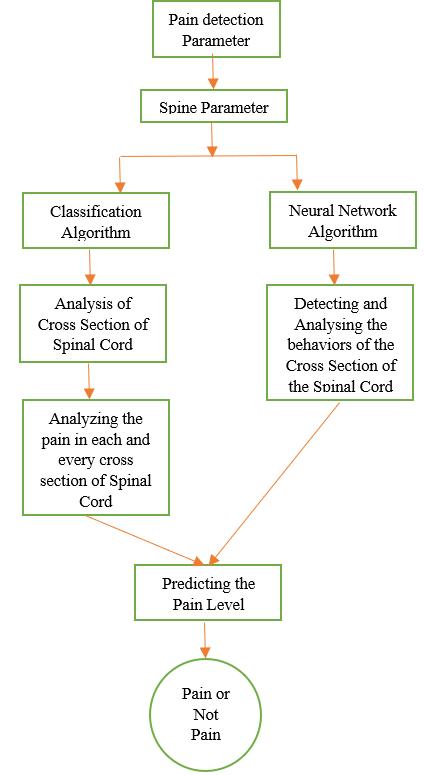
Forreal-timehealthmonitoringandpaindetectionadvanced Artificial Intelligence and Neural Network Techniques are used. Advanced Neural Network and Transfer Learning TechniquessuchasANNandRNN.ClassificationAlgorithms like Random Forest, XGBoost, and LightGBM are used to classifythediseaseandthehealthparametersforreal-time healthmonitoringandPainDetection.
RNNClassification:
RecurrentNeuralNetwork(RNN)isatypeofneuralnetwork architecture that is commonly used for sequential data analysis, including time series and natural language processingtasks.Bybuildingnumerouschoicetrees,theRNN (RecurrentNeuralNetwork)isaneuralnetworkanddecision tree-basedfullyensemblefortasksliketype,regression,and othersimilarones.Trainingisawayoflearningtoclassifyor simply forecast regression for individual trees through trainingandoutputintheirmodes.Tooverfilltheinstruction set, the RNN alters the selection tree's behavior. A neural networkrulewasappliedtothedatasetatthislevel.Neural networks serve as human biological strategies exactly here.[7][9].RNNandTransferLearningTechniquesareused RNNs are commonly used for sequential data such as time seriesortextdata.InthecontextofHumandiseasedetection, RNNscanbeusedtodetectchangesinthebehaviorofevery
For Detecting the pain based on the Lumber Spine Type ClassificationalgorithmssuchasXGBoostandRandomForest Classifiersareused.
5. Result And Discussion:
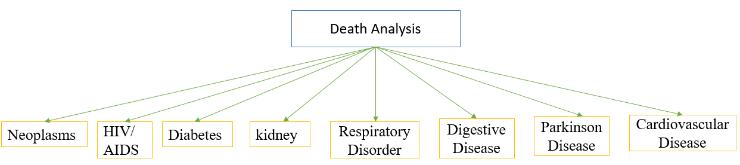
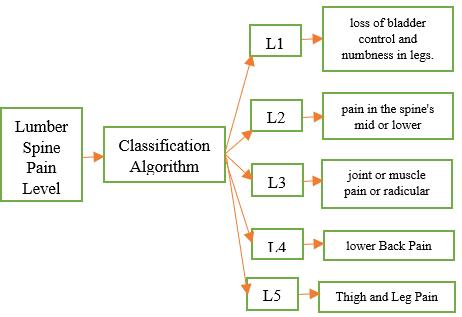
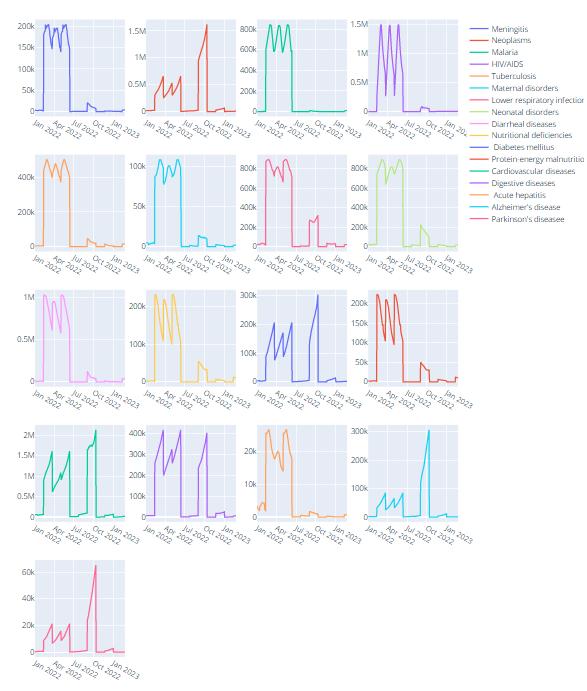
For Analysing the different parameters of the spinal cord responsibleforthespinalcordinjuryandpaindetectionare analyzedusingtheRandomForestClassifier LumberSpine SectionssuchasL1,L2,L3,L4,andL5aretobeclassifiedto analyzethepaininthe body.ByUsingXGBoostClassifierit can easily analyze the death ratio of the patient due to the differentdiseases UsingPlotlyPackageseveryfactoriseasily studiedandanalyzed.WiththehelpoftheTimeDensityPlot, the Death Ratio is analyzed. The Facebook Prophet Time SeriesAnalysisisusedforfuturePrediction
6. Conclusion:
Data mining has become a crucial component in the healthcare industry, particularly in the field of disease measurements from lumbar MRI. A potential project in the future would involve testing transfer learning strategies to sharesubjectmotionsusingneuralnetworkweightsforrealtime data analysis. The clinical data that the features are collected have an intrinsic fixed structure, due to the kinematiclimitationsofthehumanbody.
prediction.Diagnosticsareusuallyemployedwhensicknessis anticipated.ThelumbarspineMRIandCTscansrevealeda positive correlation between low back pain and lower disc heights (statistically significant for L2 and L4) as well as a positive correlation between low back pain and increased ligamentum flavum hypertrophy. Based on the data, the RandomForestclassificationalgorithmwassuccessfullyable topredictthepresenceorabsenceofPainusingquantitative
7. References:
[1] Ravichandra Madanu, Wei-Ta Chen, and Jiann-Shing Shieh,”ExplainableAI(XAI)AppliedinMachineLearningfor PainModeling”, 2022
[2]PeterBellmann,PatrickThaim,HansA Kestlier,Fridhelm Schwenker,” Machine Learning Based Pain Intensity Estimator”, 2022
[3]MingzheJiang,WanqingWu,RiittaRosio,SannaSalantera, AmirM.Rahmani,PasiLiljeberg,”PersonalizedandAdaptive Neural Network for Pain Detection from Multi-model PhysiologicalFeatures”, 2021
[4]DianboLiu,DanCheng,TimothyT.Houle,LucyChen,Wei Zhang,HaoDeng,“MachineLearningMethodforAutomatic PainAssessment”, 2020
[5]DanielLopez-Martinez,KePeng,SarahC Steele,ArielleJ Lee, David Borsook, Rosalind Picard,” Multi-task Multiple Kernel Machines for personalized Pain Recognition from functionalnear-infraredspectroscopybrainSignals”, 2020
[6] Dhanashri Gujar, Rashmi Biyani, Tejaswini Bramhane, SnehalBhosale,TejaswitaP.Vaidya,”DiseasePredictionand DoctorRecommendationSystem”, 2021
[7]ShreyaGhosh,andJyotiJoshi, “PainLevelAssessmentwith Anomaly-detectionbasedNetwork”, 2021
[8]JerryChen,MaysamAbbodandJiann-ShingShieh,“Pain andStressDetectionUsingWearableSensorsandDevices”, 2021
[9] Panure, T.; Sonawani, S. “Stress Detection UsingSmartphone and Wearable Devices: A Review. Asian J. Converg. Technol.” 2021
[10]BreivikH,CollettB,VentafriddaV,CohenR,Gallacher D.SurveyofchronicpaininEurope:prevalence,impacton dailylife,andtreatment.EurJPain 2021;
[11] Li Y, Ghosh S, Joshi J, Oviatt S. 2020 15th IEEE international conference on automatic face and gesture recognition(FG2020)
[12]BalaguéF,MannionAF,PelliséF,etal “Non-specificlow backpain”,2020
[13]SinnottP,WagnerTH.“LowbackpaininVAuser”,2019
[14]WangC,PengM,OlugbadeTA,LaneND,WilliamsACC, Bianchi-Berthouze N (2019) Learning temporal and bodily attention in protective movement behavior detection. In: International conference on affective computing and intelligentinteractionworkshopsanddemos,pp324–330
[15]WangC,OlugbadeTA,MathurA,WilliamsACC,LaneND, Bianchi-BerthouzeN(2019)Automaticdetectionofprotective behaviorinchronicpainphysicalrehabilitation:Arecurrent neuralnetworkapproach.
[16]Song,X.;Li,H.;Gao,W “MyoMonitor:EvaluatingMuscle FatiguewithCommoditySmartphones”.SmartHealth2020, 100175.
[17] Posada-Quintero, H.F.; Kong, Y.; Nguyen, K.; Tran, C.; Beardslee,L.;Chen,L.;Guo,T.;Cong,X.;Feng,B.;Chon,K.H. “Using electrodermal activity to validate multilevel pain stimulationinhealthyvolunteersevokedbythermalgrills”.
Am.J Physiol Integr Comp.Physiol 2020
[18] Posada-Quintero, H.F.; Chon, K.H. “Innovations in ElectrodermalActivityDataCollectionandSignalProcessing: ASystematicReview” Sensors2020
[19] Carreiro, S.; Chintha, K.K.; Shrestha, S.; Chapman, B.; Smelson, D.; Indic, P. “Wearable sensor-based detection of stressandcravinginpatientsduringtreatmentforsubstance use disorder: A mixed methods pilot study”. Drug Alcohol Depend.2020
[20]CasianoVE,Dydyk,AM,VaracalloM BackPain “Treasure Island(FL):StatPearlsPublishing”,2020.
[21]CampagnerA,BerjanoP,LamartinaC,etal “Assessment and prediction of spine surgery invasiveness with machine learningtechniques”.ComputBiolMed2020
[22]ChampainS,BenchikhK,NogierA,etal “Validationof newclinicalquantitativeanalysissoftwareapplicableinspine orthopedicstudies”.EurSpineJ2020
[23]HanssonT,SuzukiN,HebelkaH,etal “Thenarrowingof thelumbarspinalcanalduringloadedMRI:theeffectsofthe discandligamentumflavum”.EurSpineJ2020
[24] Mekhail N, Vallejo R, Coleman MH, et al. “Long-term resultsofpercutaneouslumbardecompressionmildforspinal stenosis”.PainPract2020
[25]DownieA,WilliamsCM,HenschkeN,etal.“Redflagsto screenformalignancyandfractureinpatientswithlowback pain:asystematicreview”.BMJ2020
[26] Dewar C. “Diagnosis and treatment of vertebral compressionfractures”.RadiolTechnol2019
[27]ChouR,ShekelleP “Willthispatientdeveloppersistent disablinglowbackpain?”JAMA2019
[28]OldJL,CalvertM “Vertebralcompressionfracturesinthe elderly”.AmFamPhysician2019
[29]DemšarJ,CurkT,ErjavecA,etal “Orange:DataMining ToolboxinPython”.JMachLearnRes2019
[30] Breiman L “Random Forests: Statistics Department”, UniversityofCalifornia Berkeley,CA94720;January2019