Soldier Health Severity Checking using Machine Learning And IOT
Noor Sumaiya1 , Divika S2 , Yuvashree J3 , Harshitha K M4 , K S Suchitra5
1 Assistant Professor, Department of Computer Science and Engineering, Jnanavikas Institute of Technology, Karnataka, India

2,3,4,5Undergraduate Student, Department of Computer Science and Engineering, Jnanavikas Institute of Technology,Karnataka, India ***
Abstract – Employing a combination of machine learning and IoT technologies, a system that seeks to forecast the soldiers' health status. The system is made to gather information from medical sensors, and evaluate that information in real time to determine how each soldier's health is doing. Personalized health predictions and severity checking are created from the collected data using machine learning algorithms. This method can assist military personnel and medical workers in promptly identifying soldiers who may need medical attention, allowing for more effective and efficient treatment. In addition, the system can offer insightful information on the general condition of a military unit, empowering commanders to make wise choices regarding troop deployment and mission preparedness. Overall, the Soldier HealthSeverity Checking system is a promising use of AI andIoTinthefieldofmilitaryhealthcare.
Keywords- Military Healthcare, Medical Sensors, RealTime Data Analysis, Soldier Health, Personalized HealthPredictions,SeverityChecking
INTRODUCTION
Soldier health is a crucial component of military operations and the capacity to track and forecast it in real-timecanhaveabigimpactonboththetroops'wellbeing and the success of missions. It is now possible to create a complex system for Soldier Health Severity Checking because to the growing number of wearable technologies, medical sensors, the capability of machine learning algorithms, and IoT technologies. The goal of this project is to develop a system that can gather information from a variety of sources, use machine learning algorithms to analyze it, and produce unique health forecasts and severity checking for each soldier. In this article, wearable technology for troops is describedthatallowsforpreciselocationtracking.
As a result, this technology can assist in identifying soldiers who might need medical assistance, offer insightfuldataregardingamilitaryunit'sgeneral health, and empower commanders to make defensible choices regardingtroopdeploymentandmissionreadiness.
LITERATURE SURVEY
1. Health monitoring and tracking system for soldiers using internet of things (IOT),
Niket Patil, Brijesh Iyer, 2017 International conference oncomputing,Communication,andautomation(ICCCA), IEEE. The article describes a system that uses the Internet of Things (IoT) to track and monitor soldiers' health.
The soldier's body can be fitted with the suggested system, it keeps tabs on their whereabouts and wellbeing using GPS. This data will be transmitted to the controlpanelusingIoT.Thesuggestedsystemconsistsof tiny, transmittable modules, sensors, and wearable physiologicalequipment.Becauseofthis,itispossibleto create a low-cost system that uses the suggested technology to protect irreplaceable human life on the battlefield.
2. Novel wearable device for health monitoring and tracking of soldiersbased on LoRa Module, YashashJain,BhupeshSoni,AyushGoyal,ChetnaSharma, 2020 Conference on Information and Communication Technology(CICT),IEEE
Theinternethasalteredour wayoflife,buttheinternet of things (IoT) is about to transform everything once more.usingIoTtochecktheirhealthonthebattlefield.
Body factors including heart rate, temperature, oxygen levels, and GPS position can all be measured by this device.
3. Soldier strap for health monitoring and tracking a proposed solution,
Rahul SG,RajnikantKushwaha,SayantanBhattacharjee, AgnivAditya,KSomasekharReddy,DurriShahwar,2021 Innovations in power and advanced computing technologies(i-PACT).
A military operation's or a military patrol's success depends on information and data, two important components. Monitoring a soldier's condition and
location, along with gathering ground intelligence, is essential during any active circumstances or interactions.Inthedesiredcircumstances,theheartrate, temperature,humiditylevel,andGPSpositionshouldall becontinuouslytrackedin ordertoprovidepromptand effective medical or tactical help in the event of any emergency.
4. IOT based soldier health and position tracking system
J Lakshmi Prasanna, M. Ravi Kumar, Chella Santhosh, S V Aswin Kumar, P. Kasulu, 2022, International conference on computing methodologies and communication (ICCMC), IEEE Currently, preserving national security is under the purview of the armed forces. To defend themselves in this regard, their better health and tracking,respectively, are more crucial. The Internet of Things (IoT)andGPSwere employedinthisstudy'slive trackapplicationstotrackandmonitorthehealthissues affectingthemilitary.
METHODOLGY
The proposed approach for assessing the health of soldiersusingmachinelearningandtheInternetofThings isintendedtoassessthehealthofsoldiersinreal-time.It usesahardwareconfigurationwithanumberofsensors, including an Arduino Uno microcontroller, a heartbeat sensor, an ECG sensor,and a lm35 temperature sensor. The microcontroller is connected to the sensors, and theLCDdisplaydisplaysthevalues.Thecollected datais thenusedtomakepredictionsonsoldier healthseverity usinglogisticregressionalgorithm.
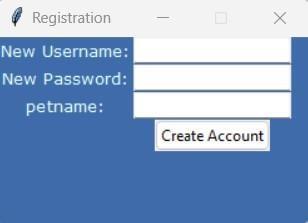
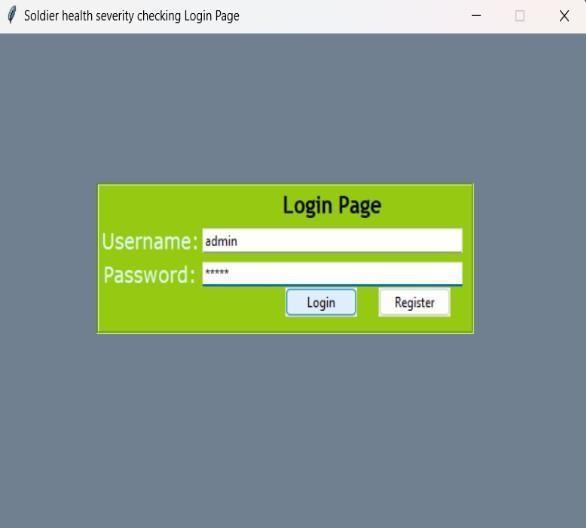
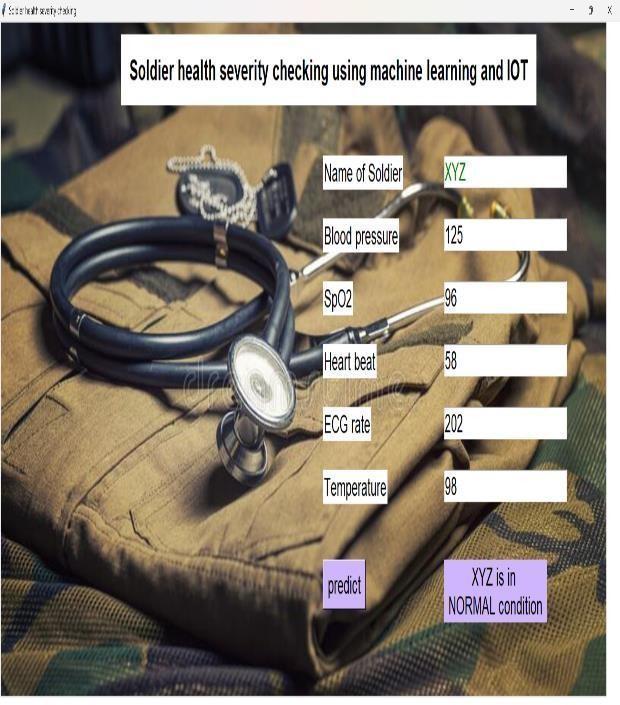
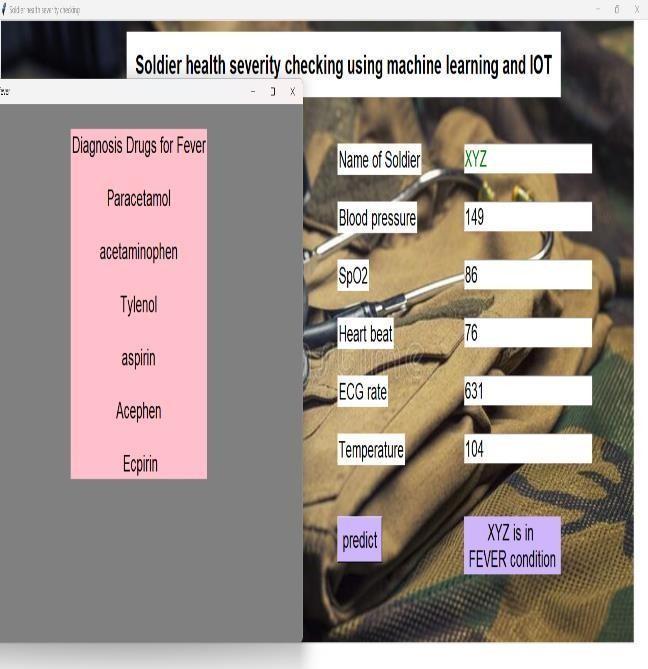
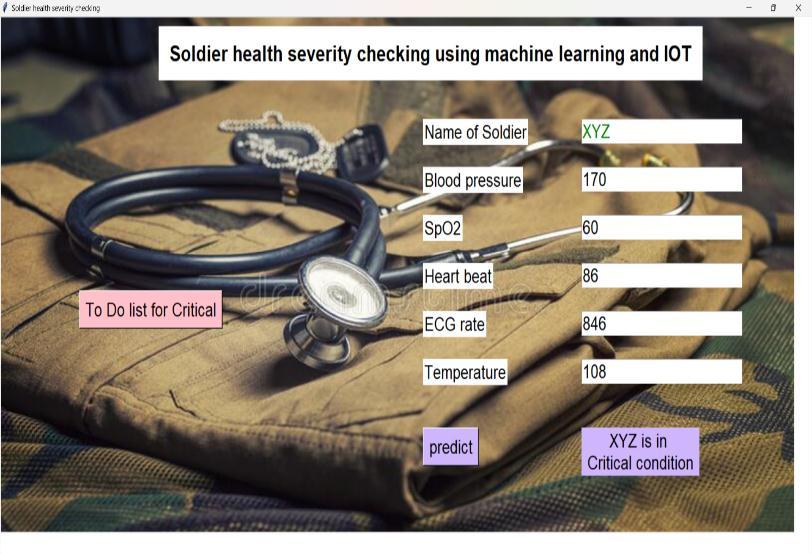
AGraphicalUserInterface(GUI)is developedusingFlask to provide a user-friendly way of inputting and outputtingdata.Afterregistration,soldierdetailssuchas name, blood pressure, spo2, heart rate, ecg rate, and temperature are entered into thesystem. Based on the data gathered, the program then forecasts whether the soldierisinanormalorcriticalstate.
Abuzzerandvibratorareusedtocreateanalarmsystem that will alert theappropriate authorities inthe event of an emergency. In an emergency, the soldier's whereaboutscanbetrackedusingtheGPSmodule.
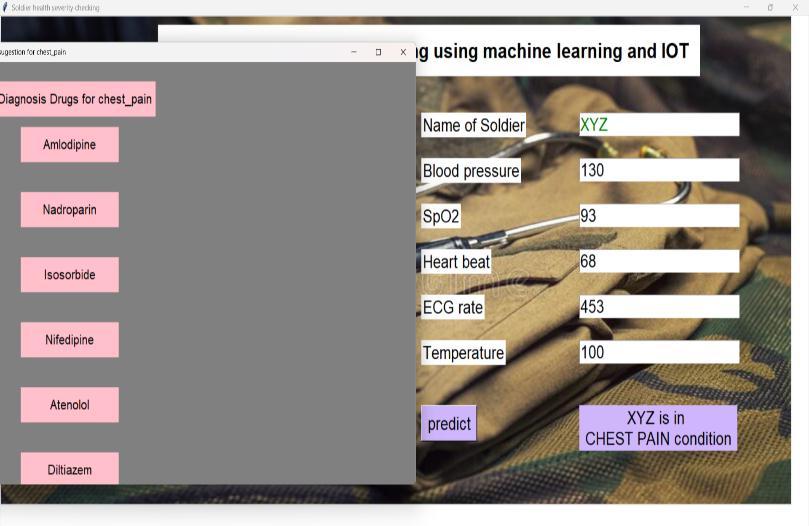
The system recommends giving the soldier common medications in urgent situations. This methodology is expected to enhance the monitoring and tracking of soldiers' health, minimize response time in case of a medicalemergency,andprovideimmediatecaretothose whoneedit.
The system has the potential to improve the healthcare of soldiers in remote areas where medical facilities are limited.Byprovidingreal-timemonitoringandtracking,
thesystemcanhelptopreventmedicalemergenciesand savelives.
ARCHITECTURE DIAGRAM
Fig-1 HardwareArchitecture
A crucial aspect of ensuring the health and safety of active duty troops is the hardware architecture of the soldierhealthseveritycheckingsystem.AnArduinoUno microprocessor, which is part of the system, acts as the central hub for all of the attached devices. The microcontrollerislinkedtoanumberofsensors,suchas an LM35 temperature sensor, heartbeat sensor, ECG sensor, SPO2 sensor, and GPS module, which gather information on a soldier's physical characteristics and position.Theprocesseddataisthenpresentedona16x2 LCD screen, giving the soldier's vital signs a real-time readout.
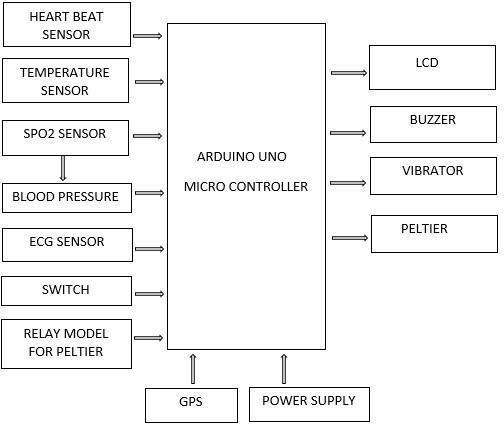
The system also features a Peltier relay model that can be used to regulate temperature in cases of heat or hypothermia. A buzzer and vibrator provide auditory and tactile alerts to draw attention to any critical conditions, and an emergency switch allows troops to sendadistresssignalincaseofanemergency.
With all the necessary parts to gather, examine, and react to data on a soldier's vital signs, the hardware
framework is made to be sturdy, dependable, and portable. Because of its small size, the system is simple todeployinthefieldandgivestroopstheresourcesthey needtokeepaneyeontheirhealthandwell-beingwhile on duty. The system's layout guarantees that troops can access vital information about their health quickly and simply and react accordingly, possibly saving lives and avertinglong-termhealthissues.
which also gives people useful information they can use to act appropriately. The system's software architecture playsacrucialroleinensuringthattroopsonactiveduty receivethebestcareandattentionpossible.
ALGORITHM LOGISTIC REGRESSION ALGORITHM
A statistical method for binary classification tasks is logistic regression. It forecasts the likelihood that an input will belong to a specific class. The steps of the logisticregressionalgorithmareasfollows:
1. Initialize the weights: Set the initial weightvalues to zeroorasmallrandomvalue.
2. Calculatethesigmoidfunction:Thesigmoidfunction is used to map any inputvalue to a value between 0 and 1. It is calculatedbydividing1by1plusthe exponentialofthenegativeproductoftheinputand theweights.
3. Calculate the loss function: The difference between the anticipated value and the actual value is measuredbythelossfunction.Cross-entropylossis thelossfunctionusedinlogisticregressions.
4. Calculatethegradients:Thegradientsarecalculated by taking the partial derivative of theloss function withrespecttoeachweight.
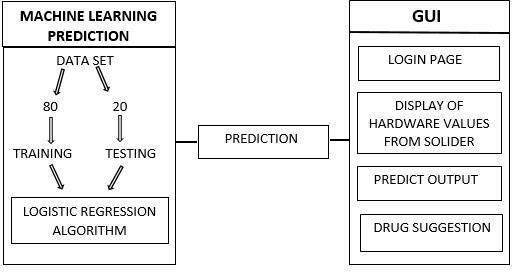
Fig-2 SoftwareArchitecture
A crucial component of the total design is the software architecture of the soldier health severity checking system. The system is designed with a graphical user interface (GUI) that makes data entry and browsing simple. Users must enter accurate information in order toaccessthesystem,andtheGUIshowsoptionsforlogin and registration. Once signed in, users can input information on a soldier's vital signs, such as blood pressure, SPO2, heart rate, ECG rate, and temperature. ThisinformationisthensentviaanArduinocabletothe ArduinoUnomicrocontroller.
Usingthelogisticregressionmethod,themicrocontroller analyses the data gathered and determines whether a soldier is in a normal or critical state. The system offers recommendations for generic medications that can be used to treat crucial conditions. The findings are then shown on the GUI in real-time, enabling users to keep trackofthesoldier'shealth.
With a straightforward interface that enables users to swiftly and easily access crucial information, the softwarearchitectureiscreatedtobe efficientanduserfriendly. The system's accuracy and dependability are ensured by the use of the logistic regression algorithm,
5. Update the weights: The weights are updated using the gradient descent algorithm, which involves subtracting the product of the learningrate and the gradientfromthecurrentweightvalue.
6. Repeat steps 2 to 5 until convergence: The above steps are repeated until the weights converge to a valuewherethelossfunctionisminimized.
7. Predict the output: After the weights have converged, the sigmoid function is used to predict the probability of an input belonging to a particular class.Iftheprobabilityisgreater than0.5,theinput isclassifiedasbelongingtothatclass.Otherwise,itis classifiedasbelongingtotheotherclass.
These steps are iteratively applied until the weights converge to a value where the loss function is minimized, and the model can accurately predict the class of new inputvalues.
IMPLEMENTATION
The implementation of the hardware and software components for soldier health severity checking using machinelearningandIoTinvolvesseveralsteps.
HardwareImplementation:
The hardware components include sensors for measuring vital signs, a microcontroller for data processing, and other devices for displaying data, alerting, and tracking the soldier's location. To implement the hardware architecture, the following stepsaretaken:
1. Gather the required hardware components, including lm35 temperature sensor, heartbeat sensor, ECG sensor, and spo2 sensor. These sensors areusedtomeasurethevitalsignsofthesoldier.
2. Connect the sensors to an Arduino Uno microcontroller board. Use jumper wires to connect the sensors to the appropriate pins on the microcontrollerboard.
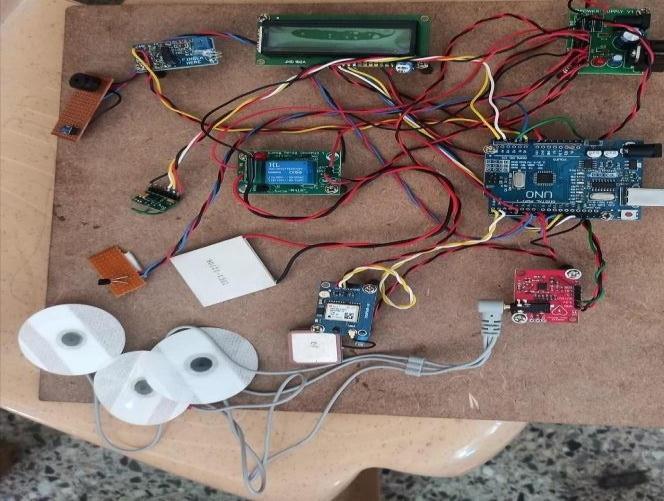
3. Connect a 16*2 LCD display to the microcontroller board. This display will be used to show the vital signsofthesoldier.
4. ConnectaGPSmoduletothemicrocontroller board. This module will be used to track the soldier's locationincaseofanemergency.
5. Connect a buzzer and a vibrator to the microcontrollerboard.Thesedeviceswillbeusedto activatethealarmsystemincaseofanemergency.
6. Connect a relay model for a Peltier device to the microcontroller board. This device will be used to regulatethetemperatureofthesoldier'sbody.
7. Connectanemergencyswitchtothemicrocontroller board. This switch will be used to trigger the alarm systemincaseofanemergency.
8. Use a USB cable to connect the microcontroller board to a computer. This cable will be used to transfer the sensor data to the software application forprocessing.
SoftwareImplementation:
The software component involves developing an application that processes the sensor data and provides apredictionofthesoldier'shealthseverity.Thesoftware implementationinvolvesthefollowingsteps:
1. Install the required software tools, including the Arduino IDE, Python, Flask, and scikit-learn library. These tools will be used to develop and run the softwareapplication.
2. Develop the software application using Flask, a Python web framework. The application should include a Graphical User Interface (GUI) for data inputandoutput.
3. After registration, the soldier details such as name, blood pressure, spo2, heart rate, ecg rate, and temperatureareenteredintothesystem.
4. Process the sensor data using a logistic regression algorithm to predict the soldier's health severity. This algorithm should be trained on a dataset of soldier'svitalsigns.
5. Check whether the soldier is in normal or critical conditions. If the soldier is in critical condition, the systemsuggestscommondrugstobeadministered.
6. UseaUSBcabletotransferthesensordatafromthe microcontroller board to the software application forprocessing.Thedataisreceivedasastringandis splitintoindividualsensorreadings.
7. Display the processed data on the GUI. The GUI should show the soldier's vital signs and the predictedhealthseverity.
8. Activate the alarm system in case of an emergency. Thebuzzerandvibratorareusedtoalertthesoldier andnotifytheappropriateauthorities.
9. Trackthesoldier'slocationusingtheGPSmodulein case of an emergency. The location data can be displayedontheGUIorsenttoamobiledevice.
In conclusion, the integration of various hardware and software components is required for the execution of soldier health severity checking using machine learning and IoT. The hardware consists of sensors for reading vital signs, a microcontroller for processing data, and various devices for data display, alerting, and position monitoring.Creatinganapplicationthatanalysessensor data and forecasts the soldier's health condition is the softwarecomponent.


CONCLUSION
IoT and machine learning technologies have been used to create a soldier health monitoring system, which offersapromisingsolutionformanagingsoldiers'health andwellbeingonthebattlefield.Thismethodisintended to track vital signs, which are important indicators of a soldier's physical health, including body temperature, heartrate,andbloodoxygenlevels.
The system's hardware design includes a number of sensors,includingthelm35temperature,heartbeat,ECG, and spo2 sensors, which are connected to an Arduino Uno microcontroller, GPS module, buzzer, emergency switch,vibrator,andarelaymodelforaPeltierdevice.A logistic regression algorithm is used in the system's software architecture to forecast how seriously the soldier'shealthisinneedofattention.
The system is intended to gather and process data in real-timefromavarietyofinstruments,analyzethedata using machine learning algorithms, and forecast the soldier's health. Additionally, the system has a GPS module that allows the authorities to monitor the location of the soldier in case of an emergency and an emergency switch that can be triggered in case of any life-threateningcircumstances.
The registration of soldier information such as name, blood pressure, spo2, heart rate, ecg rate, and temperature is one of several stages in the system's implementation. Following registration, the system uses the logistic regression algorithm to forecast the severity of the soldier's health condition. The system recommendscommonmedicationstobeadministeredif the soldier is in critical condition, and it also activates the alarm system, which alerts the proper authorities in caseofanemergency.
Comparing this method to conventional health monitoringsystemsrevealsanumberofbenefits.First,it offers real-time vital sign tracking, enabling the early identification of any health issues. Second, it makes use of machine learning methods to forecast how seriously the soldier's health is in need of attention, allowing for promptmedical assistance. Incaseofan emergency, the system's GPS module allows the authorities to track the soldier's position. The system's portability, lightweight, and ease of use make it perfect for use on the battleground.
The method does, however, have some drawbacks. For instance, the device is battery-powered, which may reduce the amount of time it can be used. For data transfer and analysis, the system also needs a steady network link, which can be difficult in remote locations. Additionally, trained employees are needed to run and maintainthesystem.
Future study should concentrate on creating new technologies that can extend the system's battery life, enhance network connectivity in remote locations, and make the system's use and upkeep simpler in order to get around these constraints. Future study should concentrate on integrating extra sensors to track other vitalsigns,likerespirationrateandbloodglucoselevels.
In terms of military health monitoring, the system createdfortrackingsoldierhealthaspartofthisproject marks a major advancement. This system provides a promisingapproachforenhancingtheadministrationof soldiers' health and wellbeing on the battlefield by utilizing IoT and machine learning technologies. This system has the potential to save lives and increase the total efficiency of military operations with more developmentandimprovement.
REFERENCES
1. "Health Monitoring and Tracking of Soldier Using GPS," International Journal of Research in Advent Technology,vol.2,no.4,pp. 291-294,April 2014.P. Kumar,G.Rasika,V.Patil,andS.Bobade.
2. "ARealTimeAutonomousSoldierHealthMonitoring and Reporting System Using COTS Available Entities," Second International Conference on Advances in Computing and Communication Engineering (ICACCE),Deharadun, India, May 2015, pp.683-687.
3. "An IoT based patient monitoring system using raspberry Pi", International Conference on Computing Technologies and Intelligent Data Engineering,Kovilpatti,India,January2016,pp.1-4.
4. “Real Time Health Monitoring System of Remote PatientUsingArm7”,R.Shaikh,InternationalJournal of Instrumentation, Control and Automation(IJICA), vol.1,no.3-4,pp.102-105,2012.
5. International Institute for Strategic Research (3 February 2014). Pages 241-246 of The Military Balance (2014). Routledge, London, ISB9781857437225.
6. Real Time Health Monitoring System of Remote Patient Using Arm7, International Journal of Instrumentation, Control andAutomation (IJICA), vol. 1,no.3-4,pp.102-105,2012.
7. D. Kumar and S. Repal, "Real Time Tracking and Health Monitoring of Soldiers Using ZigBee Technology: a Survey", International Journal of Innovative Research in Science, Engineering, and Technology,vol.4,no.7,July2015,pp.5561-5574.G.
8. Raj and S. Banu, "GPS Based SoldierTracking and Health Indication System with Environmental Analysis,"International Journal of Enhanced Research in Science, Technology, andEngineering, vol.2,no.12,December2013,pp.46-52.
9. "A Secure Freight Tracking System in Rails Using GPS Technology", Second International Conference on Science, Technology, Engineering, and Management (ICONSTEM), Chennai, India, by V. Ashok, T. Priyadarshini, and S. Sanjana. Mar. 2016, pages. 4750.
10. “A Smart System Connecting e-Health Sensors and the Cloud”, IEEE 28th Canadian Conference on ElectricalandComputerEngineeringHalifax,Canada, May2015,pp.712–716.10M.Jassas,A.Abdullah,and H.Mahmoud
© 2023, IRJET | Impact Factor value: 8.226 |
BIOGRAPHIES
NOOR SUMAIYA
AssistantProfessor,Dept.of ComputerScienceand Engineering,MS,PursuingPhD fromRevaUniversity
DIVIKA S
B.EStudent,Departmentof ComputerScienceand Engineering
YUVASHREE J

B.EStudent,Departmentof ComputerScienceand Engineering
HARSHITHA K M
B.EStudent,Departmentof ComputerScienceand Engineering
K S SUCHITRA



B.EStudent,Departmentof ComputerScienceand Engineering