SMART MEDIA PLAYER USING AI
Abstract - There has been vast development in technology in recent times, and as a result, it has become possible to create applications that can understand user movements and perform tasks accordingly. The current project aims to develop an application that can recognize a user's face and hand movements and pause, play, increase-decrease volume and forward and reverse a video based on guesture movements. This application can be programmed using Artificial Intelligence techniques, which are widely adopted in the development of intelligent systems. Artificial Intelligence (AI) is a place of laptop technology that offers with the improvement of intelligent systems that can perform tasks that typically require human intelligence, such as perception, reasoning, and learning. AI algorithms can be used to recognize patterns in data, allowing the development of intelligent systems that can perform complextaskusingHaarCascadeClassifier.
Key Words: Guesture Recognition, Haar Cascade Classifier, Artifical intelligence, Media Player, Smart Media Player.
1. INTRODUCTION
Smart Media Player is a player designed as a time-saving multimedia player. This player plays a key role as it includeseye,faceandhand gesturesthatallowtheplayer to play, pause, fast forward, rewind and mute the video. Usually,whenyouarewatchingavideoandsomeonecalls you,youhavetolookawayorleavethescreenforawhile to miss some part of the video. Then drag the video to where it left off. To alleviate this difficulty, we want to develop a multimedia player that pauses according to the user's current viewing habits. The player plays the video whentheuserlooksatthescreenagain.Inadditiontothe computer, we need a camera or webcam for this. The video is played until the camera detects the user's face, eyes or hand movements. The player stops as soon as the user's face, eyes or hand movements are not fully recognized.
2. SCOPE OF PROJECT.
The project is aimed at providing a simple and easytouseplayerforplayingandpausingvideos.
Thisplayerwillbeusefulforpeoplewhocanplay, pause,increase,decreasethevolumeandforward andreverse thevideobyeyes,faceandfingers.
The pandemic forced everything from nurseries tobigbusinessestogoonline.
This player will play a major roles, it will play, pause, forward, mute depending upon the user actions.
3. PROBLEM DEFINITION.
Designing a system to control Media player throughGuestureRecognitionsystem
Designthesysteminauserfriendlymodelsothat canbeusedbyanyoftheagegroup
BetterExperiencewithhelpofmediaplayer
To watch the whole video without missing any partofthevideo.
4.OBJECTIVE OF THE STUDY.

The main objective of the system is to develop a FaceandHandGestureRecognitionSystem.
Todevelopa successful system whichfollows the userInputandprovideusertherespectiveoutput.
Save time by reducing the number of keystrokes andmouseclicks.
In order to be a smart media player, it has to be convenienttouse.
5. LITERATURE SURVEY.
5.1)MP-FEG: Media Player controlled by Facial Expressions and Gestures.
This paper has helped to understand that that communication with the computer can be done in a non tangible way. There were many methods were tangible communications are been taken place through keyboard
and mouse to operate or get a respond from system. In thispaperithas provedthatcommunicationcanbedone in non tangible way by using hand and face guestures to communicate with the system. For facial expressions deformable model is been used. This model gives around 49 points on face region to analyse the guestures of face andhand.
5.2)Human face detection algorithm via Haar cascade classifier combined with three additional classifiers
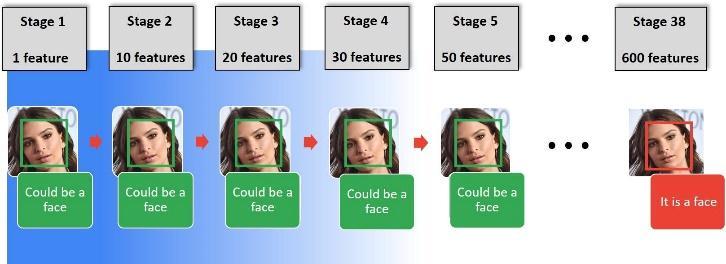
From this paper we learned about the new face detection algorithmcalledHaarcascadeclassifier.Firstitisbasedon node based on human skin histogram matching detection.2nd weakclassifierisbasedontheeyedetection and the third weak classifier is based on the mouth detection.Thisbothhaveahighdetectionrates.
5.3) Human Computer Interface Using Hand Gesture Recognition Based on Neural Network
From this paper , we have learned about hand guesture which are used for controlling media player using neural network. This algorithm recognises features such as play, pause, reverse and forward. The algorithm works in 4 phases : Feature extraction, Image acquisition, Hand segmentation, and Classification. An image will be captured from the webcam and then with help of skin detectionanewimageofboundarywillbecreatedofhand detection’s. The obtained desired output is almost 95 percentasperaverage
6. METHODOLOGY
The use of Haar Cascade classifiers for object detection is efficient. Fast Item Detection using a Boosted Cascade of Basic Features is the paper that Paul Viola and Michael Jones wrote that first described this technique. The classifieriseducatedtheuseofabigquantityofeachhighquality and bad photos withinside the Haar Cascade technique, that's primarily based totally on gadget learning. Positive images - These pic encompass the pic thatweneedourclassifierwiththeintentiontorecognise. Negativeimages:Thesearepicsoftheentiretyelsethatdo not encompass the element we are looking to find. Facerecognitionisamethodforlocatingorauthenticating the face in digital photographs or video frames. A human can easily and rapidly recognise the faces. For us, it is a simpletask,butforacomputer,itischallenging.Thereare many difficulties, including low resolution, occlusion, different lighting conditions, etc. These elements have a significant impact on how accurately the computer can identify faces. The distinction between face detection and face recognition must first be understood. Face detection is typically understood to involve locating and maybe extractingthefaces(intermsofsizeandlocation)froman image for use by the face detection algorithm.
Fundamentals of the HAAR Cascade Algorithm:In the HAAR cascade, a cascade function is trained using a large number of both positive and negative pictures. Images withfacesareconsideredpositive,whereasthosewithout faces are considered negative. Image characteristics are viewedinfacedetectionasnumericaldatatakenfromthe images that can differentiate one image from another. On every training image, we run every algorithm feature. Atfirst,eachimageisgivenequalweight.Itdiscoveredthe mostaccuratethresholdforclassifyingfacesaspositiveor negative. Errors and incorrect categorization could exist. Wechoosethefeatureswiththelowesterrorrate,i.e.,the featuresthatcategorisefacesthemostaccurately.
7..REQUIRMENTS
1)IntelCorei5andaboveSpeed-2.5GHz
2)RAM-8GB(min),HardDisk-50GB,
3)Webcam,OSversion5.0andabove.,
4)OperatingSystemWindows10
5)Python3.6Compiler-PythonIdle/VSCode
8.FLOW DIAGRAM.
9.RESULT ANALYSIS.
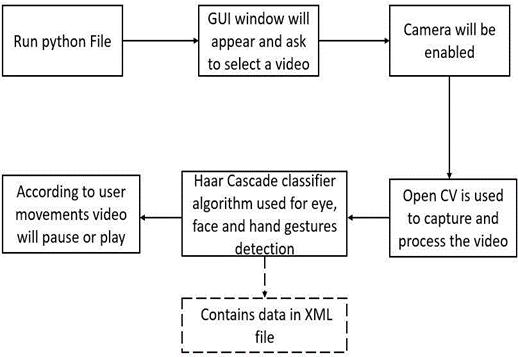
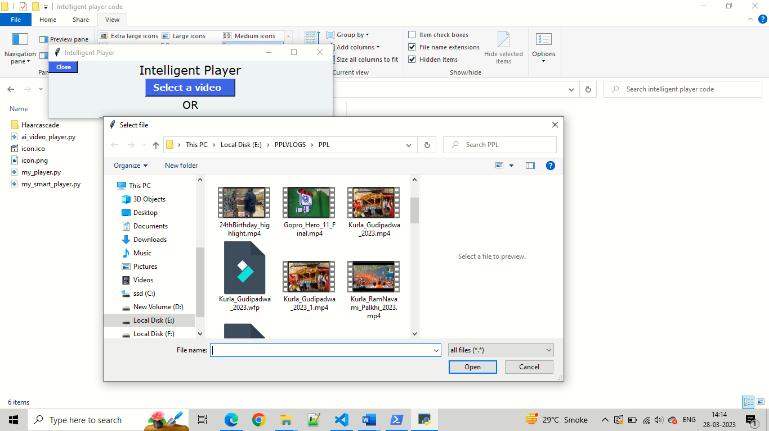
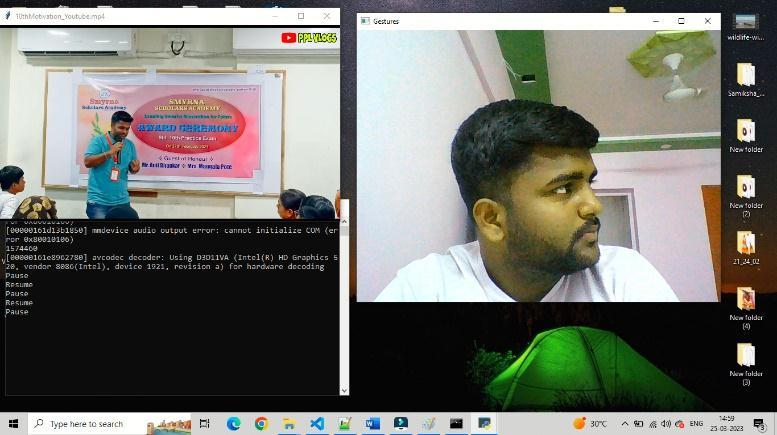
1.OncethePythonfilehasbeenexecutedaGUIwillappear thatwillaskinputfromusertoselectthevideowhichisto beplayed.

2.Once the GUI has appeared the user has to select the respectivevideowhichhe/shehastowatch.
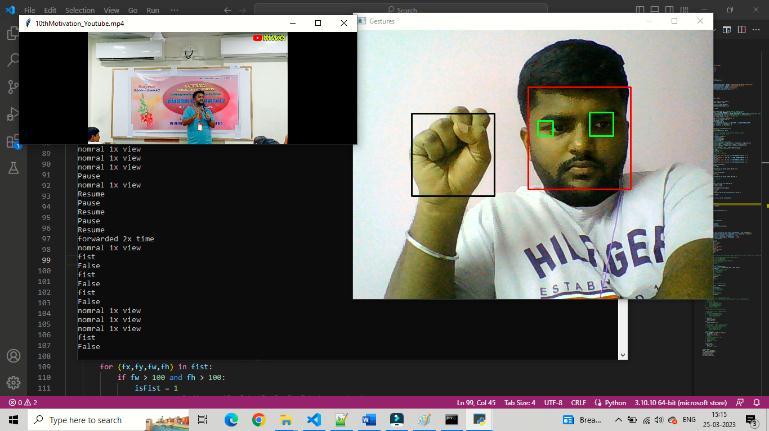
5.WhenFistisbeendetected,themediaplayerdecreases it’ssound.
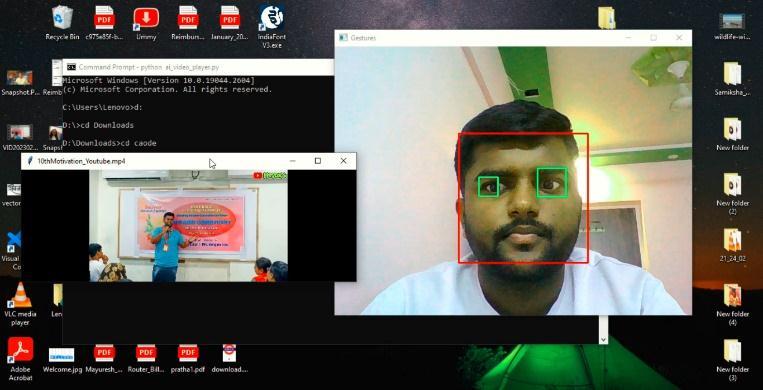
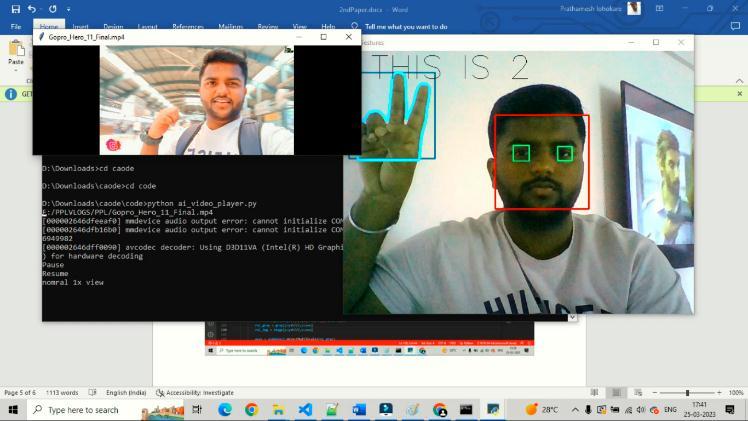
3.Afterselectingthevideo,thecamera will beenabledand When Face is Detected the media player will start automaticallyplayingthevideo.
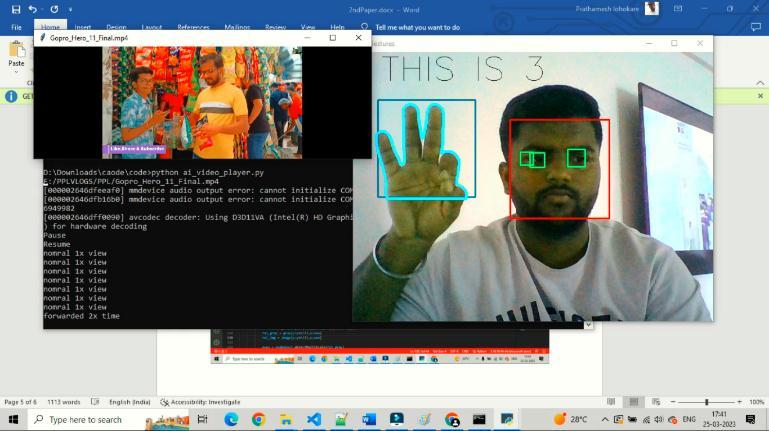
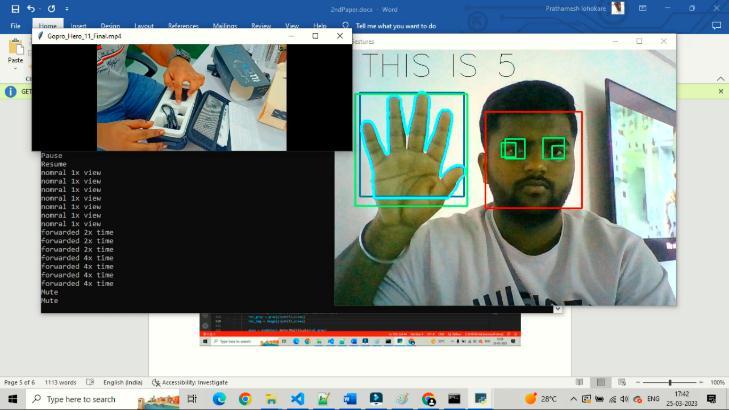
6.When3Fingersareshown,itwill forwardthevideo 2x Times
4.Herein2nd scenariowherethefaceisnotdetecteditwill pausethevideoplayer
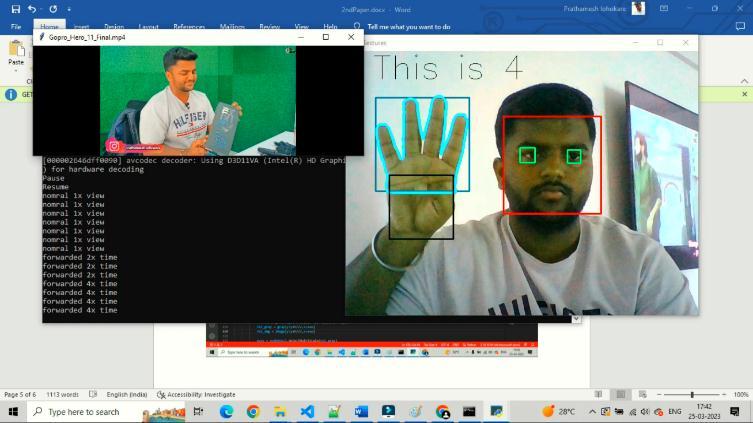
7.When4fingersarebeenshowed,themediaplayerwill forwardthevideo4xTimes
CONCLUSION
In this project, we aim to help the user get a better experience of using intelligent media players. We are doing this by using hand gestures and face detection for controlling features of the media player such as playing, pausing, forward, mute when proper hand guestures are being given as input. The main purpose of this research wastoexploreSystemthatallowsfordetectionoftheface andhandgestures. Thesystemhastobeuser-friendlyhis devicewillbevery usefulforpeoplewhoareparalyzedor handicapped as it would allow them to control their computerwithoutusingtheirhands
REFERENCE’S.
1. ISL: Vision based Hand Gesture Recognition Using DynamicTimeWarping.AhmedW,ChandaK,MitraS. Image processing based gesture recognition using dynamictimewarping.2016.
2. 2)Nithin Kumar ,Akshay Chalwadi,Ananthraj Upadhye,Dhanraj ,FACIAL AND HAND GESTURE BASED MEDIA PLAYER,International Journal of
Scientific&EngineeringResearchVolume10,Issue3, March-2019
3. Swapna Agarwal and Saiyed Umer, MP-FEG: Media Player controlled by Facial Expressions and Gestures,IEEE National Conference on Computer Vision, Pattern Recognition, Image Processing and Graphics(NCVPRIPG)19December2015
4. Hand Gesture Recognition for Controlling Multimedia Applications” by Neha S. Rokade, Harsha R. Jadhav, SabihaA.Pathan,UmaAnnamalai.
5. Culbert,Michael,"Personal mediadevice controlled via user initiated movements utilizing movement based interfacesJan.2015