Power Factor Detection and Data Analytics
1Student, Dept. of Electrical & Electronics Engineering, PES University, Bangalore

2Student, Dept. of Electrical & Electronics Engineering, PES University, Bangalore
3Student, Dept. of Electrical & Electronics Engineering, PES University, Bangalore
4Student, Dept. of Electrical & Electronics Engineering, PES University, Bangalore
5 Assistant Professor, Dept. of Electrical & Electronics Engineering, PES University, Bangalore ***
Abstract - With the growing power demand and increasing usage of energy, the traditional electricity transmission and distribution network can be improved into an interactive service or a smart grid. Smart meters are one of the main proposed solutions for the smart grid. Hence, the implementation of this can contribute to the detection of power factor value as well as other power parameters. This information can be useful if available to users directly, as it allows for comparison and analysis of the load's efficiency. The aim of the project is to provide a medium for this data transfer from server to the client in a secure and efficient manner. Thus involving data security and analytics. With the use of a personalized android application, the user can access the data easily.
Key Words: PowerFactor,Efficiency,SmartGrid,Android Application.
1.INTRODUCTION
With the growing power demand, the traditional electricity transmission and distribution network can be improvedintoaninteractiveserviceorasmartgrid.Smart meters are one of the main proposed solutions for the smartgrid.
The implementation of this network cancontribute to the detection of power factor value as well as other powerparameters. This information can be useful if available to users directly, as it allows for comparison and analysis of theload'sefficiency.Theaimoftheprojectistoestablisha secure and an effective medium to transfer data from the server to the client. The involvement of data encryption will further enhance the system. With the use of a personalized android application, the user can access the dataeffortlessly.
2. POWER FACTOR
The primary motive of any mechanized industry is the efficient utilization of energy. The power factor of any electrical system plays a significant role in determining
how efficient it is to do the useful work. The main definition of power factor (PF) of an AC electrical power system is “the ratio of the real power flowing to the load, to the apparent power in the circuit”. Real power (kW) is considered as the capacity of the circuit for performing work in a particular time whereas apparent power (kVA) istheproductofthecurrentandvoltageofthecircuit.
Reactivepoweristhepowerthatisn’tusedtodowork on load.
Theformulaofpowerfactorcanbeexpressedasfollows(1)
The ideal power factor is known to be unity, or one. It is the most desirable power factor value and anything less than unity means that extra power is required to achieve thesameoutput.
3. ZERO CROSSING METHOD
The main method used in the project to determine the power factor of an industrial load is the zero-crossing method. Zero crossing detection (ZCD) is the most common method for measuring the frequency or the periodofaperiodicsignal.Whenthefrequencyofasignal, usually the number of cycles of a reference signal is measured over one or more time periods of the signal beingmeasured.
Measuring multipleperiods helpstoreduce errorscaused by phase noise by making the perturbations in zero crossings small relative to the total period of the measurement.
Thenet resultisanaccuratemeasurementatthe expense of slow measurement rates. ZCD is one of the ways that can be used to find the power factor of a given load. The voltage and current wave-forms are recorded. From multiple cycles : each of 20ms (50Hz), the zero crossing point is determined. Since a 10 bit ADC is used (it has
1024 values), the zero crossing point found from the sensorisalwaysaround512.
4. SIGNIFICANCE OF DATA SECURITY
The main intention of data security is to ensure that only the authorized users can read, write and change the data thatisbeing transferredor received.In the project one of our main goals is to safe-guard the data being sent betweentheserverandclient.Toavoiddatabreaching,we have incorporated the concept of Firebase Real-Time Database security rules and an encryption algorithm. Its securityrulesdeterminewhohasreadandwriteaccessto your database, how your data is structured, and what indexes exist. Data values like the voltage, current and powerreadingswillbesharedviathefirebasedatabase.
5. METHODOLOGY
The complete integration of the hardware and software architectureisdoneforthedetectionofpowerfactorinan industrialenvironment.
Thepowerfactorvaluesarefoundusingthezerocrossing method.Therawsensorvaluesrecordedfromthecurrent and voltage sensors are plotted. The graph obtained has two sinusoidal waveforms, one being the voltage and one being current. The zero crossing point of both the waveforms are found and then, the time difference is found between them. The smart meter will send the calculated values (Power, Power factor, Penalty factor, Powerconsumption)inanencryptedformattotheonline database where the data will be stored. This encrypted data will then be available for access to the user on another database, where individual values will be decrypted and shown accordingly. the user with the help ofanandroidapplicationcanviewthecollecteddatafrom theloadsconsideredinanorganizedmanner.
6. HARDWARE ARCHITECTURE
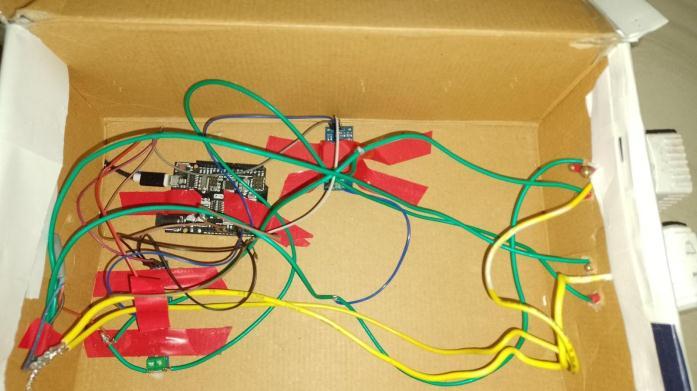
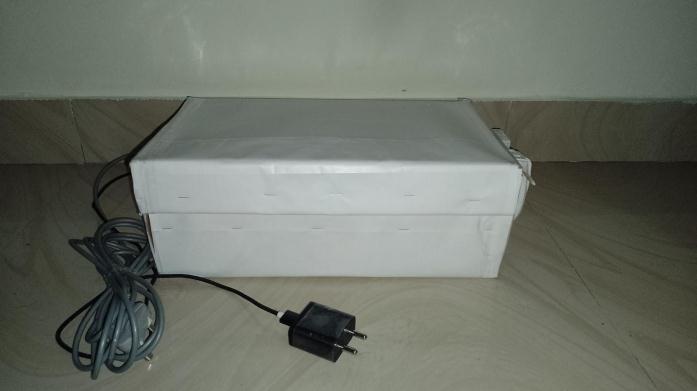
This product's hardware revolves around the design and operationofasmartmeter.Thesmartmeterthatwehave built can take two loads into consideration (working in tandem). A voltage sensor (ZMPT101B) and two current sensors (ACS712) are used to record the V and I values respectively.Thevoltagesensorisconnectedinparallelto both the loads, whereas two current sensors are used individuallyforeachload(connectedinseries).
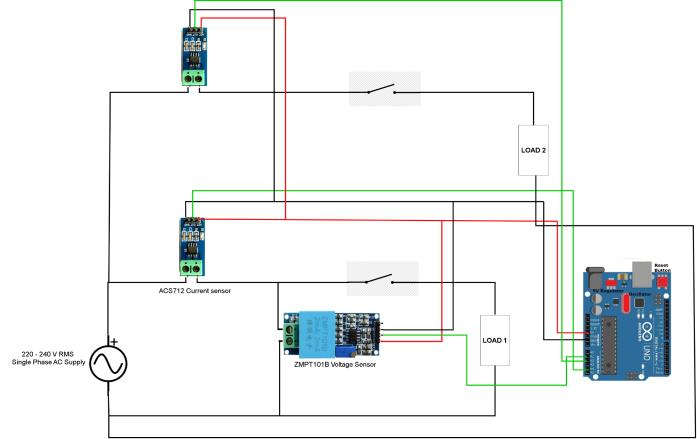
The raw sensor voltage will be converted to current this way: raw voltage * resolution. This will be subtracted by 2.45 (offset value). We divide the final voltage by 0.185 which is the sensitivity for acs712, as given in the datasheet.
We take 235 current values which when combined contribute to a current waveform. We then find the peak current value out of the 235 recorded data sets. So the maximum current value is Im, which when divided by √ givesusthermsvalueofcurrent.
The rms current value can be further used to determine thepowerfactorvalues.
n addition to current parameters, raw voltage sensor values are recorded. Since a 10 bit ADC is used (ATMEGA328P), there are 1024 analog values. It is understoodthat thezerocrossing point of the sensor will be around512, which when compared withtheoperating voltage of the sensor (5V), is 2.5V. So by default, 512 is subtracted from the analog value read from the sensors. Each recorded value is squared, 1000 such values are consideredwhere eachvalueisreadevery1 or2ms. The mean value of the 1000 values is found and the square rootofthesameiscalculated.Whichwhenmultipliedwith 1.5 (amplification factor) gives out the Root Mean Square Voltage.
Android Studio is a reliable platform to create android projects/apps that can be accessed on devices like smartphones, tablets, etc. Android Studio along with its Gradle-based build system extends a consolidated environment where we can develop for various android devices and hence, provides extensive testing tools and frameworks.
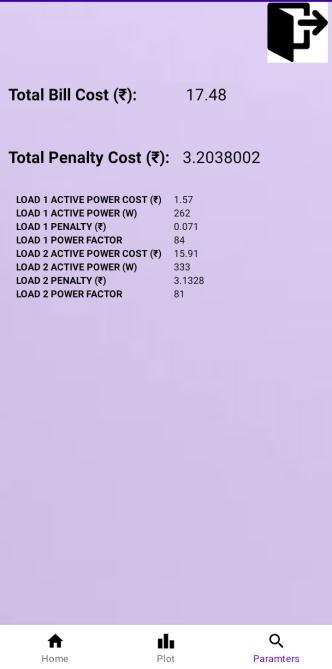
In the app developed, we have established a connection between the Android Application and the firebase database. The application will retrieve data values from thefirebaseinasecureencryptedformat,andasaresultit will display the analyzed data in an interactive-unique stylefortheendusertoview.

The smart meter will send the calculated values (Power, Power factor, Penalty factor, Power consumption) in an encrypted format to the online database where the data will be stored. This encrypted data will then be available for access to the user on another database, where individual values will be decrypted and shown accordingly. the user with the help of an android application can view the collected data from the loads consideredinanorganizedmanner.
8. CALCULATIONS
Thepowerfactorcalculationscanbedoneaccordingtothe approachimplementedbelow:
Time Difference = 20 ms => Phase Difference = 360 degrees
TimeDifference=2ms=>PhaseDifference
= =
Therefore,powerfactor=cos( )=0.8
If the power factor is found to be less than 0.85 , a surchargeof30paiseperunitconsumedwill betaxedfor every reduction of Pf by 0.01, below 0.85. For example, if theaveragedpowerfactorwas0.75for1unit,the penalty factor would be:
9. CONCLUSION
Thisprojectdealswiththedesignandimplementationofa model which enables users to directly access the power figures and efficiency of the load used. The model also permits the comparative analysis between two different apparatusrunningintandem.Withthehelpofanandroid application,wehavegiventheuseramediumtoaccessall the necessary information and the added feature of cost and penalty factor based on power consumption. The transferandstorageof suchimportantinformation, made it susceptible to malware and cyber-attacks, and thus we have also implemented an encryption and decryption processthusmakingthedatatransfersafeandsecure.The mainreasonastowhyourmodelissoefficientisbecause the entire process happens on a real time basis and is automaticallyupdatedaftereverytimeinterval.
10. FUTURE SCOPE
Withthehelpoftheproofofconceptexplained,theproject can be extended to industry standards and provide an online platform to perform effective data analytics on power parameters which will prove to be very useful in differentapplications.
11. REFERENCES
[1] Herrmann, Christoph & Posselt, Gerrit & Zein, André. (2010). Industrial Smart Metering – Application of Information Technology Systems to Improve Energy EfficiencyinManufacturing.
[2] A.R.Al-Ali,I.A.Zualkernan,M.Rashid,R.GuptaandM. Alikarar,"Asmarthomeenergymanagementsystemusing IoTandbigdataanalyticsapproach,"inIEEETransactions on Consumer Electronics, vol. 63, no. 4, pp. 426-434, November2017,doi:10.1109/TCE.2017.015014.
[3] Mishra, Nikhil & Kumar, Vinay & Bhardwaj, Garima. (2019). Role of Cloud Computing in Smart Grid. 252-255. 10.1109/ICACTM.2019.8776750.
The energy charges are considered from Bangalore Electric Supply board’s Documentation for 2022 - 2023 period. Since the proposed product finds power parameters for loads individually, a mean value of the above tariff rates is considered for simplicity. So, for one unit, the cost wouldbe:
[4] Xun Li, Qingwu Gong, Member IEEE, Xiao Zheng,“The applicationofIOTinpowersystems”,inIEEE2011,978-14577-1002-5/11
[5] DeepakK.D.andPawanD.,―PerformanceComparison of Symmetric Data Encryption Techniques‖ ISSN: 2278 –1323 International Journal of Advanced Research in Computer Engineering & Technology Volume 1, Issue 4 June2012.