Digitalisation of Education with NEP - 2020 and its Impact on Quality of Life
Priyam Vishwakarma1 , Disha Singh21Research Scholar, Faculty of Commerce, Banaras Hindu University, Varanasi

2 Research Scholar, Faculty of Commerce, Banaras Hindu University, Varanasi ***
Abstract - This study is designed to investigate the impact of NEP 2020 with digitalisation on quality of life and society. The convenience sampling technique was used to draw sample size and use causal research methodology. Study data were collected from students, academicians and other respondents through a structured questionnaire method. As part of the study, 235 responses were collected from the respondents. In order to analyse the responses, the study was carried out using various statistical tools like exploratory factor analysis (EFA), confirmatory factor analysis (CFA) and linear regression. The finding shows that NEP 2020, with digitalisation, positively and significantly influences the quality of life. NEP 2020 policy is a popular education policy for educational reforms and for a better future of society but the expected implementation of the policy in the context of digitalisation, it would be very difficult, because it needs proper flexible lifelong education and training. So, our policymakers, democratic representative and educational institutions should focus on experimental learning, digital infrastructure, and skill formation and promote digitalisation in education to improve individuals' collaborative learning and quality of life.
Key Words: NEP 2020,Digitalisation,Qualityoflife,Education.
1. INTRODUCTION
Thesuitableanddynamicadjustmentsintheeducationalsystemthatpeopledesiretoadoptovertime,dependingonhow adoptingculturalexpectationsgrow,haveanimpactonsocialgrowthandimpartialdemocraticprocesses.Educationasa wholeisaqualitativephenomenonwithenormouspotentialtoinfluencesocial,cultural,political,economic,andscientific aspectsofhumanexistence.
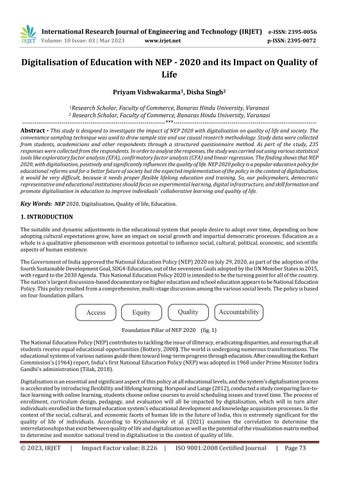
TheGovernmentofIndiaapprovedtheNationalEducationPolicy(NEP)2020onJuly29,2020,aspartoftheadoptionofthe fourthSustainableDevelopmentGoal,SDG4-Education,outoftheseventeenGoalsadoptedbytheUNMemberStatesin2015, withregardtothe2030Agenda. ThisNationalEducationPolicy2020isintendedtobetheturningpointforallofthecountry. Thenation'slargestdiscussion-baseddocumentaryonhighereducationandschooleducationappearstobeNationalEducation Policy.Thispolicyresultedfromacomprehensive,multi-stagediscussionamongthevarioussociallevels.Thepolicyisbased onfourfoundationpillars.
FoundationPillarofNEP2020 (fig.1)
TheNationalEducationPolicy(NEP)contributestotacklingtheissueofilliteracy,eradicatingdisparities,andensuringthatall studentsreceiveequaleducationalopportunities(Bottery,2000).Theworldisundergoingnumeroustransformations.The educationalsystemsofvariousnationsguidethemtowardlong-termprogressthrougheducation.AfterconsultingtheKothari Commission's(1964)report,India'sfirstNationalEducationPolicy(NEP)wasadoptedin1968underPrimeMinisterIndira Gandhi'sadministration(Tilak,2018).
Digitalisationisanessentialandsignificantaspectofthispolicyatalleducationallevels,andthesystem'sdigitalisationprocess isacceleratedbyintroducingflexibilityandlifelonglearning.HorspoolandLange(2012),conductedastudycomparingface-tofacelearningwithonlinelearning,studentschooseonlinecoursestoavoidschedulingissuesandtraveltime.Theprocessof enrollment, curriculum design, pedagogy, and evaluation will all be impacted by digitalisation, which will in turn alter individualsenrolledintheformaleducationsystem'seducationaldevelopmentandknowledgeacquisitionprocesses.Inthe contextofthesocial,cultural,andeconomicfacetsofhumanlifeinthefutureofIndia,thisisextremelysignificantforthe quality of life of individuals. According to Kryzhanovsky et al. (2021) examines the correlation to determine the interrelationshipsthatexistbetweenqualityoflifeanddigitalisationaswellasthepotentialofthevisualizationmatrixmethod todetermineandmonitornationaltrendindigitalisationinthecontextofqualityoflife.
India'sEducationPolicy2020ensuresthateveryindividualneedtodeveloptheircreativepotential.Educationdevelopsnot onlycognitiveabilitiesandskills,butalsoemotional,socialandethicalskillscapacity.This policyis basedontheideaof education.Italsoprovidesthenecessarytools,andresourcesfordevelopinghigher-ordercognitiveandcriticalthinkingability.
2 Review of Literature
2.1 NEP 2020 POLICY
Educationplaysapowerfulroleinbuildingthenationanddecidesthenation'sfutureanddestinyofthepeople(PawanKalyani, 2020).India’seducationsystemhasbeenactiveandrunningforthelast34yearsandin2020newradicalreformshavebeen seenafterthesupplementationofNep2020intheforthcomingyear.ThevisionofNEPis“Byensuringthateveryonehasaccess toahigh-qualityeducation,theNationalEducationPolicy2020aimstocreateaneducationsystemthatisfocusedonIndiaand directlycontributestoourcountry'ssustainabletransformationintoajustandthrivingknowledgesociety”.NEP2020isthe besteducationpolicyofthe21stcentury,designedtoaddresssomeofthecountry'sgrowingdevelopmentneedsandpropose therevisionandrevampingofallaspectsofeducationstructure(NEP,2020).Nationaleducationpolicyhelpsintacklingthe problemofilliteracy,eliminatesdisparities,andprovidesequalandfavourableeducationalcircumstances(Bottery,2020).This policy provides an amalgamation of concepts on providing student competency based on education (Shi et. al, 2020). GovernmenthasalsodecidedtoestablishtheNationalresearchfoundationasanautonomousbodyunderNEP2020(Panditrao & Panditrao, 2021). In NEP 2020 also focused on the digitalisation of education. According to R.E. Navarro et.al (2011) integrationoftechnologyinlearningprocessenableinteractionandinterrelationwithinongoingcommunicationprocess.The emergenceofnewonlineapplicationsandtoolshasthepotentialtotransformeducationbyexpandingaccesstoeducationand enhancinglearningoutcomes(Correa,2008).Wealsoknowthateducationisalsopartoflifeandqualityoflifealsodependson education.Thecompletionofsecondaryeducationandfreebasiceducationaremorelikelytoimprovequalityoflife(Ngelu et.al,2017).Differentstudieshaveexploreddifferentlevelsofeducationandassociateditwithdifferentpositiveoutcomes, includinghealth,well-beingandhighersocialtrust(Manstead,A.,2014).
2.2 Digitalisation
Digitaltechnologyhaschangedtheeducationscenariobyenhancingteaching,learning,researchandgovernance(Shrivastav& Shrivastav,2022).Incorporatingtechnologyintoeducationoffersvariousbenefits,includinglowcost,quickaccess,easiness, andflexibility(Saileelaetal.,2020).Inrecentyearshigher,educationalinstitutionshavealsoexperiencedvariousimportant changesderivedfromtechnologicalandsocialtrendstowarddigitisation(Milicevic,2015,Ghemawat,2017).Adoptionof informationtechnologybyeducationalinstitutionsisconceivedasaninterconnectedenvironmentenablingstudentdigital learning(Chen&Wu,2020).Inthisregard,NEP2020considersoneoftheprincipleswhichis“exclusiveuseoftechnologyin teachingandlearning.SustainableeducationfromtheperspectiveofICTconsiderssocialtransformation,enablingstudentsto transformthemselvesandthesocieties,inwhichtheylive(Cantwell,2020)&(Baseletal.,2017).Fu(2013)highlightsthe appropriateuseofICT,whichefficientlyraisespeople’s,educationquality.Nationaleducationpolicyhasdoneastellarjobof imbibing technology in education, in Indian context; this also connects what needs to be addressed for the proper implementationoftheNEP2020(Chakraborty,2022).Inoureducationsystemindigitaltransformation,considerSWAYAM, SWAYAMPRABHAetc.,whichenhanceteachingandlearningcapability.
2.3 Quality of Life
Educationiskeyissueinresearchstudiesandinpublicdebateonqualityoflife(DonDumitruionescuetal.,2013).Education bringsarangeofreturnsthatbenefitboththepersoninvestingintheeducationandcommunityinwhichtheylive(Stiglizetal., 2009,p.).Insocialoutcomesofeducation,Pfeifer(2007)mentionedthatawell-educatedpersoncouldachievesocialand economicprogressandahighstandard oflivingwhichpositivelycorrelatedwitheducation.Worldorganizationslikethe UnitedNationDevelopmentProgram(UNDP),theWorldHealthOrganization(WHO),andtheWorldBankpopularizedthe conceptofqualityoflifeasameansofassessingpeople'slivingconditions.Lonesusetal.(2003)emphasizetherelationship betweeninvestmentineducationandqualityoflife.QualityoflifeisalsorelatedtoNEP2020policy.Acomplexissueand a clearresultofcriticalthinkingacrossstakeholdersandsocialdevelopmentwasarticulatedinapolicycalledNEP2020.NEP 2020ispopularforeducationforeducationalreformsforabetterfutureinthecontextofqualityoflife(Muralidharanetal., 2022).TheUnitedNations'fourthsustainabledevelopmentgoalmakesitabundantlyclearthattheeducationsystem'sprimary objectiveshouldbetoprovide"QualityEducation,"andithasoutlinedspecificactionsthatmustbetakenby2030.Qualityof lifeisdeterminedbyabilitytobuildupsocialcapital,achieveprofessionalgoalsandreducedqualityeducation(Kryzhanovskij &Baburina,2021)
3. Research Gap
Afteracriticalevaluationofpreviousliteraturerelatedtoeducationandqualityoflife,itwasobservedthat,mostofthestudy considerthatqualityoflifealsodependsontheindividual'seducationlevel.Thereareveryfewstudywhichfocusoneducation withdigitalisationanditsimpactonqualityoflife.So,inthisstudy,weconsiderourneweducationpolicywithdigitalisation andit’srelationswithqualityoflife.
4. Research objective
WeallknowthatNEP2020policynotfullyimplementedalloverthecountry,itsisinintroducingphaseinoperation,sothere aredifferentviewsofpeopleaboutNEP2020,whichalsoconsiderdigitalisationanditsimpactontheirqualityoflifesothe objectiveis
ToanalysetheNEP2020withDigitalisationanditsrelationshipwithqualityoflife.
5. Hypothesis
H0:ThereisnosignificantrelationshipbetweenNEP2020withdigitalisationandqualityof Life.
H1:ThereissignificantrelationshipbetweenNEP2020withdigitisationandqualityoflife.
6. Research Methodology
6.1 Research design and Sampling
Thisstudyisdescriptiveandcausalinnature,wherewestudytheimpactofNEP2020withdigitalisationonqualityoflifeof individualinsociety.Samplingdesignforthisstudywasframedbasedonpreviousempiricalstudies.Inthisstudy,primary datawerecollectedbyusingconveniencesamplingtechniques.Inthisstudytargetpopulationareacademicianetc.wherewe collectedtheirviewsandopinionaboutitsimpactontheirqualityoflife.
6.2 Data collection
Thedata werecollectedthrougha structuredquestionnairemethodusing bothonlineandofflinemodes, where wehave distributedmorethan300questionnaires;outofthese,wegot235responsesfromrespondents.
6.3 Variable measures
Inthisstudy,weconsidertwoconstructs:NEP2020withdigitalisation,whereweconsider12itemsrelatedtoNEP2020and 10itemsofdigitisationinNEP.Thescaleusedinthisstudyisbasedonafive-pointLikertscalefromstronglyagreetostrongly disagree.Anotherconstructisqualityoflife,whichconsidersrealincome,individual’sethical,moralandsocial practices, reductionofsocialconflictsandincreasesocialinterest,socialdevelopmentetc.sohereweconsider4itemsbasedonafivepointLikertscalefromveryhightoverylow.Weadoptedthesestructuredquestionnairesfrom(Muralidharanetal.,2022)and modifieditaccordingtoourstudy.
6.4 Data Analysis tools
Inordertoexaminethecollecteddata,exploratoryfactoranalysis(EFA)andconfirmatoryfactoranalysiswereusedbecausein studywhichscaleandtheitemadoptedhasbeenmodifieditaccordingtoourstudyandvalidateditwiththesetools.Instudy wealsoappliedlinearregressiontoknowtheimpactofNEP2020onqualityoflife.
7. Data Analysis
7.1 Demographic Profile of the Respondents
Intotal,235responsesinagewedivideditintofourcategories,inwhich,from18to21years,129respondentsare54.9%of thetotalresponse.Theothergroupis22to25,considering76respondents,whichis32.3%oftheresponse.In26to30years agegroup,thereare26respondents,whichis11.2%andthelastagegroupismorethan30considering4respondentswhich 1.7% of the respondents. In education, we consider graduation were 135 respondents with 57.4%, in postgraduation 74 respondentswith31.5%andinPh.D.andothers,thereare26respondents.Inoccupation,weconsiderstudents,academicians, andothers,wherethereare214studentswith91.1%,and12academicians,and9otherrespondents.
7.2 Reliability
Reliability Statistics
Sources:
Acronbach’salpha0.70oraboveisconsideredanacceptablelimit,whichdescribesthedata’sappropriatenessandreliability forresearchpurposes(Nunnally,1978).ThevalueattainedinCronbach'salphais0.852,whichismoresignificantthanthe prescribedlimitwith26itemsofthestudy.Whichindicatesconsistencyintheresearch.
7.3 Normality Measurement
Table 3
Source: Authors’ calculation
Atthetimeofdataanalysis,normalityisnecessaryindata,whichisthebasicassumptionfortest(Hairetal.,2015).Inorderto assess the data normality, skewness and kurtosis calculation were made, and the results are shown in table 3. As all the variables’skewnessandkurtosisvaluesfallwithintheacceptablerangeof+2(Tabachnick&fidell,2007)and+7(Byren,2010), respectivelytheresultsdemonstratethenormalityofthedata.
7.4 Factor Analysis
Infactoranalysis,consider26itemsinwhich12itemsarerelatedtoNEP2020policy,10arerelatedtodigitalisation,and4are relatedtoqualityoflife.Fortheanalysispurposeusedprinciplecomponentmethodofexploratoryfactoranalysis.Furtherfor thedataanalysis,exploratoryfactoranalysiswasused,andforthesuitabilityofthedataKaiser-MayerOlkinandBartlett’sTest ofSphericitywasperformed(Hairetal.,2010).
Twoveryimportantfactorswereextractedintotalvariance,whichexplainedmorethanoneeigenvalue.In26itemsafterthe factoranalysis,weconsideronly14itemsfortheanalysispurpose.Inthisanalysis,twoimportantfactorsrepresent76.867%of thetotalvariance,whichisgreaterthan60%(Hairetal.,2010),anditisacceptableforthefurtherprocessasmentionedbelow:
7.5 Total Variance Explained
Intherotatedcomponentmatrixvarimaxmethodwasperformedforfactorloading,inbelowtable,whichshowsthefactor loadingofallusedstatements.Theloadingofallgivenstatementsaremorethan0.5whichconsiderssatisfactoryoutputand makesit’ssuitableforfurtheranalysis.
7.6 Rotated Component Matrix
DG_4(Educationalvideos,animations,andpicturecontentaregoingtobethenewmantraofteachingandlearning)
DG_3(Teachingandcriticalthinkingintheprocessoflearningaregoingtobecompromisedintheonlinemode)
DG_2 (Online education for regular coursesputsfinancialburden on both providersand usersand also on the government)
DG_1(Themassonlineprogramandcomputerizednetworkeducationsystemwilltakecareofinclusiveeducation.)
DG_5(Videosandonlinedemonstrationboardsaregoingtoberevitalizingvariousdimensionsofthecreationand disseminationofknowledge)
NEP_4(Digital libraries are the future realities and source of considerable information and knowledge for the creativeandinnovativeeducationaldevelopmentofindividuals.)
NEP_1(Asenvisagedbytheglobaleducationagenda(SDG-4)andsubsequentlybyNEP2020,itispossibletoattain optimaloutcomesinthedomainsofphysical,mental,andemotionaldevelopment)
NEP_3(Thetechnology-assistededucationalsystemthroughenjoyableandinspirationalbookswouldcreatean enormousimpactonthevaluesystemofindividuals) .762
NEP_2(Theprofessionallyqualifiededucatorsandcontinuousassessmentcouldcreateastrongfoundationforearly childhooddevelopmentandqualityeducationforafutureparadigmshiftinthequalityoflife.) .709
NEP_5(Theoverallinitiativesandcomprehensiveapproachwillbeundertakentoreducedrop-outratesdrastically)
QOL_4(NEP2020wouldenable,individualswhoeffectivelyparticipateinthedigitalizeddemocraticprocess,to provideappropriatesocialdevelopmentandproperfunctioningofdemocraticinstitutionsmoretransparentlyand equitably.Thisoutcomeisexpectedtobe…) .918
QOL_3(Overallsocialdynamicsintermsofreductioninthesocialconflict,anamalgamationofsocialinterest,and socialdevelopmentwillbe….)
QOL_1(AfterformallygoingthrougheducationbasedonNEP2020yourchanceofincreasingrealincomeisfairly…)
QOL_2(NetconsequencesofNEP2020onindividual’sethical,moral,andsocialpracticesinday-to-daylifewillbe…)
Rotation Method: Varimax with Kaiser Normalization
Source: Authors’ calculation
7.7 Confirmatory Factory Analysis
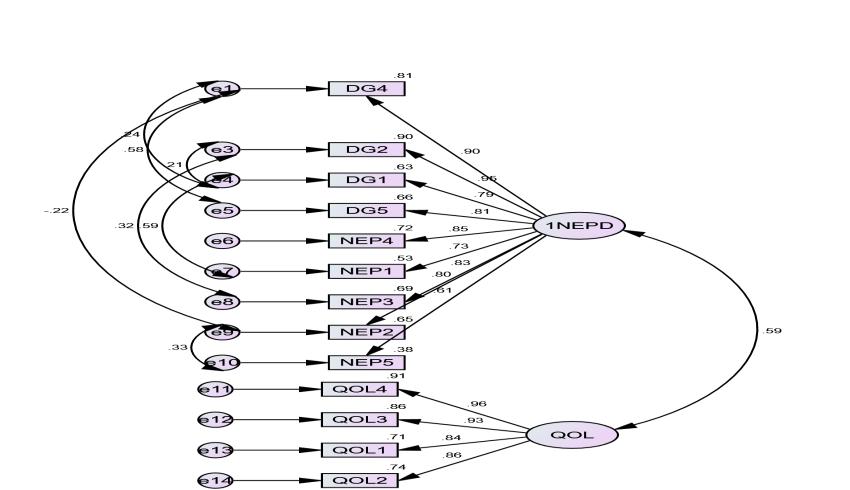
Thevalidityofthemodelinastudyconsidersconfirmatoryfactoranalysiswithamaximumlikelihoodprocesstogetthefactors loadingvalues,reliabilityandvalidityofthescalemeasurementmodel.Presentmodelfitnessismentionedintable,which representsthevalueofthresholdlimitoffitindices.Themainindicatorofgoodmodelfitnessoutputischisq/dfvaluewhichis 2.030anditconsiderwithintherangeofacceptablelimitwhichislessthen3(Hairetal.,2010).
7.8 Model Fit Measures
Pvalueofmentioneditemislessthan0.001,whichshowsthatallitemsaresignificantlyloadedontheirrespectiveconstructs, andallconsidereditemshavestandardizedfactorloading,whichisabove0.07,whichshowscompositereliability(CR)and discriminantvaliditywhichusedfortestingthehypothesis.
7.9 Factors loading, validity and reliability of items
Table 8
Source: Authors' calculation
Convergentvalidityrepresentstheacceptedvalueforalltheconsideredconstructs,anditacceptablelimitshouldbemorethan 0.50(Hairetal.,2010).Thediscriminantvalidityalsoshowedanacceptablevalueforagivenconstruct;itshouldbegreater than0.70.Inthestudy,allconstructshavemorethan0.70(Nunnally&Bernstein,1994).
7.10 Regression Analysis
Impact of NEP 2020 with digitalisation on Quality of life
a.Predictors:(Constant),Total(NEPD)NEP&Digitalisation
b.DependentVariable:QOL
Source: Authors’ calculation
Asindicatedinabovetable
Rshowsacorrelationcoefficientamongtheexogenousandendogenousvariables,whichis.726,anditshowsavery strongandpositivecorrelationbetweenNEP2020withdigitalisationandqualityoflife.
Rsquareasthecoefficientofdeterminationwhichshowstheproportionofvarianceinthedependentvariablethatcan beexplainedbytheindependentvariable.Fromthegiventablevalueof.528thatourindependentvariableexplained 52%ofthevariabilityofourdependentvariable,i.e.qualityoflife.
Table 10
a.DependentVariable:totalqol
b.Predictors:(Constant),TotalNEPD
Intheabove(table10)95%confidenceintervalor5%significancelevelischosenforstudypurposes,andthep-valueshould belessthan0.05.Intheoutput,itis0.000;thereforeresultissignificant.ThevalueofFisgreaterthan1,andthemodelis efficientmodelandthevalue93.775,whichisgood.
a. Dependent Variable: totalqol
StatisticallysignificantofindependentvariableispredictingthequalityoflifebecausethePvalueislessthan0.05,anditis significant.So,wecansaythatournullhypothesisisgettingrejected,andthealternativehypothesisisgettingaccepted.
8. Finding of the study
Inthisstudy,weconsidertwofactors,andaftertheanalysis,wefindthatdigitisationinNEP2020affectsthequalityoflifeofan individual.Thisstudyisalsosupportedby(Muralidharanetal.,2022).Sothequalityofeducationandeducationsystemlargely determinesinnovations,economicgrowth,socialjusticeandqualityoflife(Ball,2016,Mundy,Green,Lingard,&Verger,2016). SoNEP2020emphasizesonimportantparametersofqualityeducationsuchasbetterenrolmentinhighereducation,teaching and learning outcome etc. (Kishore Kumar et al., 2020). In terms of digitalisation and its impact on quality than not only transformthewaypeopleinteractwiththeworldaroundthembutalsochangestheirinternalworld:likeattitudetotheworld, tooneselfetc.(Fors,A.C.etal.,2010).Invariousstudiespointoutthatthepositiveornegativeimpactofdigitalisationon qualityoflifedependsonsocialeconomicandpoliticalconditionsandprocesses(Kryhanovskijetal.,2021).
9. Conclusion and Implications
Educationisoneoftheimportantpartsoflife,andthequalityoflifedependsonqualityofeducation.Thegovernmentplanson digitisation,amultidisciplinaryapproachandlifelonglearningtostrengthenthequalityoflife.BetterimplementationofNEP 2020strengthenssocialwell-being,livingstandards,growthandprosperity.So,thegovernmentandpolicymakershould focus onproperimplementationofNEPandalsoshouldfocusonthosethingsineducationwhichimprovetherealqualityoflifeof people.Itisconsideredthatsystemwillbebestandperfectifitproducesthedesiredresult,whenitisimplementedonground levelandinaverypracticallymanner.So,therewehavetowatchtheimplementedversionofNEP.
10. Limitations and Future Scope of the Study
ThisstudyfocusedonestablishingtherelationshipbetweenNEP2020withdigitalisationandqualityoflife.Therefore,welimit thescopeofourstudy Further,NEP2020makesavailableavarietyofotherfactors.Wecanrelateittothosefactorswith qualityoflife.Thelimitationofthestudyisthat,thisstudyconsidersonlylimiteddata.Atthetimeofdatacollection,wefound out that many people were not aware of NEP 2020 policy. In the further scope of the study, we can work on a better implementationstrategyforNEP2020inthewholecountry,whichenormouslypromoteseducationawarenessandimproves thequalityoflife.
REFERENCES
[1] Alkire,S.,Humandevelopment:definitions,critiquesandrelatedconcepts.Oxford PovertyandHumanDevelopment Initiative,WorkingPaper36,2010
[2] Ball,S.J.(2016). Following policy: Networks, network ethnography and education policy mobilities. Journal of Education Policy,31(5),549–566.https://doi.org/10.1080/02680939.2015.1122232
[3] Baser, D.; Ozden, M.Y.; Karaarslan, H. (2017). Collaborative project-based learning: An integrative science and technological education project.Res.Sci.Technol.Educ.,35,131–148
[4] Bottery,M.,2000. Education, Policy and Ethics. A&CBlack
[5] Cantwell,B.(2020).Explanatoryaccountsininternationalandcomparativehigher educationresearch.High.Educ.Q., 74,149–161.
[6] Chakraborty,B.(2022).NationalEducationPolicy-2020:Opportunities,ChallengesandImplications(BookChapter). January.
[7] Chen, C.-L.; Wu, C.-C. (2020). Students’ behavioral intention to use and achievements in ICT-Integrated mathematicsremedial instruction: Case study of a calculus course. Comput.Educ.,145,103740.
[8] Correa,D.K.EducationandTraining.In Digital Quality of Life: Understanding the Personal and Social Benefits of the Information Technology Revolution; Information Technology and Innovation Foundation:Washington,DC,USA,2008; Chapter4.
[9] Fu,J.(2013).The complexity of ICT in education: A critical literature review and its implications. International Journal of Education and Development using ICT,9(1),112-125.
[10] Hair,J.F.,Anderson,R.E.,Babin,B.J.andBlack,W.C.(2010),MultivariateDataAnalysis:AGlobalPerspective,Vol.7, PearsonPublisher,UpperSaddleRiver,NewJersey.
[11] Horspool,A.,&Lange,C.(2012).Applying the scholarship of teaching and learning: Student perceptions, behaviours and success online and face-to-face.Assessment&EvaluationinHigherEducation,17(1),73–88
[12] Kryzhanovskij,O.A.,&Baburina,N.A.(2021).How to Make Digitalization Better Serve an IncreasingQualityofLife ?1
11.
[13] Lonescu, D.D.; Lonescu, A.M.; Jaba, E. The Investments in Education and Quality of Life. J. Knowl. Manag. Econ. Inf. Technol.2013,3,70
[14] Manstead,A. The wellbeing effect of education. Evid.Brief.2014,34,1–2.
[15] Milicevic,M.(2015). Contemporary education and digital technologies. Int.J.Soc.Sci.Humanit.,5,656–659.
[16] Mundy,K.,Green,A.,Lingard,B.,&Verger,A.(Eds.).(2016).Handbookofglobal education policy. WestSussex,UK: JohnWiley&Sons.
[17] Muralidharan, K., Shanmugan, K., & Klochkov, Y. (2022). education sciences The New Education Policy 2020 , Digitalization and Quality of Life in India : Some Reflections.
[18] NEP2020.NationalEducationPolicy2020;Ministry of Human Resource Development, GovernmentofIndia:NewDelhi, India,2020.
[19] Ngelu,J.M.;Omwenga,J.;Mungatu,J.;Iravo,M. Effect of Free Basic Education on Improving Quality of Life in Kenya: EvidencefromMachakosCounty.Dev.Ctry.Stud.2017,7,54–62.
[20] NunnallyJC(1978)Psychometrictheory,2ndedn.McGraw-Hill,NewYork.
[21] Pfeifer,A., Good Practices in Basic Education in Latin America, OECDConference,Istanbul,Turkey,2007
[22] R.E.Navarro,M.J.Pacheco,Y.N.Rangel,&M.S.Montoya,(2011).Interregional research forum on virtual learning environments: Integration of academic and technological networks. México: Redtic. pp.154
164.
[23] Saileela,K.,Lawrence,A.S.A.,&Kalaivani,S.(2020).Technologyusageandtechnologyaddictionofhighersecondary students.JournalofXi'anUniversityofArchitecture&Technology,12(4),2588-2602.https://xajzkjdx.cn/gallery/242april2020.pdf
[24] Shi,J.,Orkin,J.,Chu,S.,Walsh,C.,Keilty,K.J.,McKay,S.,etal.,2020. Paediatric tracheostomy care: an evaluation of an innovative competency-based education program for home care nurses. B51. Pediatric Sleep II. American Thoracic Society,p.A3682.
[25] Stiglitz,J.E.,Sen,A.K.,Fitoussi,J.P., Report by the Commission on the Measurement of Economic Performance and Social Progress; www.stiglitz-sen-fitoussi.fr,2009
[26] Tilak,J.B.(2018).TheKotharicommissionandfinancingofeducation. In Education and Development in India (pp.255282).PalgraveMacmillan,Singapore.