GrowFarm – Crop, Fertilizer and Disease Prediction usingMachine Learning
Suresh Singh Rajpurohit1 , Sowmen Parui2 , Rakshita Bhole31 Assistant Professor, Dept. of Information Technology, Thakur College of Science and Commerce,Mumbai, India.

2 Undergraduate Student, Dept. of Data Science, Thakur College of Science and Commerce, Mumbai,India.
3 Undergraduate Student, Dept. of Data Science, Thakur College of Science and Commerce, Mumbai,India. ***
Abstract - Thefarmingindustryisextremelyimportantin India for economic growth and employment creation. Agriculture employs around 48% of the inhabitants in India. It gives locals the opportunity to work and contributetothegrowthofacountrylikeIndiaonalarge scale,aswellasstrengthenstheeconomy,asagricultureis the backbone of India's developing economy. Farmers have always followed historical agricultural techniques and traditions. But, a single farmer cannot beexpected to consider all of the numerouselements that influence crop development. A single erroneous judgment made by the farmer might have unfavorable consequences. The project's goal is to help farmers determine the quality of their soil and analyze its many properties, as well as to propose crops and fertilizers based on the results of a machine-learning approach. The system utilizes multiple Categorization strategies to increase the performance of the Crop Recommendations System and Fertilizer Recommendation System. As a result, the strategy assists novice farmers in gathering information. This project takes soil and ph dataas inputs and creates a website to anticipate which crops are most suited to the soil and whichfertilizersmaybeusedtotreatillnesses discovered inplants.
Keywords - Crop Recommendation, Fertilizer Recommendation, Plant Disease Detection, Smart Farming.
INTRODUCTION
Agriculture is a major industry in India, employing the majority of the population. As the world's population expands, so do agricultural challenges. It is one of the most important vocations for human survival. Wehave noted that the environment is always changing, which is damagingcropsanddrivingfarmersintodebtandsuicide. The majority of farmers face the problem of planting the wrongcrop for their land based on a traditional or nonscientific approach. This is a daunting taskfor a country like India, where agriculture feeds over 42% of the population. Crop selection mistakes lead to reduced yield and profit. As a result, farmers are relocating to cities for jobs,attemptingsuicide,givingupfarming,leasinglandto industrialists,orutilizingitfornon-agriculturalpurposes.
Because resources are limited, it is vital that they be used carefullyandefficiently.In this setting,technologyiscritical sinceitmayhelpsolveproblemsandpreventresourcewaste by analyzing and anticipating circumstances. The proposed systemisbeingimplementedusing machinelearning, which is one of the applications of Artificial Intelligence. Crop recommendation will offer the ideal crop for your property basedonsoilnutrientvalueandclimateinthatregion.
The ensemble method is used to create a recommendation model that integrates the predictions of various machine learning models to select the optimum crop and fertilizer to utilizebasedonsoilvalue.Oneofthemostimportantaspects ofagoodfarmingsystemisdiseaseidentification.Ingeneral, a farmer monitors disease symptoms in plants that require regular monitoring through eyeobservations. Various types of illnesses, damage plant leaves. Farmers encounter increased challenges in recognizing these illnesses, so we utilize image processing methods that are acceptable and efficient with the help of plant leaf images for disease identification.
Objective and scope of the project
Theproject'sgoalistocreateacroprecommendationsystem to create a robust model suitable for predicting crop sustainability in a particular state based on soiltype and climatic parameters. It recommends the best crops for the regionsothatfarmerscanreducetheirlosseswhilefarming. This project also suggests which fertilizer to use as well as how to care for plants and crops. To assist people in identifying unfamiliar crops and plants, as well as to detect cropdisease.Itserves as a one-stop shop for an individual toobtain all basicknowledgeon plantsand crops,as well as their uses and benefits, in one location. This approach can give a mechanism for crop, fertilizer, and crop disease prediction.
LITERATURE SURVEY
Thissectionsummarises theconclusions ofmultiplearticles that have been studied and reviewed. This section contains records that were reviewed prior to and during project development. The documents provided an improved understanding of existing solutions, how methods can be optimized, and howalgorithms could be selected based on theirperformancetogetabetterresultwhiledevelopingthe Project.
International Research Journal of Engineering and Technology
Title and Authors Year of public ation
Work Done TechniquesUsed
SADisacrop SupportVector Machine, RandomForest, NeuralNetwork, REPTree, Bagging,and Bayes
selection Crop methodthat Recommen improvesnet dation Systemfor 2016 yieldrateby improving Precision accuracyand Agriculture classification performance APIisusedto
predictweather parametersML algorithmsare Crop usedtocompare Recommen theresultsof derSystem modelsRandom Using 2021 Forestisthe Machine algorithmused Learning withanaccuracy Approach Of95%
2019
ANNsareusedto predictrainfall eventsand categorizethem, resultingina hybridapproach withanaccuracy percentageof 96%
Improving Ensembling techniqueto improveyieldof crops, pre-processingand classifyingthem usingthesoil dataset Theaccuracy obtainedfromthis techniqueis 99.91%.
ANN,DNN, LayerRecurrent networks, FFBPNs,and Cascaded-Feed Forward-Back Propagation networks,Naïve Bayes
Crop Productivit ythrougha Crop Recommen dation 2018 System Using Ensembling Technique A Asystemto ANN,KNN, SVM,Decision TreeLearning, RandomForest, GradientBoosted DecisionTree,
Recommen detectdisease dedSystem andpredict forCrop Disease 2020 cropyield usingmachine Detection learningto andYield maximize Prediction productionon
Naïve-Bayes,kNearest, RandomForest, LinearSVM, MajorityVoting
Using Machine Learning Approach
alimitedland resource Regularized GreedyForest Agricultural
Crop Recommen dations basedon 2021 Productivit yand Season Efficient
Thesystemuses collaborative and content-based filteringto analyze agriculture parametersusing machinelearning techniques
K-means,Kmeans++,JRip, J48,Naïve Bayes,neural networks,soft computing,SNN model,GIS, ANN,KNN
CropYield
TheSupervised Learning Algorithmis usedtopredict harvestswith higherprecision andproductivity forranchersto settleonthe yieldtobe planted
BackingVector Recommen Machine dation Calculationto System Using 2021 performAI, Supervised Machine machine Learning learning ForDigital algorithm Farming
METHODOLOGY
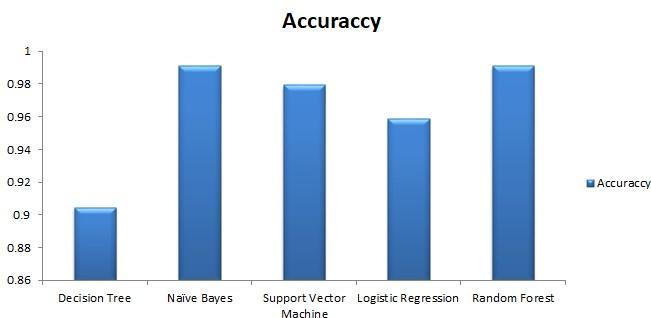
We propose a system with a simple, cost-effective, userfriendly User Interface that is also time efficient. Our proposedapproachassistsfarmersandusersinachieving their objectives. This method recommends crops and fertilizers while also forecasting plant problems. In this proposedsystem,wewillcollectfactorssuchasnitrogen, phosphorus, potassium, and others and recommend crops or fertilizers using methods such as Decision Tree, Random Forest, Naive Bayes, Support Vector Machine, and Logistic Regression, which will aid in accurate prediction. In addition, in this proposed system, we will takea pictureof the plantthen the algorithmwill predict the disease using the ResNet algorithm. As a result, this approach will makefarming easier while also increasing customersatisfaction.
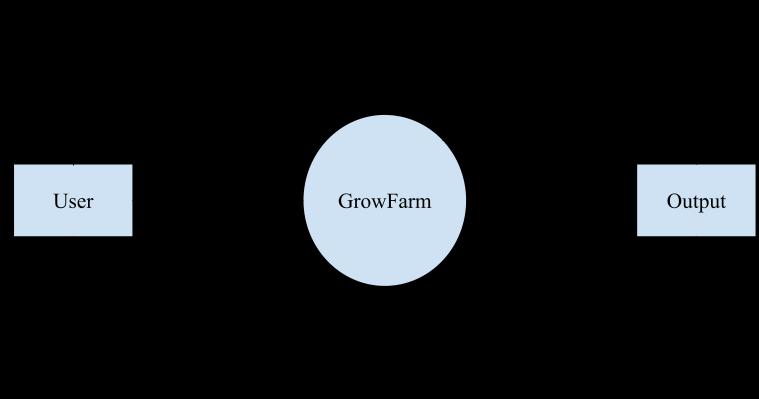

Step 1: Loading the dataset, the data which was collected from the study Crop will be used in the system to optimize Crop Production Using Machine Learning Algorithms, which included a crop recommendation dataset. The accuracy of a machine learning model is determined by thequalityofthedata.
Step 2:
Pre-processingoftheinputdataset,themost essentialor time-consuming task in any machine learning project is data pre-processing. During the pre-processing step, missing values are filled using techniques such as mean, mode, and median, scaling or transforming values in acertain range,cleaning the data, encoding categorical data,and checking for variable correlation so that the accuracycanbeincreased.
Step 3:
Analyzing exploratory data, before getting hands dirty with model construction, univariate, bivariate, and multivariate analysisare carried out to uncover hidden patterns in the data and to try to interpret the data. A few examples of the univariate analytic plot arePDF and CDF while multivariate plotsarepairplot,boxplot,andHeatmaps.
Random Forest:
RandomForestisamachine-learningsystem thatis built on ensembles. Ensemble approaches are a type of method that allows us to mix independent or similar algorithms toconstruct a powerful model. A random forestis a collection of multiple decision trees that have the highest depth until the nodes can separate with the leastvariabilityandbias.
Gaussian Naive Bayes:
Gaussian Naive Bayes is a simple and straightforward machinelearningtechnique.AccordingtotheNaiveBayes hypothesis,qualitiesmustbeindependentofoneanother. Internally, the Bayes theorem is applied in Binary Classification,whichisastatisticalbasedtechnique.Ifthe characteristics of the dataset have a Gaussian distribution,themodelisknownasGaussianNaiveBayes.
Support Vector Machine:
Step 4:
Splitting data into training and testing in this step, the preprocesseddatasetisdividedintotrainingandtestinggroups basedon80:20ratios,whichindicatesthat80%ofthedata is used for training and 20% for testing on the unseen dataset and cross-validation to discover the best hyper parameter.
Step 5:
Creating a classification model based on the training data, the training dataset is delivered to the individual classifier inthisstage,andthemodelistrainedontopofit.
Decision Tree:
A decision tree is a supervised machine-learning technique that can be applied to both classification and regression. A decision tree has a structure similar to a flowchart, with attributesandclasslabelsdisplayedbyatree.
Logistic Regression:
Logistic regression is any other efficient supervised ML set of guidelines used for binary categorization problems (while thegoal is categorical). Logistic regression uses a logistic characteristic mentioned below to model a binary output variable. The primary distinction between linear regression and logistic regression is that logistic regression has a range of zero to one. Furthermore, logistic regression, as opposed to linear regression, no longer requires a linear connection between input and output variables. This is due to the employment of a nonlinearlogtransformationonthechanceratio.
SVM stands for Support VectorMachine algorithm which isamachinelearningtechnique. First, it plots each data element inNDimensionspaceandthenselectsthehyperplane that best segregates the two classes with the greatest margin in the Linear Kernel. It is tough to find theoptimalhyper-planeinaSupportvectormachine.
ResNet :
This network's topology is designed to allow vast amounts of fully connected layers to feature efficiently. Yet,addinganumberofdeeplayerstoanetworkfrequently causes output degradation. This is known as the vanishing gradientproblem,inwhichneural networks,whilelearning via reduced back propagation, rely on gradient descent, descending the loss feature to identify the minimizing weights. Because of the presence of several layers, the repeated multiplication effects inside the gradient get less and smaller,"vanishing," leading to saturation within the community's overall performance or maybe worsening the
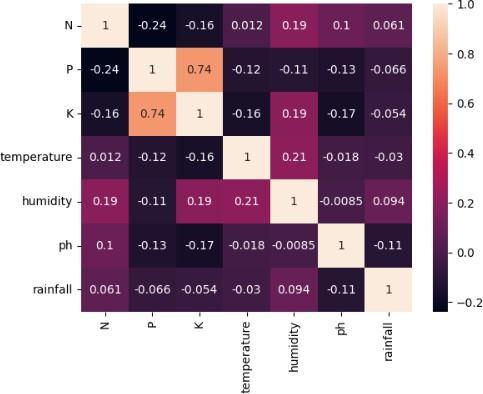
Figure 3: Correlation Metrics on the croprecommendation dataset
Figure 4: Accuracy comparison chart of differentalgorithms used in the classification model
overall performance. The
primary principle of ResNet is the use of leaping connections, also known as shortcut connections or identification connections. These connections are typically formed by jumping over one or two layers, forming shortcuts between those layers. The goal of
establishingthoseshortcutconnectionswastotackle the major problem of vanishing gradient encountered by deep networks. Theseidentificationmappings,for starters, no longer perform anything more than bypass the connections, resulting in the employment of previous layer activation.
Future Work
Toimproveresultsandsupport,thesystemcanbeexpanded furtherbyaddingthefollowingfunctionality:
Thefocusoffutureworkwillbeonupgrading datasetsona regular basis to create reliable forecasts, and the process can be automated without modifying the dataset manually. Linking the system to physical devices to transform it into an IOT device that can check soil components without human interventionandselectcropstogrowdependingon the results. Providing users with real-time crop market rates. Multilingual communication is possible, allowing peoplefromallovertheworldtousethissystem.
CONCLUSION
This system developed with machine learning known as Crop Recommendation orPrediction system will assist in recommending the best crop to grow inland, as well as which fertilizer to use, and provide plant disease detection basedonimages,whichwill beeasilyavailableandusedby users in order to make a decision on which crop to grow based on the soil nutritional values and climate in that region. The model proposed in the research can be expanded in the future to include crop and fertilizer recommendations as well as plant disease detection in a mobileapp.Consequently,ourwebsitewillassistfarmersin sowing the appropriate seed based on soil requirements andincreasingtheircropyieldsinordertoboostproduction andprofitintheiroperations(ifany)fromsuchtechniques.
REFERENCES
1. S. Pudumalar, E. Ramanujam, R. H. Rajashree, C. Kavya, T. Kiruthika and J. Nisha, "Crop recommendation system for precisionagriculture," 2016 Eighth International
Conference on Advanced Computing (ICoAC), 2017, pp. 32-36,doi:
10.1109/ICoAC.2017.7951740.IEEE
2. S. M. PANDE, P. K. RAMESH, A. ANMOL, B. R. AISHWARYA, K. ROHILLA and K. SHAURYA, "Crop Recommender System Using Machine Learning Approach," 2021 5th International Conference on Computing Methodologies and Communication (ICCMC), 2021, pp.
1066-1071, doi: 10.1109/ICCMC51019.2021.9418351.IEEE
3. S.BangaruKamatchi,R.Parvathi,Improvementof CropProductionUsingRecommenderSystembyWeather Forecasts,ProcediaComputerScience,Volume165,2019, Pages724-732,ISSN1877-0509.ScienceDirect
4. N.H.Kulkarni,G.N.Srinivasan,B.M.SagarandN.K. Cauvery,"ImprovingCropProductivity Through A Crop Recommendation System Using Ensembling Technique," 2018 3rd International Conference on Computational Systems and Information Technology for Sustainable Solutions (CSITSS), 2018, pp. 114-119, doi: 10.1109/CSITSS.2018.8768790.IEEE
5. Akulwar,Pooja.(2020).ARecommendedSystemfor Crop Disease Detection and Yield Prediction Using Machine Learning Approach. 10.1002/9781119711582.ch8.ResearchGate
6. S.Vaishnavi.,M.Shobana.,R.Sabitha.andS.Karthik., "Agricultural Crop Recommendations based on Productivity and Season," 2021 7th International Conference on AdvancedComputing and Communication Systems (ICACCS), 2021, pp. 883-886, doi: 10.1109/ICACCS51430.2021.9441736.IEEE
7. Dr.. G.Suresh, Dr. A.Senthil Kumar, Dr.S.Lekashri, Dr.R.Manikandan,“EfficientCropYieldRecommendation System Using Machine Learning For Digital Farming”, IJMA,vol.10,no.1,pp.906-914,Mar.2021.
8. Sameer Panat , Acropolis Institute Of Technology And Research , Indore; Siddhant Tripathi, Acropolis Institute Of Technology And Research , Indore; Sarthak Bhaiji, Acropolis Institute Of Technology And Research, Indore; Vandana Kate, Acropolis Institute Of Technology And Research , Indore; Kavita Namdev, Acropolis Institute Of Technology And Research , Indore.IJSRD.
9. S. S. KaleandP.S.Patil,"AMachineLearningApproach to Predict Crop Yield and Success Rate," 2019 IEEE PuneSection International Conference (PuneCon), Pune, India, 2019, pp. 1-5, doi: 10.1109/PuneCon46936.2019.9105741.
10. R.Kumar,M.P.Singh,P.KumarandJ.P.Singh,"Crop Selection Method to maximize crop yield rate using machine learning technique," 2015 International Conference onSmart Technologies and Management for Computing, Communication, Controls, Energy and Materials (ICSTM),Avadi, India, 2015, pp. 138-145, doi: 10.1109/ICSTM.2015.7225403.
11. V. Kumar, H. Arora, Harsh and J. Sisodia, "ResNetbased approach for Detection and Classification of PlantLeaf Diseases," 2020 International Conference on Electronics and Sustainable Communication Systems (ICESC), Coimbatore, India, 2020, pp. 495-502, doi: 10.1109/ICESC48915.2020.9155585.
12. Ramkumar,M.,Catharin,S.S.,Ramachandran,V.,& Sakthikumar, A. (2021). Cercospora Identification in SpinachLeavesThroughResnet-50BasedImageProcessing. Journal of Physics, 1717(1), 012046, doi: 10.1088/17426596/1717/1/012046.