LINEAR STABILITY ANALYSIS ON THE ONSET OF DDC IN A DPM SATURATED WITH CSF WITH INTERNAL HEATING
Kamble Shravan S.Assistant Professor, Dept. of Mathematics, Sri Shivalingeshwara Govt. First Grade College, Aland, Karnataka-India ***
Abstract - The effect of rotation on the onset of double diffusive convection (DDC) in a horizontal couple stress fluid saturated porous layer with an internal heat source is investigated using linear stability analysis. Thelinearstability analysis is based on the classical normal mode technique. The extended Darcy model which includes thetimederivativeterm and Coriolis term has been employed in the momentum equation. The expressions for stationary and oscillatory Rayleigh number are obtained as a function of governing parameters such as internal Rayleigh number, couple stress parameter, Taylor number, normalized porosity and Lewis number and their effects on the stability of the system are shown graphically
Key Words: Rotation, couple stress fluid (CSF), Darcy Porous medium (DPM), Double diffusive convection (DDC), Internal Heat Source.
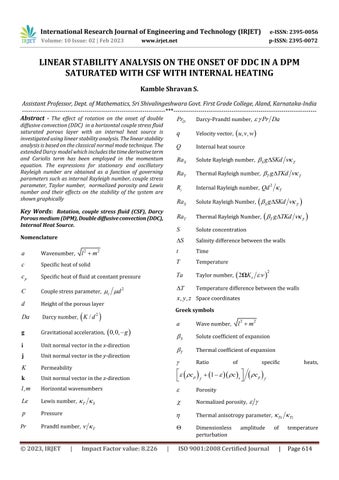
Nomenclature
a Wavenumber, 22lm
c Specificheatofsolid
p c Specificheatoffluidatconstantpressure
C Couplestressparameter, 2 c d
d Heightoftheporouslayer
Da Darcynumber, 2 / Kd
g Gravitationalacceleration, 0,0, g
i Unitnormalvectorinthe x-direction
j Unitnormalvectorinthe y-direction
K Permeability
k Unitnormalvectorinthe z-direction
, lm Horizontalwavenumbers
Le Lewisnumber, TS
p Pressure
Pr Prandtlnumber, T
DPr Darcy-Prandtlnumber, PrDa
q Velocityvector, ,, uvw
Q Internalheatsource
SRa SoluteRayleighnumber, S T gSKd
TRa ThermalRayleighnumber, T T gTKd
iR InternalRayleighnumber, 2 T Qd
SRa SoluteRayleighNumber, S T gSKd
TRa ThermalRayleighNumber, T T gTKd
S Soluteconcentration
S Salinitydifferencebetweenthewalls
t Time
T Temperature Ta Taylornumber,
T Temperaturedifferencebetweenthewalls ,, xyz Spacecoordinates
Greek symbols
a Wavenumber, 22lm
S Solutecoefficientofexpansion
T Thermalcoefficientofexpansion Ratio of specific heats,

Thermalanisotropyparameter, TxTz
Dimensionless amplitude of temperature perturbation
S
Solutediffusivity T
Thermaldiffusivity Dynamicviscosity
Couplestressviscosity
c
Kinematicviscosity, 0
Fluiddensity
0 Referencedensity
Growthrate
Dimensionless amplitude of concentration perturbation
contaminant transport in fluid saturated soils, liquid gas storage, and food processing [see [11] & [13]]. Double diffusive convection (DDC) in porous media has attracted manyauthorslike[2]&[14]duringthelastseveraldecades.
The effect of internal heat source is important in several applicationsthatincludereactorsafetyanalysis,metalwaste form development for nuclear fuel, fire and combustion studies,andstorageof radioactivematerials.The onset of convection due to internal heat source has become an interesting problem in various areas of geophysics and engineeringunderthesituationsofradioactivedecayora weekexothermicreactionwithintheporousmaterial.
0,0, Ω Other symbols
Ω Angularvelocity,
Subscripts
b Basicstate
c Critical
f Fluid
h Horizontal
m Porousmedium 0 Reference
s Solid
Superscripts
* Dimensionlessquantity
′ Perturbedquantity
Osc Oscillatory
St Stationary
1. INTRODUCTION
Doublediffusiveconvection(DDC)inporousmediahasbeen intensively studied because of its applications in different branchesofscienceandengineering,suchasunderground disposal of nuclear wastes, groundwater pollution,
Earlierstudiesofconvectiveflowsinporousmediawithin rectangularenclosures,withoutthelocalheatsourceeffects. Averylittleattentionhasbeendevotedtothisproblemwith non-Newtonian fluids. The corresponding problem in the caseofporousmediumhasalsonotreceivedmuchattention untilrecently.Withgrowingimportanceofnon-Newtonian fluidswithsuspendedparticlesinmoderntechnologyand industries,theinvestigationsofsuchfluidsaredesirable.The studies of such fluids have applications in number of processes that occur in industry, such as the extrusion of polymer fluids, solidifications of liquid crystals, cooling of metallicplateinabath,exoticlubricationandcolloidaland suspension solutions. In the category of non-Newtonian fluids couple stress fluids have distinct features, such as polareffects.
Themainaimfeatureofcouplestresseswillbetointroduce a size dependent effect that is not present in the classical viscousfluids.Thetheoryofpolarfluidsandrelatedtheories aremodelsforfluidswhosemicrostructureismechanically significant. The constitutive equations for couple stress fluidsweregivenby[1].
Anisotropy is generally a consequence of preferential orientation of symmetric geometry of porous matrix or fibers and is in fact encountered in numerous systems in industryandnature.Alsoartificialporousmatrixanisotropy can be made deliberately according to applications. [3] studied the combine defect of horizontal and vertical heterogeneityandanisotropyontheonsetofconvectionina porousmedium. [4]performedlinearandnonlinearstability analysisofdoublediffusiveconvectioninanisotropicporous mediaincludingSoreteffectandreportedthattheeffectof mechanicalanisotropicparametersistodestabilizeandof thermalanisotropicparametersistostabilizethesystem.
There are large number of practical situations in which convectionisdrivenbyinternalheatsourceintheporous media.Thewideapplicationsofsuchconvectionsoccurin nuclear reactions, nuclear heat cores, nuclear energy, nuclearwastedisposals,oilextractions,andcrystalgrowth. [5] investigated linear stability analysis for the onset of naturalconvectioninafluidsaturatedporousmediumwith uniform internal heat source and density maximum in an
local thermal nonequilibrium model and predicted that internal heat source parameter advances the onset convection,[6]studiedtheonsetofstationaryconvectionin alowPrandtlnumberwithinternalheatsourceandfound that effect of internal heat source parameter is destabilization.Recently,[7-10]havestudiedtheproblemof thermal instability in porous media with internal heat source.Few authors have studied on rotation withcouple stressfluidinporousmedia[see[19],[20],[21],[22]&[23]].
Although few literatures on DDC in a porous medium saturatedbyordinaryfluidwithorwithoutaninternalheat source is available, no attention has been devoted to the studyofDDCinaporouslayersaturatedbyacouplestress fluids in the presence of an internal heat and rotation. Thereforeinthepresentworkweintendtoinvestigatethe onsetdoublediffusiveconvectioninarotatingcouplestress fluid saturated porous layer with an internal heat source employing a modified Darcy model using linear stability analyses.Ourobjectiveistostudyhowtheonsetcriterion forstationaryandoscillatoryconvectionareaffectedbythe Lewis number, solute Rayleigh number, Taylor number, Couple stress parameter, internal heat source and normalizedporosity.
2. GOVERNING EQUATIONS
We consider an infinite horizontal couple stress fluid saturatedporouslayerconfinedbetweentheplanes 0 z and zd with the vertically downward gravity force g actingonit.Aconstanttemperature 0TT and 0T with stabilizingconcentrations 0SS and 0S respectivelyare maintained between the lower and upper surfaces. A Cartesianframeofreferenceischosenwiththeorigininthe lowerboundaryand z -axisverticallyupwards.Theporous layer rotates uniformly about the z -axis with a constant angular velocity (0,0,) . The modified Darcy model, whichincludesthetimederivativeandtheCoriolistermis employed as a momentum equation [see [17]]. The basic governingequationsare
where, the variables and constants have their usual meaning, as given in the Nomenclature. Further ()/(),()(1)()(), mfmsf ccccc pp c isthespecificheatofthesolidand p c isthespecificheatof thefluidatconstantpressurerespectively.
1.1 BASIC STATE
Thebasicstateofthefluidisassumedtobequiescentandis given
Thentheconductionstatetemperatureandconcentration aregivenby
Onthebasicstatewesuperposeinfinitesimalperturbations intheform
indicate
equationsaregiven
Byoperatingcurltwice-onequation(10),weeliminate ' p fromitandthenrendertheresultingequationandtheEqs. (11) and (12) dimensionless using the following transformations.
Where l,m are horizontal wavenumbers and is the growthrate.Infinitesimalperturbationsofthereststatemay either damped or grow depending on the value of the parameter . Substituting Eq. (18) into the linearized versionofEqs.(14)-(16),weobtain
Toobtain non-dimensional equationsas(on dropping the asterisksforsimplicity),
is the Taylor number and
istheinternalRayleghnumber,andallthe other non-dimensional parameters are as defined in the Nomenclature.
The boundary conditions are assumed to be stress free, isothermalandisohaline,theEqs.(14)-(16)aretobesolved fortheboundaryconditions
2. LINEAR STABILITY ANALYSIS
Wepredictthethresholdsofbothmarginalandoscillatory convections using linear theory. The Eigenvalue problem definedbyEqs.(14)-(16)subjecttotheboundaryconditions (17) is solved using the time-dependent periodic disturbances in a horizontal plane. Assuming that the amplitudesoftheperturbationsareverysmall,wewrite
and
alm
. The boundary conditions(17)nowbecomes
We assume the solutions of Eqs. (19)-(21) satisfying the boundaryconditions(22)intheform
Themostunstablemodecorrespondsto 1 n (fundamental mode).Therefore,substitutingEq.(23)with 1 n intoEqs. (19)-(21),weobtainamatrixequation
2.1
STATE
Forthevalidityoftheprincipalofexchangeofstabilities(i.e., steadyoscillatory),wehave 0 (i.e. 0 ri )atthe marginalofstability.ThentheRayleighnumberatwhichthe marginallystablesteadymodeexistsbecomes
This coincides with the results of [24]. Further
, Eq.(30)gives
which has the critical value
obtainedby[15]and[16].
2.2
We now set i i in Eq. (25) and clear the complex quantitiesfromthedenominator,toobtain
0
Intheabsenceofheatsource 0 i (i.e.,R) ,Eq.(26)reduces to
1 1 St TS (a)(C(a))Ta(a) RaLeRa aa(C(a))
Thisresultexactlycoincideswiththeonegivenby[17].
It is important to note that the critical wavenumber St c a dependsonthecouplestressparameterandTaylornumber. In the absence of Taylor number 0 (i.e.,Ta) , Eq. (27) gives
2 1 1 St TS Ra(a)[C(a)]LeRa
Whichistheresultgivenby[12]. Forsinglecomponentfluid 0 S Ra, inEq.(27)gives
Which is the one obtained by [18]. When 0 C (i.e., Newtonianfluidcase),Eq.(29)reducesto
D w
Pr((R)(aLeRa)
Pr(aLeRaTa)(Le(R))))
2 2 2
DSi RaPr(R)(TaaLeRa)
3. RESULT AND DISCUSSION
The effect of rotation on the onset of double diffusive convection (DDC) in a horizontal couple stress fluid saturated porous layer with an internal heat source is investigated using linear stability analysis. The linear stability analysis is based on the classical normal mode technique.Onlythelinearparthasconsideredinthispaper.
Theneutralstabilitycurvesinthe T Raa planeforvarious parameter values are as shown in Figs.1-6. We fixed the values for the parameters except the varying parameter. From these figures it is clear that the neutral curves are connectedinatopologicalsense.Thisconnectednessallows thelinearstabilitycriteriatobeexpressedintermsofthe criticalRayleighnumber TcRa ,belowwhichthesystemis stableandunstableabove.
InFig.1themarginalstabilitycurvesfordifferentvaluesof couplestressparameter C aredrawn.Itisobservedthat withtheincreaseof C thevaluesofRayleighnumberand the corresponding wavenumber for oscillatory mode decreases while those for stationary mode increases. Therefore, the effect of C is to advance the onset of oscillatory convection while its effect is to inhibit the stationaryconvection.
Fig.2depictstheeffectofTaylornumber Ta ontheneutral stabilitycurves.Wefindthattheeffectofincreasing Ta is toincreasethevalueoftheRayleighnumberforstationary andoscillatorymodesandthecorrespondingwavenumber. ThustheTaylornumber Ta hasastabilizingeffectonthe double diffusive convection in a horizontal couple stress fluidsaturatedporouslayerwithaninternalheatsource.
Fig.3indicatestheeffectofinternalRayleighnumber iR on the neutral stability curves for the fixed values of other parameters. It is observed that the value of the Rayleigh numberforstationaryandoscillatorymodeincreaseswith increasing iR ,indicatingthattheeffectof iR istoinhibitthe onsetofstationaryandoscillatoryconvection.
InFig.4themarginalstabilitycurvesfordifferentvaluesof Lewisnumber Le aredrawn.Itisobservedthatwiththe increase of Le the values of Rayleigh number and the correspondingwavenumberforoscillatorymodedecreases while those for stationary mode increases. Therefore, the effect of Le is to advance the onset of oscillatory convection while its effect is to inhibit the stationary convection.
Fig.5depictstheeffectofsoluteRayleighnumber SRa on the neutral stability curves for stationary and oscillatory modes. We find that the effect of increasing SRa is to
increase the critical value of the Rayleigh number for stationary and oscillatory modes and the corresponding wavenumber.ThusthesoluteRayleighnumber SRa hasa stabilizing effect on the double diffusive convection in a horizontalcouplestressfluidsaturatedporouslayerwithan internalheatsource.
Theeffectofnormalizedporosityparameter isdepicted in the Fig. 6. We find that an increase in decreases the minimum of the Rayleigh number for oscillatory mode, indicatingthattheeffectofincreasing istoadvancethe onsetofoscillatoryconvection.
5. CONCLUSION
The effect of rotation on the onset of double diffusive convection (DDC) in a horizontal couple stress fluid saturated porous layer with an internal heat source is investigated using linear stability analysis. The linear stability analysis is based on the classical normal mode technique.Thefollowingconclusionsaredrawn: TheTaylor number Ta hasastabilizingeffectonthedoublediffusive convection in a horizontal couple stress fluid saturated porous layerwithan internal heatsource. The effect of solute Rayleigh number SRa is todelayboth stationary
and oscillatory convection. And the effect of Lewis number Le is to delay the onset of stationaryconvection while it advances the oscillatory convection. The internal Rayleighnumber iR hasadestabilizingeffectonthedouble diffusive convection in a porous medium. The effect of couple stress parameter C is to advance the onset of oscillatory convection whereas its effect is to inhibit the stationaryonset.Thenormalizedporosityparameter has adestabilizingeffectinthecaseofoscillatorymode.
REFRENCES
[1] Stokes, V. K. (1966). Couple stresses in fluids(Vol.9). Physics of Fluids, 1709-1716.
[2] Vafai, K. (2000). Handbook of porous media. Marcel Dekker,NewYork(Ed).
[3] Nield, D. A. & Kuznestsov, A. V. (2007). The effects of combined horizontal and vertical heterogeneity and anisotropy on the onset of convection in a porous medium(vol.46). International Journal of Thermal Science,1211-1218.
[4] Gaikwad,S.N.,Malashetty,M.S.,&Prasad,K.(2009).An analyticalstudyoflinearandnonlineardoublediffusive convectioninafluidsaturatedanisotropicporouslayer withSoreteffect(Vol.33). Applied Mathematical Model, 3617-3635.
[5] Saravanan,S.(2009).Thermalnonequilibriumporous convectionwithheatgenerationanddensitymaximum (Vol.76). Transport in Porous Media,35-43.
[6] Cookey,C.I.,Omubo,P.V.B.,Obi,B.I.,&Eze,L.C.(2010) Onset of thermal instability in a low Prandtl number fluidwithinternalheatsourceinaporousmedium. The American Journal of Science and Industrial Research, 1 (1),18-24.
[7] Bhadauria, B.S., Anojkumar, Jogendra Kumar, Sacheti, N.C., & Chandran, P. (2011). Natural convection in a rotating anisotropic porous layer with internal heat. Transport in Porous Medium, 90(2),687-705.
[8] Bhadauria,B.S.(2012).Doublediffusiveconvectionina saturated anisotropic porous layer with internal heat source. Transport in Porous Media (Vol.92),299-320.
[9] Bhadauria,B.S.,Hashim,I.,& Sidheshwar,P.G.(2013a). Effect of time periodic theremal bouindary conditions and internal heating on heat transport in porous medium(Vol.97). Transport in Porous Media,185-200..
[10]B.S. Bhadauria, B. S., Hashim, I., & Sidheshwar, P. G. (2013b).Studyheattransportinporousmediumunder G-jitterandinternalheatingeffects (Vol.96). Transport in Porous Media,21-37.
[11]Shivakumara, I. S., Lee, J., & Sureshkumar, S. (2011). Linear and nonlinear stability of double diffusive convectionincouplestressfluidsaturatedporouslayer (Vol.81) Archive of Applied Mechanics,1697-1715.
[12]Malashetty,M.S., Dulal,P.,&Premila,K.(2010)Double diffusiveconvectioninDarcyporousmediumsaturated withcopulestressfluid(Vol.42), FluidDynamicResearch, 035502-035523.
[13]Azaiez, J., & M. Sajjadi, M. (2012). Stability of Double diffusive convective miscible displacements in porous media. Physical Review E,85(2),ArticleId026306.
[14]Nield,D.A.&A.Bejan,A.(2006).Convectioninporous media,Springer,NewYork,NY,USA,3rd ed..
[15]Horton,C.W.&Rogers,F.T.(1945).Convectioncurrent in a porous medium, Journal of Applied Physics ( Vol. 16),367-370.
[16]Lapwood,E.R.(1948).Convectionofafluidinaporous medium. Proceedings of the Cambridge Philolsophical Society (Vol.44),508-521.
[17]Malashetty, M.S., Premila Kollur, & Sidram, W.(2013). Effect of rotation on the onset of double diffusive convection in a Darcy porous medium saturated with couple stress fluid (Vol. 37), Applied Mathematical Modeling,172-186.
[18]IShivakumara, I.S., Sureshkumar, S. & Devaraju, N. (2010).Corioliseffectonthermalconvectioninacouple stressfluidsaturatedrotatingrigidporouslayer. Archive of Applied Mechanics,81(4), 513-530.
[19]Gaikwad, S. N. & Kamble, S. S. (2014). Linear stability analysis of double diffusive convection in a horizontal sparsely packed rotating anisotropic porous layer in presence of Soret effect. Journal of Applied Fluid Mechanics, 7(3), 459-471.
[20]Banyal, A. S. (2013). A mathematical theorem on the onset of stationary convection in couple stress fluid. Journal of Applied Fluid Mechanics,6(2),191-196.
[21]Kumar, P. (2012). Thermosolutal maneto-rotating convection in copule stress fluid through porous medium. Journal of Applied Fluid Mechanics,5(4),45-52.
[22]Rudraiah, N. & Chandrashekhar, G. (2010). Effects of couple stress on the growth rate of Rayleigh-Taylor instability at the interface in a finite thickness couple stressfluid. Journal of Applied Fluid Mechanics,3(1),8389.
[23]Agoor,B.M.,&Eldable,NTM.(2009). Rayleigh–Taylor instabilityattheinterfaceofsuperposedcouplestress
fluidsflowsinporous media. JournalofAppliedFluid Mechanics,7(4),573-580.
[24]Vadasz, P. (1998): Coriolis effect on gravity-driven convectioninarotatingporouslayerheatedfrombelow (Vol.376), Journal of Fluid Mechanics,351-375.