AI-based Healthcare Chatbot
Duckki Lee Assistant Professor, Department of Smart Software, Yonam Institute of Technology, Jinju, South Korea
Abstract - Amid the development of artificial intelligence technologies such as deep learning and natural language processing, chatbots are our society's most extensively used services. Chatbot is a combination of the words "chat" and "robot," and it refers to software that either provides appropriate responses to questions or receives commands through communication with humans. Chatbots are used by computers to replace customer response tasks that humans used to do. Chatbots combine the concepts of chatting and robots. Chatbots powered by artificial intelligence make use of conversation systems to enable users to have conversations in natural language with the chatbots through voice, text, or both. Non-face-to-face culture, also known as "untact", which has emerged as both a societal phenomenon and a part of everyday life as a direct result of the rapid spread of COVID-19 is becoming the new standard. Amidst all of these shifting societal climates and changes, there are also active transitions occurring in the provision of healthcare services and the management of health using AI chatbots. This article examines the definition and structure of artificial intelligence chatbots. It also examines many examples of how AI chatbots are used in the healthcare industry. Finally, it identifies the advantages and limitations of AI-based healthcare chatbots and presents the future direction of AI-based healthcare chatbots.
Key Words: AI, AI-based Chatbot, AI-based Chatbot Architecture, AI-based Healthcare Chatbot, Healthcare Chatbot
1. INTRODUCTION
Amid the development of artificial intelligence technologies such as deep learning and natural language processing, chatbots are our society's most extensively used services in our society. Chatbot is a combination of thewords"chat"and"robot,"anditreferstosoftwarethat either provides appropriate responses to questions or receivescommandsthroughcommunicationwithhumans. Chatbots are used by computers to replace customer responsetasksthathumansusedtodo.Chatbotspowered byartificialintelligencemakeuseofconversationsystems to enable users to have conversations in natural language with the chatbots through voice, text, or both [1,3]. AI chatbots that are enabled by natural language processing and computing infrastructure can be implemented in two different ways: one is as a rule-based method that is restricted, and the other is as an artificial neural network
method that is unconstrained. The global market for chatbotsisanticipatedtoexpandatsucha rapidratethat itwillmorethandoubleitscurrentvalueof$2.6billionin 2019 to $9.4 billion in 2024 [2]. According to Gartner, interactiveAIthroughvoicebotsorchatbotscanautomate all or a part of customer interactions at the customer center, and by 2026, one in ten customer consultations will be automated using interactive AI. With the advancement of artificial intelligence technology, AI chatbots are being utilized in various disciplines. First, AI chatbots are utilized in online shopping malls, banks, and airlines for customer service. The chatbot can resolve basiccustomerquestionsorissues.Thesecondfunctionof chatbots is to provide information on medical care, medicines,andpreventativemeasuresinthemedicalfield. Forexample,inputtingapatient'ssymptomsasdataintoa chatbotenablesittomakepredictionsaboutthelikelihood of the patient contracting the disease or to make suggestions about how the symptoms can be alleviated. Third. A chatbot is an artificial intelligence secretary that can carry out a variety of duties, including the management of schedules, the writing of memos, and notification functions. Fourth, educational content utilizing chatbots iscontinuouslyevolvingand expanding. For example, chatbots are used to solve English or math problems and to acquire foreign languages. Non-face-tofaceculture,alsoknownas"untact"whichhasemergedas bothasocietalphenomenonandapartofeverydaylifeas adirectresultoftherapidspreadofCOVID-19isbecoming the new standard. Amidst all of these shifting societal climates and shifts, there are also active transitions occurring in the provision of healthcare services and the management of health using AI chatbots. This study investigates the definition and structure of artificial intelligencechatbots.Ittheninvestigatesseveralexamples ofAIchatbotsbeingusedinthefieldofhealthcare.Finally, it derives the benefits and limitations of AI-based healthcare chatbots and discusses the path that artificial intelligence-based healthcare chatbots will take in the future.
2. DEFINITION AND ARCHITECTURE OF AI-BASED CHATBOT
The term "chatbot" refers to a hybrid of the words "chat" and"robot."Achatbotisasoftwareprogramthatengages intextandvoice-typeconversationswithuserstorespond appropriately to their inquiries or provide them with the
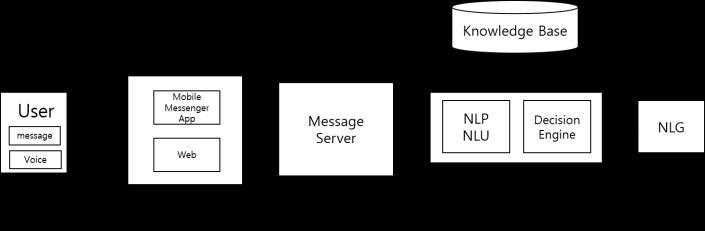
information that they require. Artificial intelligence chatbots utilize artificial intelligence technologies such as voice recognition, deep learning, and natural language processing to determine the question-asking intent of users and provide appropriate responses. As can be seen in Fig -1[4], AI chatbots are primarily made up of two parts: the Frontend, which is a mobile messenger app or web form that receives messages from users, and the Backend, which is an area that provides answers to inquiries posed by users. The backend identifies and analyzes the question intentions of users using Natural Language Processing (NLP) and Natural Language Understanding (NLU). The backend then generates and delivers appropriate responses to users with a Decision Engine and Natural Language Generation (NLG) utilizing Knowledge Base. Computing technologies for pattern recognition, natural language processing, semantic web, text mining, and context recognition are necessary to put thisprocessintoaction.Thetechnicalcomponentsofthese AIchatbotsareshowninTable-1[5].
industry evolves. At the moment, AI chatbots continue to serve in the roles of simple information delivery and intelligent secretary; however, with the continued advancement of technology, it is anticipated that they will eventuallybecomecapableofprovidingapersonalizedand professionalemotionalassistantserviceasshowninTable -2[5]
Division Level1 Chatbot Level2 Intelligent Assistant
Level3 Conscious Assistant
Delivery Method Text,Voice Text, Voice, and VisualData Text,Voice,Visual Data, Behavior Recognition
Input Method Closed, Partially Open PartiallyClosed Open Combined use of open and closed types
Key Technologies Patternmatching, keyword, and related word extraction,etc
Service Provided - Q&A on the learnedcontents
- Simple form of communication withusers
-Resultsprovided bysearch
CoreTechnology KeyFeatures
Pattern Recognition Machine identification of figures, texts, voices,etc
Natural Language Processing
Includes information search, question response, automatic translation, interpretationthroughthesystem,etc
SemanticWeb The intelligent web of the next generation givescomputersthe ability to comprehend themeaningofdatasourcesandevendraw rationalconclusionsfromthatmeaning
TextMining Aprocessortechniquefordiscoveringnew andusefulinformationinunstructuredtext data
Context-aware Computing Providing intelligent, user-centric services by digitizing real-life situations in virtual space
Due to the advancement of artificial intelligence technology, AI Chatbot services are used in a variety of industries. These chatbot services are progressively diversifying their delivery methods and channels as the
Deep learning, machine learning, natural language processing, a convergence of other new technologies,etc
- provides personalized serviceconsidering the user’s pattern andsituation
- simple task handing
Emotion recognition technology, data standardization technology,etc
- Preemptive response to services and various services throughemotional exchange
3. CASE STUDY OF AI-BASED HEALTHCARE CHATBOT
The advancement of technology that utilizes artificial intelligence has resulted in the introduction of several noveldevelopmentsinthefieldofhealthcare.Theso-called "non-face-to-face culture" that has emerged as a social phenomenon and an integral part of day-to-day life as a direct result of the rapid spread of COVID-19 is quickly becoming the standard in today's society. In addition, current efforts are being made across the industry to manage health by delivering non-face-to-face medical services using healthcare chatbots that are powered by artificial intelligence. AI-based healthcare chatbots [1, 3] use artificial intelligence technology to autonomously respond to users' questions or requests for information, monitor their health status and provide advice. AI-based healthcare chatbots have the advantage of being able to manage users' health in a manner that is both convenient andefficient,andtheyareeasytoaccessatanytime,from any location. This chapter examines various examples of healthcarechatbotspoweredbyartificialintelligence.
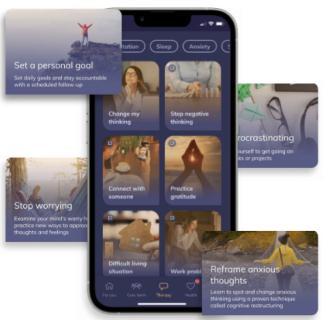
Youper [6] is an artificial intelligence-based remote healthplatformthatwasdevelopedbyaStanfordresearch team in the United States. It helps decrease symptoms of depression and anxiety. Within this artificial intelligencepowered platform, it is possible to verify the patient's moodstatusbyusingaself-diagnosistablethatthepatient has prepared. In addition, when a patient provides a chatbotwithinformationabouthisorheremotionalstate, the chatbot suggests a method or behavior to alter the patient's mood. Youper is integrated with telemedicine, which enables users to speak with medical professionals and receive diagnoses through the use of video conversations. In addition, it offers a service that delivers prescription medicines to patients' residences via consultationwithchatbotsandmedicalprofessionals.
3.2 Babylon Health
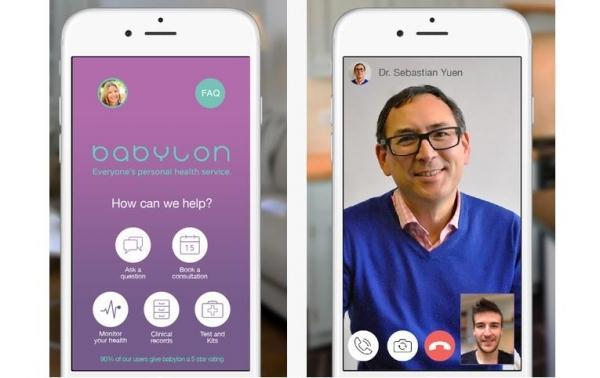
The Babylon Health app [7] was designed for roundthe-clock individualized medical consultations. Chatbot BabylonbeganoperationsinJanuary2017tosupplantthe UKNationalHealthServicecontactnumber111forhealthrelated counseling (NHS). Babylon provides counseling services on behalf of professional counselors, including adviceon patienthealthcare, connectionstolocal medical services, and after-hours medical services. When mobile users inquire about symptoms or diseases, artificial intelligence analyzes millions of medical databases for answers, and patients can consult with doctors or specialistsviavideoortext.
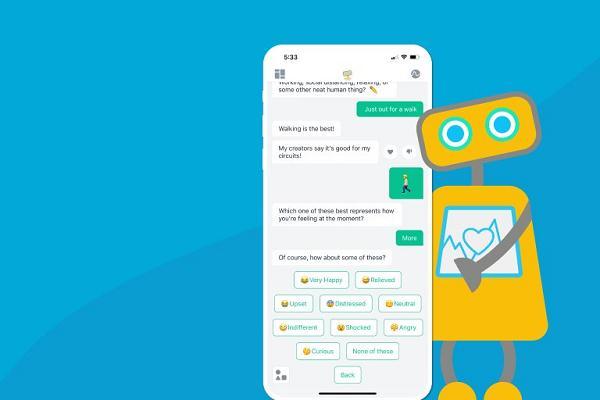
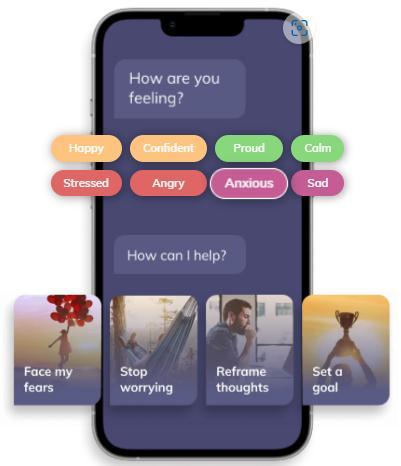
Woebot[8] seeks to improve people's mental health through dialogue regardless of location or time. Chatting with patients allows Woebot, which is equipped with a naturallanguageprocessingfunction,todeliverservicesto patients including psychological monitoring, psychological pattern analysis, psychological status improvement, and cognitivebehavioraltherapy.Consultationisperformedby utilizingexpertiseandcounselingdetails,andasaresultof chattingwithpatients,italsosuggestsa methodtoaskfor help from an actual therapist if the condition is serious. A recent study conducted at Stanford University on depressive patients who were separated into groups with and without Woebot demonstrated the efficacy of Woebot by demonstrating a reduction in depressive symptoms in 85 percent of patients who used Woebot. Woebot is accessible via multiple channels and devices, as it is designed not only on social media platforms such as TwitterandFacebookbutalsoonAppleStoreandAndroid. ItispossibletosharepersonalstorieswithWarbot,acyber therapist,makingitpossibletoreceiveaccuratecounseling. Patients are expected to use it frequently because there is nocostfortreatmentandtherearenomedicalrecordsleft.
3.4 Safedrugbot
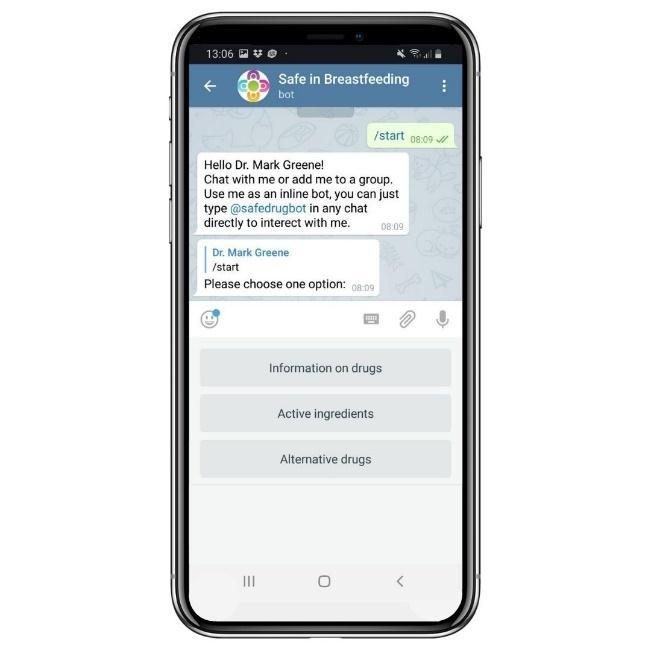
The Safedrugbot[9] is a chat service that delivers pertinent information regarding the use of drugs while breastfeeding through the platform of Telegram. Using search terms that are derived from the active ingredients or brand names of the drug, Safedrugbot can explore an extensive database and provide information that is comprehensiveregardingthedrugguide.
3.5 Sensely
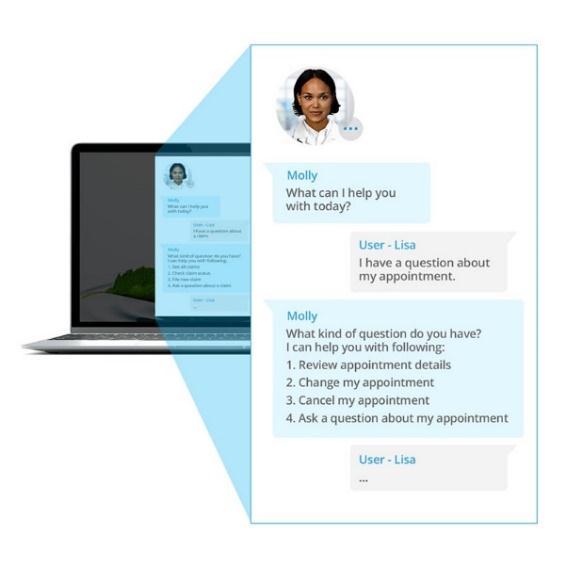
Sensley [10] is a service that assists patients who require continuous treatment at home after hospital discharge, and virtual nurse Molly monitors patients' health status. Blood pressure measurement and telemedicine scheduling are Molly's primary responsibilities. Molly says, "It's time to measure blood pressure," when a patient accesses the service through a smartphonewhiletheyareathome.Afterthat,thepatient or a member of their family wraps the I-health, a home medical device that is supplied to service subscribers, aroundtheirarmstobegintakingtheirbloodpressure.The measured data is transmitted to the smartphone via Bluetooth,andMollycomparesthecurrentmeasuredvalue to the previously measured value to clarify the current state. The measured data is then sent to the hospital. The measuredresultsaresentdirectlytothehospital,allowing the physician to respond quickly. In this manner, Molly treats patients similarly to hospital nurses. In addition, Molly can diagnose diseases and provide nursing care to patients using voice communication with patients thanks to her sophisticated voice recognition capabilities, which arebasedonavatarAItechnology.
4. ADVANTAGES AND LIMITATIONS OF AI-BASED HEALTHCARE CHATBOT
As was just mentioned, healthcare chatbots powered by artificial intelligencehavemanyadvantages, including the ability to provide service around the clock, the ability to provide personalized service, cheap costs, and quick responses.Thefollowingisanexplanationofeachofthese advantages[11,12]indetail:
24-hourservice:Sinceartificialintelligence-based healthcare chatbots are services provided by computers rather than humans, they can offer services round-the-clock regardless of when people are typically available for work. This indicates that patients can receive medical informationoradviceviachatbotsatanytimeof thedayornight.
Personalized Services: Healthcare chatbots powered by artificial intelligence can collect and evaluatepatients'personalhealthinformationas well as their symptoms to provide customized advice and treatment options. Patients can receive treatment that is more accurate and efficientbecauseofthis.
Low cost: Healthcare chatbots powered by artificial intelligence can be provided at a lower cost than conventional medical services. This makesiteasierforlow-incomefamiliesandareas with limited healthcare care to utilize medical services.
Quick Response: Chatbots in the healthcare industrythatispoweredbyartificialintelligence can provide prompt responses to the inquiries posed by patients, enabling clinicians to effectivelymanageurgentsituations.
Large-scale services: Intelligent-based healthcare chatbotscansimultaneouslyservelargenumbers of users. This ensures that many people can use it simultaneously, even in areas with limited access to medical care or densely populated cities.
These AI-based healthcare chatbots have introduced a great deal ofinnovationtothehealthcare industrythanks totheirmanyadvantages;however,theyaresubjecttothe followingrestrictions[13,14]:
Accuracy of question responses: The majority of chatbots with artificial intelligence analyze medical information and respond using natural language processing algorithms. However, the limitations of these algorithms may reduce the accuracy. In addition, because predictions are based on vast quantities of data, poor data qualityleadstolessaccuratepredictions.
Limitations of medical diagnosis: Chatbots in the healthcare industry powered by artificial intelligencecanprovidepatientswithanswersto their questions, as well as make predictions about the patient's symptoms and the likelihood thattheyhaveadisease.However,fordoctorsto arrive at an accurate diagnosis, they will still need to conduct additional research or ask additionalquestions.
Privacy concerns: Chatbots with artificial intelligence collect and analyze health information about patients. It is necessary to have an adequate security system in place to avoid potential invasions of privacy that could resultfromthecollectionofsuchinformation.
Inthefuture, when designingorimplementing healthcare chatbots that are based on artificial intelligence, efforts should be made to overcome the limitations and provide more efficient healthcare services. This can be accomplished by improving the quality of the data, enhancing artificial intelligence algorithms, working together with medical experts, and introducing security systems.
5. CONCLUSIONS
The purpose of this research was to investigate the definition and structure of AI-based chatbots, as well as
key technologies for putting AI-based chatbots into practice. In addition to that, the development stage of an AI-basedchatbotservicewasinvestigatedinthisresearch as well. As a result of this research, it was found that artificial intelligence-based healthcarechatbotsare a very effective instrument in the delivery of medical services. This was demonstrated through numerous examples of artificial intelligence-based healthcare chatbots, which were accelerated by the non-face-to-face culture that has become the new normal as a result of the rapid spread of COVID-19. In addition, it was discovered that the healthcare chatbot based on artificial intelligence is very effectiveinimprovingtheeffectivenessofmedicalservices andthe convenience ofpatients. On the otherhand,ithas been established that these healthcare chatbots built on artificial intelligence have several glaringly obvious limitations. Efforts must be made to overcome these limitationsandprovidemoreeffectivehealthcareservices byaddressingtheminavarietyofways,suchasenhancing the quality of the data collected, refining the algorithms usedbyartificialintelligence,workinginconjunctionwith qualified medical professionals, and implementing securitymeasures.
REFERENCES
[1] Oh, Y. J., et al. "A systematic review of artificial intelligence chatbots for promoting physical activity, healthydiet,andweightloss."InternationalJournalof Behavioral Nutrition and Physical Activity18 (2021): 1-25.
[2] Global Chatbot Market Size, https://markets.businessinsider.com/news/stocks/gl obal-chatbot-market-anticipated-to-reach-9-4-billionby-2024-robust-opportunities-to-arise-in-retailecommerce-1028759508
[3] Laranjo L, Dunn AG, Tong HL, Kocaballi AB, Chen J, Bashir R, Surian D, Gallego B, Magrabi F, Lau AYS, Coiera E. Conversational agents in healthcare: a systematic review. J Am Med Inform Assoc. 2018 Sep 1;25(9):1248-1258. doi: 10.1093/jamia/ocy072. PMID:30010941;PMCID:PMC6118869.
[4] S.Ayanouz,B.AbdelhakimandM.Benhmed,"Asmart chatbotarchitecture based NLPandmachinelearning forhealthcareassistance",AssociationforComputing MachineryProceedings,pp.1-6,2020.
[5] SeoKyori,AnalysisofDomesticandGlobalTrendsand DevelopmentProspectsofArtificialIntelligence-based Chatbot Service, National Information Society Agency (NIA),D.govTrend&Future,2018
[6] Youper,https://www.youper.ai/
[7] BabylonHealth,https://www.babylonhealth.com/
[8] Woebot,https://woebothealth.com/
[9] Safedrugbot,https://twitter.com/safedrugbot
[10] Sensely,https://sensely.com/
[11] L. Athota, V. K. Shukla, N. Pandey, and A. Rana, "Chatbot for Healthcare System Using Artificial Intelligence,"2020 8th International Conference on Reliability, Infocom Technologies and Optimization (TrendsandFutureDirections)(ICRITO),Noida,India, 2020,pp.619-622.
[12] Aggarwal, Abhishek, et al. "Artificial Intelligence (AI)based Chatbots in Promoting Health Behavioral Changes: A Systematic Review."medRxiv(2022): 2022-07.
[13] K.Denecke,A.Abd-Alrazaq,andM.Househ,“Artificial Intelligence for Chabots in Mental Health: Opportunities and Challenges.“ Multiple Perspectives on Artificial Intelligence in Healthcare, pp.115-128, 2021.
[14] Collinsworth, Amy, and Destiny Benjamin. "Uses of Artificial Intelligence in Healthcare: A Structured Literature Review."Bridging Human Intelligence and ArtificialIntelligence(2022):339-353.
BIOGRAPHIES
Duckki Lee is currently an Assistant Professor in the Department of Smart Software, Yonam Institute of Technology in South Korea His research interests include smart health andAI-basedhealthcarechatbot