EARLY BLIGHT AND LATE BLIGHT DISEASE DETECTION ON POTATO LEAVES USING CONVOLUTIONAL NEURAL NETWORK
Dr. T. Praveen Blessington1, Bhargav Krishnan2, Yash Bharne3, Kartiki Khoje4, Prathamesh Padwal5Department of Information Technology, Zeal College of Engineering and Research, Pune-41, Maharashtra, India ***
Abstract - In order to provide the basic demands of food for the growing population worldwide, agriculture is a crucial industry. The growth of grains and vegetables, meanwhile, is essential to human nourishment and the global economy. Asa result of their reliance on manual monitoring of grains and vegetables and their lack of correct knowledge and disease detection, many farmers cultivate in distant places of the world and incur significant losses. Digital farming techniques might be an intriguing way to swiftly and readily identify plant leaf diseases. This research suggests a method for identifying plant leaf diseases and taking preventive action in the agriculture sector utilizing image processing and Convolutional Neural Networks (CNN) in order to address these concerns. Automatic plant disease detection is growing in popularity as a field of study. It benefits the hugecropfields' surveillance and aids in spotting disease symptoms when they appear on the leaves. Here, a strategy for detecting plant diseases using CNN has been suggested. Techniques for image processing can be used to find plant diseases. Disease symptoms are typically visible on the fruit, stem, and leaves. The plant leaf is taken into consideration for disease identification since it exhibits disease signs. Deep learninghas been used to utilize existing models that have been trained on a more general disease identification problem, and the results have been quite good.
Key Words: Disease Detection, Plant Leaf, Image Processing, Deep Learning, CNN
1. INTRODUCTION
India is a developed nation where agriculture supports around70%ofthepopulation.Farmerscanchoosefroma wide variety of eligible crops and choose the right insecticidesfortheirplants.Therefore,cropdamagewould resultinasignificantlossinproductivity,whichwouldhave animpactontheeconomy.Themostvulnerablecomponent of plants, the leaves, are where disease symptoms first appear.Fromtheverybeginningoftheirlifecycleuntilthey arereadytobeharvested,thecropsmustbeinspectedfor illnesses. A variety of strategies have been used in recent years to produce automatic and semi-automatic plant diseasedetectionsystems,andautomaticdiseasedetection by simply observing the symptoms on the plant leaves makesitbothsimplerandmoreaffordable.Asofnow,these methods have proven to be quicker, less expensive, and
more precise than the conventional approach of manual observationbyfarmers.Manyinitiativeshavebeencreated tostopcroplossfromdiseases.Integratedpestmanagement (IPM)tacticshavereplacedtraditionalmethodsofapplying insecticides widely over the past ten years. Whatever the method, the first step in effective illness management is accuratediseaseidentificationwhenitfirstmanifests.Deep learning (DL) algorithms are now primarily employed for patternrecognitionbecausetheyhavesuccessfullyidentified various outlines. DL makes feature extraction automated. The DL achieves a high accuracy rate in the classification task and, when compared to other conventional machine learning methods, reduces error rate and computational time.WiththeassistanceofConvolutionalNeuralNetworks (CNN), the primary goal of our job is to identify plant illnessesandoffertreatmentsforthem.Asaresult,adopting technologyanddigitalizationisessentialfortheagricultural sector to benefit both farmers and consumers. One can recognizediseasesattheirveryearlieststagesandremove thembyusingtechnologyandroutinemonitoring.Ahigher cropproductionisdesired.Deeplearninghassignificantly outperformed conventional methods in the field of digital imageprocessinginrecentyears.Theuseofdeeplearningin plant disease recognition can minimize the drawbacks associated with the artificial selection of disease spot features,maketheextractionofplantdiseasefeaturesmore objective, and accelerate the pace of technological advancement.

1.1 Risk Analysis
Image size: The size of the image affects how secure the program is. Smaller images give us less alternatives for choosing pixels, which cuts down on the time needed to extractthekeyfromtheimage.Inanimagehavingaheight ofhandawidthofw,therearew*hpixelsintotal.Toextract thekeyfromtheimage,theintruderorattackermusttestall possible combinations of the pixels they choose. We can improve the security of the application by enlarging the image.
2. LITERATURE REVIEW
A previous study [1] uses a CNN model to classify the different plant diseases obtained from the Plant Village dataset.TheAlexNetarchitecturewhichwilldistinguishthe
different types of diseases of the plant into 38 various unique classes. Also, the proposed system gives a good solutiontopredictthediseasesintheplantandcanhelpin early identification of them. In the future, it is possible to workondifferentlearningratesontheproposedsystem.[2] Itfocusedhowimagefromgivendataset(traineddataset)in field and past data set used predict the pattern of plant diseasesusingCNNmodel.Thesystemwillcoverthemost sortsofplantleavesimaginable,allowingfarmerstolearn about leaves that may have never been cultivated and providealistofallpotentialplantleaves,whichaidsthemin choosingwhichcroptoproduce.In[3]theworkingmodel usesconvolutionalneuralnetworksandtransferlearningto classifydifferentplantleafdiseases.CNNisatypeofdeep learning neural network and has good success in imagebasedclassification.Theproposedsystemisfasterandmore accuratethantheconventionalwayofmanualobservationof eachplantleaf.TheCNNmodelisusedtopredictdifferent plantdiseasescorrectly.Themodel'stestingisdoneusing performanceevaluationmetricssuchasaccuracy,precision, recall,andF1score.[4]TheproposedsystemofClassification ofPomegranateDiseasesBasedonBackPropagationNeural NetworkwhichmainlyworksonthemethodofSegmentthe defectedareaandcolorandtextureareusedasthefeatures Theimagecapturedisusuallytakenwithaplainbackground to eliminate occlusion. For accuracy, the algorithm was comparedtoothermachinelearningmodels
3. PROPOSED SYSTEM ARCHITECTURE
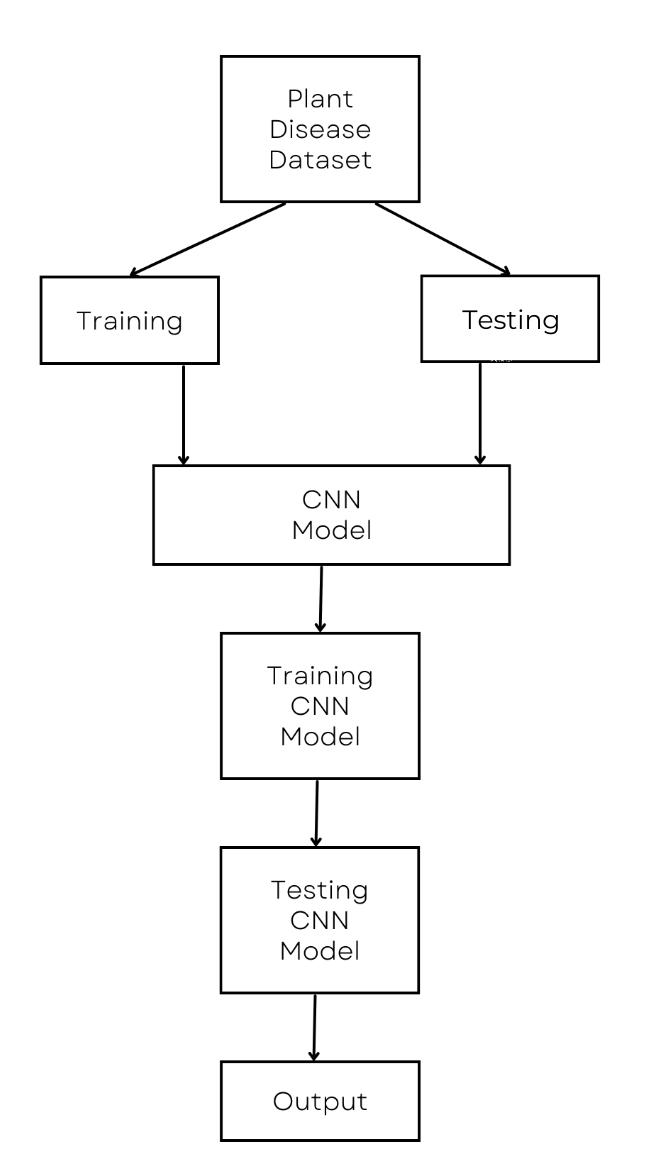
Theconceptual model thatdescribesa system'sstructure, behavior,andotheraspectsiscalledsystemarchitecture.A formaldescriptionandrepresentationofasystemthatisset up to facilitate analysis of its structures and behaviors is calledanarchitecturedescription.Systemarchitecturecan bemadeupofdesignedsubsystemsandsystemcomponents thatwillcooperatetoimplementthewholesystem.Inthis section, we'll examine the many procedures that must be followedinordertodevelopandusevariousclassifiersand obtainthemostlikelyoutcomes.Wewillusethemodelthat produces the best results and accuracy for detecting leaf diseaseoutofallthevariedresultsandaccuraciesproduced bydifferentmodels.
Preprocessinganddatacleaning:Preparingdataforanalysis entails eliminating or changing any information that is inaccurate, lacking, irrelevant, duplicated, or formatted incorrectly. However, as we already indicated, it is not as straightforwardasrearrangingcertainrowsordeletingdata tomakeroomforfreshinformation.Topreparerawdatain aformatthatthenetworkcanaccept,preprocessingdataisa typicalfirststepinthedeeplearningworkflow
4. PROJECT DESIGN
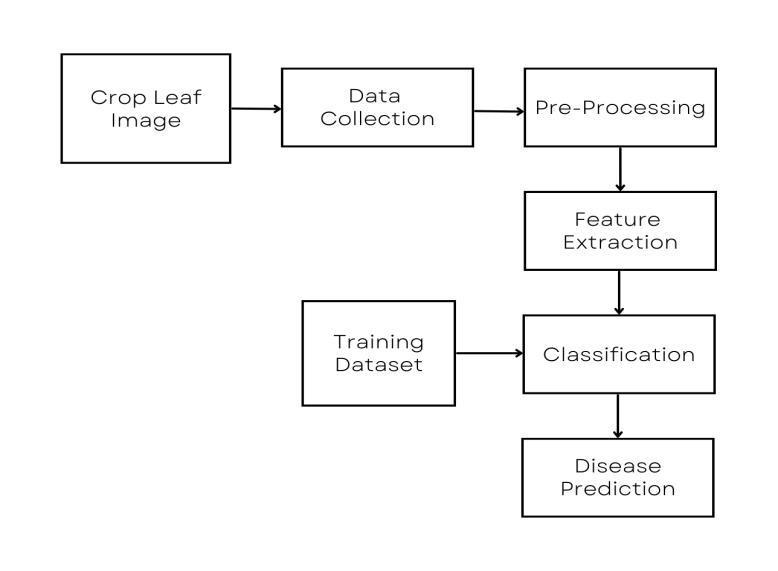
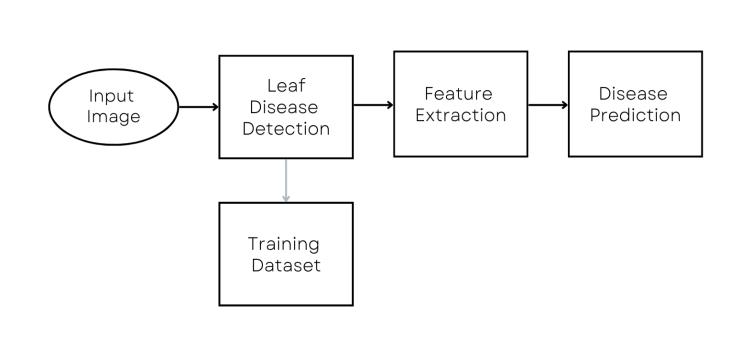
3:DataFlowDiagram
Here,trainingdatasetisusedtotesttheinputimageinitially. Features are extracted from the image after testing. Followingthat,theclassifier receivedthesetraitsasinput alongwiththeknowledgeofwhethertheimagedepicteda healthy or diseased leaf. The classifier then discovers the connectionbetweenthefeaturesthatwereretrievedandthe likelihood that a disease is present. The following stage involvescomparisonofinputimagewiththedataset'spreexisting images and on the basis of comparison, the leaf diseaseisidentified.
5. EXPERIMENTAL RESULTS
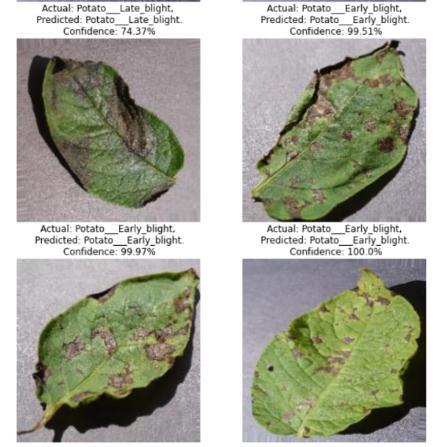
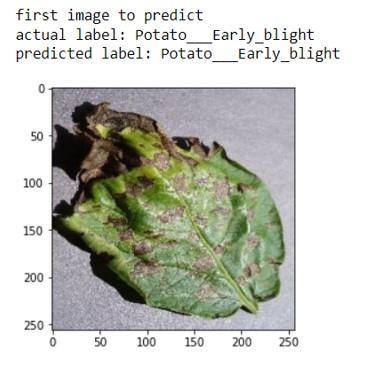
TheTrainedmodelisusedforpredictionofthediseaseby whichleafofplantisaffected.Thenp.argmaxfunctionofthe numpy library is used for finding the highest probability fromthebatchpredictionofthediseasehavingthehighest probability in order to provide the more accurate results. Theactualandthepredictedlabeloftheimageiscompared tocalculatetheconfidence.Theresultsaredisplayedwith their respective actual and predicted values along with accuracyorconfidenceafterthecodeblock.
6. IMPORTANT LIBRARIES/PACKAGES
Keras: Theopen-sourcesoftwareprogramknownasKeras offersaPythoninterfaceforartificialneuralnetworks.Keras offerstheTensorFlowlibraryinterface.
TensorFlow: Amachinelearningandartificialintelligence softwarelibrarycalledTensorFlowisopen-sourceandcostfree.Despitebeingapplicabletoawiderangeofactivities, deep neural network training and inference are given particularemphasis
ResNet: ThisdesigndevelopedtheResidualBlocksconcept todealwiththevanishing/explodinggradientissue.Inthis network,weuseatechniquecalledasskipconnections.The skipconnectionskipsafewlevelsbetweenthemtoconnect theactivationsofonelayertothenext.Consequently,ablock is left over. To form ResNets, these leftover blocks are layered.
7. CONCLUSION
Imageprocessingandmachinelearningmethodsareusedto detect and identify leaf diseases. The discovery makes it easiertoidentifyplantillnessesatanearlystage,preventing croplossandthespreadofdisease.Thisalgorithm'sgoalis todetectanomaliesonplantsintheirnaturalorgreenhouse environments. To avoid occlusion, the image is typically taken with a plain background. The convolutional neural network is used to identify plant diseases with greater precision. When trained on a large number of photos and addingadditionallocalfeatures,accuracycanbeimproved.
REFERENCES
[1] “Recognition of Plant Diseases using Convolutional Neural Network” | G. Madhulatha, O. Ramadevi | ProceedingsoftheFourthInternationalConferenceonISMAC(IoTinSocial,Mobile,AnalyticsandCloud)|IEEE 2020

[2] “DetectionofPlantLeafDiseasesusingCNN”|S.Bharath, K.VishalKumar,R.Pavithran,T.Malathi|IRJET2020
[3] “Plant disease classification using deep learning” | AkshaiKP,J.Anitha|3rdInternational Conferenceon Signal Processing and Communication (ICPSC) | IEEE 2021
[4] “PlantDiseaseDetectionUsingMachineLearning”|Mr. PVVinod,Mr.RamachandraHebbar,NivedithaM,Pooja R,PrasadBhatN,ShashankN|InternationalConference onDesignInnovationsfor3CsComputeCommunicate Control|IEEE2018
[5] “MachineLearningforPlantLeafDiseaseDetectionand Classification–AReview,”|L.SherlyPusphaAnnabel,| InternationalConferenceonCommunicationandSignal Processing|IEEE,2019.
[6] “DetectionofPotatoDiseasesUsingImageSegmentation and Multiclass Support Vector Machine,” | Monzurul Islam,AnhDinh,KhanWahid,|CCECE,IEEE,2019.
[7] “A Review on Machine Learning Classification TechniquesforPlantDiseaseDetection”|Mrs.ShruthiU, Dr.Nagaveni V, Dr.Raghavendra B K | ICACCS, IEEE, 2022.
[8] “DetectionandClassificationofGroundnutLeafDiseases using KNN classifier” | M. P. Vaishnnave, K. Suganya Devi,P.Srinivasan,G.ArutPerumJothi|IEEE,2019.
[9] “MachineLearningforPlantLeafDiseaseDetectionand Classification–AReview,”|L.SherlyPusphaAnnabel| InternationalConferenceonCommunicationandSignal Processing|IEEE,2019.
[10] “Plant Disease Detection Techniques: A Review,” | GurleenKaurSandhu,RajbirKaur|ICACTM,IEEE,2019
BIOGRAPHIES
1Dr. T. Praveen Blessington Professor, IT Department, Zeal CollegeofEngineeringandResearch, Pune. He is having 17 years of experienceinteachingandresearch. HisareasofinterestareVLSIDesign, IoT, Machine Learning and Blockchain technology. He has published25researchpaperssofar.


2Bhargav Krishnan
PursuingBachelorofEngineeringin Information Technology from Zeal CollegeofEngineeringandResearch, Pune-41.
2Yash Bharne
PursuingBachelorofEngineeringin Information Technology from Zeal CollegeofEngineeringandResearch, Pune-41.
4Kartiki Khoje
PursuingBachelorofEngineeringin Information Technology from Zeal CollegeofEngineeringandResearch, Pune-41.
5Prathamesh Padwal

PursuingBachelorofEngineeringin Information Technology from Zeal CollegeofEngineeringandResearch, Pune-41.
