DRIVER DROWSINESS DETECTION SYSTEMS
Supreetha Ganesh, Amit K B, Akif Delvi, C N Shreyas, Gagandeep K
Supreetha Ganesh, Dept. of Computer Science Engineering, K.S Institute of Technology, Karnataka, India
Akif Delvi, Dept. of Computer Science Engineering, K.S Institute of Technology, Karnataka, India
Amit K B , Dept. of Computer Science Engineering, K.S Institute of Technology, Karnataka, India
C N Shreyas , Dept. of Computer Science Engineering, K.S Institute of Technology, Karnataka, India
Gagandeep K , Dept. of Computer Science Engineering, K.S Institute of Technology, Karnataka, India ***
Abstract - Drowsiness has significant contribution to the accidents on road. Accurate measurement is required to track the state of the driver. It has various shortcomings. Convolutional neural networks(CNN) developed using Keras were utilized to create the model that we employed. CNN is a branch of deep neural networks that is appropriate for image classification. It consists of many layers that include input, output and hidden layers. The drowsiness detection systems for drivers have the potential to greatly increase traffic safety by warning drivers to stop or take breaks when they are in danger of nodding off behind the wheel.
Key words: CNN (Convolutional NeuralNetworks), deep neuralnetwork, drowsiness, python, jupyter.
1. INTRODUCTION
Asystemcalleddriverdrowsinessdetectioncantellwhena driver is getting fatigued or dozing off while operating a vehicle. Drowsy driving has been linked to fatal accidents andothertrafficfatalities,thusthiscanbeaserious safety risk.Driverdrowsinesscanbeidentifiedusingavarietyof methods,including:
1.Eyetracking:Somesystemstrackthedriver'seyesusing eyetrackingtechnology.Thedrivercanbenoddingoffiftheir eyesareclosedormovingerratically.
2.Face-recognitiontechnology:Somesystemsexaminethe driver'sfacialexpressionstolookfortirednessindicatorslike droopingeyelidsoraslackjaw.
3.Monitoringofthedriver'sheartrate:Somesystemsutilize sensorstotrackthe driver'sheartrateandalarmthemifit drops belowa predeterminedlevel,which couldbea sign thattheyarenoddingoff.
4.Vehiclemonitoring:Somesystemskeepaneyeonhowthe carisdrivingandsearchforindicationsthatthedrivermay not be fully awake, such as lane wandering or abrupt changesinspeed.
2. RELATED WORKS
LSTM-CNN Architecture for Human Activity Recognition
Thepaper[1]proposesamodelforthetraditionalpattern recognitiontechniqueshaveadvancedsignificantlyinrecent
years.Theuseofdeeplearningtechnologies tounderstand humanactivitiesinmobileandwearablecomputingscenarios hasdrawnalotofinterestduetoitsgrowingacceptanceand success. A deep neural network with Convolutional layers andlongshort-termmemory(LSTM)wassuggestedinthis research.Withjustafewmodelparameters,thismodelcould automaticallyextractactivityfeaturesandcategorizethem.In conclusion,the LSTM-CNNmodelconsistentlyoutperforms those suggested in other research and exhibits sound generalization.
A Real-Time Driving Drowsiness Detection Algorithm With Individual Differences Consideration

Thepaper[2]proposesadevelopmentofadrivingsleepiness detection algorithm iscrucial for enhancing traffic safety. However,themajorityofthemarefocusedondevelopingan all-encompassing sleepiness detection technique while ignoringthevariationsamongindividualdrivers.Thisstudy suggestsareal-timesleepinessdetectionmethodfordrivers thattakesintoaccounttheiruniquedrivingstyles.Finally,to develop a offline training module and online monitoring module in thestudy, taking into account the individual variationsofthedrivers.Aspecificdriver-specificclassifier builtonSVMistrained,and while driving, the per-trained classifierisusedtoassesstheconditionofthedriver'seyes.
Comprehensive Drowsiness Level Detection Model Combining Multi-modal Information
Thepaper[3]proposesadrowsinessdetectionmodelthat canidentifyalllevelsofdrowsiness,fromweaktostrong, is presented in this study. This method is predicated on the fundamentalpremise.First,itisassessed howsensitivethe postureindexandotherindicesweretodifferentdegreesof drowsiness. Then, to cover all stages of drowsiness, and develop a drowsiness detection model by combining a number of indices sensitive to both weak and strong drowsiness.Afterdrowsinessdetection,futureresearchwill concentrate on the creation of arousing and arousalmaintenancesystems.Thesuccessindetectingdrowsinessat a variety of degrees, even light drowsiness, will make it possibletodesigninterfacesthatletuserschoosestimulithat arebestsuitedtotheirlevelofdrowsinessandthesettingsin whichtheyaredriving.
Real-Time Driver-Drowsiness DetectionSystem Using Facial Features
The paper [4] proposes a system the DriCare uses video imagestodetectdrivers'signs oftirednesswithoutusageof any gadgets on human body. Additionally, based on 68 criticalfeatures,Itcreatesanewdetectingalgorithmforface regions. Then, assessment onthedrivers'condition using these facial areas.It takesthefeaturesfrom eyesandlips and generates a warning to driver. Based on facial key points,itdefinesthedetectionzonesfortheface.Duetoits rapidoperation,DriCareworksinreal-time.
Real Time Driver Fatigue Detection System Based On Multi_Task CNN
The paper [5] proposes a model for Multi- tasking ConvolutionaNeural Network (ConNN) which is suggested in this articleto identify driver weariness and drowsiness.When modelling a driver's behaviour, theeyes and mouth are used. Driver wearinessis tracked through changes to these traits.In contrast to studies in the literature, the suggested Multi-task ConNN model now simultaneously incorporates mouth and eyeinformation. Calculations of the durationand percentage of closed eyes (PERCLOS)as well as the frequency and duration of mouthandyawningsneezesareusedtoassessdriverfatigue (FOM).Threecategoriesinareused inthisstudyto categorizethedriver'slevelofweariness.Thestudy'sability to build afaster and more effective system with justone model rather than separately buildingmodels for two differentConNNarchitecturesisoneofitsstrongestpoints. Future work will add the head condition, which is just as crucial as the eye andmouth conditions,andintegrate the systemintoanembeddedsystem.
Driver’s Drowsiness Detection
Thepaper[6]statestheadvancementoftechnologyoverthe last50yearshasgivendriversalotofsupportbyensuring highlevelsofcomfortandsafetyintheirautomobiles.Driver wearinessisoneofthe many possiblecauses of accidents, and itwillbediscussedandaddressed issuesinthispaper. Thiswork,willemploypowerfulartificialintelligence-based algorithms toidentify driver exhaustion and the rate of drowsiness.Itsuggestsamethodtoidentifydrivertiredness using artificial facial traits including eye closure, yawning, and vertical distances between the eyes and mouth. The methodfordrivingdrowsinessdetectionanddriverrateof drowsinessisproposedinthisresearchproject.Itinfersfrom thedataof9patientsthatdecisiontreeand neuralnetwork classifiers haveproducedsuperiorresults thanlinearSVM and LDA forclassifying the driver into sleepy and nondrowsy. As previously mentioned, we have defined an algorithm for the Rate of Drowsiness. Decisions could be madeusingpreviousmethodologiesbasedoncharacteristics likeeyeblinksandocularclosure.Ithastakenintoaccount the subject's eyes and lips as features and employed contemporaryclassifierstocategorizethesubjectasdrowsy
or not .Although the presented classifiers are capable of producingresultsthatarereasonable,thereisstillroomfor improvement in their efficiency. By examining numerous otherclassifiers,onecanuseadrowsinessdetectionclassifier thatismorereliable.Thealgorithmcanstillbeenhancedby conducting research onadditional datasets toincrease the rateofdrowsinessdetection.
3. OBJECTIVES
The objective is that the driver drowsiness detection system's goal is to help reduce accidents involving both passengersandvehicles.
The primaryobjectiveof driver drowsiness detection is to increaseroadsafetybyreducingaccidentsbroughtonby drowsydriving.Motorvehicle collisions involving drowsy driversfrequentlyresultinsevereinjuriesorfatalities.The objectivesincludeidentifyingdrowsinessstates,poppingup alerts,decreasingthecrashrisksandalsoenhancingtheroad safety.
4. METHODOLOGY
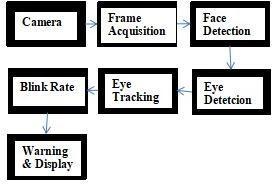
In this Python project, we'll use OpenCVtocollectwebcam photosandfeedthemintoaDeepLearningmodelthatwill identify whether a person's eyes are "Open" or "Closed" basedon theirposition.ForthisPythonproject,thestrategy we'llemployisasfollows:
Let'snowexamineouralgorithm'soperationstepbystep.
Step 1: Take an image as input from acamera.
Inputistakenintheformofanimageusingcamera.Hence, aninfiniteloopiscreatedto recordeveryframeinorderto usethewebcam.
Step 2:Create a region of interest (ROI) and identifyfaces in the image.
SinceMarkthefacewithrectangularboundandthencreate theregionofinterest(ROI).OpenCValgorithmfordetection oftheobjectacceptsgrayscaleimagesintheformofinput,so firstconverttheimagetograyscaleinordertotraceoutthe faceinit.
Toidentifytheitems,colourinformationisnotrequired.To findfaces,we'llusethehaarcascadeclassifier.
Step 3: Identify the eyes using ROI andprovide the information to the classifier.
TheclassifierintakesinputdataofeyesfromROI,whichis similartothatforfindingface.Priortodetectingtheeyes,a cascadeclassifierissetfortheleftandrighteyes
Step 4: Whether the eyes are open or closed will be classified by the classifier
Nowclassifierfindsthestateofeyewhetherclosedornot. Forforecastingthe eyestate,CNNclassifierisutilized.The colourimageisfirstconvertedtograyscale.Wethenresize the image to specified pixels in accordance with how our modelwastrained.
Step 5:Calculate a score to find out if aperson is drowsy.
Find the score to determine the drowsiness . The score indicatehow longtheeyesareclosed.Increasethescoreif botheyesareclosedelsedecrease.
c. Fully Connected Layers
Afullyconnected(FC)neural networkcanbeusedtoclassify the data into distinct classes after the features have been retrieved.SVMcanalsobeusedinplaceoffullyconnected layers, although doing so results inan additional layer of complexity. Completely interconnected layers to enable training of themodel. This layer contains the data that is crucial to the input, and it produces aprobability that the modelisattemptingtoforecast.
5. APPLICATION REQUIREMENTS
TensorFlow
AnopensourcelibraryforAI&MLiscalledTensorFlow.Deep neuralnetworkscanmakeextensiveuseofittoconcentrate ontrainingandinterference.It hasacomprehensivesetof toolsandlibraries,enablesacademicstoincludecutting-edge technology in machine learning, and makes it simple for developers to create and deploy applications that use machinelearning.
Numpy:
Fig 1 : Block Diagram of Drowsiness detection
1.CNN Architecture
CNN: Convolutionalneuralnetworks Thesenetworksmay soundlikeanoddamalgamofbiology,math,andcomputer science with a dash of CS, but they have been some of the mostimportantdevelopmentsintheareaofcomputervision andimageprocessing.Themultilayerperceptron(MLP)isa regularized variant of the Convolutional neural networks . Theywerecreatedbased onhowtheneuronsinthevisual cortexofanimalsfunction.
a. Convolution Layers
Theinputlayer,thehiddenlayer,andtheoutputlayermake up theconvolution layers.While in neural networks every inputneuronislinkedtothehiddenlayerbelow it, in CNN only a small subset of input layer neurons are linked to thoseinthehiddenlayer.Thefeaturesofaninputimagecan beextractedwiththeaidofconvolutionlayers.Additionally, itiscapableofnumeroustasksincludingedgedetection.
b. Pooling Layers
The major objective of the pooling layer isto extract features; by doing so, it helps to reduce the size of the representationandtheparameters,makingthismodelmore efficient.Italsoaidsinminimizingoverfitting.Poolinglayers are new layers that areapplied in convolution layers. The featuremaps'dimensionisdecreasedusingit.
It is primarily intended for numerical computations. Additionally, the Python programming language has a packagecalledNumpy.Multidimensionalarraymetricsanda substantialnumberofhighlevelmathematicaloperationsare definedusingNumpy.
Keras:
It is the TensorFlow library's interface. It isexpandable, modular, and user-friendly. It supports other widely used featuressuchasdropout,batchnormalization,andpooling.
Jupyter Notebook:
Thebasicobjectiveoftheopen-sourcescientificcomputing programme Jupyter Notebook is to mix equations, visuals, and live code. It supports more than 40 programming languages.ThetermsJulia, Python,andR arecombinedto form the moniker Jupyter. While Anaconda comes preinstalled,Jupyterisprimarilydesigned fordatascience and analytics applications. Data sets, such as visuals and charts,are produced by modules like Matplotlib, Plotly, or BokehinAnaconda.
Open CV:
OpenCVisanopen-sourcelibraryusedforprocessingimage and computer vision. It has a significant part in real-time applications, which is much needed in modern world scenario.Itisusedtoanalyzeimagesandfilmstofindfaces, objects,andhandwriting.Pythonhasaabilitytohandlethe OpenCVwhenitisintegratedwithlibrarieslikeNumPy.This isusedtoidentifyvisualpatternsandfeatures.
6. CONCLUSION
A non-invasive system to localize the eyes and monitor fatiguewasdeveloped.Informationabouttheeyesposition is obtained through self-developed image processing algorithm. During the monitoring, the system is able to decideiftheeyesareopenedorclosed.Whentheeyeshave been closed for too long, a warning signal is issued. In addition, during monitoring, the system is able to automaticallydetectanyeyelocalizingerrorthatmighthave occurred.Incaseofthistypeoferror,thesystemisableto recoverandproperlylocalizetheeyes.
Thefollowingconclusionsweremade:
Image processing achieves highly accurate and reliable detectionofdrowsiness.
Image processing offers a non-invasive approach to detecting drowsiness without the annoyance and interference.
A drowsiness detection system developed around the principle of image processing judges the drivers alertness levelonthebasisofcontinuouseyeclosures.
REFERENCES
[1]KunXia,JianguangHuangAndHanyuWang,”LSTM-CNN ArchitectureforHumanActivityRecognition”,UniversityOf ShanghaiFor Science And Technology, Shanghai 200093, China,March20,2020.
[2]FengYou,XiaolongLi,YunboGong,HaiweiWang,”ARealTime Driving Drowsiness Detection Algorithm With Individual Differences Consideration”, School Of Civil EngineeringAndTransportation,SouthChinaUniversityOf Technology,Guanzhou,510640,China,December10,2019
[3]MikaSunagawa,Shin-IchiShikii,Wataru Nakai,Makoto Mochizuki,“Comprehensive Drowsiness Level Detection Model Combining Multimodal Information”, Ieee Sensors Journal,Vol20,No.7, April1,2020
[4]Wanghua Deng, And Ruoxue Wu,”Real- Time DriverDrowsinessDetectionSystemUsingFacialFeatures”,School OfSoftware,Yunnan University, Kunming 650000,China, August21,2019
[5]BurcuKirSavas,AndYasarBecerikli,”Real TimeDriver Fatigue Detection System Based On Multi-Task ConNN”,Computer Engineering Department, Kocaeli University, Turkey,January3,2020.