A Comparative Study of Congestion Control Algorithm in Vehicle Adhoc Networks in Aleppo City
Mohammad Hammadi1 , Souheil Khawatmi2 , Bader eddin Kassab31pursuing a M. S. Computer Networks at the Faculty of Informatics Engineering, University of Aleppo, Syria.
2associate professor at the Faculty of Informatics Engineering, University of Aleppo, Syria.
3associate professor at the Faculty of Informatics Engineering, University of Aleppo, Syria.

Abstract - Many research agencies in transportation seek to find safe ways by equipping vehicles with devices that collect information about the vehicle and sense the road condition. After that, this information is delivered to central units for processing and giving appropriate orders to the vehicles. Vehicular Ad-hoc Network (VANET) is a special part of Mobile Ad-hoc Network (MANET) and a step towards Intelligent Transportation Systems (ITS). It ensures road safety, facilitates traffic management, and provides travelers with some safety and entertainment applications. With the rapid increment in the auto drive vehicles over time, VANETs are suffering from congestion due to the enormous amount of data exchanged between vehicles, negatively affecting Vehicular adhoc Networks’ performance. For this reason, many researchers have resorted to developing and discovering techniques and algorithms to reduce this congestion and detect and treat it in a timely manner to prevent collisions and congestion that lead to traffic accidents and disasters.
Key Words: VANETs, congestion control algorithm, NCaAC, SAE-DCC, Adaptive Power Level Control Algorithm
1. INTRODUCTION
The great development of cities and transportation has created several problems, including pollution and traffic congestion,whichmakelifeuncomfortable.Theseproblems promptresearcherstodevelopcitiesandmakethemsmart, link vehicles to each other by establishing a network, and control vehicles and traffic jams[1] Vehicular Ad-hoc Network(VANET)concernsthelivesofroadtravelersand roadsafetybyreducingtrafficaccidents.However,VANET networkssufferfromfrequentinterruptionsininter-vehicle links.Oneofthemainreasonsfortheseinterruptionsisthe dynamic nature of VANET caused by frequent changes in layout and the locations of mobile nodes. That poses challengestointer-vehiclecommunicationsincreasedbythe large amount of data spread between vehicles on limited bandwidth.Ontheotherhand,thedynamiclayoutofVANET networkscausescongestioninthecommunicationchannel leading to lost messages, delays, and a lack of quality of service.BecauseoftheseproblemsexperiencedbyVehicular Ad-hoc Network, researchers have found and developed algorithmsandtechniquestocontrolcongestioncausedby
vehiclesdensity.Inthisresearch,westudythreealgorithms, NCaAC, SAE-DCC, and APLCA used to control congestion. Then,wesimulatethesealgorithmsusingappropriatetools andapplythesimulationtothecityofAleppoasastudycase.
2. System architecture and network operation
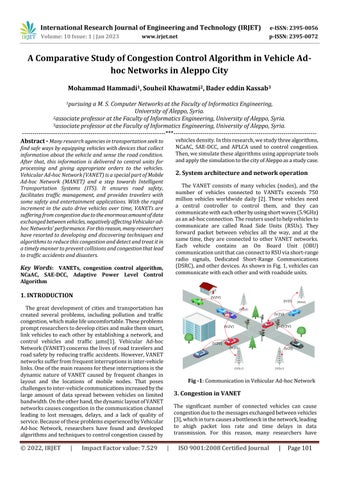
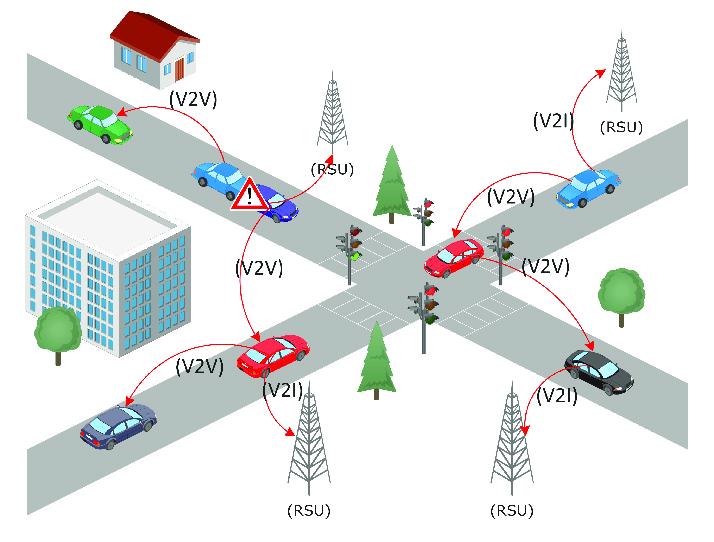
The VANET consists of many vehicles (nodes), and the number of vehicles connected to VANETs exceeds 750 million vehicles worldwide daily [2]. These vehicles need a central controller to control them, and they can communicatewitheachotherbyusingshortwaves(5.9GHz) asanad-hocconnection.Theroutersusedtohelpvehiclesto communicate are called Road Side Units (RSUs). They forward packet between vehicles all the way, and at the same time, they are connected to other VANET networks. Each vehicle contains an On Board Unit (OBU) communicationunitthatcanconnecttoRSUviashort-range radio signals, Dedicated Short-Range Communications (DSRC),andotherdevices.AsshowninFig.1,vehiclescan communicatewitheachotherandwithroadsideunits.
3. Congestion in VANET
The significant number of connected vehicles can cause congestionduetothemessagesexchangedbetweenvehicles [3],whichinturncausesabottleneckinthenetwork,leading to ahigh packet loss rate and time delays in data transmission. For this reason, many researchers have
proposed some solutions to mitigate preventing network throttling,eitherbyimprovingexistingroutingprotocolsor bydevelopingalgorithmsthatdetectandcontrolcongestion [4]
4. Congestion control algorithms
Most congestion control algorithms consider two main factors individually or combine both, named hybrid algorithms.Thesefactorsareasfollows:
1. Messagetransmittingrate:thealgorithmcontrols eitherthenumberofperiodicmessagesbyreducing orincreasingthemessagesaccordingtothestateof thechannelorthesizeofthetransmittedmessages [5].
2. Capacitytosendmessages:thealgorithmincreases or decreases the message transmission power accordingtothestateofthechannel[5].
4.1. Network Coding aware Admission Control (NCaAC)
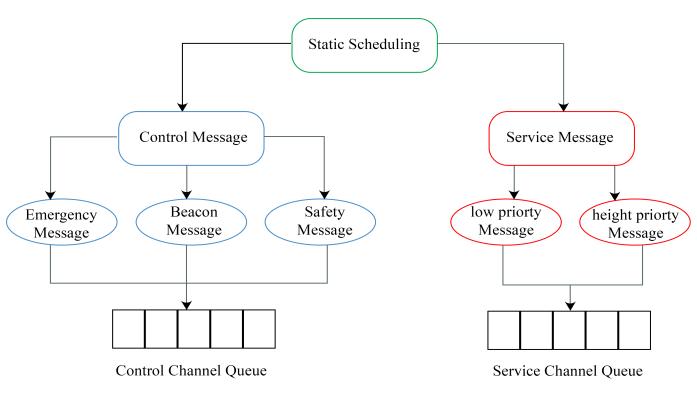
Inthisalgorithm,theRSUcategorizesmessagesashighand lowpriority[6]Then,ittransfersthemessagestothecontrol channelandtheservicechannel,respectively,asshownin Fig.2.Ifthenumberofnodesintheareaincreasesorthereis aserioustrafficsituation,theRSUcanbalancetheloadwith nearbyRSUstoreducenetworkcongestion.Theadvantages ofVANET’scongestionnetworkcodingaretheefficientuse ofbandwidthandthelowpacketlossatallnodes.However, NCaAC undergoes higher energy consumption and costs whileloadbalancingcanredistributeloadstonearbyRSUs [7].
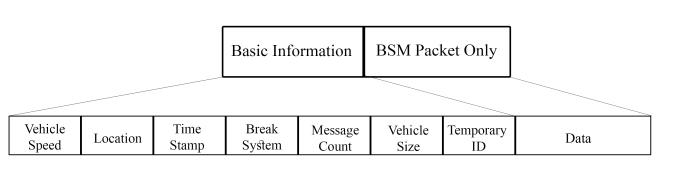
[8].DCCadaptsvarioustransmissionfactors(messagerate, datarate,etc.)tokeepthechannelloadbelowthethreshold accordingtothreemainapproaches: firstly,itchangesthe transmission rate by sending fewer messages per second. This approach causes a delay due to the period between messages.Secondly,itchangesthetransmissionstrength,so themessagedoesnotgofar.Inthissituation,Beaconsand Acknowledgmentssentbyvehiclesarereduced.Thirdly,DCC is tuning both previous factors into hybrid congestion control technology [9]. SAE-DCC adjusts the message rate according to the number of vehicles within a 100-meter range and adjusts the transmit power according to the Channel BusyRatio(CBR)incasethereare noevents.Ifa serious event occurs, SAE-DCC generates a Basic Safety Message(BSM)-a beacon messageusedforSafetyinV2X communications - and transmits it instantaneously at the maximumpermissibletransmitpower[10].ABSMmessage comprisestwoparts.AsshowninFig.3Thefirstpartisthe basic part of the BSM packet, which includes basic status information(vehiclespeed,location,timestamp,numberof messages, brake system status, etc.). The second part is included in the BSM packet only. If no emergency event happens, the BSM packet is created periodically or basedonthecongestioncontrolalgorithm.However,ifthe condition of an emergency event is met, an empty BSM packet must be created for the accelerated event and the EventFlaginthesecondpartoftheBSMwillbemarked.
Various Decentral Congestion Control (DCC) algorithms have been proposed to address the critical congestion problem,whichcanbereactiveorproactiveDCCtechniques
4.3. An Adaptive Power Level Control Algorithm (APLCA)
In this algorithm, the energy consumption of sending messagesisadoptedsothatmessagesaresentwithdifferent capacities depending on the state of the channel [9]. As a result, if congestion occurs in the channel, the power is reduced;thus,themessagedoesnotreachlongdistancesin the network - alleviating congestion. APLCA showed good resultsinthecaseofcitieswithhighdensityofcars,butin lowdensityoronhighways,therewasaSignificantofdata loss, which negatively affected network performance in general.
5. Simulation and result
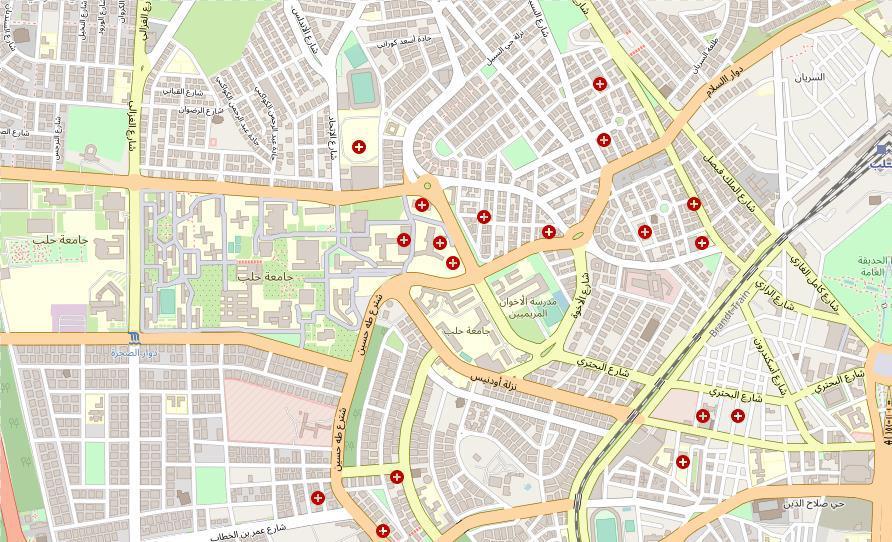
Thesimulationwascarriedoutusingthreetools,andan area within Aleppo city was adopted. The first tool we used is the OpenStreetMap tool, which helps download custom maps in XML format, as shown in Fig. 4. Then, we convertedtheXMLfilesintoaspecificformattobeincluded
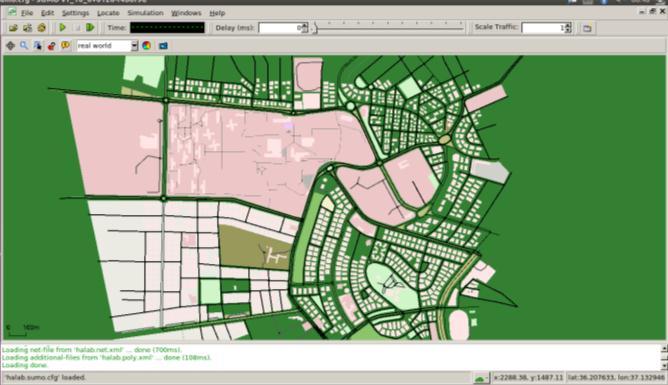
In the SUMO simulator – the second tool - .As shown in Fig. 5, the SUMO simulator is an open-source vehicle networksimulatorthatsupportsdifferenttypesofvehicles and roads in addition to traffic lights at intersections and priorities.Roadnetworkscanbeimportedeithermanually orthroughtheOpenStreetMaptool.
Theexperimentparametersusedinthesimulationwereset as shown in Table -1. After setting up and running the simulation, several performance measures have been measured,asfollows:
Table -1: experimentparametersusedinthesimulation parameters value
Simulationarea AleppoCity
Nodeaveragespeed 40-80km/h
No.ofVehicles 20-100
Transmissionrange 350m
PacketSize 512bytes
TrafficType CBR
SimulationTime 300s
5.1. End-to-end (E2E) delay
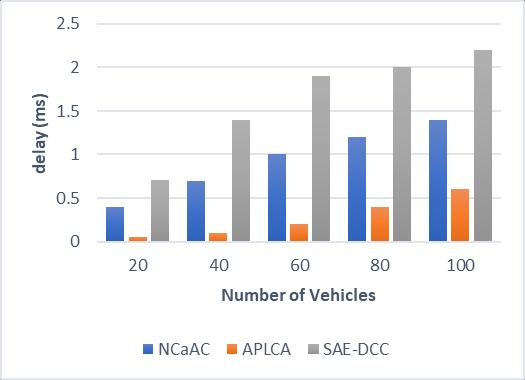
TheE2Edelayofeverysinglepacketisdefinedasthesum of the delays that occurred in a series of nodes the whole way from the source to the destination. As the number of vehiclesincreases,thedelayincreasesduetotheincrement inthenumberofmessagesexchangedbetweennodes.This parameterisveryimportantforchoosingthebestalgorithm performance regarding E2E delay. Chart-1 shows the simulationE2Edelayforthethreealgorithms
ThethirdtoolweusedinourexperimentisNS2(Network Simulator). It is a well-known network simulator used to simulate the movement of nodes within the network, generatetrackingfilesfornodes,andanalyzetheresultsof these files. Fig. 6 shows the random movement of nodes withinthegeneratedpathsbasedontheAleppomap.
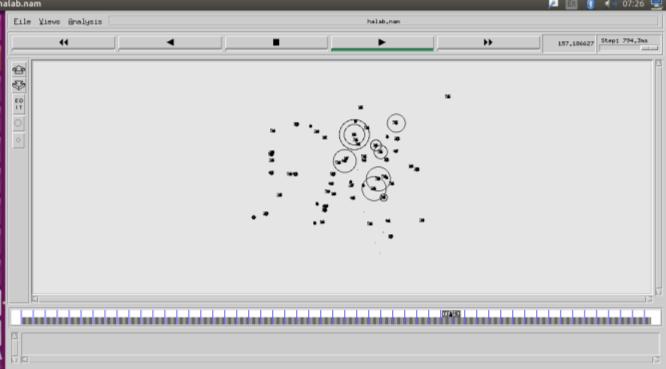
Chart-1:EndToEndDelay
5.2. Packet Delivery Ratio (PDR)
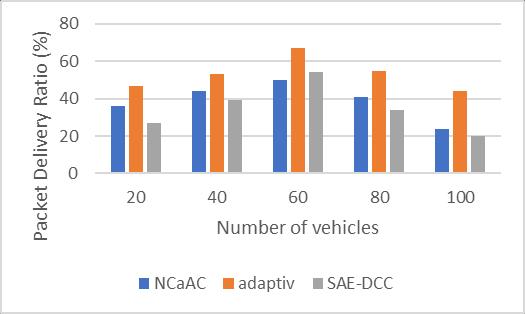
The packet delivery ratio is the rate of the average number of packets received at the destination to the total numberofpacketssentfromthesourcetothisdestination.
The results show that the percentage of data delivery increases with the number of vehicles to a certain extent.
However,whenahighdensityisreached,thePDRdecreases due to the large number of exchanged messages and network congestion. Chart-2 shows the simulation results forthethreealgorithmsintermsofPDR.
delay,PDR,andPacketLossRate.However,whenitcomes to the network throughput, We note that the rate of throughput is low compared to the rest of the algorithms, becauseitreducesthenumberofmessagessentbyreducing theenergyofsendingthesemessage,andthisinturnleads to a reduction in the number of messages in the whole network, which explains the low throughput and also explainsthereductionindelaytimeandtheincreaseinthe percentage of PDR In future research, we will modify the adaptive power level algorithm to reduce congestion in vehicleAd-hocnetworks,improvingtheirperformanceand thus increasing road safety and providing the necessary servicesfortravelers.
REFERENCES
[1] M.Lee,T.Atkison,Vanetapplications:Past,present,and future,VehicularCommunications28(2021)100310.
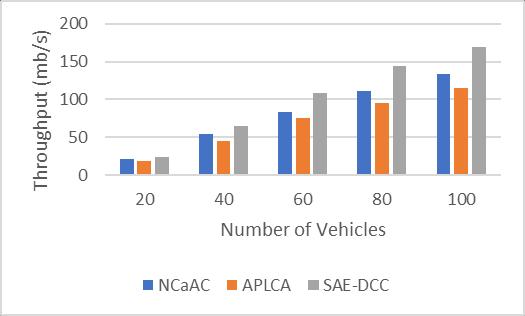
5.3. Throughput
Network throughput is the amount of data successfully transferredfromoneplacetoanotherduringagivenperiod of time, usually measured in bits per second (bps) and its multiples. Throughput tells the user how often messages successfullyreachtheirdestination,representingapractical measure of actual packet delivery rather than theoretical packetdelivery.Thethroughputincreasesdirectlywiththe number of vehicle . According to the results in Chart-3, the SAE-DCC algorithm showed the best productivity comparedtotherestwhenthenumberofcompoundsranges between20and100.
[2] O.S.Al-Heety,Z.Zakaria,M.Ismail,M.M.Shakir,S.Alani, H.Alsariera,Acomprehensivesurvey:Benefits,services, recentworks,challenges,security,andusecasesforsdnvanet,IEEEAccess8(2020)91028–91047.
[3] L.M.Giripunje,D.Masand,S.K.Shandilya,Congestion control in vehicular ad-hoc networks (vanet’s): A review, in: International Conference on Hybrid IntelligentSystems,Springer,2019,pp.258–267.
[4] X. Liu, A. Jaekel, Congestion control in v2v safety communication: Problem, analysis, approaches, Electronics8(2019)540.
[5] J.Singh,K.Singh,Congestioncontrolinvehicularadhoc network: A review, Next-generation networks (2018) 489–496.
[6] S.Wang,Q.Zhang,S.Lu,Ncaac:networkcoding-aware admissioncontrolforprioritizeddatadisseminationin vehicular ad hoc networks, Wireless Communications andMobileComputing2020(2020).
[7] J.T. Willis,A. Jaekel,I. Saini, Decentralizedcongestion control algorithm for vehicular networks using oscillating transmission power, in: 2017 Wireless TelecommunicationsSymposium(WTS),IEEE,2017,pp. 1–5.
Chart -2:Throughput
6. Conclusion and Future Work
Inthispaper,weevaluateandcomparetheperformance ofthreecongestioncontrolalgorithmsbysimulatingthem within a near-real environment and the results show the superiorityoftheadaptivepowerlevelalgorithmcompared to the rest of the algorithms concerning the End-to-End
[8] Y. Wei, C. B. Math, H. Li, S. H. de Groot, Sae-dcc evaluationandcomparisonwithmessagerateanddata rate based congestion control algorithms of v2x communication, in: 2018 IEEE 87th Vehicular TechnologyConference(VTCSpring),IEEE,2018,pp.1–7.
[9] M. Joseph, X. Liu, A. Jaekel, An adaptive power level control algorithm for dsrc congestion control, in: Proceedingsofthe8thACMSymposiumonDesignand
Analysis of Intelligent Vehicular Networks and Applications,2018,pp.57–62.
[10] "PerformanceEvaluationofAOMDVandAODVinCity Scenario With Changeable Traffic Density in VANETS BLSTM With Attention Mechanism".Research Square.2021.
BIOGRAPHIES
MohammadHammadireceivedhisB.S. degreefromtheFacultyofInformatics Engineering, AlBaath University, Syria in2018.HeiscurrentlypursuingaM.S. Computer Networks at the Faculty of Informatics Engineering, University of Aleppo, Syria. His current research interests include VANET communication.
Souheil Khawatmi received his B. S. degree from the Faculty of Computer Engineering,UniversityofAleppo,Syria in 1982 and PhD degrees from the Institute of saint-Petersburg for Communication,Germanyin1989.Heis currentlyan associateprofessoratthe Faculty of Informatics Engineering, UniversityofAleppo,Syria.Hiscurrent research focuses on Computer NetworksandWirelessCommunication.
Bader aldin Kassab received his B S. degree from the Faculty of Computer Engineering,UniversityofAleppo,Syria in 1986 and PhD degrees from the Institute of saint-Petersburg for Communication, Russia in 1992. He is currentlyan associateprofessoratthe Faculty of Informatics Engineering, UniversityofAleppo,Syria Hiscurrent research focuses on the management telecommunicationcenters