Volume: 10 Issue: 02| Feb2023 www.irjet.net

Volume: 10 Issue: 02| Feb2023 www.irjet.net
Abstract - Carbon Nanotubes are one-dimensional nanostructured materials that play a key role in future electronics since Moore’s Law is proceeding to its end. The electronicstructureofasingle-walledzigzagcarbonnanotube has beenstudiedtheoretically byemploying extendedHuckel theory.Forthe(n,0)nanotubewithn=3pwherep ∈ [2,8]the observed bandgap ranges from 0.126 to 0.009 eV. Computed results arise from hybridization between π and σ orbital, caused by the curvature effects. The results reveal that “metallic” zigzag CNT studied are not actually metals but exhibit narrow gap semiconductor behavior. Computed data indicate that the bandgap depends inversely on the square of the diameter of the tube.
Keywords: CNT, Band structure, Bandgap, Semiconducting, diameter

Semiconductors are the basics of electronics. The first transistorwasdiscoveredbyBardeen&Brattain,1949using asemiconductinggermaniumblock[1].Moore’slaw[2]has been a prominent pathway to assign the pace at which transistor dimensions are continuously decreasing. But, since Moore’s law is proceeding towards its end, new semiconductingone-dimensionalnanostructuredmaterials may play a prime role in future electronics. In particular, CarbonNanotubes(CNT)hasbeenthefocalpointofinterest among researchers due to their wide spectrum of applicationsrangingfromnanoelectronicstochemicaland biological sensors [3-11]. Recent findings [12,13] using density functional theory (DFT) calculations predict the potentialapplicationofzigzagCNTsasananodeforMg-ion batteries.
CNTdiscoveredin1991by Ijima [14]are regardedasthe most fascinating materials due to their unique electrical, mechanical and thermal properties. Single-wall carbon nanotubes(SWCNT)arehollowcylindersofcarbonatoms bound together in a hexagonal pattern and are formed by rollingatwo-dimensionalgraphenesheet[15].Amultiwall nanotubeismadeupofmorethanoneSWCNTwithdifferent diametersandacommonaxis.Incomparisontomulti-walled nanotubes,theSWCNTareprincipallynarrowerandhavea diameterneartoonenanometer.TheSWCNThasafeature thattheytendtobecurvedratherthanstraight[16].
Thegeometry,aswellastheelectronicpropertiesofCNT, are described by a chiral vector , where a pair of indices (n, m) correlates the two crystallographic equivalentsitesonthegraphenesheet[17].Onthebasisof Chiralindices(n,m)CNTisclassifiedasazigzag,armchair, or chiral. When either n or m is zero, the rolling of the graphenesheetleadstotheformationofzigzagCNT.When n=mtheCNTisarmchairandtheconditionswhenn≠mCNT haschiralstructure.
The diameter and the helical arrangement are the two importantfactorsthatdecidewhetherCNTwillbemetalor semiconductor[18].Armchair(n,n)CNTisalwaysmetallic innature.ButthenatureofzigzagCNTforchirality(n,m), forn=3pandm=0,iscontroversial.Thesimplezonefolding tightbindingtheoreticalcalculations[19]predictsthat(3p, 0) tubes are metallic and other zigzag CNTs are semiconducting.However,onthebasisoflow-temperature atomicallyresolvedscanningtunnelingmicroscopy,Ouyang etal[20]showedthatsome (3p,0)zigzagnanotubeshavea fundamental gap and hence are semiconductors. B3LYP hybriddensityfunctionaltheory[21]alsoindicatedthat(3p, 0)nanotubeshavea small bandgap.Togeta clearpicture thereisaneedformoreexperimentalworkinthisareabut theyareverycomplicatedandcostlyaswell.Hence,keeping thisinmindtheelectronicbandstructureof(3p,0)zigzag nanotubes is explored using a non-equilibrium green functionapproachwithself-consistentcalculations[22].
Carbon nanotubes are cylindrical shaped allotropes of carbon. CNT are 1-Dimensional nanostructured materials obtainedbyrollingupofagraphenesheetintoacylinder[6]. Agraphenesheetisasinglelayerofcarbonatomspacked into 2-dimensional honeycomb lattice structure. The diameter of CNT is of the order of few nanometers and micrometersizedlength. Theyarecappedattheirendsby one half of a fullerene-like molecule. CNT belong to the family of fullerene, which also incorporate buckyballs. BuckyballsaresphericalinshapewhereasCNTiscylindrical. They are most promising material in the field of nanotechnology.
Nanotechnology is science, engineering, and technologyconductedatthenanoscale,whichisabout1to 100 nanometers. The material used to exhibit peculiar applicationsatthisdimensionalscale.Atthissmallscale,to
be more precise at nanoscale the physical, chemical properties of material are entirely different from the propertiesofindividualatomsormolecules.Ananometeris one Billionth of a meter and numerically it is written as 10-9mor10Å
ThenameCNTisderivedfromtheirsize,asthediameterof CNT is of the order of few nanometers [14]. The chemical bonding in CNT is mainly composed of sp2 bonds. This bondingstructureresultsinamolecularstructurewhichhas uniquestrength,itisevenstrongerthansp3bondspresentin diamond. Carbon nanotubes are strongest material as explored by human being. The value of Young’s moduli of CNT is higher than 1TPa, which is five times higher than steel. Carbonnanotubesaremuchlighterthansteelmaking thematruematerialforreinforcementsinpolymermatrix composites.Duetoexceptionallyuniquepropertiesitcanbe regardedasthematerialof21stcenturyandisgainingthe attentionofscientificcommunity.
CondensedmatterPhysicsisthebranchofPhysicsthatdeals with the study of matter in its condensed state, broadly linkedwithsolidandliquidphasematerials.Thematterin thesoldphasecanbe easilyunderstood byadoptingsolid statephysics.ThisbranchofPhysicsdependsonnumerous numbers of experimental, theoretical and computational techniquesforadetailedandindepthknowledgeofthese materials.Theelectronicbandstructureofmaterialscanbe exploredthroughtheuseofcomputationaltechniques.The bandstructureofvariousmaterialshavingdifferentlength scalerangingfrommacroscaletosubatomic scalecanbe computed.
InitiallyPhysicistreliesonclassicalorNewtonianmechanics toexplainvariousconceptualphenomena. Atmacroscale, classical mechanics is successful in explaining the entire phenomenon. Inconsistency is seemed at smaller length scales and rules of classical mechanics are not rigidly followed in this length scale. On atomic and sub atomic scalestherewasaneedofnewconceptsthatarecapableof explaining the observed experimental results. Later, with theadvancementsPhysicistadoptedanewapproachnamed Quantummechanics,whichiscapableoffurnishingproper explanation of experimental findings at atomic and subatomicscales.Schrodingerproposedthewaveequation, whichopenedthedoortocompletelyexplaintheproperties ofmaterials.
The model incorporates atom-like orbitals as the basis functions. The adjusted parameters in the theory are only the diagonal matrix elements of the Hamiltonian and the slater-typeorbitals(STO)asa basisset[23].STOsarethe
product of radially decaying functions and spherical harmonics.Theknowledgeofdefinedbasisfunctionisused tocomputetheoverlapmatrixelementSandhenceitleads tothedeterminationoftheoff-diagonalHamiltonianmatrix elementsH.TheextendedHuckeltheoryisassociatedwitha non-equilibriumGreenfunctiontodeterminethetransport propertiesofnanotubes.Toaccomplishthistask,theband structure of (3p, 0) (with p=2 to 8) zigzag CNT has been computedusingsimulationtechniqueCNTbandsinnanoHUB [24].
For computation of electronic properties of SWCNT the nanohub simulator CNTbands [24] has been used. The outputofthesimulatorincorporatesphysicalandelectronic properties,includingdiameter,bandstructureandbandgap. CNTbandsisarappturizedsuiteofsimulationtoolforcarbon nanotube and graphene nanoribbons. This rappturized (RapidApplicationInfrastructure)suiteofsimulationtool generatesagraphicalinterfaceofelectronicstructureonce theuserdefinestheoutputsandinputs..Rappture,atoolkit on nanoHUB has been the major source for the rapid developmentandrobustdeploymentofsimulationpackage. Withaconsistentinterface,onecaneasilyachievethegoalin lesstimeandcostascomparedtotheexperimentalscenario developedforthisspecified purpose.Thesimulatorneeds input,oneoftheinputsbeingstructure.Structurehastobe chosenastheinputparameter.Twocarbonnanostructures CNT and GNR are available on the simulator. If CNT is selected then one can adopt the Extended Huckel Theory model whichtakeintoaccountcarriersfromasingles,Pz, Px, and Py orbital for each carbon atom. Other important parameterthatisneededasinputisChirality.Thechirality (n.m) defines the type of carbon nanotube. Here n and m mustbepositiveintegers. Uponexecutionofsimulationand using these input parameters the rappturized suite of simulation tool generates a graphical interface of the electronicstructureofnanoribbonshavingvaryingchirality (width).Rappturized software has an advantage that it is userfriendlyaswellasonecaneasilyachievethegoalinless time and cost but has the disadvantage of being less rigorous
The molecularstructureof one-dimensional nanomaterial (n,0)comprises2nnumberofhexagonsinaunitcell.The circumferenceofanyCNTisexpressedintermsofthechiral vector, which couples two crystallographically equivalent sites on a two-dimensional graphene sheet [17]. With the increase in the value of p in n=3p, the circumference and diameterofnanotubesincreases.Thedistancebetweenthe centerofanytwocarbonatomsinthenanostructureistaken to be 1.42 Å and is kept fixed for all zigzag CNT having differentdiameters.
Firstly, the band structure of an extremely small diameter nanotube(6,0)isevaluatedandisdisplayedinFig.1(a).Itis observedthataverysmallbandgap=0.126eVopensatthe Fermilevelduetoastronghybridizationeffect.However,the previous results obtained using the tight-binding method [19] demonstrated that in (6, 0) nanotube the top of the valencebandtouchesthebottomoftheconductionbandatΓ point.Thediscrepancymaybeduetothefactthatinthetight bindingmethodnoπ-σhybridizationeffectsweretaken.But, for such a small diameter d=0.4697nm the hybridization effects,causedbythecurvatureofCNT,playacrucialrole. Bands higher than the Fermi level are the antibonding π bonds.BandslowerthantheFermilevelarebondingπbonds andbondingsp2σbondshavinglowenergy.Theπ*andσ* states mix and repel each other and hence resulting in a lowerpureπ*state.
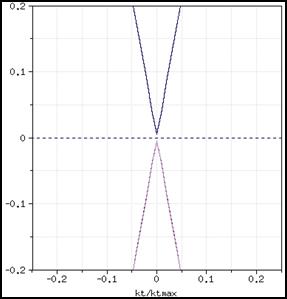
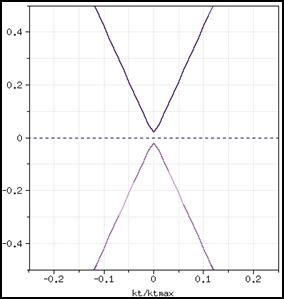
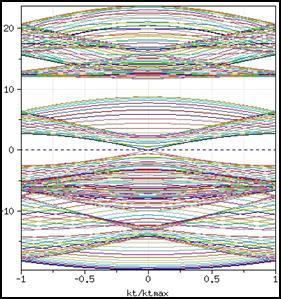
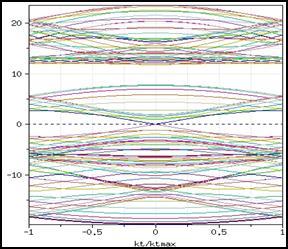
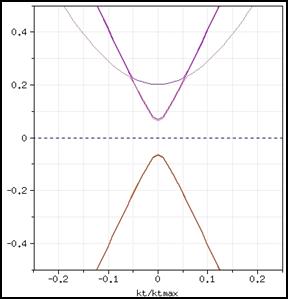
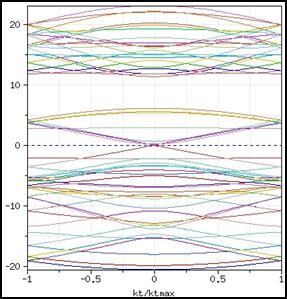
Further, the computed result of the quasiparticle band structureof(9,0),(12,0),(15,0),(18,0),(21,0)and(24,0) nanotubesrevealthatthesematerialsare semiconducting. However, beyond (24, 0) no bandgap is observed. The narrowbandgapfoundin(3p,0)nanotubewithp=3,4and5 is strongly in accordance with the experimental data obtainedbyadoptingalow-temperatureatomicallyresolved scanning tunneling microscopy [20]. For p=6, 7 and 8 comparison with experiment cannot be made because of scarcityofavailabledata.Moreover,theresultsobtainedfor all(3p,0)CNTsarealsoingoodaccordancewiththe B3LYP hybrid density functional approach [21] and the results obtainedbydensityhybridfunctionaltheory[25]. Theπ-π* gapof(3p,0)tubesaretabulatedinTableI.Asdemonstrated inFig.1(b)and(c),bytheexampleofZGNRwithchirality (12, 0) and (24, 0) nanotubes, the semi-empirical theory leads to a semiconducting state in (3p, 0) tubes. For CNT withsignificantlylowdiameter,thestructuraldeformation ofgraphenesheettorolltoaCNThasanenormousinfluence ontheelectronicstructureinducingthemodificationofthe overlapofπorbitalsandconsequentlyopeningabandgap.
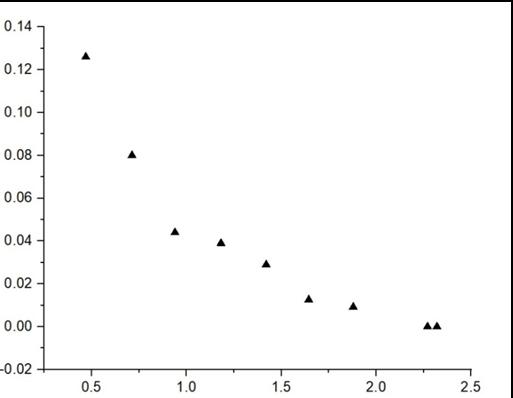
The graphical representation depicted in Fig. 2 reveals an inverse relationship between the energy gap and the diameter of the tube. Inspection of the graph shows that band gaps scale as ~ A0/d2, in harmony with the model proposed by Ouyang et al [20]. The constant factor A0 is related to γ0, the transfer binding matrix element as A0 = 3γ0a2 c-c/4.Thestudyshowedthatfinitecurvaturereduces theoverlapbetween nearest-neighborπ orbitalswhich in turn leadtotheshiftingof kF fromthe first Brillouin zone corner(Kpoint)ofa2Dgraphenesheet.Hence,for(3p,0) tubestheFermiwavevectorkFproceedfarawayfromtheKpointalongthecircumferential directionina mannerthat theallowedsubbandKnolongerpassesthroughkF,leading totheopeningofbandgapinthesematerials.
ExtendedHuckelTheoryusedtoevaluatethebandstructure of zigzag (3p, 0) demonstrated that the sizable band gap arises from the intrinsic properties of CNT. The finite curvature present in CNT modifies the overlapping of π orbitals resulting in a bandgap that is found to decay monotonicallywiththeincreaseindiameter.Hence,metallic (3p,0)zigzagCNTisnolongermetallic,concludingthatthey aresemiconductors.
[1]J.Bardeen, W.H.Brattain, Physical principles involved in transistor action, Physical Review, 75(8), 1208 (1949)DOI: 10.1103/physrev.75.1208
[2] F. Schwierz, Graphene transistors, Nature nanotechnology, 5(7), 487-496 (2010), DOI: 10.1038/nnano.2010.89
[3]R.Maheswaran, B.P.Shanmugavel, A Critical Review of the Role of Carbon Nanotubes in the Progress of NextGeneration Electronic Applications, Journal of Electronic Materials, 51, 2786-2800 (2022), DOI: 10.1007/s11664022-09516-8
[4] P.I. Okwu, I.N.Onyeje, Carbon Nanotubes: The Hub Of Nanoelectronic, International Journal of Engineering Trends and Technology (IJETT), 4(10), 4344-4348(2013)
[5]M.Irfan,A.Sattar,A.Iqbaletal, Investigationof Effects of Diameter,DopingandVacancyDefectsontheBandStructure and Transport Properties of Silicon Nanowires for Potential Applications in Field-Effect Transistors, Journal of Electronic
Materials, 48(5), 2761-2769(2019),DOI:10.1007/s11664019-06933-0
[6] S.H.Chae, Y.H.Lee ,. Carbon nanotubes and graphene towards soft electronics, Nano Convergence, 1(1), 1-26 (2014),DOI:10.1186/s40580-014-0015-5
[7] V.Dmitriev, F.Gomes, C. Nascimento , Nanoelectronic devices based on carbon nanotubes, Journal of Aerospace, Technology and Management, 7, 53-62 (2015). DOI:10.5028/jatm.v.7i1.358
[8]P.Clément,X.Xu., C.T.Stoppielloetal,.DirectSynthesis of Multiplexed Metal‐Nanowire‐Based Devices by Using Carbon Nanotubes as Vector Templates, Angewandte Chemie International Edition, 58(29), 9928-9932 (2019). DOI:10.1002/anie.201902857
[9]M.Hussain,M.N.Naeem, Mass density effect on vibration of zigzag and chiral SWCNTs: A theoretical study, Journal of Sandwich Structures & Materials, 23(6),2245-2273(2020). DOI:10.1177/1099636220906257
[10] R.Izadi, M.Tuna, P.Trovalusci, E.Ghavanloo, Torsional characteristics of carbon nanotubes: Micropolar elasticity models and molecular dynamics simulation, Nanomaterials,11(2), 453 (2021) DOI: 10.3390/nano11020453
[11] DeepaSharma, S.Banerjee, S.K.Pati et al, Effect of Conjugation on the Vibrational Modes of a Carbon Nanotube Dimer, Spectrochimica Acta Part A: Molecular and Biomolecular Spectroscopy, 246, 118985 (2020). doi:10.1016/j.saa.2020.118985
[12] E.Shakerzadeh, H. Mirzavand , Z.Mahdavifar, A comparative DFT study on prospective application of C24, Si12C12, B12N12, B12P12, Al12N12, and Al12P12 nanoclusters as suitableanodematerialsformagnesium-ionbatteries(MIBs), PhysicaE:Low-dimensionalSystemsandNanostructures, 140, 115161(2022),DOI:10.1016/j.physe.2022.115161
[13]S.A.Aslanzadeh, A computational study on the potential application of zigzag carbon nanotubes in Mg-ion batteries, Structural Chemistry, 31(3), 1073-1078 (2020), DOI: 10.1007/s11224-019-01485-9
[14] S. Iijima, Helical microtubules of graphitic carbon, nature, 354(6348), 56-58 (1991), DOI: 10.1038/354056a0
[15] P.M.Ajayan, Nanotubes from carbon, Chemical reviews, 99(7), 1787-1800(1999), DOI:10.1021/cr970102g
[16]S.Iijima,T.Ichihashi, Single-shellcarbonnanotubesof1nm diameter. nature, 363(6430), 603-605 (1993), DOI: 10.1038/363603a0
[17] N.Saifuddin, A.Z.Raziah , A.R. Junizah, Carbon nanotubes: a review on structure and their interaction with proteins, Journal of Chemistry, 2013,1-18 (2013), DOI: 10.1155/2013/676815
[18] N.Hamada, S.I. Sawada, A.Oshiyama, New onedimensional conductors: Graphitic microtubules, Physical review letters, 68(10), 1579 (1992), DOI: 10.1103/PhysRevLett.68.1579
[19] R.Saito, M.Fujita, G. Dresselhaus, U.M.Dresselhaus, Electronic structure of chiral graphene tubules, Applied physics letters, 60(18), 2204-2206 (1992), DOI: 10.1063/1.107080
[20] M.Ouyang,J.L.Huang,C.L.Cheung, C.M.Lieber, Energy gaps in" metallic" single-walled carbon nanotubes, Science, 292(5517), 702-705(2001),DOI:10.1126/science.1058853
[21] Y.Matsuda, J.Tahir-Kheli, W.A.Goddard III, Definitive band gaps for single-wall carbon nanotubes, The Journal of Physical Chemistry Letters, 1(19), 2946-2950(2010),DOI: 10.1021/jz100889u
[22]W.Lu,V.Meunier,J.Bernholc, Nonequilibriumquantum transportpropertiesoforganic molecules onsilicon, Physical review letters, 95(20), 206805 (2005) DOI: 10.1103/PhysRevLett.95.206805
[23] D.Kienle, J.L.Cerdaand , A.W.Ghosh, Extended Hückel theoryforbandstructure,chemistry,andtransport.I.Carbon nanotubes, Journal of applied physics, 100(4), 043714 (2006), DOI:10.1063/1.2259818
[24] Gyungseon Seol, Youngki Yoon, James K Fodor et al, "CNTbands,"https://nanohub.org/resources/cntbands-ext (2019)., DOI:10.21981/QT2F-0B32
[25]R.Wan,J.H.Peng,X.Zhang,C.Leng, Bandgapsandradii of metallic zigzag single wall carbon nanotubes, Physica B: Condensed Matter, 417, 1-3 (2013), DOI: 10.1016/j.physb.2013.02.025