An Overview of Traffic Accident Detection System using IoT
Muthulakshmi K1 Thulasimani K2 Sathya M3
1.3 P. G. Student, Department of Computer Engineering, GCE, Tirunelveli, TamilNadu, India
2Professor, Department of Computer Engineering, GCE, Tirunelveli, TamilNadu, India ***

Abstract -Vehicle accidents have become one of the major issues, which cause the death of many people around the globe. One of the most important steps is to provide the victim with immediate, adequatemedicalcare. Although the concept of vehicle accident detection is not new one now-adays. But, in automobile industry has achieved significant advancements in technology optimization. The accident location is determined using the accelerometer. The issue will be corrected and the code created to launch the notification and SMS alert will run if the values of the x, y, and z parameters are greater than the defined values. Accidents are automatically detected based on GPS information and the location is quickly transmitted to nearby hospitals, police station and frequently called relatives. The main advantages of this system is low cost, ease of implementation, use and processing speed, high accuracy,andconfidence
Keywords: Accelerometer, GPS, Technology, Accident, Victim
1. INTRODUCTION
A network of uniquely identifiable embedded computing devices connected to an existing Internet infrastructure is referred to as the Internet-of-Things (IoT). In addition to Machine-to-Machine (M2M) communication, the Internet of Things enables a complex device, system, and service connectivity often across multiple protocols, domains, and applications. Almost all automation sectors leverage the interconnection of these embedded devices like including smart objects, enabling cutting-edge applications like a Smart Grid. In the context of the Internet of Things, the term "Things" can refer to a wide range of gadgets, including implanted heart monitors, biochip transponders on farm animals, electric clamsincoastalwaters,carswithbuilt-insensors,orfield operation devices that help firefighters with search and rescue missions. Thermostats and washers and dryers with Wi-Fi capabilities are used for communication purpose.
2. EXISTING TECHNOLOGIES
Numerous methodologies, algorithms, and technologies are available to automatically detect traffic incidents. Every system has advantages and
disadvantages. Andtheproposedtechnologiesormethods are accurately identified the automatic traffic accident detectioninaparticularlocation.
2.1. Gaussian Mixture Model
[1] The model for real-time traffic accident detection is proposed by Zu Hao et al. and this method uses the Gaussian Mixture Model (GMM) to identify vehicles and then tracks the identified vehicles using the MeanShiftmethod.Thisprocesshandlesocclusionduring collision very well and significant attenuation. In unpredictable traffic flow and bad weather conditions, it dependsonseveralparameters.
2.2. Internet of Things and GPS
[2]EliNasr,EliKfuri,andDavidKhouryproposed a public safety agency model using the Internet of Things and GPS. This method uses public safety agencies, emergency services, the Internet of Things, sensors, and geographiccoordinates.Itisthepurposeofthisdocument to detect incidents and notify relevant public safety authorities. It detects impact using airbag deployment or collision sensors. The downside to this strategy is that it onlyinformsdriversofvehiclesequippedwithairbagsand impact sensors in the event of an accident. Accident detectionisunreliableduetohighfalsepositiverates.
2.3. Alcohol Sensor with Arduino Nano
[3] Prevent traffic accidents using alcohol detectors and accelerometer modules. Using an alcohol sensor with an Arduino Nano is a suggested from Ahmar Zam and Kshitiya Ku Mar Singh. Short Message Service (SMS) notifications are sent through GSM modems, which stands for Global System for Mobile Communications. A CPU fan (Central Processing Unit), LCD (Liquid Crystal Display),andGPS (Global Positioning System)areused to simulateacarengine.Analcoholreadingdeviceissuitable for this method of detecting alcohol absorption through breath odor. Driver is very sensitive to alcohol and exhibits some behavioral anomalies when exposed to benzene. Alcohol reading devices measure the same outputimpedanceasmaintainedbyalcoholabsorption. In GSM module, the incident detector and alarm system and themobilephonecommunicateviatheGSMmodule.
The scene of the accident is located and tracked bytheGPSwhichsendsmicrowavesignalsto satellites as well. Compare to the previous method that the author's main focus is on vehicle speed. But Ahmar Azam and KshitiyaKumarSinghweren'tjustconcernedwithvehicle speed in this strategy. They also looked for signs that the driverwasintoxicated.
2.4. Support Vector Machine
[4] Traffic accidents are predicted, G. Liang developed automatic traffic accident detection using a Support Vector Machine (SVM) modified with ACA (Ant Colony Algorithm). In this case, Internet of Things platforms are typically retired as the basis for intelligent transportation. The author are used wireless technology and RFID technology and also used tests based on realworldtrafficdatatopredictseventypesofcrashes:vehicle crashes, person-traffic crashes, vehicle crashes, traffic streams, accidents, crowd traffic accidents - standard traffic accidents, and bad track conditions. They noticed that the ACA-corrected SVM could combine the data at a fasterrateandthemeansquarederror(MSE)wassmaller compared to the simple SVM. The ant colony algorithm wasusedeffectively.
2.5.MEMS (Micro Electro- Mechanical System)
[5] Varsha Goud has presented a model that uses an ARM controller, a MEMS (Micro Electro-Mechanical System), a vibration measuring device, GPS, and GSM to identify accidents and deliver the alarm message to the traffic control room and a rescue squad. When there is a little disaster or no serious risk to anyone's life, they employaswitchtoendthealarmmessage.TheyusedGSM technology for wireless communication and GPS technology to determine the location. They claim that in another technique, only accidents detect and send alarm messages automatically, but in this approach, alert messages are detected and sent automatically in addition toaccidentsratherthanbeingterminatedbyaswitch
2.6.Deep Learning Model
[6] Nimish Agarwal and colleagues suggested a Deep Learning model. This approach depended on cameras for fast detection because GPS devices require time to depict the effects of an accident on the road. This model was developed using two ways. They initially used the learning approach to hone state-of-the-art deep learning models that had been pre transferred on the traffic dataset. Second, it created a unique dataset using web crawling (the Bing image search API) to enhance the system's usefulness. Different datasets are required for picture classification. The other datasets are Accident, Crash,ConcentratedTraffic,andSparseTraffic.
2.7. Image handling and Machine learning
[7] V. Ravindran et al. employed image handling and machine learning approaches to recognize damaged automobilesfromstaticimagesobtainedfromobservation cameras installed in streets and roads to automatically detect traffic accidents. Here, five Support Vector Machines (SVM) that were trained on the HOG and GLCM geographics are combined into a single frame to see accidents from the static image. The first step entails putting up a novel technique for automatically locating traffic accidents. The second stage entails a supervised learning strategy that detects scratched cars as standing images, a period of items that have not yet been studied using machine vision methods. Two free datasets of damagedcars,DCD-1(DamagedCarsDataset-1)andDCD2 (Damaged Cars), are included in the final stage. These datasets were modified based on the quality and distance of the photos they contained. When Damaged Cars Dataset-1 was captured at a distance of about 2 meters using good excellence, the system's accuracy was 82%; whenDamagedCarsDataset-2wascaughtatadistanceof about20metersusingacommonfeature,itwas64%.The machine vision technique was successful in locating damagedvehicles.Themaindrawbackofthisstudyisthat itdoesn'trecognizeseriouslydamagedautos
2.8. Intelligent Transportation model
[8[ An Intelligent Transportation model for Smart City Atmospheres has been proposed by Fizzah Bhatti et al. IoT-enabled ITS (Intelligent Transportation Systems) is receiving the essential attention in research and development and is believed to improve road safety in intelligent cities. Information and communication technologies (ICT) are used to make sure that rescue effortsarequickandeffective.ICTisusedforefficientand timely rescue operations. They employed GPS, or the Global Navigation Satellite System, in this model to pinpoint their location. This strategy uses databases for hospitals and used cars to collect data. The accident detection components in this study include the accelerometer sensor on a smart phone, GPS, pressure sensor,andthemicrophoneonasmartphone.
3. PROPOSED SYSTEM
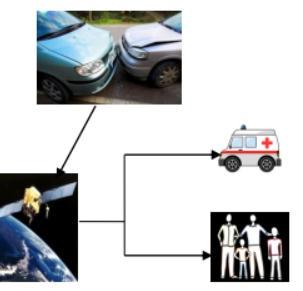
There are so many cases in which it is difficult to rescuevictimsontimeduetoaccidentsoccurringatnight or in remote places where people cannot be heard. As a result, many people die. This device solves the above problem by sending data to emergency services immediatelyafteranaccident.
3.1.Working principle
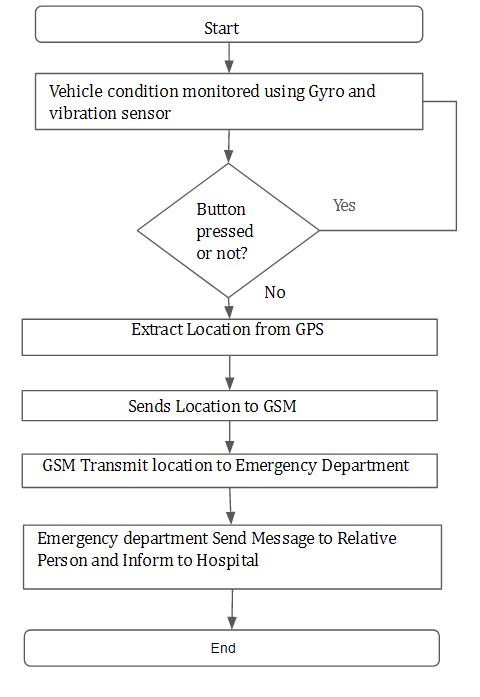
In this work, Arduino Mega microcontroller is used for implementation. The Arduino Mega microcontroller is derived from the car's cigarette lighter socket (CLR). Gyro sensors and vibrations are used to monitor the condition of the vehicle. The microcontroller determinesthevehicle'slocationfromGPSintheeventof an accident and passes the information to GSM. Information is transmitted via GSM to emergency response agencies. The GPS returns data after receiving thelocationoftheaccidentvehicle.
A WhatsApp message with this information will be sent to that phone number. The channel's Internet connection is used to receive this message. These messages contain latitude and longitude information and use the values to estimate vehicle position. As a token of appreciationtotheuser,theEmergencyResponseService sendsaWhatsAppmessage.
Respond by sending a WhatsApp message to your mobile devicetoacknowledgereceipt.Thentakefurtheraction.
3.2. Block Diagram
3.3. System Implementation
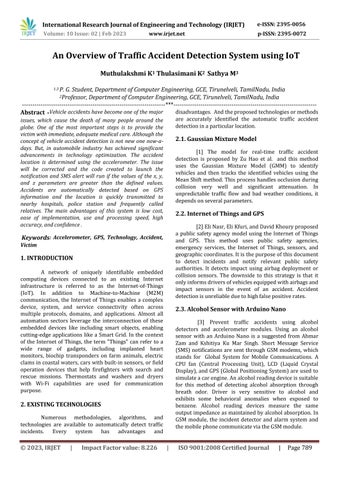
TheArduinoUnoisamicrocontrollerboardbased on the ATmega328P. It has a 16MHz quartz crystal, 6 analog inputs, a USB port, a power jack, an ICSP header, and a reset button (of which 6 can be used as PWM outputs).Therearealso 14digitalinputs/outputs
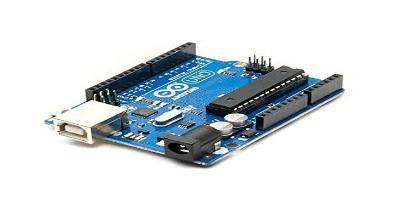
AccelerometerAsensorisadevicethatmeasures the acceleration of a person or object while momentarily stationary. This is not coordinate acceleration. Accelerometer sensors are used in many electronic devices,suchassmartphonesandwearables.
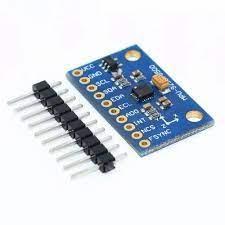
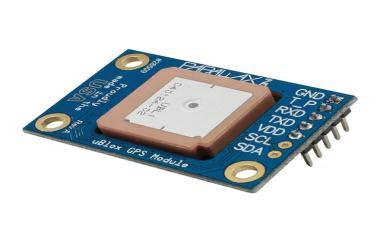
Identify emergencies and send instant messages using GSM and GPS technology. The exact location, altitude, distance, and direction of the accident are determined by GPS satellites. Typical microcontrollerbased traffic sensing and communication devices use infrared sensors to identify objects. In the event of an accident, the gadget uses a GPS module to determine the longitude and latitude of the point of the accident. When the vehicle is in the location it came from, call the emergencyroom.
4. CONCLUSIONS
The number of people killed or injured in car accidentsisgrowingrapidly.Hadthevictimsbeenrescued immediately, many lives could have been saved. We looked at different tactics for detecting and preventing accidents. These methods used various sensors such as accelerometers,gyroscopes,andGPSin Gaussianmixture modelstodetectaccidents.
The proposed method is the most practical alternative to the poor quality emergency care provided to road traffic accident victims. When an incident does occur, this technology can be used to alert the right people with a messagesotheycanactquickly.
REFERENCES
[1] Jiansheng, Fu. "Real-Time Vision-Based Collision Detection". Publication of the 11th World Conference on IntelligentControlandAutomation.IEEE,2014
[2] Nasr, Eli, Eli Kfuri, and David Khoury. "IoT Approaches to Traffic Incident Detection, Reporting and Navigation". 2016 IEEE IMCET (International Interdisciplinary Conference on Engineering Technology). IEEE,2016.
[3] Azam,Ahmar,andKshitIjSingh. Accidentprevention with alcohol detector and accelerometer module. 5047. EasyChair,2021.
[4] Bhatti, Fizza, et al. “A Novel IoT-Based Detection and Alert System for Incidents in Smart City Environments.” Sensor19.9(2019)
[5] "Automatic traffic accident detection and vector machine support based on IoT". International J. Smart Home9.4(2015)
[6] Agarwal, Nimish, et al. "Camera-based Smart Traffic State Detection in India using Deep Learning Models." 2021 International Conference on COMmunication Systems&NETworkS(COMSNETS).IEEE,2021.
[7] Ravindran, Vaishnavi, Lavanya Viswanathan, and Shanta Rangaswamy. "A novel approach to automatic road-accidentdetectionusingmachinevisiontechniques." IntJAdvComputSciAppl7.11(2016):235-242.
[8] Bhatti, Fizzah, et al. "A novel internet of things-enabled accident detection and reporting system for smart city environments." Sensors 19.9 (2019): 2071.
[9] Alright, Barça. "Automatic Traffic Accident Detection and Remote Signaling Devices". International Journal of ReconfigurableandEmbeddedSystemss1.2(2012)
[10] Kattukaran, Nicky, Arun George and TP Mithun Haridas.
[11] "Intelligent Accident Detection and Emergency Medical Alerts". 2017 International Conference on Computer Communications and Informatics (ICCCI). IEEE, 2017
[12] Mohd Khairul Afiq Mohd Rasli et al, Smart Helmets withSensorsforAccidentPrevention,IEEE–International Conference on Electrical, Electronics and Systems Engineering(2013)
[13] Sayan Tapadar et al. Accident and Alcohol Detection inBluetooth Enabled Smart HelmetsforMotorbikes,IEEE 8thAnnualComputingandCommunicationWorkshopand Conference(CCWC)(2018)
[14] Nicky Kattukkaran, et al., Intelligent Accident Detection and Alert System for Emergency Medical Assistance, International Conference on Computer CommunicationandInformatics(2017)
[15] Ancy John, et al., Real-Time Embedded System for AccidentPrevention, International Conference on Electronics, Communication and Aerospace Technology (2017)
[16] Selvathi, et al., Intelligent Transportation System for Accident Prevention and Detection, International Conference on IntelligentComputing and Control Systems (2017)
[17] Ju Ren, et al., Edge Computing for the Internet of Things,IEEENetwork,6-7(2018)