A Survey on Person Detection for Social Distancing and Safety Violation Alert based on Segmented ROI

Abstract – Distancing ourselves from othersprotects everybody - particularlythe morevulnerableinsociety. It is important to be clear that it is close and extended personal contact that increases our risk of transmission. Coming into close proximity to someone incidentally is unlikely to lead to transmission. Physical distancing helps limitthespreadofCOVID-19–meanskeepadistanceofat least 1m from each other and avoid spending time in crowdedplacesoringroups.Byavoidingphysicalcontact, theriskofCovid-19transmissioncanbedecreased.Oneof themostefficientwaystostopthespreadisthroughsocial distancing (SD), which calls for people to keep a certain distance from one another. The distance between the peoplefoundintherecordedvideowillbecalculated,and the results will be compared to the values of fixed pixels. The segmented tracking area's core points and the overlapping boundary between individuals are measured for distance. Alerts or cautions can be sent out if it is determinedthatthespacebetweenpersonsisunsafe.The system's ability to detect the presence of people in restricted areas, which may also be used to trigger warnings, is another important function in addition to socialdistancemeasurement.Inordertopreventphysical contact between individuals, this study suggests a methodology for monitoring social distances using surveillance is based on deep learning and performance measures are evaluated by deep learning object detection methodwiththesafetyviolationwarningfeaturebasedon segmentedROIwasshowntohavehigheraccuracy.
Key Words: Covid-19, Person Detection; Social Distancing,RestrictedArea,SegmentedROI
1. INTRODUCTION
Social distancing aims todecrease or interrupt transmission of COVID-19 in a populationby minimizing contact between potentially infected individuals and healthy individuals, or between population groups with high rates of transmission and population groups with no or low levels of transmission. The WHO states that tiny droplets from the mouth and nose are how the coronavirusistransferredfromonepersontoanother.Trytoput it another way, social distance is the best method for avoiding physical contact with suspected corona-virus carriers by maintaining a distance of at least one meter.
Oneofthecreativeapplicationsofintegratedtechnologies that have recently experienced remarkable success and growthisobjecttrackinganddetection.Objectdetectionis the process of identifying and categorizing objects that appear in live streams, video frames, and photographs in ordertotellusoftheirnatureandlocation.
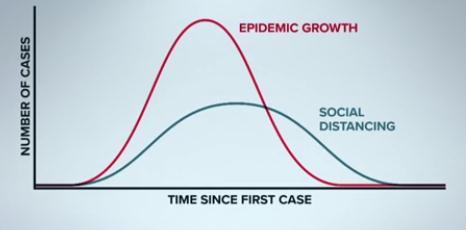
Gaussiancurvesshowaslightincreaseintheefficiency of the healthcare system, which enables patients to easily avoid contracting the virus by paying attention to the authorities'resoluterecommendations.Anyunanticipated sharpened spike and rapid rise in the infection rate will result in a breakdown of the healthcare system and an increase in the number of mortality. Fig1 highlight how crucial it is to adhere to the recommendations for using social distance in order to reduce the spread of the virus amongpeople.
1.2 RELATED WORKS
Severalmeasuresareavailableforhumandetectionand social distance in a crowd environment. Some articles are researched for the implementation of work. The goal of Prem et al. [1] was to investigate the impact of social distancing techniques on the transmission of the COVID19 outbreak. Susceptible – Exposed – Infected -Removed (SEIR) models to replicate the ongoing course of the outbreak using synthetic location. Specific contact
International Research Journal of Engineering and Technology (IRJET)
Volume:
patterns are also hypothesized in early stage. Abrupt lowering of social separation might result in an earlier secondary peak, which could be leveled by gradually relaxinginterventions[15].
Aslani et al. [2] suggested a spatio - temporal filterbased methodology for motion identification in which the motion parameters are discovered by analyzing threedimensional(3D)spatio-temporalaspectsofthepersonin motion in the picture stream. These approaches are favorable because of the simplicity and lower computer cost, but the performance is restricted due to noise and uncertaintyonmovingpatterns.
Using a single picture acquired from a visible light cameraatnight,JongHyunKimetal investigatedaCNNbased technique for person identification in a range of situations[5]. For evaluation procedure, the detection accuracy of a CNN with and without pre-processing, resulted in the accuracy being greater when utilizing a combineddatabasewith pre-processing.
Adolph et al. [4] emphasized that it could not be implementedatanearlystageowingtoa lack ofcommon consent among all officials, resulting in ongoing harm to public health. Although social alienation has reduced economic output, many researchers are working hard to compensate. Allexaminedliteratureandassociatedstudy work clearly provides a picture that the use of human detection may easily be extended to many applications to accommodatethecurrentcircumstances,suchaschecking mandatedstandardsforhygiene,socialdistance,andwork practices.
2. WORKFLOW
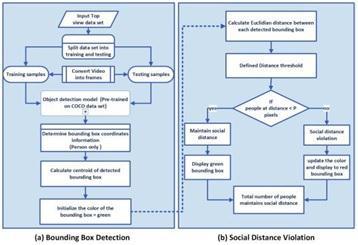
Controlling the spread of COVID-19 requires social distancedetectionamongthecollectonofpeoplethatisin crowd environment. The suggested approach uses any of the algorithms to detect social distance between persons. There are several stages, including video capture, video frame conversion, preprocessing, human recognition, distance computation, and SMS notifications. The algorithmisfeedvideoobtainedfromCCTV.Theresultant would be recognising persons in the frame, determining social distance among the people, and delivering SMS to thespecificin-charge.
Fig.2 Workflowforpersondetectionforsocialdistancing andsafetyviolationalertbasedonsegmentedROI flowchart.
3. METHODOLOGY
Deep learning technique is an object detection strategy that reduces computer complexity by simulating tasks for predicting objects in the images. Convolutional NeuralNetworks(CNNs)areaformofneuralnetworkthat are good at capturing patterns in multidimensional fields. CNN model is a popular for object detection algorithm in deep learning frameworks. This algorithm takes an input imageandassignsbiasesandlearnableweightstodistinct classes in the image, allowing them to be distinguished from one another. CNN models of various varieties are usedinmanyapplicationsforobjectdetection.
3.1 Faster Regional-CNN (Faster R-CNN)
Faster RCNN is based on an exterior region proposal technique based on Selective Search (SS) and is evolved from its predecessors. Many researchers discoveredthat,insteadofemployingtheSelectiveSearch, the benefits of convolution layers are advised for better andquickerobject localization.QuickerR-CNN isa region proposal network that employs CNN models to create region proposals that are 10 times faster than RCNN. The RPN module conducts binary classification of an item as eitheranobjectornotanobject,whereastheclassification module provides categories to each detected object by pooling Region Of Interest (ROI) on extracted feature mapswithprojectedareas.
ThefasterRCNNisamixtureoftwomodules,RPN andfastRCNNdetector.Thetotalmultitasklossfunctionis madeupofclassificationlossandboundingboxregression loss,bothofwhichhaveLcls andLreg functionsspecified. tu isthepredictedcorrectionsoftheboundingbox tu ={tux; tuy ; tuw ; tuh }. Here u is a true class label, (x, y) corresponds to the top-left coordinates of the bounding box with height h and width w, v is a ground-truth
International Research Journal of Engineering and Technology (IRJET) e-ISSN: 2395-0056
Volume: 10 Issue: 02 | Feb 2023 www.irjet.net p-ISSN: 2395-0072
boundingbox,pi* isthepredictedclassandpi istheactual class.
3.2 Single Shot Detector (SSD)
A Single Shot Detector (SSD) is another object identification approach used in real time video surveillance systems to detect individuals. R-CNN works faster on region suggestions to generate boundary boxes to designate objects, resulting in higher accuracy but slower Frame Rate Processing (FRP/second). SSD enhances accuracy and FRP/second even more by combining multi-scale features and default boxes in a single operation. It employs the feed-forward convolution network approach, which creates bounding boxes of specifiedsizesaswellasascorebasedontheexistenceof object class instances in those boxes, followed by an NMS steptogeneratethefinaldetections.
3.3 YOLO V3
YOLO is another SSD contender for object detection.YOLOpredictsthekindandpositionofanobject item based on a single look at the image and treats the object detection issue as a regression task rather than a classification one in order to assign class probabilities to theanchorboxes.Asingleconvolutionalnetworkpredicts severalboundingboxesandclassprobabilitiesatthesame time.YOLOhasthreemajorversions:v1,v2,andv3.Instead ofutilizingsoftmax,YOLOv3 doesmulti-labelclassification using logistic classifiers. YOLO v3 makes three predictions for each spatial position in a picture at different sizes, removing the problem of not being able to identify small items effectively. Objectless, boundary box regresses, and classificationscoresarecomputedforeachprediction.
3.3 YOLO V4
YOLO-v4 has been investigated as a fast and accurate object detector. This model significantly improves on prior iterations. YOLO-v4 extracts the impact of a cutting-edge Bag of Freebies (BoF) and numerous BagsofSpecials(BoS).Itraisestheexpenseoftrainingand dramatically improvesobjectdetectingaccuracy.Interms of both accuracy and speed, YOLO-v4 is rated the fastest and most accurate model. YOLO-v4 is a simplified version of the YOLO-v4 architecture. This model is simple to build and performs well in terms of object detection and also thisapproachcanreducethecomputationalcomplexityon assumptions while assuring the neural network model's correctness.
4. RESULT
Object identification models are fine-tuned for binary classification with a labeled called human or nonhuman using the Nvidia GTX 1060 GPU with Inception v2 as a backbone network, utilizing multiple datasets
obtained from Google Open Source Community's Open Image Dataset (OID) repository. The accuracy of this system is measured to assess its effectiveness and the performance values for True Positive (TP), True Negative (TN), False Positive (FP), and False Negative (FN) for social distance monitoring are counted for determining accuracy. The formula for determining precision is providedin:
Based on the observations, the object identificationmodelcandetectthepresenceofahumanif the camera used to capture the video is situated close to the item or in a controlled interior setting and circumstance. As a result, the social distancing system for the outside environment, particularly for recordings that capture distant landscapes, has to be upgraded. The outcomesofeachmodelacquiredattheendofthetraining phase, including the Training Time (TT), Number of Iterations(NoI),mAP,andTotalLoss(TL).
Table-1:Performancecomparisonoftheobjectdetection model
Faster R-CNN model achieved minimal loss with maximum mAP, however, has the lowest FPS, which makes it not suitable for real-time applications. Furthermore, as compared to SSD, YOLO V3, YOLO V4 achieved better results with balanced mAP, training time, andFPSscore.
/
Table-2:Accuracyoftheobjectdetectionmodel
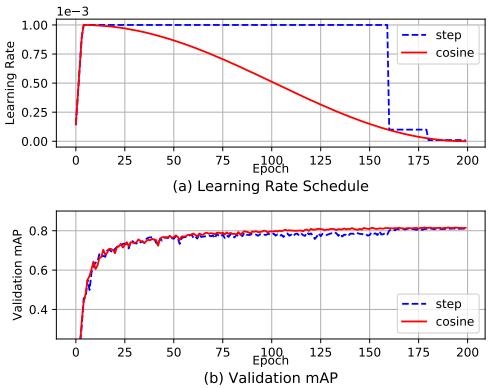
During the training phase, the models' performance is continually checked using the mAP, as well as the localization, classification, and total loss in person detection, as shown in Fig.2. Sample output for object detectionmodelisshowninFig.3.
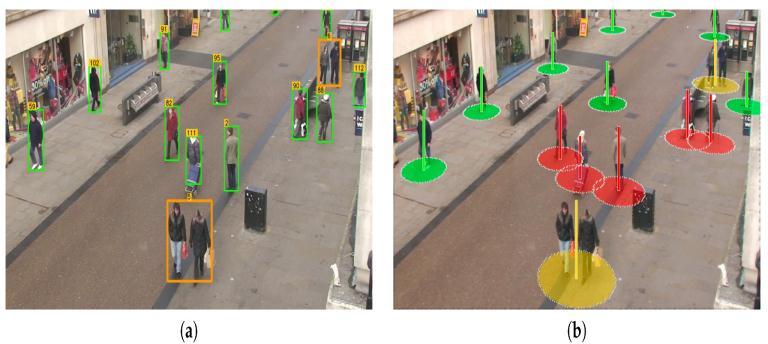
The processed frame with the recognised persons restricted in the bounding boxes while simultaneously simulating the statistical analysis showing the total number of social groups represented by same color encodingandaviolationindextermgeneratedastheratio of the number of people to the number of groups. The framesinFig.3exhibitviolationindexesof3,2,2,and2,3, 3. Frames containing detected breaches are time stamped andsavedforfurtherexamination.
fine-tunedtobetteradaptwiththematchingfieldofview. Based on the overall findings, this study appears to have metallofitsobjectives.
REFERENCES
[1] K. Prem, Y. Liu, T. W. Russell, A. J. Kucharski, R. M. Eggo, N. Davies, S. Flasche, S. Clifford, C. A. Pearson, J. D. Munday et al., “The effect of control strategies to reduce social mixing on outcomes of the covid- 19 epidemic in wuhan, china: a modeling study,” The LancetPublicHealth,2020.
[2] S. Aslani and H. Mahdavi-Nasab, “Optical flow based moving object detection and tracking for traffic surveillance,” International Journal of Electrical, Computer, Energetic, Electronic and Communication Engineering,vol.7,no.9,pp.1252–1256,2013.
[3] S. A. Niyogi and E. H. Adelson, “Analyzing gait with spatiotemporalsurfaces,”inProceedingsof1994IEEE Workshop on Motion of Non-rigid and Articulated Objects.IEEE,1994,pp.64–69.
[4] C.Adolph,K.Amano,B.Bang-Jensen,N.Fullman,andJ. Wilkerson,“Pandemic politics: Timing state-level social distancing responses to covid-19,” medRxiv, 2020.
[5] F.Ahmed,N.Zviedrite,and A.Uzicanin,“Effectiveness of workplace social distancing measures in reducing influenza transmission: a systematic review,” BMC publichealth,vol.18,no.1,p.518,2018.
[6] J. Harvey, Adam. LaPlace. (2019) Megapixels.cc: Origins, ethics,and privacy implications of publicly available face recognition imagedatasets. [Online]. Available:https://megapixels.cc/
5. CONCLUSIONS
This system was built with Python and the OpenCV package to implement two suggested functionalities. The first function detects violations of social separation, while the second detects violations of accessing prohibited locations. Both features have been accuracy checked. The produced bounding boxes help in finding clusters or groups of persons that fulfill the proximity property determined using the pair-wise vectorized technique. The number of violations is validatedbycalculatingthenumberofgroupsestablished and the violation index term, which is calculated as the ratio of persons to groups. Extensive testing were carried out using popular cutting-edge object detection models: RCNN, Faster RCNN, SSD, and YOLO-v3, YOLO-v4, But in YOLO-v4 demonstrating efficient performance with balanced FPS and mAP score. This technique is very sensitive to the camera's spatial placement and it may be
[7] A. Agarwal, S. Gupta, and D. K. Singh, “Review of opticalflowtechniqueformovingobjectdetection,”in 2016 2nd International Conference on Contemporary Computing and Informatics (IC3I). IEEE, 2016, pp. 409–413.
[8] World Health Organization, “Coronavirus Disease 2019,”Coronavirus disease (COVID-19) pandemic, 2020.https://www.who.int/emergencies/diseases/no vel-coronavirus-2019(accessedJun.19,2020).
[9] A.Krizhevsky,I.Sutskever,andG.E.Hinton,“Imagenet classification with deep convolutional neural networks,” in Advances in neural information processingsystems,2012,pp.1097–1105.
[10] J. Redmon, S. Divvala, R. Girshick, and A.Farhadi, “You only look once: Unified, real-time object detection,” in Proceedings of the IEEE conference on
International Research Journal of Engineering and Technology (IRJET) e-ISSN: 2395-0056
Volume: 10 Issue: 02 | Feb 2023 www.irjet.net p-ISSN: 2395-0072
computer vision and pattern recognition, 2016, pp. 779788.
[11] M. Putra, Z. Yussof, K. Lim, and S. Salim, “Convolutional neural network for person and car detection using yolo framework,” Journal of Telecommunication, Electronic and Computer Engineering(JTEC),vol.10,no.1-7,pp.67–71,2018.
[12] R. Eshel and Y. Moses, “Homography based multiplecamera detection andtracking of people in a dense crowd,” in 2008 IEEE Conference on Computer VisionandPatternRecognition.IEEE,2008,pp.1–8.
[13] D.-Y. Chen, C.-W. Su, Y.-C. Zeng, S.-W. Sun, W.-R. Lai, and H.Y. M. Liao, “An online people counting system for electronic advertising machines,” in 2009 IEEE International Conference on Multimedia and Expo.IEEE,2009,pp.1262–1265.
[14] C.-W. Su, H.-Y. M. Liao, and H.-R. Tyan, “A visionbased people counting approach based on the symmetry measure,” in 2009 IEEE International Symposium on Circuits and Systems. IEEE, 2009, pp. 2617–2620.
[15] J. Yao and J.-M. Odobez, “Fast human detection from joint appearance and foreground feature subset covariances,” Computer Vision and Image Understanding,vol.115,no.10,pp.1414–1426,2011.
[16] B. Wu and R. Nevatia, “Detection and tracking of multiple, partially occluded humans by bayesian combination of edgelet based part detectors,” International Journal of Computer Vision, vol. 75, no. 2,pp.247–266,2007.
[17] F.Z.Eishita,A.Rahman,S.A.Azad,andA.Rahman, “Occlusion handling in object detection,” in Multidisciplinary Computational Intelligence Techniques: Applications in Business, Engineering, andMedicine.GIGlobal,2012,pp.61–74.
[18] M. Singh, A. Basu, and M. K. Mandal, “Human activity recognition based on silhouette directionality,” IEEE transactions on circuits and systemsforvideotechnology,vol.18,no.9,pp.1280–1292,2008.
[19] N. Dalal and B. Triggs, “Histograms of oriented gradients for human detection,” in 2005 IEEE computer society conference on computer vision and pattern recognition (CVPR’05), vol. 1. IEEE, 2005, pp886–893.
[20] P. Huang, A. Hilton, and J. Starck, “Shape similarity for 3d video sequences of people,”
International Journal of Computer Vision, vol. 89, no. 2-3,pp.362–381,2010.
[21] [51] A. Samal and P. A. Iyengar, “Automatic recognition and analysis of human faces and facial expressions: A survey,” Pattern recognition, vol. 25, no.1,pp.65–77,1992.
[22] D. Cunado, M. S. Nixon, and J. N. Carter, “Using gait as a biometric, via phase-weighted magnitude spectra,” in International Conference on Audio-and Video-Based Biometric Person Authentication. Springer,1997,pp.93–102.
[23] B. Leibe, E. Seemann, and B. Schiele, “Pedestrian detectionincrowdedscenes,”in2005IEEEComputer Society Conference on Computer Vision and Pattern Recognition (CVPR’05), vol. 1. IEEE, 2005, pp. 878–885.