International Research Journal of Engineering and Technology (IRJET) e-ISSN:2395-0056

Volume: 10 Issue: 01 | Jan 2023 www.irjet.net p-ISSN:2395-0072
PI TOP: HARDWARE-ENABLED SUPERCOMPUTER
Devraj Chavan1, Pranav Narvekar2, Sushma Amudallapally3, Heth Gandhi4, Jyoti Mali5
1,2,3,4Student, Department of Electronics and Telecommunication, Malad Marve Road, Shri Sevantilal Khandwala Marg, Charkop Naka, Malad West, Mumbai, Maharashtra 400095, India.
5Professor, Department of Electronics and Telecommunication, Malad Marve Road, Shri Sevantilal Khandwala Marg, Charkop Naka, Malad West, Mumbai, Maharashtra 400095, India. ***
Abstract - According to the most recent research, we discovered that teachers who are proficient in using digital tools could help students develop higher-order thinking skills, give them unique and creative ways to express what they have learned, and better prepare them to deal with ongoingtechnologicalchangeinboththerealworldandthe workplace. India needs cost-effective and cutting-edge educational equipment to support this revolution in education. An essential part of STEM education is technology. We created affordable educational laptops for teachers, students, and schools. This laptop is user-friendly and has strong connectivity and processing power. The physicalcomputingfeature willimprove theyoungstudents' programmingabilitiesandcreativity.
Key Words: Raspberry Pi, Laptop, Operating Systems, Supercomputer, Affordable, Programming.
1. INTRODUCTION
Information technology is a rapidly evolving field that frequently offers the public new solutions. To communicate, distribute, create, store, and organize information, schools use a variety of ICT tools. The use of smartphonesandtabletsortabletcomputersforhavingto learn during lectures, as well as the "flipped classroom" model, where pupils watch live and documented lectures at home on the smart device and use class time for more interactive activities, are some examples of how ICT has sometimes become an integral part of the teachinglearning process. These methods can promote higherorder thinking skills, offer unique and personalized ways for learners to express their identities, and keep students better equipped to deal with continuing technological changes in both the globe and the workplace when instructorsaredigitallyliterateandtrainedtouseICT.
Devices like the Raspberry Pi are often used as examples ofthis phenomenon. Engineers wereableto create a lowcost, hand computer with convincing technical specifications thanks to ongoing miniaturization and inexpensive components. These microcomputers can performawiderangeoftasks,fromindustrialapplications to domestic entertainment. The Raspberry Pi Foundation raised the bar even further by questioning themselves to createaflexibletooltoraisethecaliberofITinstruction.
value:
Thisprojectdemonstrateshowalow-costprojectcangive educational institutions new capabilities that will enable them to give students opportunities to learn how to developanduseapplicationsthattheywillcomeacrossin the future. The project's independent project-based structure turned out to be a crucial element in its successfuldesignandexecution.
The construction of large cluster computers has become affordable thanks to the availability of low-cost, highpower single-boardcomputerslike theRaspberry Pi. This paper outlines a cheap and simple method for giving students programming experience on supercomputers without using simulation or visualization methods. To help readers understand the benefits of writing programmes to make use of parallel computer architectures, a sample prime search programme created torunona multinodeclusterisprovidedalong withruntimes.
In this paper, we suggest a low-cost laptop for education that has the distinctive capability of physical computing. Raspberry Pi, a single-board computer, was used in the design of this laptop. This device is compatible with a number of programming languages, including C, C++, Python, Java, and Scratch. It offers top-notch software for performing office tasks like creating spreadsheets, word processing, and presentation preparation. It uses an open source operating system based on Linux and can be used forbotheducationalandnon-educationalpurposes.
2. PROBLEM STATEMENT
A new area of the digital world arises due to the current epidemicCOVID-19whichisbeingfacedworldwide,while theworldisstillespousingsocialdistancepractice.System Technology takes a step ahead in order to deal with this issue where nearly all of India is working from home. scholars of seminaries/sodalities are floundering to manage with expensive tackle(Laptop/ Desktops). To overcomethischallenge,I'vecomeupwiththeexceptional idea of using a low- cost bias which can save millions of dollarsonalaptop/desktop.
More and more students are looking for opportunities to gain experience with emerging technologies that
International Research Journal of Engineering and Technology (IRJET) e-ISSN:2395-0056
Volume: 10 Issue: 01 | Jan 2023 www.irjet.net p-ISSN:2395-0072
personally interest them but may go beyond the intended curriculum. This essay examines a single, independent project in which a student used the parallel processing power of ten Raspberry Pi devices to build a supercomputer. The value of this paper lies in its understandings of how impartial tasks may be used for students to gain outside of the education system to increase their intellectual presence in the field, how to nurture a comprehensive community of learners for the immediate society, provide a way for learners to earn course credit without causing financial hardship for the college, and at last this specific project of building a supercomputer
Numerous people have started to use ‘Raspberry Pi 4 B withRaspberryPiOS’.Thishelpstoconnecttotheironline classroom, surf the internet, connect office systems to virtualmachines,andhaspowerforrealmultitaskingand productivity.
Inouropinion,theclassroomcangreatlybenefitfromthe inexpensive, quick, intuitive, engaging, and long-lasting physical computing solutions available today. The raspberry pi is one of many integrated, carefully crafted physicalcomputingdevicesthathasthepotentialtofirmly establish physical computing as a crucial component of contemporary computer science education. These boardlevel embedded devices should eventually have greater computational power, better wireless connectivity, better physical construction kit integration, and greater extensibility. They will also probably become less expensive and smaller than current products, which will make them even better suited for a range of school projects and uses like wearable technology, robotics, and gaming.
Inthenatural andenvironmental sciences, data collection is easily supported by physical computing devices. The nextgenerationofscientistswillbeengagedandeducated as physical computing devices natural sources of sensor data become more and more relevant in the rapidly developingfieldofdatascience.Finally,bothstudentsand amateurs can be given the tools they need to start a maker-to-market journey in a variety of application domains.
But there are still a lot of difficulties. Teachers and technology developers must work closely together to design an end-to-end experience that is compelling for bothstudentsandteachers.Aseamlessandengagingendto-end experience depends on tight hardware and programmingenvironmentintegration.Ofcourse,itisalso imperative to have high-quality curriculum, instruction, andteacherpreparation.
3. LITERATURE SURVEY
Only26.42%ofIndianschoolshavecomputers,according to a government survey conducted by the Department of School Education & Literacy and National University of Educational Planning and Administration (NIEPA). In India's36statesandunionterritories,1.52millionschools were included in the report for the academic year 2014–15. Students in secondary schools have a critical need for an affordable educational laptop to learn about fundamental programming and physical computing. This gadget will give students in schools an easy way to learn programmingandphysicalcomputing.
Theabundanceofexcellenteducationalappsandwebsites thatcanbeaccessedisundoubtedlyabenefitofcomputers being so widely used. Learning can take the form of entertaining and instructive games, movies, and lessons that will help students advance their understanding of everything from vocabulary to mathematics, typing to logical reasoning, and everything in between. Atal Tinkering Labs (ATLs) were established by the Indian government in a number of locations to offer makers and innovators cutting-edge facilities. This ATL's requirement for physical computing devices and computers in large quantitiescanbesatisfiedwithacheapandsimpledevice.
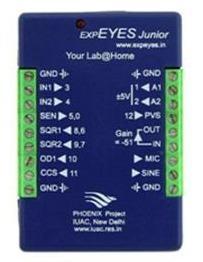
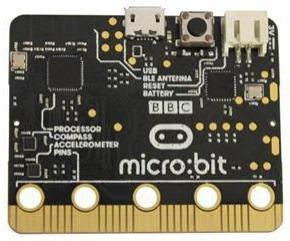
Physical computers with computing capabilities are extremely rare. Three products that are currently on the marketaresimilar:Pi-Top,ExpEYES(previouslyknownas Phoenix), and BBC micro:bit. The BBC micro:bit is a practicalprogrammablecomputerthatincludesBluetooth, motiondetection,anda built-incompass.Withitsbuilt-in compassor"magnetometer,"25LEDs,twoprogrammable buttons, and five input/output ports, the Micro:bit can be connected to other devices or sensors. To students in the UKbetweentheagesof11and12,BBCdistributedabout1 milliondevices.BecausetheBBCMicro:bitlacksadisplay, programming requires a computer or laptop. A cheap platform for computer-assisted science experiments is calledExpEYES.ItiscreatedbytheNewDelhi-basedInterUniversityAcceleratorCenter.
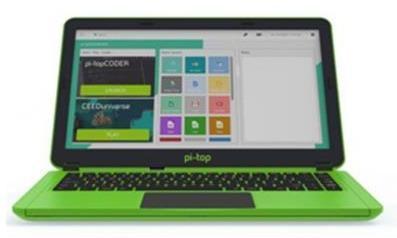
It has 50 experiment GUIs, 12 bit analogue input/output, digital input/output, time interval measurements, waveform generation, and test equipment functionality. Thebestfeatureofthisdeviceisthatitshardwareisopen source, but programming it also necessitates a computer or laptop. In the end, it serves as a cheap platform for scientific experiments. A modular laptop called the Pi-top offers resources for developing creative do-it-yourself (DIY)projectsandbringinginventionstolife.Thesystem's brain is a Raspberry Pi single-board computer. A quadcore Arm cortex processor running at 1.4GHz, four USB ports, 40 GPIO pins, an HDMI port, Gigabit Ethernet port, wireless LAN (Wi-Fi), and a display interface are all
International Research Journal of Engineering and Technology (IRJET) e-ISSN:2395-0056
Volume: 10 Issue: 01 | Jan 2023 www.irjet.net p-ISSN:2395-0072
included. This device costs about 27000 INR, which is a veryhighandnearlyidenticalprice.
For students, this is a cost-effective laptop for learning, tinkering, and conducting experiments whenever and wherever they like. They can be liberated from lab hours and, in some cases, get around the issue of individual students' need for equipment. For presentations, demonstrations, experiments, and the creation of new experiments, projects, and prototypes, teachers and educators can use their personal laptops. Engineers can pick up skills in sensor interfacing, GUI programming, physical computing, electronics, microcontroller programming, computing, and a variety of programming languages. Hobbyists can purchase a nice device to pass their time more efficiently. This tool can be used by innovators to demonstrate concepts and create original products.
The micro:bit offers an experience that is accessible to beginners but also offers a lot of headroom for more advanced usage, including as an embedded controller in class and hobby projects. The micro:bit packs a lot of functionality into a small and reasonably priced package. TheRaspberryPiisalogicalnextstepforthoselookingto movebeyondtheMicro:bit.It'smoredifficulttosetupbut supports a wide variety of applications, making the Pi an incrediblyversatilegeneral-purposecomputer.ThePiisa self-contained,Linux-basedcomputer.Thereareanumber ofmodels,including theRaspberryPi 3Model B+andthe mostrecentRaspberryPi4.
Connectingakeyboard,mouse,monitor,SDcard, andUSB power supply to a Pi is the first thing to do. Raspian, the operating system for the Raspberry Pi, must be installed ontheSDcard.The40-pinconnectoronthePiisintended for connecting to actuators, sensors, and other physical computingdevices.
By using software and hardware that can sense and react totheanalogueworld,physicalcomputingischaracterized as "the construction of interactive physical systems." It links together a variety of mechatronics-related tasks. Computer science, robotics, electrical engineering, and embedded development. Physical kits based on microcontrollers and the usage of computers in educational contexts is common for a long period of time for environmental research and scientific interactive art, robotics, and sensing. Electronic prototyping is particularlypopularwithArduino.Forcustomerstocreate interactive electronic things, it offers a software package andhardware.computerswithjustoneboard,suchasthe Raspberry Pi, in comparison to platforms that use microcontrollers. We interact with SBCs, additional storage is provided via the display or displays. Strong process power and capability. Memory cards are needed forSBCsthathaveanoperatingsysteminstalled,readyfor useasacomputer.
4. PROPOSED SYSTEM
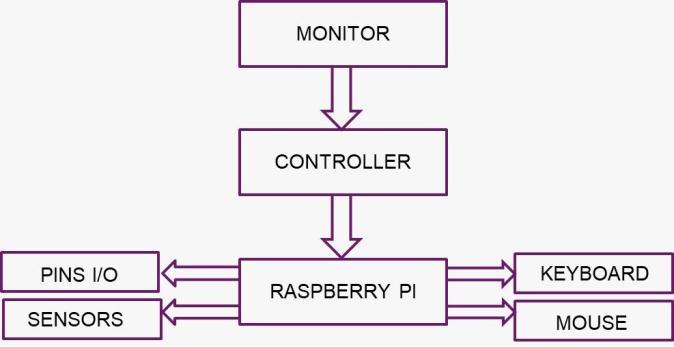
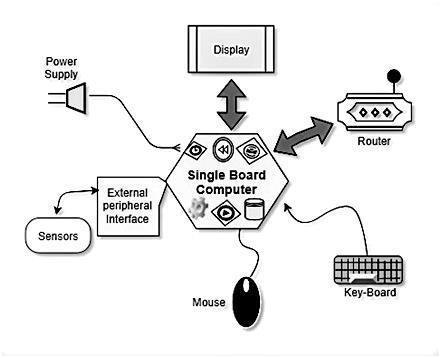
The system's single board computer (SBC) is its core component. Memory, a processor, LAN and WiFi interfaces,andanaudio/videointerfacemakeuptheSBC. For storing data and loading the operating system, use a memory card and otherwise internal memory. The open sourcenatureofLinuxandtheabundanceoffreesoftware make it a viable option for operating systems. Graphical userinterface(GUI)canbepresentedonastandardHDMI monitor or touch screen when used as a display device. When a display doesn't have a touch screen, a standard USB keyboard and a mouse are used as the input devices. A single board computer (SBC) offers an external peripheral interface (GPIO) to connect different sensors andelectronicsparts
International Research Journal of Engineering and Technology (IRJET) e-ISSN:2395-0056
Volume: 10 Issue: 01 | Jan 2023 www.irjet.net p-ISSN:2395-0072
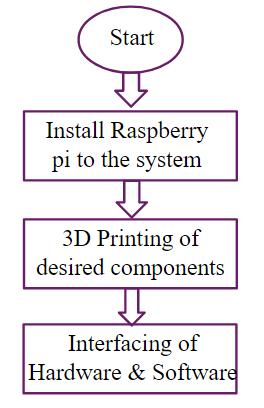
Fig No. 7. FlowChart
6. CONCLUSIONS
"Building interactive physical systems by using software and hardware that can sense and respond to the analog world" is the definition of physical computing. Electrical engineering, mechatronics, embedded development, robotics, and computer science are all interconnected by physical computing. For years, academic institutions have made extensive use of physical computing devices and toolkitsbasedonmicrocontrollersforrobotics,interactive art,environmentalsensing,andscientificexperimentation. A well-liked platform for electronic prototyping is Arduino. It offers users hardware and software packages so they can create interactive electronic objects. Comparing single-board computers like the Raspberry Pi to such microcontroller-based platforms, there are advantages. SBCs, with their additional storage capacity and high processing power, are connected to displays or monitors.SBCsaretinycomputers,soinordertofunction as a computer, a memory card must be loaded with the operatingsystem.
International Research Journal of Engineering and Technology (IRJET) e-ISSN:2395-0056
Volume: 10 Issue: 01 | Jan 2023 www.irjet.net p-ISSN:2395-0072
This computer is developed to be used for educational purposes. It can be used to make word documents, spreadsheets & presentations. It can also pierce the internet and connect people to the vast amount of resources available. It can be used for learning to write codes, developing software, building circuits, developing projects, etc. Its main advantage is its portability and affordability.Ithasamanufacturingcostsolow,thatitisa lot cheaper than most computers. Therefore, a greater number of people can afford them. Raspberry Pi’s performance is compared with some of the more popular boards and development platforms across the board by size, computing power and overall costs of the software solutions. Based on performed analysis, it can be articulated that Udoo, has the best performances among all of the considered IoT hardware platforms, but at the sametimeitspriceisrelativelyhigh.Ontheotherhand,A detailed analysis on the Raspberry Pi has shown that it's theperfectplatformforaPCintheareaofsensornetwork. ThatiswhyitmakesRaspberryPitheperfectplatformfor interfacingwithawideassortmentofexternalperipherals andisusedinabroadscopeofimplementations.
Communications and Information Technology can affect how well students learn. According to the most recent research, we discovered that teachers who are proficient in using digital tools can help students develop higher order thinking skills, give them unique and creative ways to express what they have learned, and better prepare them to deal with ongoing technological change in both the real world and the workplace. India needs costeffective and cutting-edge educational equipment to supportthisrevolutionineducation.Animportantpartof STEM education is technology. We created affordable educational laptops for teachers, students, and schools. This laptop is user-friendly and has strong connectivity and processing power. The physical computing feature will improve the young students' programming abilities andcreativity.
REFERENCES
[1] J.Á.ArizaandS.G.Gil,"RaspyLab:ALow-CostRemote Laboratory to Learn Programming and Physical Computing Through Python and Raspberry Pi," in IEEE Revista Iberoamericana de Tecnologias del Aprendizaje,vol.17,no.2,pp.140-149,May2022,doi: 10.1109/RITA.2022.3166877.
[2] B. A. M. Patel and H. R. Hamirani, "Affordable Educational Laptop With Physical Computing Using Single Board Computer," 2021 International Conference on Computer Communication and Informatics (ICCCI), 2021, pp. 1-4, doi: 10.1109/ICCCI50826.2021.9402691.
[3] Paulo Blikstein. 2013. Gears of our childhood: constructionist toolkits, robotics, and physical computing,pastandfuture.InProceedingsofthe12th International Conference on Interaction Design and Children (IDC '13). Association for Computing Machinery, New York, NY, USA, 173–182. https://doi.org/10.1145/2485760.2485786
[4] Franks, Shaun, and Johnathan Yerby. "Creating a Low Cost Supercomputer with Raspberry Pi." Proceedings of the Southern Association for Information Systems Conference.2014.
[5] Turton, P.; Turton, T.F.: 'PiBrain - a cost-effective supercomputer for educational use', IET Conference Proceedings, 2014, p. 3.04 (4 .)-3.04 (4 .), DOI: 10.1049/cp.2014.1121 IET Digital Library, https://digitallibrary.theiet.org/content/conferences/10.1049/cp.2 014.1121
[6] Krajcik,J.S.,Blumenfeld,P.C.,Marx,R.W.,&Soloway, E. (1994). A collaborative model for helping middle grade science teachers learn project-based instruction.Theelementaryschooljournal,483-497
[7] Pounds, A. J., Nalluri, R., & Coleman, B. L. (2005). The developmentofaTri-Useclusterforgeneralcomputer education, high performance computing education, and computationally intensive research. ACM Southeast Regional Conference, 345. doi:10.1145/1167350.1167446.
[8] Yerby, Johnathan. (2014). INDEPENDENT PROJECT BASED LEARNING: APPLYING KNOWLEDGE BY CREATING A LOW-COST SUPERCOMPUTER. Issues in InformationSystems.15.252-257.
[9] School education in india, National University of Educational Planning and Administration & DepartmentofSchoolEducationandLiteracyMinistry of Human Resource Development Government of India
[10] Micro:bit Educational Foundation https://microbit.org/
[11] pi-top-https://pi-top.com/
[12] Raspberry Pi Teach, Learn, and Make with RaspberryPihttps://www.raspberrypi.org/
[13] Visual programming language https://en.wikipedia.org/wiki/Visual_programming_l anguage
International Research Journal of Engineering and Technology (IRJET)
e-ISSN:2395-0056
[14] "Scratch - Imagine, Program, Share" https://scratch.mit.edu/statistics/
[15] Comparison of single-board computers https://en.wikipedia.org/wiki/Comparison_of_singleboard_computers
[16] S. Hodges, S. Sentance, J. Finney and T. Ball, "Physical Computing: A Key Element of Modern Computer ScienceEducation,"inComputer,vol.53,no.4,pp.2030,April2020,doi:10.1109/MC.2019.2935058.
[17] M. F. Cloutier, C. Paradis, and V. M. Weaver, “Design andAnalysisofa 32-bitEmbeddedHigh-Performance Cluster Optimized for Energy and Performance,” in Hardware-Software Co-Design for High Performance Computing(Co-HPC),2014,2014.
[18] Buechley, L. and Eisenberg, M. 2007. Fabric PCBs, electronicsequins,andsocketbuttons:techniquesfor textile craft. Journal of Personal and Ubiquitous Computing. Buechley, L. and Eisenberg, M. 2009. Children’s programming reconsidered: settings, stuff, andsurfaces.InProceedingsofIDC’09.Como,Italy.
[19] Eisenberg,M.,Eisenberg,A.,Gross,M.,Kaowthumrong, K.,Lee,N.,Lovett,W.2002.Computationally-enhanced construction kits for children: prototypes and principles. In Proceedings of the Fifth International ConferenceoftheLearningSciences.
[20] McNerney, T. 2000. Tangible computation bricks: buildingblocksforphysicalmicroworlds.Proceedings ofCHI2011
[21] J. Moore, “Performance Benchmarking a Raspberry Pi Cluster,”2014.
[22] Martin, F., Mikhak, B., and Silverman, B. 2000. MetaCricket: a designer’s kit for making computational devices. IBM Systems Journal. vol. 39, no.3-4.
[23] Sipitakiat, A., Blikstein, P., and Cavallo, D. 2002. The GoGo Board: Moving towards highly available computational tools in learning environments. Interactive Computer Aided Learning International Conference,Villach,Austria.
[24] Sipitakiat, A., and Blikstein, P. 2010. Think globally, build locally: a technological platform for low-cost, open-source, locally-assembled programmable bricks for education. Proceedings of TEI 2010, Boston, Massachusetts,USA.
Volume: 10 Issue: 01 | Jan 2023 www.irjet.net p-ISSN:2395-0072 © 2022, IRJET | Impact Factor value: 7.529 | ISO 9001:2008 Certified Journal | Page 228