International Research Journal of Engineering and Technology (IRJET) e-ISSN:2395-0056
Volume: 10 Issue: 01 | Jan 2023 www.irjet.net p-ISSN:2395-0072
International Research Journal of Engineering and Technology (IRJET) e-ISSN:2395-0056
Volume: 10 Issue: 01 | Jan 2023 www.irjet.net p-ISSN:2395-0072
1,2,3 Computer Science and EngineeringSreenidhi Institute of Science and Technology Hyderabad, Telanganga, India.
4,5Assistant Professor, Computer Science and EngineeringSreenidhi Institute of Science and Technology Hyderabad, Telanganga, India. ***
Abstract:
Thetopicofmovierecommendationsiscoveredinthisessay.Thevalueofamovierecommendationinoursociallivesstems fromitscapacitytoofferbetteramusement.Basedontheusers'interestsorthepopularityofthefilms,sucha systemcan recommenda selectionofmoviestothem.Utilizinga sizablecollectionofinformation,a recommendationsystemisused to offer goods for consumers to see or buy that will fulfil their demands. A recommender system, also known as a recommendation systemorarecommenderengine,isa typeofinformationfiltering system that attempts to forecast the "rating"or"preferred"auserwouldassigntoaparticularitem.Theyaremainlyappliedincommercialsettings.
Keywords: Recommendation System
Collaborativefiltering,alsoknownasthepersonality-basedapproach,andcontent-basedfiltering,aswellasothersystems likeknowledge-basedsystems,arefrequentlyusedinrecommendersystems.Approachestocollaborativefilteringcreatea modelbasedonpastactionsofauser(thingspreviouslypickedorpurchased,and/ornumerical ratingsprovidedtothose items),aswellascomparablechoicesmadebyotherusers.
A series of discrete, pre-tagged qualities of an item are used in content-based filtering algorithms to recommend more itemswithrelatedfeatures.Thismodelisthenusedtoforecastitems(orratingsforitems)thattheusermaybeinterested in.Themajorityofthetime,hybridrecommendersystemsnowadayscombineoneormoremethodologies.
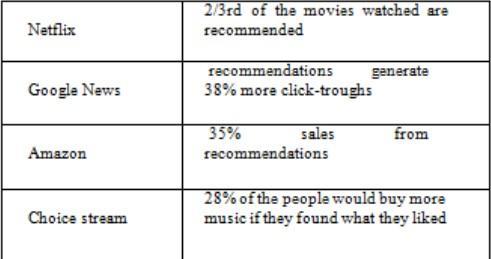
A recommender system, or recommendation system (sometimes replacing'system' with a synonym such as platform or engine),isasubclassofinformationfilteringsystemthataimstopredictthe"rating"or"preference"auserwouldgiveto anitem. Therehasbeena significantincreaseinaudiovisual data.Theyaremainlyapplied incommercial settings.There aremanyapplicationsforrecommendersystems,buttheyaremostfrequently knownasplaylistgeneratorsforvideoand music services like Netflix and YouTube, as well as as product recommenders for websites like Amazon and content recommendersforsocialmediasiteslikeFacebookandTwitter.
© 2022, IRJET | Impact Factor value: 7.529 | ISO 9001:2008 Certified Journal | Page218
 G Dinesh Prakash1 , Y Giri Reddy2 , D Avinash Reddy3 , D Rambabu4 , Sathyanarayana5
International Research Journal of Engineering and Technology (IRJET) e-ISSN:2395-0056
Volume: 10 Issue: 01 | Jan 2023 www.irjet.net p-ISSN:2395-0072
Machine
Anillustration ofa ratings-basedcollaborative filtering method. Collaborative filteringisa popular methodfor designing recommender systems. The premise behind collaborative filtering is that people who have previously agreed will do so again and that they will continue to enjoy the same kinds of things. Recommendations are generated by the algorithm solely based on data from rating profiles for various persons or objects. They producerecommendations utilising this neighbourhood by identifying peer users/items with rating histories similar to thecurrent user or item. There are two typesofcollaborativefilteringtechniques:memory-basedandmodel-based.
Content-based filtering is another strategy that is frequently used when constructing recommender systems. The foundation of content-based filtering techniques is the item's description and the user's preference profile. These techniquesworkbestwheninformationabouttheitem(name,location,description,etc.)butnottheuserisknown.Contentbased recommenders approach recommendations as a user-specific classification issue and learn a classifier for a user's preferencesbasedonthecharacteristicsofanitem.
Theterm"multi-criteriarecommendersystems"(MCRS)referstorecommendersystemsthattakeintoaccountpreference data for various criteria. These systems attempt to predict a rating for unexplored items of u by utilisingpreference information on multiple criteria that affect this overall preference value, as opposed to developing recommendation techniquesbasedonasinglecriterionvalue,theoverallpreferenceofuserufortheitemi.ManyresearchersviewMCRSasa multi-criteriadecisionmaking(MCDM)problemandconstructMCRSsystemsusingMCDMapproachesandtechniques.
Most current approaches to recommender systems concentrate on recommending the most pertinent content to consumers using contextual data, but they do not account for the possibility of annoying the user with unwelcome notifications.Pushingrecommendationsduringcertaintimes,suchasduringabusinessmeeting,earlyinthe morning,or after midnight, has a risk of offending the user. As a result, how well the recommender system performs is influenced by how much risk it has factored into the suggestion process. DRARS, a system that modelsthecontext-awarerecommendation asabanditproblem,isonewaytohandlethisproblem.Thismethodcombinesacontextualbanditalgorithmandacontentbasedtechnique.
RecommendationbasedonlocationSmartphoneswithinternetconnectivityareusedbymobilerecommender systems to provide individualised, context-sensitive recommendations. Given that mobile data is more complex than the data that recommendersystemsfrequentlyworkwith,thisisaparticularlychallengingfieldofresearch.Ithasissueswithvalidation and generality, is diverse, noisy, and necessitates both spatial and temporal auto- correlation. The context, the recommendation mechanism, and privacy are three variables that could influence mobile recommender systems and the precision of prediction outcomes. A transplanting problem also affects mobile recommender systems; for instance, it wouldbefoolishtosuggestadishinalocationwhereallofthenecessarycomponentsmightnotbepresent.
International Research Journal of Engineering and Technology (IRJET) e-ISSN:2395-0056
Volume: 10 Issue: 01 | Jan 2023 www.irjet.net p-ISSN:2395-0072
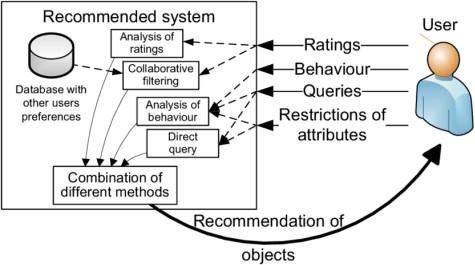
Nowadays,themajorityofrecommendersystemsemployahybrid strategythatcombinescollaborativefiltering,contentbased filtering, and other techniques. There is no reason why multiple methods of the same type cannot be combined. There are several ways to implement hybrid approaches, including making content-based and collaborative-based predictions separately before combining them, adding content-based capabilities to a collaborative-based approach (and viceversa),andcombiningtheapproachesintoasinglemodel(see]forathoroughreviewofrecommendersystems).
Severalmethodsofhybridizationinclude:
• Weighted:Addingtogetherthenumericalscoresofthevariousrecommendationcomponentscores.
• Changing:Decidingwhichsuggestioncomponenttouseandapplyingit.
• Mixed:Therecommendationisofferedusingrecommendationsfromavarietyofrecommenders.
•FeatureCombination:Asinglerecommendationalgorithmisgivenasetoffeaturesthatwerederivedfrommany sourcesofknowledge.
Computingafeatureorgroupoffeaturesthatwillbeusedaspartoftheinputforthefollowingapproachisknownas "featureaugmentation."
• Cascade:Recommendersaregivenstrictpriority,andthelowerpriorityonesareusedtobreaktiesbetweenthe higherpriorityonesinthescoring.
• Meta-level: After applying a recommendation approach, a model is created that is used as an input by a subsequenttechnique.
Over the years, several different recommendation systems have been created. These systems employ a variety of methodologies, including collaborative, content-based, utility-based, hybrid, etc. Considering the purchase. A recommendersystemthatsuggeststhenewproductinthemarketwaspresentedbyLawrenceetal.in2001basedonthe behaviourandhistoryoftheshoppers.Acollaborativeandcontent-basedfilteringstrategywasemployed toimprovethe recommendation. The majority of today's recommendation systems rely on user evaluations to locate potential clients. These ratings are also used to forecast and suggest the desired item. According to a 2007evaluationstudybyWeng,Lin, and Chen, integrating multidimensional analysis and additional customer profiles improves the quality of recommendations.
Fig 1: System
International Research Journal of Engineering and Technology (IRJET) e-ISSN:2395-0056
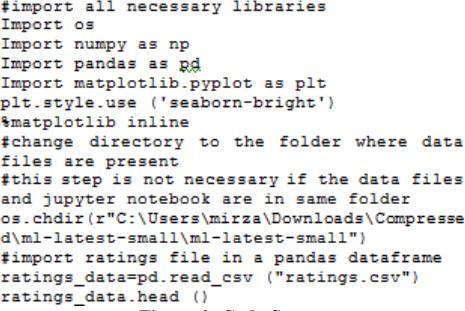
WewillusetheMovieLenstinydatasetforthisexerciseandconcentrateontwofiles.i.e.,themovies.csvand ratings.csv
Thethreefieldsinthemovie.csvfileare:
1.MovieId–Ithasadifferentidforeachmovie.
2.Title–Thetitleofthefilmisit.
3.Genre–Themovie'ssubgenre
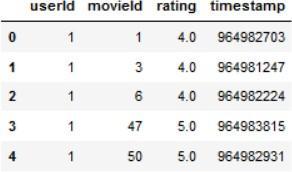
Therearefourfieldsintheratings.csvfile,namely:
1.Userid-Eachuser'sownidentificationnumberaftertheyhaveratedoneormorefilms
2.MovieId-Eachmovie'sdistinctidentifier
3.Rating-Thescoreauserassignstoafilm.
4.Timestamp-Whenwasaspecificmovie'sratinggiven?
Figure 2: Code Segment
Figure 3: Output
We've introduced Movie REC, a recommender system for movies, in this paper. It enables a user to choose from a predetermined set of criteria and then suggests a list of movies for him based on the cumulative weight of the various attributes and the K-means algorithm. Due to the nature of our system, evaluating performance is a difficult process becausethereisnorightorincorrectrecommendation;itissimplyamatterofopinions.
They responded favourably toour informal evaluations of a small group of users, which weconducted. We wouldlike to haveadditionaldataavailablesothatoursystemcanproducemoreinsightfulfindings.
Volume: 10 Issue: 01 | Jan 2023 www.irjet.net p-ISSN:2395-0072 © 2022, IRJET | Impact Factor value: 7.529 | ISO 9001:2008 Certified Journal | Page221
International Research Journal of Engineering and Technology (IRJET) e-ISSN:2395-0056
[1]https://labelyourdata.com/articles/movie-recommendation-with-machinelearning#:~:text=A%20movie%20recommendation%20system%2C%20or,their%20past%20choices%20and%2 0behavior
[2] https://towardsdatascience.com/how-to-build-a-movie-recommendation-system-67e321339109
Volume: 10 Issue: 01 | Jan 2023 www.irjet.net p-ISSN:2395-0072 © 2022, IRJET | Impact Factor value: 7.529 | ISO 9001:2008 Certified Journal | Page222