Tree-based ensemble approaches for desert grid-tied solar module temperature prediction
Mr. Bijendar1 , Mr. Mukul21 Master of Engineering, Department of Mechanical Engineering, St. Margaret Engineering College, Neemrana, Rajasthan Technical University, Kota, India
2 Assistant Professor, Laxmi Devi Institute of Engineering & Technology, Alwar, Rajasthan ***

Abstract - A key factor in a grid-tied PV station's performance anda significant factor inthe efficiencyofthePV systemis the temperature ofthe PV modules. Usingtree-based ensemble approaches, such as random forest and boosted decision tree, we are interested in forecasting the module temperature ofa grid-tiedphotovoltaicsysteminthisstudy.In order to compare the outcomes of tree-based ensemble approaches, the linear least squares method and the artificial neural network method were utilised. To increase accuracy, avoid overfitting, and optimise the model's parameters, the tree ensemble approach was hyper-tuned. The accuracy of each produced model was comparable throughout training, and they are all equally useful for forecasting PV module temperature. The findings demonstrated that, during testing, the tree-based ensemble approaches maintained their accuracy with R2 over 0.98. The value of the tree-based ensemble over the traditional technique, notably the ANN, is demonstrated by the declining accuracy of other methods.
Key Words: Grid-tiedPVstation,Photovoltaictree,Module temperature,Photovoltaiccell,Optimization
1. INTRODUCTION
Photovoltaicsarecrucialtocombatingglobalwarmingand buildinganeco-friendlyeconomy(Bouraiouetal.2020).
TheconversionefficiencyofthePVmodulecanbeaffected byPVtechnologies(Edalati,Ameri,andIranmanesh2015), PVarraytiltangles(Saberetal.2014),dustaccumulationon photovoltaicpanels(Abderrezzaqetal.2017b;Mostefaouiet al.2018,2019),partialshadingonPVmodules(Dabouetal. 2017),andanarraytiltanglethatistoosteep(Abderrezzaq et al. 2017a; Dabou et al. 2016). However, the PV module temperature is the main factor that significantly affects efficiency(FranghiadakisandTzanetakis2006;Necaibiaet al. 2018; Skoplaki and Palyvos 2009b), output power (Ba, Ramenah,andTanougast2018),andenergyyield(CorreaBetanzo, Calleja, and De León-Aldaco 2018), as well as energyandpoweroutput(Ogbonnaya,Turan,andAbeykoon 2019).
Duetotheseconsiderations,variousresearchersattempted to construct a thermal model to compute and forecast PV moduletemperaturesusingexplicitandimplicitconnections between PV module temperature and metrological data
(Santiagoetal.2018).SkoplakiandPalyvos2009a;Coskun etal.2017;Obiwulu2020).
Usingclimaticfactorssuchambienttemperature,irradiance, andwindspeed,severalresearchpredictedPVsolarmodule operating temperatures using linear and nonlinear regression(Huangetal.2011;Kamuyuetal.2018;Rawat, Kaushik, and Lamba 2016; Skoplaki and Palyvos 2009a; Tuomirantaetal.2014).Thegovernmenturgeseveryoneto promotethegreatestandmostefficientinventionstoreduce carbon emissions to ensure a sustainable and environmentallyfriendlyfuture.Improvedimmunityfrom solar energy aids in reducing the spread of infectious diseasesinpeople(Shahet.al.,2021,Shahet.al.,2020,Shah et.al.,2021).
Inref,athermalmodelsimulatesandexperimentsonhow windspeed,direction,orientation,andinclinationimpactPV moduletemperature(KaplaniandKaplanis2014).
Kamuyuetal.usedtwomodels,onewithandonewithout water temperature, to anticipate photovoltaic module temperatureforfloatingPVpowerproduction(Kamuyuet al. 2018). Mahjoubi et al. developed a real-time analytical modeltoevaluatephotovoltaicwaterpumpingsystemcell temperature (Mahjoubi et al. 2014). Solar panel temperatures have been measured experimentally using thermalimagingandmodelling(Irshad,Jaffery,andHaque 2018).Despitethesestudies,moduletemperatureforecast accuracymaystillbeimprovedconsideringitsimportancein PV system diagnostics. Tree-based machine learning techniquescanimprovepredictionaccuracy.Photovoltaics can play important role in technology such as prosthetic arms which is very well described by (Pawar & Mungla, 2022)and(Pawar&Bhatt,2019)
Tree-based algorithms successfully predicted PV system behaviour and characteristics. Combining decision tree classifierstocreateensembleapproachescanalsoimprove theirperformance.
Ahmad,Mourshed,andRezgui(2018)usedboosteddecision treestoanticipatesemi-aridsolarradiationcomponentsand extra trees and random forests to estimate photovoltaic system output (Rabehi, Guermoui, and Lalmi 2018). Assouline et al. used Random Forests and GIS data
processing to calculate rooftop PV potential (Assouline, Mohajeri,andScartezzini2018).Gradientboostdecisiontree forecastsshort-termsolarpower(Wangetal.2018).
The first is the bootstrap-aggregated random forest. Bootstrap aggregation reduces volatility and overfitting (Assouline, Mohajeri, and Scartezzini 2018). Gradient boostingimprovestreechoiceregression.Thisimprovement may minimise bias and variance (Ahmad, Mourshed, and Rezgui2018).
Thesetwoapproachespredictthemoduletemperatureofa 7kWp grid-tied PV system in a desert climate using 2017 experimentalirradianceandambienttemperaturedata.The method's accuracy and precision are compared to linear leastsquaresandneuralnetworkstoevaluateit.
2. TECHNIQUE AND MATERIALS
2.1. THE SETUP FOR THE EXPERIMENT
Photovoltaicsarecrucialtocombatingglobalwarmingand buildinganeco-friendlyeconomy(Bouraiouetal.2020).
TheconversionefficiencyofthePVmodulecanbeaffectedby PVtechnologies(Edalati,Ameri,andIranmanesh2015),PV array tilt angles (Saber et al. 2014), dust accumulation on photovoltaicpanels(Abderrezzaqetal.2017b;Mostefaouiet al.2018,2019),partialshadingonPVmodules(Dabouetal. 2017),andanarraytiltanglethatistoosteep(Abderrezzaq et al. 2017a; Dabou et al. 2016). However, the PV module temperature is the main factor that significantly affects efficiency(FranghiadakisandTzanetakis2006;Necaibiaetal. 2018; Skoplaki and Palyvos 2009b), output power (Ba, Ramenah,andTanougast2018),andenergyyield(CorreaBetanzo,Calleja,andDeLeón-Aldaco2018),aswellasenergy andpoweroutput(Ogbonnaya,Turan,andAbeykoon2019).
Duetotheseconsiderations,variousresearchersattempted to construct a thermal model to compute and forecast PV moduletemperaturesusingexplicitandimplicitconnections between PV module temperature and metrological data (Santiagoetal.2018).SkoplakiandPalyvos2009a;Coskunet al.2017;Obiwulu2020).
Usingclimaticfactorssuchambienttemperature,irradiance, andwindspeed,severalresearchpredictedPVsolarmodule operating temperatures using linear and nonlinear regression(Huangetal.2011;Kamuyuetal.2018;Rawat, Kaushik, and Lamba 2016; Skoplaki and Palyvos 2009a; Tuomirantaetal.2014).
Inref,athermalmodelsimulatesandexperimentsonhow windspeed,direction,orientation,andinclinationimpactPV moduletemperature(KaplaniandKaplanis2014).
Kamuyuetal.usedtwomodels,onewithandonewithout water temperature, to anticipate photovoltaic module
temperatureforfloatingPVpowerproduction(Kamuyuetal. 2018).Mahjoubietal.developedareal-timeanalyticalmodel to evaluate photovoltaic water pumping system cell temperature(Mahjoubietal.2014).Solarpaneltemperatures havebeenmeasuredexperimentallyusingthermalimaging and modelling (Irshad, Jaffery, and Haque 2018). Despite thesestudies,moduletemperatureforecastaccuracymaystill be improved considering its importance in PV system diagnostics. Tree-based machine learning techniques can improvepredictionaccuracy.
Tree-based algorithms successfully predicted PV system behaviour and characteristics. Combining decision tree classifierstocreateensembleapproachescanalsoimprove theirperformance.
Ahmad,Mourshed,andRezgui(2018)usedboosteddecision treestoanticipatesemi-aridsolarradiationcomponentsand extra trees and random forests to estimate photovoltaic system output (Rabehi, Guermoui, and Lalmi 2018). Assoulineetal.usedRandomForestsandGISdataprocessing to calculate rooftopPV potential (Assouline,Mohajeri,and Scartezzini 2018). Gradient boost decision tree forecasts short-termsolarpower(Wangetal.2018).
The first is the bootstrap-aggregated random forest. Bootstrap aggregation reduces volatility and overfitting (Assouline, Mohajeri, and Scartezzini 2018). Gradient boostingimprovestreechoiceregression.Thisimprovement may minimise bias and variance (Ahmad, Mourshed, and Rezgui2018).
Thesetwoapproachespredictthemoduletemperatureofa 7kWp grid-tied PV system in a desert climate using 2017 experimentalirradianceandambienttemperaturedata.The method'saccuracyandprecisionarecomparedtolinearleast squaresandneuralnetworkstoevaluateit.
2.2. PREDICTING TECHNIQUES
A decision assistance tool that uses a decision tree-based methodrepresentsagroupofoptionsgraphicallyasatree.
Thenumerousoptionsarepositionedatthebranches'ends (the "leaf" of the tree), and they are chosen based on the selectionsmadeineachindividualsituation.Adecisiontreeis atechnologythatisemployedinseveralindustries,including datamining,security,andmedical.Astrategybasedonusing adecisiontreeasanonparametricpredictivemodelisknown asdecisiontreelearning.Weemployedrandomforestand boosted decision trees as prediction methods for module temperatureamongensembletreeapproachesfordecision trees.Thedecisiontreemaybemodifiedbymeta-algorithm togenerateanensembleofadecisiontree.
2.2.1. RENDOM FOREST
Leo Breiman's Bootstrap aggregating or bagging approach underpins the random forest, a decision tree classifier ensemble (Breiman 1996). Bagging reduces decision tree classifiervariance.Thus,thegoalistorandomlybuildsubsets ofthetrainingsamplewithreplacement(TinKamHo2003). Eachsubsetdatasettrainstheirdecisiontreestoproducea random forest (Tin Kam Ho 1998, 1995). We have an ensembleofparallelmodels.AccordingtoZianeetal.(2021), regression employs the average of all predictions from numerous trees, which is more trustworthy than using a single decision tree classifier. Classification depends on a majorityvoteonclassificationfindings(TinKamHo2002).
Thismethodcanmaximiseaccuracyandminimisevariation withoutoverfittingthetrainingdataset(TinKamHo,1998). Therandomforestcanalsoimproveunstableclassifiersthat varydrasticallywithlittledatasetchanges.
2.2.2. IMPROVED DECISION TREE
Gradient boosting underpins the enhanced decision tree. Gradientboostingcombinesweaklearningtechniquesintoa powerfullearnerforregressionandclassificationtasks.Weak learningalgorithmsonlyslightlyoutperformrandomguesses (Breiman1997;Friedman1999;Masonetal.1999).
LeoBreimanintroducedgradientboosting.Hesaidboosting may be used to optimise a cost function (Breiman 1997). Friedman invented explicit regression gradient boosting algorithms (Friedman 1999, 2002). Llew Mason and colleagues expanded their functional gradient boosting perspective(Masonetal.1999).
Most boosting methods train a weak learner model on a trainingdatasetandcomputeitserroroneachdataset.Later, the Adaboost method weights and creates a new adjusted training dataset to give higher prediction error data more weight. The weighted dataset generates new trees and models.Gradientboostdevelopsanewmodelfromestimated errors.Thegoalistosplitalossfunctionoptimally(Zhang andHaghani2015).Eachimprovedtreedependsontheone before it, unlike random forests. Benefits include lower susceptibilitytoseverealteration(Zounemat-Kermanietal. 2017).
Fig- 1: PVsystematURER.MS,Algeria
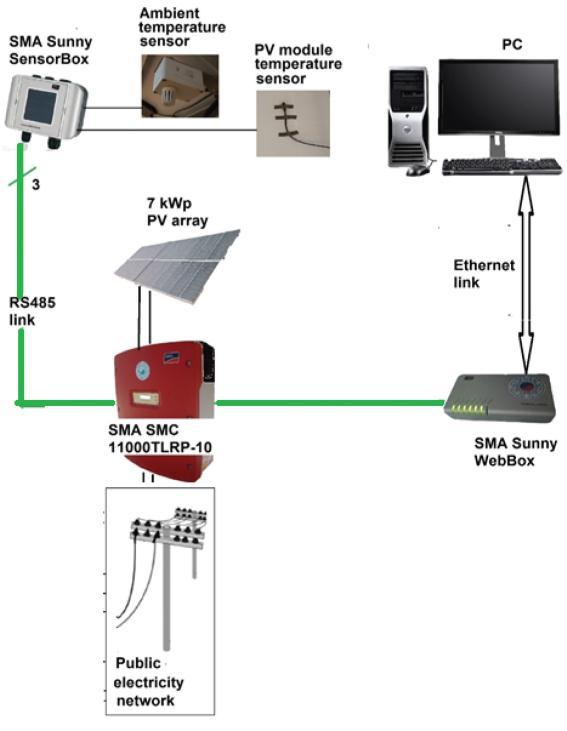
Table-2: Ambienttemperaturesensorspecs
Linear regression plots the "best-fit line" on a graph to evaluate the connection between two variables. The leastsquaresapproachminimisesthesquarederrorforeachpoint.
Simple hardware is needed to calculate this approach. An artificialneuralnetworkandlinearleastsquareframethis work.
Table-3: Moduletemperaturesensorspecification.
Parameter Specification
Measuringresistor Platinumsensor(PT100)
Defendability IP62
Cablelength 2.5m
Scale −20°C+110°C
Precision ±0.5°C
Resolution 0.1°C
Table-4: Integratedsolarradiationsensorspecification
Parameter Specification
Pvcelltype PVcell,amorphoussilicon(a-Si)
Scale 0W/m21500W/m2
Precision ±8%
Resolution 1W/m2
2.2.3. NEURAL NETWORK
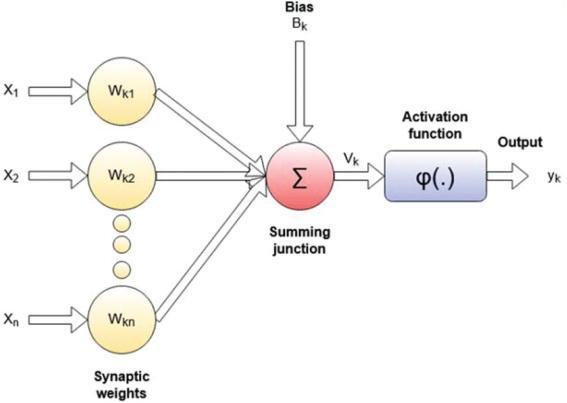
Artificial neural networks use biological neurons and statistical methods. Algorithms learn, recognise patterns, classify, and decide (Westreich, Lessler, and Funk 2010). (Elsheikh et al. 2019): formal neuron inputs = 1,2,..., n, weighting parameters, activation function (non-linear, sigmoid,etc.),andoutput(Figure2).Anactivationfunction regulatesaformalneuron'sweightedsumofexternalinputs (Abiodunetal.2018).
2.3. EVALUATION STRATEGY
Mean Absolute Error (MAE), Root Mean Square Error (RMSE), Relative Absolute Error (RAE), Relative Squared Error(RSE),andDeterminationCoefficientR2wereusedto evaluatethemodelsandcompareregressionapproaches.
2.3.1. MEAN ABSOLUTE ERROR (MAE)


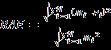
MAEisthetestsample'smeanabsolutedifferencebetween theforecastandtheobservation,weightedequally.Themean absoluteerroraveragesabsoluteerrors.
2.3.2. RELATIVE ABSOLUTE ERROR (RAE)

RAEisaratiooftheabsoluteerrortothemeasurementsize and relies on both. The measured value or absolute error determinestherelativeerror.
2.3.3. ROOT MEAN SQUARED ERROR (RMSE)
Regression analysis yields R2. R2 indicates the regression model'scontributiontodependentvariablevariance.Thus, the coefficient of determination is the square of the correlation(r)betweenanticipatedandactualyscores.
2.3.4. RELATIVE SQUARED ERROR (RSE)
RSE normalises total squared error by dividing by the average observed value. RSE can compare models with differenterrorunits,unlikeRMSE.

2.3.5. COEFFICIENT OF DETERMINATION (R2)
Regression analysis yields R2. R2 indicates the regression model'scontributiontodependentvariablevariance.Thus, the coefficient of determination is the square of the correlation(r)betweenanticipatedandactualyscores.
itrangesfrom0to 2 anditisdefinedby:
2017ambienttemperatures
3. RESULTS AND DISCUSSION
Weutilisedglobalirradianceandambienttemperaturedata from 01/01/2017 to 30/09/2017 with a 5-minute gap betweenmeasurementstotrainensembletreemodelsand neural networks. Damaged or partial measurements are sortedout.
Figures 3 and 4 show global irradiance and ambient temperature,whichareinputs.
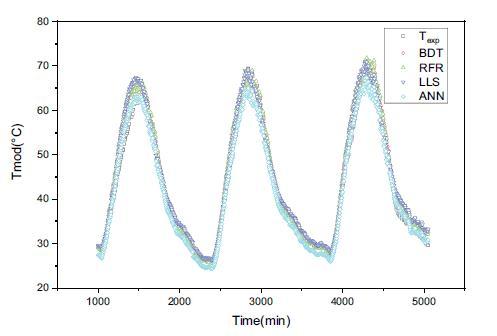
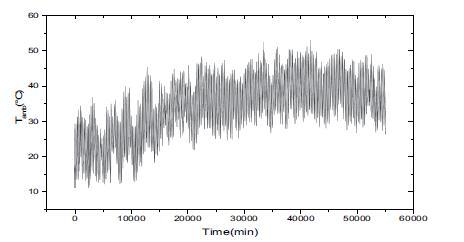
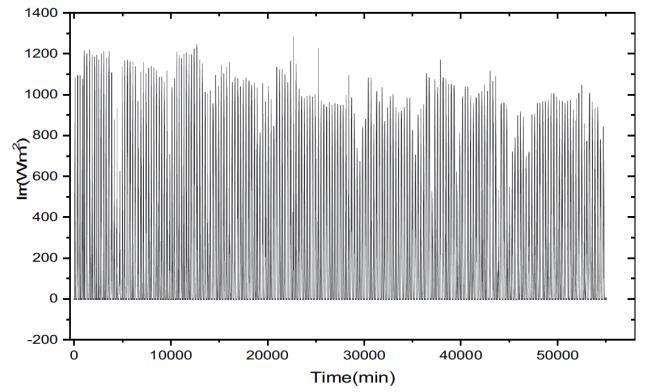
Figure3indicatesthattheobservedirradianceexceeds1300 W/m2 and the ambient temperature ranges from 10°C to 50°Cattheexperimentalsetupsite(Blaletal.2020).
Moduletemperature(Figure5)ismodeltrainingdata.The chartshowsthatglobalirradianceandambienttemperature affectmoduletemperature.
3.1. HYPER-PARAMETERS TUNING (RANDOM FOREST REGRESSION)
Fourhyper-parametersdefineRandomForestregression.To gettheoptimalmodel,changem,dmax,n,andsmin.Weused gridsearchtofindtheoptimisedparameters.Table5,6,7,8 shows how the number of trees (m), maximum depth of decisiontrees(dmax),numberofrandomsplitspernode(n), andminimumnumberofsamplesperleafnode(Smin)affect
thepredictedresults,whiletheotherparametersarefixedat the maximum value. As seen in Table 5, increasing the numberofdecisiontreesintheensembleincreasescoverage andimprovesoutcomes.However,italsoincreasestraining time.
Thedepthofthetreeandnumberofrandomsplitspernode playsanimportantrole,theycanwidenthemodelandmake itmoreinclusiveforallobserveddata,theincreaseofboth parametersincreasetheaccuracybutonlytoalimitafterthat themodelwillfellinoverfittingasshowninTables6and7.
Torecreatearuleinatreestructure,theminimumsample perleafisrequired.Theminimalvalueis1,henceonlyone observedvaluemayberuled.Table8showsthatincreasing thethresholdforgeneratingnewrules,whichmayenhance theregressiontreemodel.
TheidealBDTparametersarem=32,dmax=16,n=128,an dSmin=16.
TheparametersfortheRFRtechniquearem=500k=32,imi n=10,andr=0.025.
Figure7depictsacomparisonofthefindingsfromthefourap proachesandtheexperimentaldataforthreedaysin2017.
Thegraphillustratesthat,despitethefactthatallmethodspr oducesatisfactoryresults,bothtreebasedensemblemodelsoverestimatethemoduletemperatur eandthepredictedvaluesaresuperiortothemeasureddata, particularlyforhightemperatures,whereastheANNmodelu nderestimatesthemoduletemperature,resultinginpredicte dvaluesthatareinferiortotheobservedvalues.
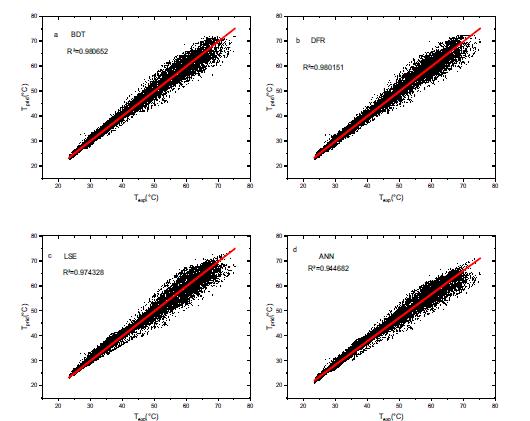
InFigure7a-c and d, theprojectedvaluesforBDT,RFR, LLS,andANNtechniquesweredisplayedagainsttheobserve ddataforfurtherinvestigation.
Thepredictedvalueshaveahighcorrelationwiththemeasur edvaluesforallmethods(R2=0.98fortree-based ensemble methods,R2=0.97forLLS,andR2=0.94fortheANN).The BDTmethodachievesthebestresults,withahighcoefficient ofdeterminationandaslightlybettervariancethantheRFR method.
Figure7furtherillustratesthatforlowertemperaturevalues, especiallyintheabsenceofsunirradiation,thefourapproac heshaveahighdegreeofaccuracy,howevertheaccuracydec reasesasthetemperatureincreases.
4. CONCLUSION
The module temperature of grid-tied solar systems was predicted in this work using the tree-based ensemble techniques,andtheirperformancewasassessed.Asacase study, a PV installation in Adrar, Algeria's desert was examined.Theoutcomesdemonstratedthevalueofhypertuninginachievinghighperformanceandguardingagainst overfitting.TheLLSmethodhasagreeableresultswithless computationaldemand,whereastheANN,althoughtraining gave good results, the accuracy dropped significantly for testing. Tree-based ensemble methods have high performance,thecoefficientofdeterminationremainsabove 0.98fortrainingandtestingforensembletreemethods,and they are feasible in predicting the module temperature of grid-tiedPVstations.Overall,alloftheapproachesshowed hightrainingaccuracy;however,thekeydistinctionisseen duringthetestingphase.
REFERENCES
[1] Abderrezzaq,Z., N.Ammar, D.Rachid,M.D.Draou,M. Mohamed, S. Nordine, and A. Geographical Location. 2017a. “Performance analysis of a grid connected photovoltaicstationintheregionofadrar.”In20175th International Conference on Electrical EngineeringBoumerdes(ICEE-B),2017-Janua:1–6.IEEE.Boumerdes, Algeria.DOI:10.1109/ICEE-B.2017.8192229.
[2] Abderrezzaq,Z.,M.Mohammed,N.Ammar,S.Nordine, D. Rachid, and B. Ahmed. 2017b. “Impact of dust accumulationonpvpanelperformanceinthesaharan region.” In 2017 18th International Conference on Sciences and Techniques of Automatic Control and ComputerEngineering(STA),471–75.IEEE.Monastir, Tunisia.DOI:10.1109/STA.2017.8314896.
[3] Abiodun,O.I.,A.Jantan,A.E.Omolara,K.V.Dada,N.A. Mohamed, and H. Arshad. 2018. State-of-the-art in artificialneuralnetworkapplications:Asurvey.Heliyon 4(11):e00938.doi:10.1016/j.heliyon.2018.e00938.
[4] Ahmad,M.W.,M.Mourshed,andY.Rezgui.2018.Treebased ensemble methods for predicting pv power generation and their comparison with support vector regression. Energy 164:465–74. doi:10.1016/j. energy.2018.08.207.
[5] Assouline, D., N. Mohajeri, and J. L. Scartezzini. 2018. Large-scale rooftop solar photovoltaic technical potential estimation using random forests. Applied Energy 217 (February):189–211. doi:10.1016/j. apenergy.2018.02.118
[6] Ba,M.,H.Ramenah,andC.Tanougast.2018.Forseeing energy photovoltaic output determination by a statisticalmodelusingrealmoduletemperatureinthe north east of france. Renewable Energy 119:935–48. doi:10.1016/j.renene.2017.10.051.
[7] Blal,M.,S.Khelifi,R.Dabou,N.Sahouane,A.Slimani,A. Rouabhia, A. Ziane, A. Neçaibia, A. Bouraiou, and B. Tidjar.2020.Apredictionmodelsforestimatingglobal solarradiationandevaluationmeteorologicaleffecton solar radiation potential under several weather conditions at the surface of adrar environment. Measurement. 152:107348. February. doi:10.1016/j.measurement.2019.107348.
[8] Bouraiou,A.,A.Necaibia,N.Boutasseta,S.Mekhilef,R. Dabou,A.Ziane,N.Sahouane,I.Attoui,M.Mostefaoui, and O. Touaba. 2020. Status of renewable energy potential and utilization in Algeria. Journal of Cleaner Production. 246:119011. February. doi:10.1016/j. jclepro.2019.119011.
[9] Breiman,L.1996.Baggingpredictors.MachineLearning 24(2):123–40.doi:10.1007/bf00058655.
[10] Breiman, L. 1997. Arcing the edge. Statistics 4:1–14. Correa-Betanzo,C.,H.Calleja,andD.L.-A.Susana.2018. Moduletemperaturemodelsassessmentofphotovoltaic seasonalenergyyield.SustainableEnergyTechnologies and Assessments 27 (March):9–16. doi:10.1016/j.seta.2018.03.005.
[11] Coskun, C., U. Toygar, O. Sarpdag, and Z. Oktay. 2017. Sensitivity analysis of implicit correlations for photovoltaicmoduletemperature:Areview.Journalof Cleaner Production 164:1474–85. doi:10.1016/j. jclepro.2017.07.080.
[12] Dabou, R., F. Bouchafaa, A. H. Arab, A. Bouraiou, M. D. Draou,A.Neçaibia,andM.Mostefaoui.2016.Monitoring and performance analysis of grid connected photovoltaicunderdifferentclimaticconditionsinSouth Algeria.EnergyConversionandManagement130:200–06.doi:10.1016/j.enconman.2016.10.058.
[13] Dabou, R., N. Sahouane, A. Necaibia, M. Mostefaoui, F. Bouchafaa,A.Rouabhia,A.Ziane,andA.Bouraiou.2017. “Impact of partial shading and pv array power on the performanceofgridconnectedPVstation.”In201718th InternationalConferenceonSciencesandTechniquesof Automatic Control and Computer Engineering (STA), 476
81. IEEE. Monastir, Tunisia. DOI: 10.1109/STA.2017.8314901.
[14] Edalati, S., M. Ameri, and M. Iranmanesh. 2015. Comparative performance investigation of mono- and poly-crystallinesiliconphotovoltaicmodules forusein grid-connected photovoltaic systems in dry climates. Applied Energy 160:255–65. doi:10.1016/j.apenergy.2015.09.064.
[15] Elsheikh,A.H.,S.W.Sharshir,M.A.Elaziz,A.E.Kabeel, W.Guilan,andZ.Haiou.2019.Modelingofsolarenergy systems using artificial neural network: A comprehensive review. Solar Energy. 180 October 2018:622–39.doi:10.1016/j.solener.2019.01.037
[16] Franghiadakis, Y., and P. Tzanetakis. February 2006. Explicitempiricalrelationforthemonthlyaveragecelltemperatureperformanceratioofphotovoltaicarrays. InProgressinphotovoltaics:Researchandapplications, 541–51.
[17] John Wiley & Sons, Ltd. Friedman, J. H. 1999. “Greedy FunctionApproximation,TechnicalReport.”Department ofStatistics,StanfordUniversity.
[18] Friedman, J. H. 2002. Stochastic gradient boosting. ComputationalStatistics&DataAnalysis38(4):367–78. doi:10.1016/S0167-9473(01)00065-2.
[19] Ho, T. K. 1995. “Random decision forests.” In Proceedings of 3rd International Conference on Document Analysis and Recognition, 1:278–82.IEEE Comput. Soc. Press. Canada. DOI: 10.1109/ ICDAR.1995.598994.
[20] Ho, T. K. 1998. The random subspace method for constructing decision forests. IEEE Transactions on
PatternAnalysisandMachineIntelligence20(8):832–44.doi:10.1109/34.709601.
[21] Ho, T. K. 2002. A data complexity analysis of comparativeadvantagesofdecisionforestconstructors. Pattern Analysis & Applications 5 (2):102–12. doi:10.1007/s100440200009.
[22] Ho,T.K.2003.“C4.5decisionforests.”InProceedings. Fourteenth International Conference on Pattern Recognition(Cat.No.98EX170),1:545–49.IEEE.Comput. Soc.Australia.DOI:10.1109/ICPR.1998.711201.
[23] Huang,C.Y.,H.J.Chen,C.C.Chan,C.P.Chou,andC.M. Chiang. 2011. Thermal model based power-generated predictionbyusingmeteorologicaldatainBIPVsystem. Energy Procedia 12:531–37. doi:10.1016/j. egypro.2011.10.072.
[24] Irshad,Z.,A.Jaffery,andA.Haque.2018.Temperature measurement of solar module in outdoor operating conditionsusingthermalimaging.InfraredPhysicsand Technology 92 (March):134–38. doi:10.1016/j. infrared.2018.05.017.
[25] Kamuyu,W.,C.Lawrence,J.R.Lim,C.S.Won,andH.K. Ahn. 2018. Prediction model of photovoltaic module temperature for power performance of floating PVs. Energies11:2.doi:10.3390/en11020447.
[26] Kaplani, E., and S. Kaplanis. 2014. Thermal modelling andexperimentalassessmentofthedependenceofpv module temperature on wind velocity and direction, module orientation and inclination. Solar Energy 107:443–60.doi:10.1016/j.solener.2014.05.037.
[27] Mahjoubi,A.,R.F.Mechlouch,B.Mahdhaoui,andA.B. Brahim.2014.Real-timeanalyticalmodelforpredicting the cell temperature modules of photovoltaic water pumpingsystems.SustainableEnergyTechnologiesand Assessments6:93–104.doi:10.1016/j.seta.2014.01.009.
[28] Mason, L., J. Baxter, P. Bartlett, and M. Frean. 1999. “Boosting algorithms as gradient descent.” In NIPS’99 Proceedings of the 12th International Conference on NeuralInformationProcessingSystems,91:512–18.
[29] Denver, CO. DOI: 10.1103/PhysRevD.91.072004. Mostefaoui, M., A. Necaibia, A. Ziane, R. Dabou, A. Rouabhia,S.Khelifi,A.Bouraiou,andN.Sahouane.2018. “ImportancecleaningofPVmodulesforgrid-connected PV systems in a desert environment.” In 2018 4th International Conference on Optimization and Applications (ICOA), 1–6. IEEE. Morocco. DOI: 10.1109/ICOA.2018.8370518.
[30] Mostefaoui, M., A. Ziane, A. Bouraiou, and S. Khelifi. 2019.Effectofsanddustaccumulationonphotovoltaic
performance in the saharan environment: Southern Algeria (Adrar). Environmental Science and Pollution Research 26 (1):259–68. doi:10.1007/s11356-0183496-7.
[31] Necaibia, A., A. Bouraiou, A. Ziane, N. Sahouane, S. Hassani, M. Mostefaoui, R. Dabou, and S. Mouhadjer. 2018.Analyticalassessmentoftheoutdoorperformance andefficiencyofgrid-tiedphotovoltaicsystemunderhot dryclimateintheSouthofAlgeria.EnergyConversion and Management. 171:778–86. September. doi:10.1016/j.enconman.2018.06.020.
[32] Obiwulu,A.U.,A.C.Michael,C.Chendo,N.Erusiafe,and S.C.Nwokolo.2020.Implicitmeteorologicalparameterbasedempiricalmodelsforestimatingbacktemperature solarmodulesundervaryingtilt-anglesinlagos,Nigeria. Renewable Energy 145:442–57. doi:10.1016/j. renene.2019.05.136.
[33] Ogbonnaya, C., A. Turan, and C. Abeykoon. 2019. Numerical integration of solar, electrical and thermal exergies of photovoltaic module: A novel thermophotovoltaic model. Solar Energy 185 (February):298–306. doi:10.1016/j.solener.2019.04.058.
[34] Pawar,B.,&Bhatt,H.(2019).DesignandDevelopment of Electroencephalography Based Cost Effective ProstheticArmControlledbyBrainWaves.International ResearchJournalofEngineeringandTechnology,6(4), 1166–1172.www.irjet.net
[35] Pawar,B.,&Mungla,M.(2022).Asystematicreviewon availabletechnologiesandselectionforprostheticarm restoration. Technology and Disability, 34(2), 85–99. https://doi.org/10.3233/TAD-210353
[36] Rabehi, A., M. Guermoui, and D. Lalmi. 2018. Hybrid models for global solar radiation prediction: A case study. International Journal of Ambient Energy. 1–10. doi:10.1080/01430750.2018.1443498.
[37] Rawat,R.S.,C.Kaushik,andR.Lamba.2016.Areviewon modeling,designmethodologyandsizeoptimizationof photovoltaicbasedwaterpumping,standaloneandgrid connectedsystem.RenewableandSustainableEnergy Reviews57:1506–19.doi:10.1016/j.rser.2015.12.228.
[38] Saber,E.M.,S.E.Lee,S.Manthapuri,Y.Wang,andC.Deb. 2014. PV (photovoltaics) performance evaluation and simulation-based energy yield prediction for tropical buildings. Energy 71:588–95. doi:10.1016/j. energy.2014.04.115.
[39] Sahouane, N., R. Dabou, A. Ziane, A. Neçaibia, A. Bouraiou,A.Rouabhia,andB.Mohammed.2019.Energy andeconomicefficiencyperformanceassessmentofa28
kwpphotovoltaicgrid-connectedsystemunderdesertic weather conditions in Algerian Sahara. Renewable Energy 143 (December):1318–30. doi:10.1016/j.renene.2019.05.086.
[40] Santiago, I., D. Trillo-Montero, I. M. Moreno-Garcia, V. Pallarés-López,andJ.J.Luna-Rodríguez.2018.Modeling ofphotovoltaiccelltemperaturelosses:Areviewanda practicecaseinSouthSpain.RenewableandSustainable Energy Reviews 90 (March):70–89. doi:10.1016/j. rser.2018.03.054.
[41] Shah, N. H., Suthar, A. H., Jayswal, E. N., Shukla, N., & Shukla, J. (2021). Modelling the impact of plasma therapyandimmunotherapyforrecoveryofCOVID-19 infectedindividuals.SãoPauloJournalofMathematical Sciences,15(1),344-364.
[42] Shah,N.H.,Suthar,A.H.,&Jayswal,E.N.(2020).Control strategies to curtail transmission of COVID-19. InternationalJournalofMathematicsandMathematical Sciences,2020.
[43] Shah, N. H., Suthar, A. H., & Jayswal, E. N. (2020). Dynamics of malaria-dengue fever and its optimal control. An International Journal of Optimization and Control:Theories&Applications(IJOCTA),10(2),166180.
[44] Skoplaki, E., and J. A. Palyvos. 2009a. Operating temperature of photovoltaic modules: A survey of pertinentcorrelations.RenewableEnergy34(1):23
29. doi:10.1016/j.renene.2008.04.009.
[45] Skoplaki, E., and J. A. Palyvos. 2009b. On the temperature dependence of photovoltaic module electrical performance: A review of efficiency power correlations.SolarEnergy83(5):614–24.doi:10.1016/j. solener.2008.10.008
[46] Tuomiranta,A.,P.Marpu,S.Munawwar,andH.Ghedira. 2014.Validationofthermalmodelsforphotovoltaiccells underhotdesertclimates.EnergyProcedia57:136–43. doi:10.1016/j.egypro.2014.10.017.
[47] Wang, J., L. Peng, R. Ran, Y. Che, and Y. Zhou. 2018. A short-termphotovoltaicpowerpredictionmodelbased on the gradient boost decision tree. Applied Sciences (Switzerland)8:5.doi:10.3390/app8050689.
[48] Westreich,D.,J.Lessler,andM.J.Funk.2010.Propensity score estimation: neural networks, support vector machines,decisiontrees(CART),andmeta-classifiersas alternatives to logistic regression. Journal of Clinical Epidemiology 63 (8):826–33. doi:10.1016/j.jclinepi.2009.11.020.
[49] Zhang, Y., and A. Haghani. 2015. A gradient boosting method to improve travel time prediction. TransportationResearchPartC:EmergingTechnologies 58:308–24.doi:10.1016/j.trc.2015.02.019.
[50] Ziane,A.,R.Dabou,N.Sahouane,andA.Slimani.2021. Detectingpartialshadingingrid-connectedpvstation usingrandomforestclassifier.InArtificialintelligence and renewables towards an energy transition, ed. M. Hatti, 174:88–95. Lecture Notes in Networks and Systems. Cham: Springer International Publishing. Switzerland.doi:10.1007/978-3-030-63846-7.
[51] Ziane, A., A. Necaibia, M. Mostfaoui, A. Bouraiou, N. Sahouane,andR.Dabou.2019.“AfuzzylogicMPPTfor three-phasegrid-connectedPVinverter.”In201820th International Middle East Power Systems Conference, MEPCON2018-Proceedings,383–88.IEEE.Egypt.DOI: 10.1109/MEPCON.2018.8635211.
[52] Zounemat-Kermani, M., T. Rajaee, A. RamezaniCharmahineh,andJ.F.Adamowski.2017.Estimatingthe aeration coefficient and air demand in bottom outlet conduitsofdamsusinggepanddecisiontreemethods. Flow Measurement and Instrumentation 54:9–19. doi:10.1016/j.flowmeasinst.2016.11.004.