International Research Journal of Engineering and Technology (IRJET) e-ISSN: 2395-0056

Volume: 10 Issue: 01 | Jan 2023 www.irjet.net p-ISSN: 2395-0072
International Research Journal of Engineering and Technology (IRJET) e-ISSN: 2395-0056
Volume: 10 Issue: 01 | Jan 2023 www.irjet.net p-ISSN: 2395-0072
1 , 2 , 3
B.Tech Scholars, Department of Computer Science and Engineering, SNIST, Hyderabad-501301, India
4Assosiate Professor, Department of Computer Science and Engineering, SNIST, Hyderabad- 501301, India ***
Abstract - The extraction of auxiliary data from various biometric approaches, including fingerprints, faces, iris, palms, voices, etc., is currently the subject of research. Gender, age, beard, mustache, scars, height, hair, skin tone, glasses, weight, facial scars, tattoos, and other traits are all included in this data. Each piece of information acquires relevance during identification. One of the most important developments in facial recognition is the ability to determine a person's age and gender. Given the significance of age and gender in social interactions, it might be challenging to infer these two facial characteristics from a single-face photo. The term "computer vision" refers to the several terminologies used to scan images and determine an individual's age and gender.
Key Words: Age, Gender, Detection, Features, Extraction, Data Visualization, Classify, CNN, proposed framework, Training data.
Inrecentyears,datafromahumanfacehasbeenusedin numerous real-world applications, including social networking, security monitoring, advertising, and entertainment. Automatic age and gender prediction from face images is a key field for computer vision researchers because it plays a crucial role in interpersonal communication.Faceanalysishasattractedtheattentionof academics in fields including demographic data gathering, surveillance, human-computer interaction, marketing intelligence, and security because face analysis includes a crucial component called face age and gender recognition. Bothhealthyandillpeoplearepayingmoreheedtonutrition advice lately. [5] This essay focuses on giving dietary recommendations to people according to their age and gender.Numeroustechniquesexistforidentifyingaperson's genderbasedontheirbiologicalcharacteristics,mannerisms, andbehaviors.Thefeaturesofapersoncangiveawayprecise informationaboutthem,includingtheirage,gender,mood, ethnicity, and expression. Gender identification from a person'sfacialimageisadifficultapplicationinthefieldof computer vision, image analysis, and artificial intelligence, which categorizes gender based on masculinity and femininity. A binary classification problem leads to the assignment of a gender category to an individual. Gender identification is one element of facial analysis that concentrates on classifying the images in a controlled environment.Accordingto,genderclassificationisnecessary in an uncontrolled context. The gender of a person gives additional information that makes retrieval quick and
accurate. It is crucial to identify the data present in the photos.Forthepurposesofdetection,thedatathattheimage includesmustbealteredandmanipulated.Differentkindsof strategiesareusedforbothproblemdetectionandsolution. In a facial recognition method: There is a wealth of information contained in the looks on the faces. There are numerousexpressionsinvolvedwheneverapersoninteracts withanotherperson.Calculatingcertainparametersismade easierbymodifyingexpressions.Ageestimateisamulti-class probleminwhichdifferentcategoriesofyearsareused.Itis challenging to compile the photographs because people of different ages have different facial features. There are numerous age-detecting techniques. The preparation is applied to the image. The convolution network is used to extractfeaturesfromtheneuralnetwork.Theimageisthen assigned to one of the age classes based on the trained models. The photos' features are taken out for additional processing. After more processing, the features are transmitted to the training systems. The databases offer a studyofthefacialfeaturesandaidinfacedetectiontoprove theageofthesubjectinthepicture
Thestudyentailsathoroughdocumentationofindividual differences based on age, gender, identity, and other characteristics. In2001,D.KornackandP.Rakicproposed Adult Primate Neocortex [1]. Age estimation using convolutionalnetworkwasintroducedbyChenjingYan.The face-matching brain activation tests are carried out and testedoutsideofthescanner.Intermsoffacialprocessing, botholderandyoungerpersonsshowedthesameresults.M. Young with proposed identical facial perspectives in both scenarios, performance is excellent [2]. There is no single cause for the aging of the elderly. The accounting of such findingsistheconsequenceofamixofmanyelements.The findings,whicharebasedonallcredentialsstoredincertain environments,needtobemonitored.Inthisresearch,Hang Qietal[3]. Madetheclaimthatanumberofmethodshave emergedforthedetectionoffacesthatcanalsodeterminea person'sage.Here,anautomatedsystemthatcandetermine theageandassistindifferentiatingbetweenachild'sandan adult'sfacehasbeensuggested.Thesystemiscomposedof threecomponents.A.KumarandF.Shaik’stheoryaboutage categorization, face alignment, and face detection are the three [4]. The standard face detection and alignment techniquesareusedtobuildthefacesamples.EranEidinger, RoeeEnbar,andTalHassner’stheoryhelpswithunfiltered face. [6] The local face components that are visible in the
International Research Journal of Engineering and Technology (IRJET) e-ISSN: 2395-0056
Volume: 10 Issue: 01 | Jan 2023 www.irjet.net p-ISSN: 2395-0072
photosareextractedusingICA.Ithasbeendemonstratedthat thissystemissubstantiallyfasterandthattheoutcomesare effective. Aditya K. Saxena, Shweta Sharma and Vijay K. Chaurasiyausedcurvaletdomain[7].Therefore,thissystem may be used as a prototype in the future. The Conditional ProbabilityNeuralNetwork(CPNN),adistributedlearning technique used for age prediction from facial expressions, wasproposedbyChaoYinetalinthepaper.Ageestimation usingahierarchicalclassifierbasedonglobalandlocalfacial features [8]. The goal values and the conditional feature vectors are utilized as the input in a three-layer neural network-basedmodel.Thismayaidinitslearningofactual ages.Theneuralnetwork'slinkbetweenthefacialimageand theassociatedlabeldistributionishowthissystemlearns. Accordingtotheearlierstrategy,theconnectionshouldbe appliedinaccordancewiththemaximumentropymodel[9]. CPNN hasdemonstratedthat it outperformsall previously developedmethodologiesintermsofresults.Resultswere easily obtained using this procedure, and there was computationallyinvolvedandtheoutcomesareveryefficient andgoodinthiscase.
Before we actually get into the model-building phase, we needtoensurethattherightlibrariesandframeworkshave beeninstalled.Thebelowlibrariesarerequiredtorunthis project:
PipinstallOpenCV Pythonnumpy pipinstallpafy pipinstallyoutube_dl pafy:PafylibraryisusedtoretrieveYouTubecontentand metadata.
Akindofartificialintelligence(AI)calleddeeplearning aims to replicate the human brain by learning from experience. These representations are learned through an instructionalprocess.Wemustfirsttrainthesoftwarewitha hugenumberofobjectphotosthatwecategorizeintoseveral classes in order to teach it how to detect an object. On average,deeplearning-basedalgorithmsneedmoretraining data and take longer to train than conventional machine learningtechniques.Findingdistinctivecharacteristicswhen attempting to identify any object or character in an image takes effort and complexity. When applying deep learning techniques, issues can be resolved as opposed to classical machinelearning,wherefeaturesareautomaticallyextracted fromdata.Anelaborateneuralnetworkwithhiddenlayersis knownasdeeplearning.
CNN,asortofartificialneuralnetwork,isoftenusedfor categorizingandrecognizingobjectsinimagesorpictures. UsingaCNN,deeplearningcanidentifyitemsinanimage.An input layer, hidden layers, and an output layer make up a conventional neural network. The structure of the human brainservedasinspirationforCNN.Artificialneurons,also knownasnodes,inCNNs,acceptinputs,processthem,and thenprovidetheoutcomeasanoutput,muchlikeaneuronin thebraindoeswhensendinginformationbetweencells.The imagesareusedasasourceofdata.Theremaybenumerous hiddenlayersinCNN’s,andeachoneemploysmathematicsto extractfeaturesfromtheimage.Thelayeratthebottomthat dividesfeaturesfrominputsistheconvolutionlayer.
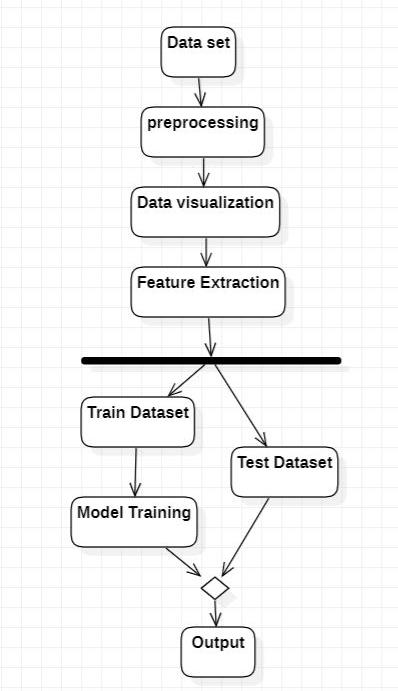
Whenanimageistakenfromagreatdistanceandtraits that resemble haar are used, gender recognition can be somewhat challenging. We came up with a simple but effective solution for this issue. We used a cascading approach.ROI(RegionofInterest)servesasourfaceinthis study. As shown in fig-5.1 we gave the classifier the ROI image. We attempted to identify the female face in this document. 500 photos of women and 500 photographs of menwereusedtotrainourhaarcascadeclassifier.Inorderto practice,weusedfrontalfacephotoswithexternalelements like a hairdo, makeup, and accessories like earrings and glasses.Thisresearchattemptstoidentifyanobjectthathas positiveXMLtraining.Inourinstance,weonlyusegoodand negativeimagesofmenandwomen
Fig:5.1Flowchart
International Research Journal of Engineering and Technology (IRJET) e-ISSN: 2395-0056
Volume: 10 Issue: 01 | Jan 2023 www.irjet.net p-ISSN: 2395-0072
This study's major objective is to streamline and accelerateawholesystem.Thedatacanbeenteredintothe algorithm in a number of different ways to expedite the process.Tobegin,theusercanimmediatelygatherdataby usingthesystem'swebcamorsimilarwebcamdigitaldevice.
Apieceofsoftwarecalledafacerecognitionsystem maycompareahumanfaceinaframeofvideooradigital imagetoadatabaseoffaces.Somenatural(lighting,posing angles, facial labeling) and digital (noise, interference) adjustments are made when a face is detected in a frame. Thechallengeofrecognizingahumanfaceiscausedbytwo characteristicsofahumanfaceasatemplate:(1)Therearea hugeandalmostdefinitelyinfinitenumberoftemplates,or facestobeclassified.(2)Almostallpatternsresembleone another. To resolve this issue and make the algorithm as effective as possible, we can use a variety of audience records. The audience set also serves as a benchmark for gendercategorizationinneuralnetworks.
Ifafaceisdiscoveredfollowingthefacedetectionprocess. Tostartprocessing,aconvolutionalneuralnetwork,orCNN, mightbeemployed.Thisparticulardeepneuralnetworkis usedlargelyforimageprocessing.Duringitstrainingphase, CNNgeneratesarangeofestimates.It'satypeofdeepneural networkthat'sfrequentlyemployedinimageprocessingand NLP.CNNwillconducttheactualtrainingphase,andmany forecasts will be made. The two genders that can be anticipatedaremaleandfemale.Estimatingageisamulticlassjobwheretheerasarebrokendownintogroups.It's challenging to compare the facial features of persons of different ages because they have to get precise data. To expedite the process, we separated the population into several age groups. Eight kinds of age estimations are possible:(0-2),(4-6),(8-12),(15-20),(25-32),(38-43),(4853),and(60–100).
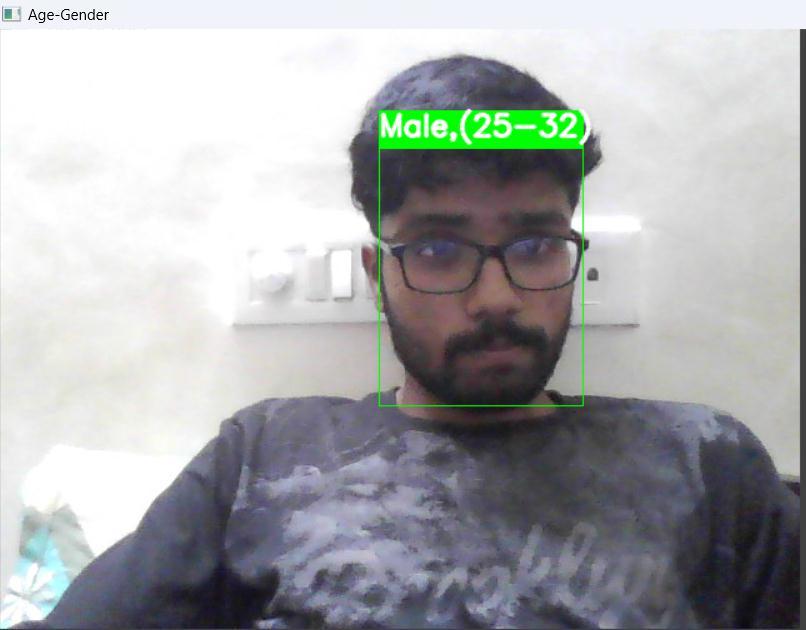
Launch the path of the code directory into the commandprompt.Thenthepathtothelocationofthecode has been set. Now, execute the code using the command python filename.py. The project window appears on the screen which begins to identify the object in front of the webcam.Iftheobjectisidentified,thealgorithmclassifies thegendertypealongwithagegroupasshowninbelowfig9.1
Fig:9.1Output
This project's discoveries regarding age-estimating contributionsandgendercategorizationcanbeusedtosolve challenges in real-time applications. Although age and gender classification concerns were addressed by earlier systems,muchofthisresearchwaspreviouslyrestrictedto constrained photos taken in lab settings. The visual discrepancies that are common in real-world photos on social media platforms and in online archives are not sufficientlyreflectedbysuchsettings.Ontheotherhand,itis moredifficulttofindphotographsonlinebecausethereare somanymoreofthem.WeexamineDeep-performanceCNNs on these tasks using Internet data and a related field's example of facial recognition. We present our results utilizing a lean Deep Learning architecture that avoids overfittingduetotheabsenceoflabeleddata.Inparticular current network topologies, our network is "shallow", minimizing the number of parameters and the risk of overfitting.
Wewouldliketoexpressourspecialthankstoour mentor Dr. R. Lakshmi Priya who gave us a golden opportunitytodothiswonderfulprojectonthistopicwhich also helped us in doing a lot of research and we came to knowaboutsomanynewthings.Wearereallythankfulto them.Secondly,wewouldalsoliketothankmyfriendswho helped us a lot in finalizing this project within the limited timeframe.
[1] Turabzadeh, Saeed, Hongying Meng, Rafiq M. Swash, MatusPleva,andJozefJuhar."Real-timeemotionalstate detectionfromfacialexpressiononembeddeddevices."
In2017SeventhInternationalConferenceonInnovative Computing Technology (INTECH), pp. 46- 51. IEEE, 2017.
International Research Journal of Engineering and Technology (IRJET) e-ISSN: 2395-0056
Volume: 10 Issue: 01 | Jan 2023 www.irjet.net p-ISSN: 2395-0072
[2] Krizhevsky,Alex,IlyaSutskever,andGeoffreyE.Hinton. "Imagenetclassificationwithdeepconvolutionalneural networks." In Advances in neural information processingsystems,pp.1097-1105.2012.
[3] A. Kumar and F. Shaik,” Importance of Image Processing”,2016.
[4] Eran Eidinger, Roee Enbar, and Tal Hassner,”Age and genderEstimationof UnfilteredFaces”,2014 in IEEE.
[5] Aditya K. Saxena, Shweta Sharma and Vijay K. Chaurasiya,”NeuralNetworkbasedHumanAge-group Estimation in Curvelet Domain”, 2015 The Authors PublishedbyElsevier.
[6] J.Chen,S.Shan,C.He,G.Zhao,M.Pietikainen,X.Chen, and W. Gao. Wld: “A robust local image descriptor”, Trans.PatternAnal.Mach.Intell.,7.S.E.Choi,Y.J.Lee,S. J. Lee, K. R. Park, and J. Kim. “Age estimation using a hierarchical classifier based on global and local facial features”,PatternRecognition,44(6):1262–1281,2011
[7] Hang Qi and Liqing Zhang,” Age Classification System withICABasedLocalFacialFeatures”,2009SpringerVerlagBerlinHeidelberg.
[8] ChenjingYan,CongyanLang,TaoWang,XuetaoDu,and Chen Zhang,” Age Estimation Based on Convolutional Neural Network”, 2014 Springer International PublishingSwitzerland.
[9] Dehghan,Afshin,EnriqueG.Ortiz,GuangShu,andSyed Zain Masood. "Dager: Deep age, gender and emotion recognitionusingconvolutionalneuralnetwork."arXiv preprintarXiv:1702.04280(2017).
2022, IRJET | Impact Factor value: 0.422 | ISO 9001:2008 Certified Journal