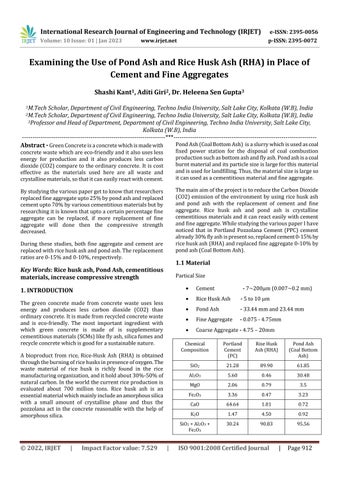
Examining the Use of Pond Ash and Rice Husk Ash (RHA) in Place of Cement and Fine Aggregates
Shashi Kant1 , Aditi Giri2 , Dr. Heleena Sen Gupta31M.Tech Scholar, Department of Civil Engineering, Techno India University, Salt Lake City, Kolkata (W.B), India

2M.Tech Scholar, Department of Civil Engineering, Techno India University, Salt Lake City, Kolkata (W.B), India
3Professor and Head of Department, Department of Civil Engineering, Techno India University, Salt Lake City, Kolkata (W.B), India ***
Abstract - GreenConcreteisaconcretewhichismadewith concretewastewhichareeco-friendlyanditalsousesless energy for production and it also produces less carbon dioxide(CO2)compare to theordinaryconcrete. It iscost effective as the materials used here are all waste and crystallinematerials,sothatitcaneasilyreactwithcement.
Bystudyingthevariouspapergettoknowthatresearchers replacedfineaggregateupto25%bypondashandreplaced cementupto70%byvariouscementitiousmaterialsbutby researchingitisknownthatuptoacertainpercentagefine aggregate can be replaced, if more replacement of fine aggregate will done then the compressive strength decreased.
During these studies, both fine aggregate and cement are replacedwithricehuskashandpondash.Thereplacement ratiosare0-15%and0-10%,respectively.
Key Words: Rice husk ash, Pond Ash, cementitious materials, increase compressive strength
1. INTRODUCTION
The green concrete made from concrete waste uses less energy and produces less carbon dioxide (CO2) than ordinaryconcrete.Itismadefromrecycledconcretewaste and is eco-friendly The most important ingredient with which green concrete is made of is supplementary cementitiousmaterials(SCMs)likeflyash,silicafumesand recycleconcretewhichisgoodforasustainablenature.
A bioproduct from rice, Rice-Husk Ash (RHA) is obtained throughtheburningofricehusksinpresenceofoxygen.The waste material of rice husk is richly found in the rice manufacturingorganization,anditholdabout30%-50%of naturalcarbon.Intheworldthecurrentriceproductionis evaluated about 700 million tons. Rice husk ash is an essentialmaterialwhichmainlyincludeanamorphoussilica with a small amount of crystalline phase and thus the pozzolana act in the concrete reasonable with the help of amorphoussilica.
PondAsh(CoalBottomAsh) isaslurrywhichisusedascoal fixed power station for the disposal of coal combustion productionsuchasbottomashandflyash.Pondashisacoal burntmaterialanditsparticlesizeislargeforthismaterial andisusedforlandfilling.Thus,thematerialsizeislargeso itcanusedasacementitiousmaterialandfineaggregate.
ThemainaimoftheprojectistoreducetheCarbonDioxide (CO2)emissionoftheenvironmentbyusingricehuskash and pond ash with the replacement of cement and fine aggregate. Rice husk ash and pond ash is crystalline cementitiousmaterialsanditcanreacteasilywithcement andfineaggregate.WhilestudyingthevariouspaperIhave noticed that in Portland Pozzolana Cement (PPC) cement already30%flyashispresentso,replacedcement0-15%by ricehuskash(RHA)andreplacedfineaggregate0-10%by pondash(CoalBottomAsh).
1.1 Material
ParticalSize
Cement - 7~200µm(0.007~0.2mm)
RiceHuskAsh - 5to10µm
PondAsh - 33.44mmand23.44mm
FineAggregate - 0.075-4.75mm
CoarseAggregate - 4.75–20mm
1.2 Advantages
RiceHusk Ash - Thequalitiesofconcrete,suchas impermeability, workability, strength, and corrosion of steel reinforcement, can all be enhancedbysubstitutingricehuskashforcement whilecreatingconcrete.
PondAsh-Theashisusedforthreemainreasons: toprovideeconomicalconcrete,forrecyclingand toreducewastemanagement.
2. Literature Review
Srikanth et. al.[1] Observed that 70% of the fly ash produced by the combustion of coal is treated, while the other30%isprecipitatedasbottomash.Althoughthereare some restrictions, pond ash can be used to replace fine aggregate in concrete. Pond ash's plasticizer property is negligiblebecauseofthelowerCaOlevel.Additionally,the building site and ash ponds affect availability. If I use the same 25% replacement Pond Ash to replace 10 kg of fine aggregate,myamountofPondAsh,usingtheabsoluteweight replacementmethod,willbe2.1675kg,whiletheweightof fineaggregatewillbe7.8325kg.
Inallthejournals,theratioofspecificgravityofpondashto fineaggregatehasbeentakenas1.Thatisthereasonwhythe volumeisgreaterthan3kg/m3.Butiftheratioislessthan1, it means there is a reduction in the slump value of fresh material.
Mahdi et. al.[2] To measure the compressive strength, waterabsorption,density,andpulsevelocityoftheconcrete, 100mm-diameterconcretecubeswerecast.Concretewith cementreplacementandavariedamountofpondashasfine aggregate was chosen for further examination due to the compressivestrengthandworkabilityoftheinitialsamples. AccordingtoASTMC496-11[23],concretemixtures'pulse velocity,tensilestrength,andshrinkageasaresultofdrying weredeterminedat7,28,91,120,150,and180daysafter mixing [23]. Flexural strength and concrete pulse velocity (km/s) relationship The proportion of porous particles in concreteriseswiththeamountofpondashadded,allowing thewatercontenttograduallyflowoutastheconcretedries. TheuseofPondAshasacompleteorpartialreplacementfor fineaggregateinconcretedecreasedtheworkabilityofflyash-bottom-ashconcrete.Flyashandbottomashconcrete mixturesdemonstratedgreatertensileandflexuralstrengths thancontrolconcretemixturesafter28daysofcuring.
Avadhutet.al.[3]Mstandsforconcretemixdesign,and the M indicates the characteristic compressive strength of concretewhentestedatthe28thdayaftercasting.Concrete specimens were prepared by replacing 0%, 15%, 17.5%, 20%,22.5%,and25%ofthefineaggregatewithpondashfor both M30 and M40 grades. Results of tests conducted are tabulatedinTableIII(forM30-gradeconcrete)andTableIV
(for masonry). Concrete with pond ash content has a maximumcompressivestrengthof20%ofthereplacement level.However,thereisnospecifictrendshowingadefinite increaseincompressivestrengthuptothislevel.Concrete specimens with pond ash content show a significant reductionincompressivestrengthcomparedtospecimens with no ash. This appears to be a problem of mix design ratherthantheeffectofreplacingfineaggregatewithpond ash.Thecompressivestrengthofconcretespecimensmade by substituting pond ash for fine aggregate shows no discernible trend in either direction. Generally speaking, pondashspecimenswitha20%replacementdemonstrate thehighestcompressivestrength.
Rath et. Al. [4] Local heat and/or dry circumstances increase the likelihood of concrete shrinkage, which decreases the resilience of structures. The partial substitution of cement with fly ash and pond ash yields satisfactoryresultsaccordingtoanequationthathasbeen proposed.Thegoalofthisstudyistolookintotheshrinkage impactcausedbypartialcementreplacementwithflyash, pondash,oracombinationofthetwo.Inthisstudy,flyash, pondash,orbothareusedinplaceofcementtoassessthe early age shrinkage of fifteen mixes. Conclusion: The formation of porosity might lower compressive strength while the rate of shrinkage lowers with higher pond ash replacement.Onthesurfaceofthestructure,cracksdevelop whichleadtoconcreteshrinkage.Structures'cost,strength, anddurabilityareallreducedasaresult.Ontheconstruction site, using high-volume fly-ash concrete is advised to minimise cement paste shrinkage. When fly ash and pond ash are used in place of cement, both alone and together, shrinkage strain is reduced, which could boost durability. Thesustainabilityofnaturalresourcesisalsopromotedby usingflyashorpondashinplaceofcement.
Arvindet.al.[5]Smolderingthehuskatatemperature below 800 °C produces fiery remains with silica in a shapeless structure. The short blazing spans (15–360 minutes) caused a high carbon content for the created material,evenwithhighburningtemperaturesof500–700 °C.Ricehusksmaybesmoulderingintofieryremainsthat satisfy the physical qualities and compound mineral admixtures. The upgraded RHA, obtained by controlled blazing and pounding, has been used as a pozzolanic material as part of bonding and cement. RHA concoction structuresareinfluencedbecauseoftheburningprocedure and silica content within the powder at that temperature. Rice-husk ash was blazed for roughly 72 hours in an uncontrolledburningmethod.
Vashishtet.al.[6]Concrete'sprimarycomponent,cement, servesasabindingagent.Approximately900kgofCO2are releasedforeverytonneofconcreteproduced.Thepurpose of this study is to investigate the profitable use of contemporary trash as an alternative to cement in construction projects. Blast furnace slag, silica fume, rice husk ash, cenospheres, and fly ash are a few examples of
industrialwastesthatcanbeusedascementitiousmaterials that are stronger. Rice husks are burned to produce rice husk ash (RHA). The best outcome is achieved when concrete contains 15% rice husk ash. The 28-day compressivestrengthforordinaryconcreteisfoundto be 27.75MPa,whereasitis32.78MPaforconcretewith15% husk ash, indicating that 15% is the ideal amount of rice husk to employ. The split tensile strength of conventional concrete after 28 days is found to be 1.526 MPa, whereas thatof15%ricehuskashconcreteisfoundtobe1.697MPa. 15%istherecommendedamountofricehuskashtousein cement concrete. The strength is below 20 MPa for other RHApercentages,hence15%istheidealRHApercentageto use.
Kaarthiket.al.[7]ThemanufacturingofPortlandcementis responsibleformorethan5%ofworldwideCO2emissions. Whenricehuskash(RHA)isaddedtocement,theslumpand compactionfactorsoftheconcretearereducedby27%and 9%,respectively.Thestudy'sobjectivesaretocomprehend howRHAaffects the characteristicsof freshly-pouredand hardenedconcrete,aswellastoestablishtheidealratioof cementtoRHA.Anumberofthericehuskash'sproperties wereidentifiedandcontrastedwiththoseofcement.When compared to cement, it was discovered that rice husk ash had a very low specific gravity Concrete that contained varied amounts of rice husk ash (RHA) improved in compressivestrengthfrom27MPato29MPaafter28days ofcuringwhen10%RHAwasadded.
3. CONCLUSIONS
Studiesareshownonvariouspaperthatresearchersused singlematerialslikeRicehuskAsh(RHA)andpondash(Coal BottomAsh)intheirresearchworkbutheretwomaterials are used together to obtain the compressive strength of concrete.
All materials used here are in waste material to save the naturalmaterialsfurther
useofthegenerationtocome
Bystudyingthevariouspapergettoknowthatresearchers replacedfineaggregateupto25%bypondashandreplaced cementupto70%byvariouscementitiousmaterialsbutby researchingitisknownthatuptoacertainpercentagefine aggregate can be replaced, if more replacement of fine aggregate will done then the compressive strength decreased.
Since,ricehuskashreplacescementinthisresearchworkto theextentof0–15%andpondashtotheextentof0–10%, bothfineaggregateandcementarereplaced.
REFERENCES
[1] A Srikanth, K Adithya Nandini, Y Anand Babu, “PerformanceofFineAggregateReplacedPondAshon strengthofConcrete”publishedinIOPJournalin2021.
[2] Mahdi Rafieizonooz, Jahangir Mirza, Mohd Razman Salim, Mohd Warid Hussin , Elnaz Khankhaje, “Investigationofcoalbottomashandflyashinconcrete as replacement for sand and cement” published in Elsevierjournalin2016.
[3] AvadhutKshirsagar,Dr.RamachandraHegde,”PondAsh asPartialReplacementofFineAggregateinConcrete” publishedinresearchgatejournalinMay2020
[4] RathBadrinarayan,DeoShirish,RamtekkarGangadhar,” A Study on Early Age Shrinkage Behaviour of Cement PastewithBinaryandTernaryCombinationofFlyAsh andPondAsh”publishedinNovember2016.
[5] Arvind Kumar, Amit Kumar Tomar, Shravan Kishor Gupta, Ankit Kumar,” Replacement of Cement in ConcretewithRiceHuskAsh”publishedinresearchgate journalJuly2016.
[6] VashishtPatil,Prof.M.C.Paliwal,“PartialReplacement of Cement with Rice Husk Ash in Cement Concrete” publishedinIjertjournalinDecember2020.
[7] N Kaarthik Krishna, S Sandeep, K M Mini,” Study on concrete with partial replacement of cement by rice huskash”publishedinIOPJournalin2016.