International Research Journal of Engineering and Technology (IRJET) e-ISSN:2395-0056

Volume: 10 Issue: 01 | Jan 2023 www.irjet.net p-ISSN:2395-0072
International Research Journal of Engineering and Technology (IRJET) e-ISSN:2395-0056
Volume: 10 Issue: 01 | Jan 2023 www.irjet.net p-ISSN:2395-0072
Abstract - Java, C, C++ are a few of the most robust and popular programming languages still used today. Python, on the other hand, is a computer programming language that is often used to design websites, automate day-to-day IT tasks, and conduct data analysis. C/C++ and Java follow an imperative and structural programming model having strict semantic rules and functions whereas Python is an Object-based language that also provides a rich set of inbuilt libraries. Python is more readable and simpler. In this project, “Language portability to Python” we would like to implement a translator engine that translates multiple programming languages namely Java, C, C++ into Python code without changing the actual meaning and functionality of the original code. This results in an automated translation rather than having to rewrite the completePythonprogrammefromstart.
Key Words: Translator, Compiler, Interpreter, Python, C, C++, Java.
Programming Languages Conversion has been a challenging topic for almost a decade. Converting a piece of code from one language to another entails more than just changing the syntax between the two languages. It involvesexecutingtransformationwhiletryingtokeepthe structureandoptimizationintact.
Python has advanced in recent years to rank among the programminglanguagesthataremostoftenusedglobally. It's a programming language that's frequently employed for data analysis, software development, and process automation. Python is a versatile programming language that may be used to construct a broad range of applications and does not concentrate on a particular problem. Because of its versatility and beginnerfriendliness, it has gone to the highest spot on the programminglanguagelistnowinuse.
Consider a scenario in which a developer or programmer experienced in structured programming languages like Java, C or C++ must implement a Python application without altering its intended use. Another scenario is a beginner programmer who wants to quickly learn Python butonlyhasexperiencewithC,C++,orJava.
A language translator, which translates one computer language to another with a single click, is useful for resolvingsuchissues.PythonandC/C++/Java arerelative newcomers to the world of programming, but they have bothearnedaspotamongthemostwidelyusedonesright now. Both of them have numerous strong characteristics thatprogrammerswant.Pythonislessdifficulttolearnfor beginningprogrammersthanJava.Pythonismoreflexible and less complicated than Java, so studying programming in Python as a first language will allow one to advance more quickly.In addition to beingmoreuser-friendlyand robust, Python is also simpler to read, comprehend, and debug.Italsohasamorenaturalcodingstyle.Becauseitis aprogramminglanguagewithdynamictypingasopposed toJava'sstatictyping,itisalsomoreproductive.Pythonis reliable and utilized by many enormous companies, like Google.
Wasi Uddin Ahmad et al.,[1] presented a corpus made of nearly8,475programmingproblemsalongwiththeirJava and Python-based solutions. They gathered the dataset from open-source repositories and online coding platforms which include CodeJam, GeeksForGeeks, and Leetcode. They trained through three different models namely the No training model, the training from the scratch model, and the pre-trained model. Out of which PLBART model performed well compared to others however it failed to convert import statements and type causingseveretypemismatch.
International Research Journal of Engineering and Technology (IRJET)
e-ISSN:2395-0056
Volume: 10 Issue: 01 | Jan 2023 www.irjet.net p-ISSN:2395-0072
EmanJ.Cocoetal.,[2]providedaparadigmforconverting JavacodetoPython.Twostagesmakeupthisprocess:the first stage involves converting Java code to an intermediate language, and the second stage involves translating the intermediate language code into Python. TheychoseXMLasaninterpretedlanguagebecauseitmay be understood by two different programs that are incompatible with one another, and because XML data is savedastext,loweringtheriskofdataloss.Thetranslator readseachcharacter inthe Javafileinordertodetermine the type and individual parts of the statements. Each Java instructionistranslatedintothenameoftheXMLtagthat best describes it, which is determined by the type of Java instruction. The tag attributes record the contents of the Java statement. Before processing the tree nodes, which are made up of XML tags, the translator extracts the Document Object Model treefromthe XML file. EachXML tag is translated into a corresponding Python instruction, with the tag name determining the statement's type. The tag attributes are used to extract the parts of the Python statement. The fundamental Java components may all be converted to Python using this paradigm. This model's drawback is that it is unable to translate Java code that containsOOPsanddatastructures.
Baptiste Roziere et al.,[3] suggested a transformer design consisting of an encoder and a decoder is used in a sequence-to-sequence model. A monolingual approach was used to represent all of the programming languages. Unsupervised machine translation initialization, language modeling, and back-translation approaches were utilized totrainit.TheyusedthepreviouslytrainedXLMmodelto initializethemodel'sencoderanddecoder.Only3%ofthe originalreferencewastranslatedwhengoingfromC++ to Java, despite the fact that 61% of them passed the unit tests.
Prof. Satish Kuchiwale et al., [4]By employing recurrent neural networks and sequence-to-sequence mapping, a pseudo code is transformed into a python code. For the mapping of sequences, it employs an end-to-end strategy. It is made up of a decoder and an encoder. The encoder transformstheinputsequenceintoa contextvectorusing multi-layer LSTM cells. The decoder then receives this context vector and uses deep LSTM cells to produce the target sequence. Only logical assertions stated in simple Englishcanbeparsedbythealgorithm.
Dony George et al., [5]The language is first processed by the compiler, after which the program is parsed to determine its structure and scanned to gather additional information about variable names, function names, etc. Theconversionsoftwarethentransformsthecodeintoan intermediarylanguagefile, after whichthecodeisfurther
processed by a Language Optimization tool. This is translated to target code by the compiler's de-conversion procedure. This is unable to translate code across two distinctplatforms.
Dr. Safwan Omer Hasson et al., [6]Pseudocode uses statements to express actions, and variable and function names are connected together by underscores. Summations and Counters must be initialized to zero before being trained using a neural network by defining a matrix with binary integers, creating random weights after initialization, and contrasting the neural network's actual output with the desired output. The output created does not match the targetoutputduetothehigherrorrate.
WimT.L.P.Lavrijsenetal.,[7]Cling,cffi,andPyPy'stoolbox are combined in cppyy, a new module for PyPy-C that offers high-performance Python bindings for contemporary C++. Modern C++ makes it easier for interfaces to communicate purpose, which considerably helps automatic bindings generators. For instance, by making ownership and thread safety crystal clear. With size and distribution in mind, the cppyy module builds bindingsinalazymannerandhasminimaldependenceon the Python interpreter. Deconstructing high-level conceptions to low-level interfaces allowed for optimizations. On the other hand, the PyPy optimizer is designedtooperatewithhigher-levelconstructs.
KaranAggarwal etal.,[8]useda Python2codetoPython 3 code by statistical machine translation. He achieved a high BLEU score by combining data from two earlier experiments. He also researched cross-project training as well as testing to identify mistakes and eliminate disparities with past situations. In order to achieve the goal of creating translation models that closely resemble natural languages themselves, he has given a thorough analysis on modelling programming languages as natural languages.
Tom Simonsen et al.,[9] invested most of their work into translating Python code to “standard” CPP. His primary goal was to get most of the basic language elements translated. He implemented the translation, and by doing so he named the translator “Python2C”. He added that by implementing the Windows CE GUI translation, the translation of code from Python to CPP can be done even more accurately. Since the translation engine has been created,hesuggestedthatitjustneedstweakingandafew upgrades to make it more powerful. He also highlighted that Python2C is capable of translating GUIs if someone takesthetimetodothis.
International Research Journal of Engineering and Technology (IRJET)
e-ISSN:2395-0056
Volume: 10 Issue: 01 | Jan 2023 www.irjet.net p-ISSN:2395-0072
IanJ.Davisetal.,[10]recommendedbash2py,asource-tosource translator for bash scripts that turns them into Python code. Using both the inbuilt parser of Bash and open-source bash code, Bash2py processed any bash script.Onthe otherhand,Bash2pyreimplementsvariable expansion in the Bash language to produce Python code thatismoreaccurate.Bash2pytransformsthemajorityof Bash scripts to Python, however, it requires human interaction to handle constructions that cannot be simply translated by the computer. He conducted experiments with the real-world Bash scripts from the open source. Thebash2pywasabletosuccessfullytranslate90percent ofthecode.
Richard C Waters et al.,[11] suggested a two-step translation that uses abstraction and reimplementation. The abstraction stage analyzes the source program globallyandattemptstocomprehendthealgorithmthatis beingusedthere.Thereimplementationstageattemptsto write a program in the needed target language using the abstraction'sdescriptionasastartingpoint.Thisapproach ismoredifficultandhasaproblemwithincompleteness.
Xinyun Chen et al.,[12] proposed using an encoderdecoder framework with the tree-to-tree neural network inwhichthesourcetreeisencodedintoanembeddingand the embedding gets decoded into the target tree. The encodermakesuseofaTree-LSTMtodeterminetoembed forboththeentireinitialtreeandsubtree.Thedestination tree is then generated by the decoder starting at the root node. For increased efficiency, binary trees are created from the source tree and the target tree. It extends each node recursively while maintaining a queue of all nodes that need to be extended. Programs that are bigger than thetaughtonesarechallenging.
Onkar Apte et al.,[13] proposed a model that translates the code written in C language to Python. They used Python language to design the translator. The facilities thatPythonoffersandtheeaseofdevelopingcodearethe key justifications for utilizing it. The work of constructing a translator was made simple by Python's abundance of built-in, ready-to-use methods suitable for string manipulation, such as split(). Without any problems and using the same logic, the translator can be written in any other language. There are actually three stages to the translatingprocess.First,theidealsyntaxisappliedtothe C code. The translator analyzes the file line by line in the secondstage,identifyingthelinetypethatwehavechosen at random. Each line is translated by using the line-type arrayestablishedinthesecondstepinthethirdphase,and the outcome is a fully translated Python code file. The model was able to translate variable declarations, comment lines, control statements, etc., The limitation of
this model is it cannot translate structure and pointers presentinClanguage.
Rahul Dubey et al., [14] proposed an Algorithm to code converter, also referred to as A2C converter. It is an interpreterortranslationprocessthatenablestheuser to just write a problem's algorithm in semi-natural English, which may then be translated into Java or C computer language code. This model consists of two phases, translatorphase:employingPOSTagging,Classificationby Naive Bayes Classifier, and Data Extraction to convert the input algorithm to an XML specification file. The main benefit of utilizing a classifier is that data extraction is made easier once the kind of statement is determined. Mapping phase: mapping the input algorithm's output XML specification file to the necessary C language code. The limitation of this model is it can only convert algorithmsthatareproperlystructured.
S.T.Gollapudietal.,[15]proposedamodelthattranslates code based on semantics. It converts Java code into Python. The Natural Language ToolKit's Java Keyword Identificationmoduleisusedtoidentifythekeywords,and the matching Python Keyword Identification module is then used to compare the keywords to convert the identified keywords from Java to Python code. The following stage entails three modules that involve "lineby-line layering" and lemmatizing the comparable Python keywords. During the concordance stage, the discovered keywords of Python are arranged based on how much they resemble the vocabulary in Python.The "line-by-line layering" technique involves stacking keywords with lemmatization in accordance with segmentation rules. In the final phase, "Synthetic Code Formatting," the stacked keywordsareindentedtocreatethepythoncode.
Neeta Verma et al. [16] proposed an NMT-based model. Neural machine translation (NMT) is a pragmatic method to machine translation that employs a large artificial neural network to model or produce the full phrase as a single integrated model in order to forecast or know the occurrence of a big sequence of words. a unidirectional, deep multi-layer recurrent neural network that uses the LSTM as a recurrent unit. The NMT model, at its most basiclevel, comprises two recurrent neural networks:the encoderRNNconsumestheoriginalwordsfromtheinput withoutmakinganypredictions;thedecoder,ontheother hand, predicts the following words while processing the targettext.
International Research Journal of Engineering and Technology (IRJET) e-ISSN:2395-0056
Volume: 10 Issue: 01 | Jan 2023 www.irjet.net p-ISSN:2395-0072
Table -2.1: EnglishtoGlobalLanguageTranslation
Hector Llorens et al [25] (2010)
Melvin Johnson, et.al (2017)
Conditional Random Fields probabilistic model(CRF),TIPSem
NMT and Multilingual modelarchitecture
precision, recall, and Fβ=1metrics
BLEUscoremetric
● For Spanish, TIPSem achieved the best Fβ=1 in all tasks
● For English, it obtained the best Fβ=1 in event recognition and classification, and event and document creationtimelinkscategorization
● trainmultilingualNMTmodelswithasinglemodel where all parameters are shared that can be used to translatebetweenanumberofdifferentlanguages,
● Without explicit bridging, zero-shot translation is proventobefeasible.
(Soft) alignment generated by the RNN search Encoder –DecodersModel
Philipp Koehn et al (2017)
(Soft) alignment generated by the RNN search Encoder–DecodersModel
MTandSMT
Alignment,accuracy
probability mass, BLEUscores
● outperformstheconventionalRNNencdec
● produced translation performance on par with phrase-basedstatisticalmachinetranslationalreadyinuse
● When put in situations that are significantly differentfromtrainingsettings,neuraltranslationmodelsdo notbehaverobustly.
● There are still many obstacles for neural machine translation to get past, mostly performed outside of the targetlanguageandwhenresourcesarelimited
Table -2.2: GlobaltoLocalLanguageTranslation
Effective preprocessing based neural machine translation for English to Telugu cross-language information retrieval (2022)
Machine Translation System Using Deep Learning for English to Urdu(2022)
Rule based Sentence Simplification for English to Tamil Machine Translation System (2020)
English to Bengali Multimodal Neural Machine Translation using Transliterationbased Phrase Pairs Augmentation(2022)
Using RNN and LSTM machinelearningmodels Accuracy, Perplexity, Cross-entropy and BLUEscores
LSTM-based deep learning encoder-decodermodel BLUE, F-measure, NIST, WER.
● BLEU score of RNN model with and without replication were 4603 and 4687 respectively.
● BLEU score of LSTM model with and without replication were 4638 and 4719 respectively.
● The proposed system after extensive simulationsachievesanaverageBLEUscoreof 4583
Rulebasedtechnique. Accuracy
● 200 sentences are given to the rule based English to Tamil machine translation system out of which 140 sentences are incorrect because of syntax and reordering error.
Transliteration based phrase pairs augmentation approach
BLUEandRIBES
● Text-only NMT Evaluation BLEU and RIBESscoreswere409and075respectively.
● Multi modal NMT Evaluation BLEU and RIBES scores were 439 and 078 respectively.
International Research Journal of Engineering and Technology (IRJET) e-ISSN:2395-0056
Volume: 10 Issue: 01 | Jan 2023 www.irjet.net p-ISSN:2395-0072
Table -2.3: LocaltoLocalLanguageTranslation
Related Work Methodology Evaluation Method Outcome
Sivaji Bandyopadhyay (2020)
Stemming and Zonal Indexing effectiveness
● A robust stemmer is required for the highly inflectiveIndianlanguages.
● Machine-readable bilingual dictionaries with more coveragehaveimprovedtheresults.
Vandan Mujadia (2022)
Jagadeesh Jagarlamudi(2019)
ParallelCorpora Average sentence length
Machine Translation Systems threshold
● Iterative Back-translation driven Post-Editing can beusedforsimilarparallelcorporacreationwork.
● Carefullycreatedandcuratedparallelcorporaboost the translation performance even with the lower parallel corporasize
● on CLEF data set, a Hindi to English cross-lingual information retrieval system using a simple word by word translation of the query with the help of a word alignment table was able to achieve ∼ 76% of the performance of the monolingualsystem
● word translations with no threshold on the translationprobabilitygavethebestresults
Mallamma V. Reddy (2020) Mapping WordPrecision
● English has Subject Verb Object (SVO) structure while Kannada has Subject Object Verb (SOV) structure in Machinetranslationwillbeunraveledbyusingmorphology
● we can also use language identification module for translationwiththehelpofbilingualdictionary Table -2.4: ProgrammingLanguageTranslation
JalilNourisa (2021) Agent based modeling (ABM)
Scalability, Versatility
WasiUddinAhmad (2022) PLBART Accuracy
BaptisteRoziere (2020) Sequence to Sequence Correctness, Precision
● The result shows that the ABM is an effective method fortranslatingfromc++topython.
● Providesseveralbuilt-infunctionswhicharedemanded forthetranslation.
● The models perform relatively well in terms of the lexicalmatch.
● Aimedtoimprovetheconvertingofimportstatements.
● Themodelrequiresnoexpertiseinthesourceortarget languages.
● This method relies exclusively on monolingual source code.
GeirYngvePaulsen (2020)
Armadillo SeismicLab Complexity, Accuracy
● It handles realistic matlab codes for translating into otherprogramminglanguages.
● This model improves the optimization of the code that hasbeenwritten.
International Research Journal of Engineering and Technology (IRJET) e-ISSN:2395-0056
Volume: 10 Issue: 01 | Jan 2023 www.irjet.net p-ISSN:2395-0072
Our proposed software is hosted on the web through the Djangoframeworkprovidinganeatuserinterfacewherea user can initially choose a programming language from C/C++ or Java as the source code. By selecting the language,theusercannowpastethecodethatneedstobe translated into the text editor. On clicking the translate button the entire code is sent to the application logic analyzer.
The primary objective of the logic analyzer is to process line-by-line source code to equivalent Python code withoutchangingthefunctionalityorpurposeofthecode. Asyntaxtreeisgeneratedfromthestructuredcodewhich isfurtherprocessedusingNLPtools.Finally,thegenerated codeisoptimizedusingtheAPIsandservedtotheuser.
We conducted extensive research for this paper on LanguagePortabilitytoPython,lookingatawiderangeof research publications on Programming Language interconversion.Welearnedthatmostofthemodelswere only able to convert basic elements of code. With current technologies, the conversion of codes containing structures, pointers, data structures, and OOPs is not possible.
Additionally,wehavelearnedaboutseveralproposedand existingsystemsthroughresearchpublications,whichhas helped us develop a new model that would make translationmuchmoreefficient.
Special thanks to our team guide, Mr. P. Venkateswara Rao,forall of his support anddirection,whichhelped the literature survey portion of the project be successfully completedandyieldpositiveresultsattheend.
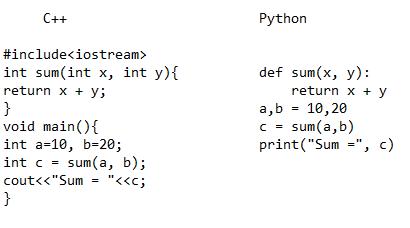
Fig -3.1:C++toPython
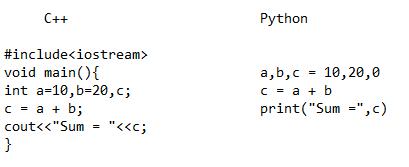
Fig -3.2:C++toPython
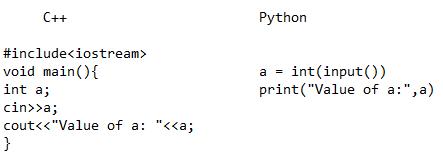
Fig -3.3:C++toPython
[1] WasiUddinAhmad,MdGolamRahmanTushar,Saikat Chakraborty‡,Kai-WeiChang.(2021).AVATAR:AParallel Corpus for Java-Python Program Translation. arXiv:2108.11590v1
[2] Coco, Eman & Osman, Hadeel & Osman, Niemah. (2018). JPT : A Simple Java-Python Translator. Computer Applications: An International Journal. 5. 01-18. 10.5121/caij.2018.5201.
[3] Marie-Anne Lachaux, Baptiste Roziere, Lowik Chanussot, Guillaume Lample. (2022). Unsupervised Translation of Programming Languages. arXiv: 2006.03511v3[cs.CL]
[4] Vinay Patil, Rakesh Pawa2, Prasad Parab, Prof. Satish Kuchiwale. (2020). Pseudocode to Python Translation usingMachineLearning.InternationalResearchJournalof EngineeringandTechnology(IRJET)
[5] Dony, George & Priyanka, Girase & Mahesh, Gupta & Prachi,Gupta&Aakanksha,Sharma.(2010).Programming Language Inter-conversion. International Journal of ComputerApplications.1.10.5120/419-619.
[6] Dr. Safwan Omer Hasson, Fatima Mohammed Rafie.(2014). Automatic Pseudocode to Source Code Translation Using Neural Network Technique.
International Research Journal of Engineering and Technology (IRJET) e-ISSN:2395-0056 Volume: 10 Issue: 01 | Jan 2023 www.irjet.net p-ISSN:2395-0072
International Journal of Engineering and Innovative Technology(IJEIT)
[7] W. T. L. P. Lavrijsen and A. Dutta, "High-Performance Python-C++ Bindings with PyPy and Cling," 2016 6th Workshop on Python for High-Performance and Scientific Computing (PyHPC), 2016, pp. 27-35, doi: 10.1109/PyHPC.2016.008.
[17] Llorens, H., Saquete, E., & Navarro, B. (2010, July). Tipsem (english and spanish): Evaluating crfs and semantic roles in tempeval-2. In Proceedings of the 5th International Workshopon SemanticEvaluation (pp.284291)
[8] [9] Simonsen, Tom.(2015). Translating Python to C++ for palmtop software development. universitetet i oslo instituttforinformatikk.
Aggarwal K, Salameh M, Hindle A. 2015 Using machine translation for converting Python 2 to Python 3 code PeerJ PrePrints 3:e1459v1 https://doi.org/10.7287/peerj.preprints.1459v
[18] MelvinJohnson,MikeSchuster,QuocV.Le,Maxim Krikun, Yonghui Wu,ZhifengChen,Nikhil Thorat Google’s MultilingualNeuralMachineTranslationSystem:Enabling Zero-ShotTranslation.arXiv:1611.04558v2[cs.CL]21Aug 2017
[19] Dzmitry Bahdanau,KyungHyun Cho,Yoshua Bengio. NEURALMACHINETRANSLATIONBYJOINTLYLEARNING TOALIGNANDTRANSLATE.arXiv:1409.0473v7[cs.CL]19 May2016
[10] I. J. Davis, M. Wexler, Cheng Zhang, R. C. Holt and T. Weber,"Bash2py:AbashtoPythontranslator,"2015IEEE 22nd International Conference on Software Analysis, Evolution,andReengineering(SANER),2015,pp.508-511, doi:10.1109/SANER.2015.7081866.
[11] R.C.Waters,"Programtranslationviaabstractionand reimplementation," in IEEE Transactions on Software Engineering,vol. 14, no.8, pp.1207-1228,Aug.1988,doi: 10.1109/32.7629.
[12] Xinyun Chen, Chang Liu, Dawn Song.(2018). Tree-totree Neural Networks for Program Translation, UC Berkeley
[13] Apte, Onkar & Agre, Shubham & Adepu, Rajendraprasad & Ganjapurkar, Mandar. (2021). C TO PYTHON PROGRAMMING LANGUAGE TRANSLATOR. 10.1729/Journal.26932.
[14] R. Dubey, B. Edward, R. Lewis and P. Karunakaran, "Algorithm to Code Converter," 2018 2nd International Conference on Trends in Electronics and Informatics (ICOEI), 2018, pp. 657-661, doi: 10.1109/ICOEI.2018.8553950.
[15] S. T. Gollapudi and S. Sasi, "Semantic Rule-based Automatic Code conversion System," 2020 International Conference on Data Science and Engineering (ICDSE), 2020,pp.1-5,doi:10.1109/ICDSE50459.2020.9310169
[16] Ms. Neeta Verma, Abhay Jain, Animesh Basak, Kshitij Bharti Saksena.(2018). Survey and Analysis on Language Translator Using Neural Machine Translation. International Research Journal of Engineering and Technology(IRJET)
[20] Philipp Koehn, Rebecca Knowles, Six Challenges for Neural Machine Translation, arXiv:1706.03872v1 [cs.CL]12Jun2017
[21] B. N. V. Narasimha Raju; M. S. V. S. Bhadri Raju; Satyanarayana, K V V. IAES International Journal of Artificial Intelligence; Yogyakarta Vol. 10, Iss. 2, (Jun 2021):306-315.
[22] Syed Abdul Basit Andrabi, Abdul Wahid, "Machine Translation System Using Deep Learning for English to Urdu", Computational Intelligence and Neuroscience, vol. 2022,ArticleID7873012,11pages,2022
[23] Poornima,C.,etal."Rulebasedsentencesimplification for English to Tamil machine translation system." InternationalJournalofComputerApplications25.8
[24] Sahinur Rahman Laskar, Pankaj Dadure, Riyanka Manna,ParthaPakray,andSivajiBandyopadhyay.2022.
[25] Bandyopadhyay, S., Mondal, T., Naskar, S. K., Ekbal, A., Haque, R., & Godhavarthy, S. R. (n.d.). Bengali, HindiandTelugutoEnglishAd-HocBilingualTaskatCLEF 2007. Advances in Multilingual and Multimodal InformationRetrieval,88–94.
[26] Vandan Mujadia and Dipti Sharma. 2022. The LTRC Hindi-Telugu Parallel Corpus. In Proceedings of the Thirteenth Language Resources and Evaluation Conference, pages 3417–3424, Marseille, France. EuropeanLanguageResourcesAssociation.
[27] Jagarlamudi,J.,&Kumaran,A.(n.d.).Cross-Lingual Information Retrieval System for Indian Languages. Advances in Multilingual and Multimodal Information Retrieval,80–87.
2022, IRJET | Impact Factor value: 7.529 | ISO 9001:2008 Certified Journal | Page74
International Research Journal of Engineering and Technology (IRJET) e-ISSN:2395-0056
Volume: 10 Issue: 01 | Jan 2023 www.irjet.net p-ISSN:2395-0072
[28] Reddy, M. V., & Hanumanthappa, M. Indic Language Machine Translation Tool: English to Kannada/Telugu. Multimedia Processing, Communication andComputingApplications,35–49.
[29] George, Dony, Priyanka Girase, Mahesh Gupta, Prachi Gupta, and Aakanksha Sharma. "Programming language inter-conversion." International Journal of ComputerApplications1,no.20(2010):68-74.
[30] Khoirom,S.,Sonia,M.,Laikhuram,B.,Laishram,J., &Singh,T.D.(2020).ComparativeanalysisofPythonand Java for beginners. Int. Res. J. Eng. Technol, 7(8), 43844407.
[31] Rai, S., & Gupta, A. (2019). Generation of pseudo code from the python source code using rule-based machinetranslation.arXivpreprintarXiv:1906.06117
[32] Bonthu, S., Sree, S. R., & Krishna Prasad, M. H. M. (2021, August). Text2PyCode: Machine Translation of Natural Language Intent to Python Source Code. In International Cross-Domain Conference for Machine LearningandKnowledgeExtraction (pp.51-60).Springer, Cham.