Modernization of Electrical Substation Automation Systems Using IEC61850
Jigisha Ahirrao1 , Lalit Patil2 , Shlok Kamath3 , Atharva Joshi4Abstract - Thereisaneed forahigh-performance, flexible substation automation system (SAS) that is easy to incorporate. The increasing use of Intelligent Electronic Devices(IEDs)insubstationprotection,coordination,control, monitoring,metering,andtestingoffersinteroperabilityand enhanced communications capabilities. The IEC Technical Committee57workedtocreateIEC61850,anopenstandard for substation modelling and communications. The international adoption of the standard has grown in popularity. This article explores the use of IEC 61850 in conventional substation automation. It introduces the experienceofarealSASmodernizationscenario.Thisinstance emphasizes how useful the IEC 61850 is for operating and monitoringsubstations.
Key Words: IEC 61850, Substation Automation System, IEDs, GOOSE message, intelligent control, protective relay
1. INTRODUCTION
To better meet the demands of expanding Intelligent Electronic Devices (IEDs) installation, effective communication, comprehensive protection, and future growth, power system substations are undergoing renovation.Inordertooperateandcontrol powersystem components,modernsubstationautomation(SA)makesuse ofdatafromIEDs,controlandautomationcapabilitieswithin the substation, and control orders from remote users. Ethernettechnologybringsastandardphysicalconnection thatmakesuniversalcommunicationprotocolspossibleand lays a solidfoundationforsubstation automationsystems (SAS). The integration of IEDs, Ethernet LAN, communicationsprotocols,andcommunicationsmethods, make the whole substation a functional system with the combination of correct physical/virtual connections, common communication protocols, shared storage, and sequential/combinationallogicforcoordinatedmonitoring, protection, and control. The data models defined in IEC 61850 can be mapped to several protocols. The most importantinternationalstandardforsubstationautomation systems is IEC 61850 and its related standards. The installationofIEDsinsubstations,whencombinedwithIEC 61850, enables interoperability, flexibility, and increased efficiencyandcreatesawiderangeofpotentialsolutionsfor substation operation, protection, monitoring, control, and automation.
1.1 Goals of SAS Project
An Open System:
Ability to configure an IEC61850 system using manufacturer tools already in existence without requiringon-sitemanufacturersupport.
Tocarryoutautomatedactivities,communication, protection,control,monitoring,andmeasurement datafromIEDscanbecombined.

Higher Efficiency:
Ethernet-based,quickcommunicationssystems.
Asuccessfuldatamanagementsystem.
Lower cost:
Usinglesscoppercables,commissioningbecoming simpler,andthelikelihoodoffailuresdecreasing.
Auxiliaryrelaysandotherapparatusinthecontrol andprotectionpanelsarereduced.
Flexibility:
The ability to test any LED individually without worrying about interfering with the substation's routineoperations.
Modernized substations enable free function allocation, allowing any vendor to carry out a particulartaskusingitsowndesign.
2. NETWORK ARCHITECTURE
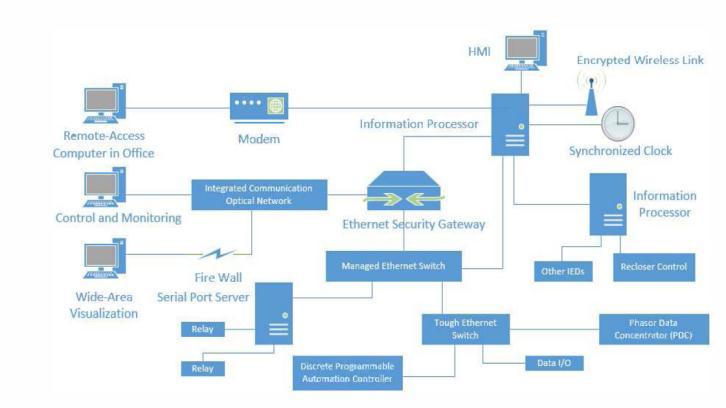
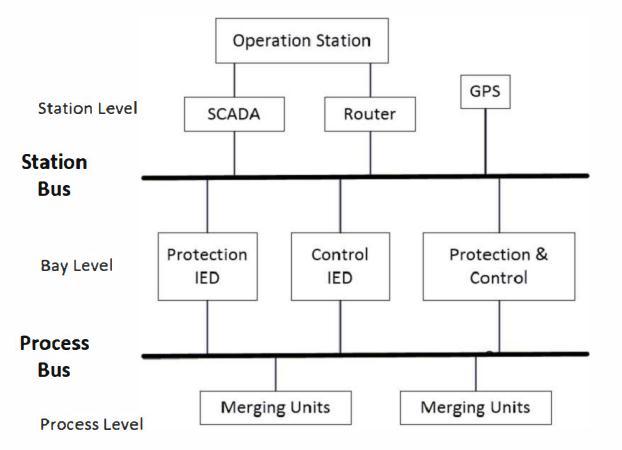
IEC 61850 standard often adopts the DNP3 LANIW AN protocolforsupervisionsystemcommunications.Inorderto usethisprotocol,agatewayisrequiredtogatherandprocess IEC61850datafromtheIEDs,convertittoLANIWAN,and deliverittothelocalHMIandthedistantcontrolcentre.The process bus is defined and essential to data collection and exchange in the IEC 61850-based architecture. The substationsystemarchitectureisseparatedintostationlevel, baylevel, and processlevel, asseen in Fig. 1. InFig. 2, the plant'snetworkconnectiondiagramisdisplayed.Signalscan betransferredbetweenthebaylevellEDandstationcontrol (stationbus),thebaylevellEDandsystemequipment,and devicesandtransducersviathestationbusandprocessbus (processbus) Thetwinredundantstationsandprocessbus
aredisplayedinthecommunicationsarchitecture.Compared toasinglebus,thisofferscrucialsubstationsahigherlevelof reliability. Ethernetswitchessetupina ringconfiguration arefrequentlyusedtoimplementthestationandprocessbus systems.Onlystationbusesareusedinconventionalsystem architecture.Hierarchicalringsarepreferredforthestation busandprocessbusinsubstationsbasedonIEC61850.The abilitytodelivercurrentandvoltagesamplesfromamerging unit to numerous devices that use them for various applicationsisthefoundationfortheapplicationsoftheIEC 61850 process bus. IEC 61850's Part 9-2 explains how sampled values can be exchanged in place of a traditional analogue interface. Control and monitoring of IEDs can be doneusingGOOSE,andtheirdatacanbetransmittedusing TCP/IP. The timestamp resolution to the microsecond is required by the IEC 61850standard.Accurate timestamps canbeproducedbyIEDswhoseclocksaresynchronizedto thesametimestandard.
circuitbreakersandswitchesatthelEDlevel.Thesampled values produced by a merging unit from conventional or non-conventional converters in the case of GOOSE are a continuous data stream ina stationarycase(nochange in status). With regard to sampling values, the process bus mustbeisolatedfromthestationbus.
3. GOOSE MESSAGE APPLICATION
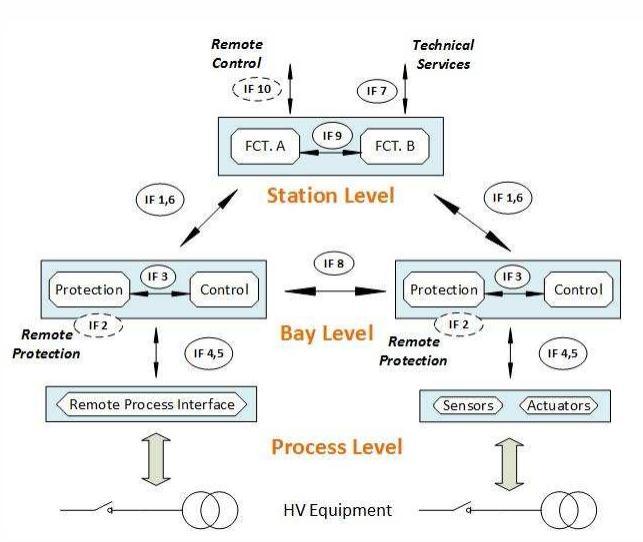
A framework for achieving interoperability between IEDs providedbyvariousvendorsisprovidedbyIEC61850.The distribution of tasks among gadgets and control levels is flexible. The standard therefore supports any function allocation.Interoperabilityshouldbeofferedbetweentasks that will be carried out in a substation but reside in equipment(physicaldevices)fromvariousvendorsinorder to enable a free allocation of functions to IEDs. Functions maybedividedintopiecesandexecutedbyvariousIEDs,yet they still communicate with one another (distributed function).The station level, the bay level, and the process levelarethethreelevelswherefunctionscanbeassigned.A new structure was created to carry out these functions, comprisingtheextralogicalinterfaces(IF).TheIEC61850 seriesisbuiltonthediagraminFig.3
Themeaningsoftheinterfacesareasfollows:
IF1: Protection-datatransmissionbetweenthestationand baylevels.
IF2: Interchangeofsecurity-relateddatabetweenlocaland distantprotection(beyondthescopeofthisstandard).
IF3: sharingofdataatbaylevel
IF4: Instantaneous data interchange between the process andbaylevelsviaCTandVT,particularlyforsamples.
IF5: Interchange of control and data between the process andbaylevels.
IF6: Control-datatransmissionbetweenthestationleveland thebay.
IF7: Data transfer from a substation (level) to a distant engineer'soffice.
IF8: Direct data transfer across the bays, particularly for quickoperationslikeinterlocking.
IF9: Dataexchangewithinstationlevel
IF10: Exchangeofcontrolinformationbetweenasubstation (devices)andadistantcontrolcentre.
IEDs attached to Ethernet switches can all be controlled. Opticalcableisusedtolinktothebaycontrollers,protection relays, circuit breakers, and gateways. For redundancy, multiple lEDs are required to control some IEDs, such as
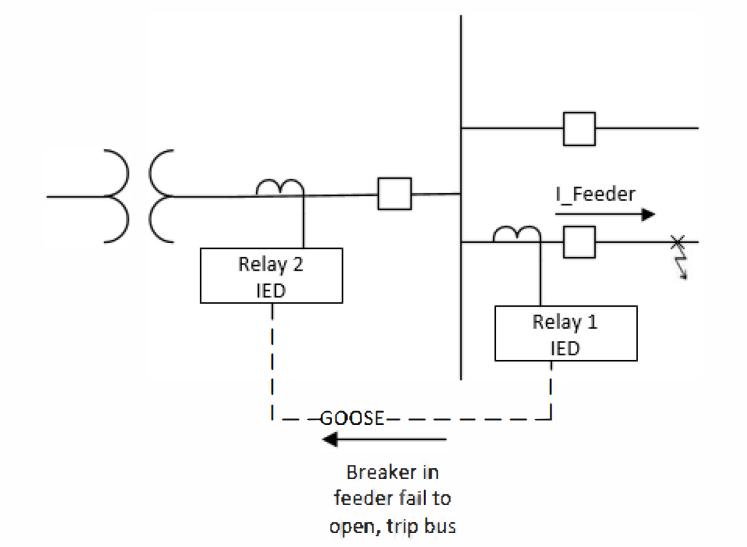
AccordingtoIEC61850-1,logical interface8isutilisedfor peer-to-peer direct data exchange between bays, and as illustratedinFig.5,GOOSEmessagesmayalsobetransferred betweenthebayandstationbus(level).Forthepurposeof sending messages between various IEDs and utilising the messagedatainautomationandinterlocklogicschemes,the IEC 61850 standard employs the peer-to-peer IEC 61850 GOOSEprotocol.Areal-worlduseofGOOSEinasubstation protectionplanisshowninFig.4.Relay/copperwirehard wiring is replaced with GOOSE messages using the IEC 61850 standard to provide comparable performance and outperformcopperconnectionsintiming.Intheeventofa feeder circuit breaker failure, the SAS may use GOOSE messages to transmit a trip command to the power transformersecondarycircuitbreaker.Traditionalcopper wire connections can fail without warning, but the IEC 61850methodismoresecurebecauseifaconnectionfails, the system quickly sends alerts due to the loss of GOOSE systemhealthmessages.
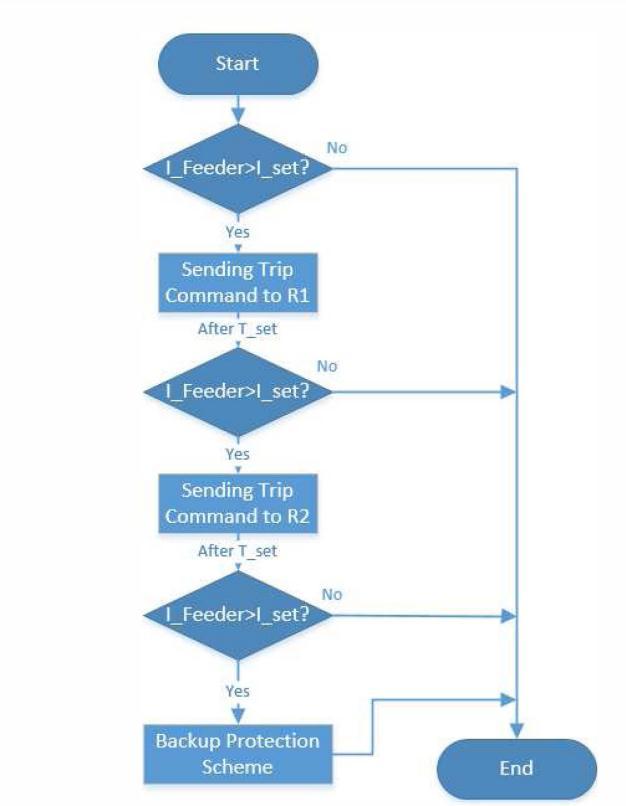
The flowchart for the protection strategy utilizing GOOSE messages is shown in Fig. 5. The feeder current will be detectedbyRelay1'slEDasbeinghigherthantypicalinsuch a malfunction. The feeder circuit breaker receives a trip order from the LED. Relay 1 lED will transmit a trip instructiontoRelay2lED,andRelay2willtrip thebusby openingthecircuitbreakerinthetransformerbranch,ifit determines that the feeder current is still high after a predeterminedamountoftime,indicatingthatthefaulthas not been cleared. The protective system terminates if the feedercurrentreachesnormallevelsafterapredetermined amountoftime.Thebackupprotectionsystemwilltakeover ifthefaultcurrentisstillpresentinthefeeder(perhapsasa result of both circuit breakers being out of commission). Circuitbreakersinthetransformerbranchreactmoreslowly toelectromagneticcurrentrelayprotectiontechniquesthan moremodernprotectionmethods.Thecircuitbreakerwill trip the bus more quickly if GOOSE messages are used. In ordertoofferredundancy,therelayIEDsareconnectedto two Ethernet channels. If one of the communication lines fails,thiswillgreatlyboostthescheme'sreliability.Inorder to offer redundancy, the relay IEDs are connected to two Ethernetchannels. Ifoneof thecommunicationlinesfails, thiswillgreatlyboostthescheme'sreliability.
3. CONCLUSIONS
To better meet the needs of upcoming power systems, power system substations are being updated with an increaseintheinstallationofintelligentelectronicdevices (lED), effective communication, and comprehensive protection. In SAS, IEC 61850 is now a widely recognized standard.Inthisstudy,theSASmodernizationexperienceof a power plant integrated with the IEC 61850 family of protocolsispresented.IEDsareeasilyintegratedintothis SAS modernization project to send control data between relays,automationcontrollers,HMIs,andotherequipment. The architecture of networks and communications is introduced in detail. In this system, the protection and controlschemesarecommunicatedbetweenthefeeder,bay control, and transformer relays using peer-to-peer IEC 61850GOOSEmessages.Acircuitbreakerfailureprevention scheme application case is provided. With the help of equipmentfromdifferentmanufacturersandtheadoptionof IEC 61850, the plant owner was able to improve system operation efficiency and implement comprehensive protection,control,andmonitoring.
REFERENCES
[1] T. S. Sidhu and Y. Yin, "Modelling and Simulation for PerformanceEvaluationofIEC61850-BasedSubstation Communication Systems," Power Delivery, IEEE Transactionson,vol.22,pp.1482-1489,2007.M.Young, The Technical Writer’s Handbook. Mill Valley, CA: UniversityScience,1989.
[2] P.P.Parikh,T.S.Sidhu,andA.Shami,"AComprehensive Investigation of Wireless LAN for IEC 61850-Based SmartDistributionSubstationApplications,"Industrial Informatics, IEEE Transactions on, vol. 9, pp. 14661476,2013. K. Elissa, “Title of paper if known,” unpublished.
[3] Y. Liu, H. Gao, W. Gao, N. Li, and M. Xiang, "A design schemeoflinecurrentdifferentialprotectionbasedon IEC61850," in Power Engineering and Automation Conference(PEAM),2011IEEE,2011,pp.520-523.
[4] Y. Liu, H. Wei, L. Wang, and T. Zhao, "Ethernet communicationbasedontheIEC61850-linemonitoring of electrical equipment lED," in Condition Monitoring andDiag.
[5] D.C.Mazur,J.A.Kay,andJ.H.Kreiter,"BenefitsofIEC 61850standardforpowermonitoringandmanagement systemsinforestproductsindustries,"inPulpandPaper Industry Technical Conference (PPIC), Conference Recordof2013AnnualIEEE,2013,pp.69-75.
[6] L. Yang, P. A. Crossley, A. Wen, R. Chatfield, and 1. Wright, "Design and Performance Testing of a
Multivendor IEC61850-9-2 Process Bus Based ProtectionScheme,"SmartGrid,IEEETransactionson, vol.5,pp.1159-1164,2014.
[7] G. Manassero, E. L. Pellini, E. C. Senger, and R. M. Nakagomi, "IEC61850-Based Systems-Functional Testing and Interoperability Issues," Industrial Informatics, IEEE Transactions on, vol. 9, pp. 14361444,2013.