International Research Journal of Engineering and Technology (IRJET) e-ISSN:2395-0056

Volume: 10 Issue: 01 | Jan 2023 www.irjet.net p-ISSN:2395-0072
International Research Journal of Engineering and Technology (IRJET) e-ISSN:2395-0056
Volume: 10 Issue: 01 | Jan 2023 www.irjet.net p-ISSN:2395-0072
1Professor, Department of Information Technology, Nagpur Institute of Technology, Nagpur, Maharashtra, India
2,3,4,5,6 Student, Department of Information Technology, Nagpur Institute of Technology, Nagpur, Maharashtra, India. ***
ABSTRACT - The idea behind this system is to give an easy and user-friendly IOT based library light management system to the users and in order to effectively use the time and energy of the staff and students, it is also important to maintain an organized way to library management. IOT Based Smart Library Lighting Management System has efficiently reduces man power to manually ON/OFF lights and can effectively work by sensing human heat by using PIR sensor. IOT Based Smart Library Lighting System is one of the best electricity saving method and can save electricity efficiently. IOT Based Smart Library Lighting System is very good for the various Library. IOT Based Smart Library Lighting system will only light ON when a person is searching a book in the bookshelf. IOT Based Smart Library Lighting system is smart because it is using sensors such as PIR Sensor and LDR sensor. In this project it uses LED, PIR sensor, LDR Sensor, Arduino UNO, Breadboard, and wires for connections.
Key words: Internet of Things (IOT), Temperature sensor,Arduino UNO, Relay, LED, Library, PIR motion sensor,Energyconsumption,energywastage.
Internet of Things is a developing technology that has the potential to and will create the better world we have all beendreamingabout.Traditionallightingsystemsareused in libraries in universities and colleges, and they require a switch to adjust the lights. This will cause unnecessary waste of electricity. As a result, this study suggests a system that uses Internet of Things (IoT) technology to automatically manage the lighting in the library to encourageefficientenergyuse.Thesystemmakesuseofan Arduino and a motion sensor to track human movement andregulatethelightingindifferentregionsofthelibrary. This solution enables organizations to manage lighting in libraries more efficiently and improve energy efficiency. Using this technique makes the organization more convenient and environmentally beneficial. The IOT-based smart lighting system for libraries has effectively reduced theamountofeffortneededtomanuallyturnonandoffthe lights and can function by detecting body heat using a PIR sensor.Oneofthebesteffectivemethodstosaveelectricity is with an IOT-based smart library lighting system. IOT
Based Smart Library Lighting System is very good for the various Library. IOT Based Smart Library Lighting system will onlylightONwhena personissearchinga book in the Thebook shelf.IOTBasedSmartLibrary Lightingsystemis smart because it is using sensors such as PIR Sensor and LDR sensor. In this project it uses LED, PIR Sensor, LDR Sensor, Arduino UNO, Breadboard, and wires for connections.
A literature review creates a "landscape" for the reader, givingherorheafullunderstandingofthedevelopmentsin the IOT based library management system. This landscape informs the reader that the author has indeed assimilated all previous, significant works in the field into her or his research.
[1] Chitra Batumalai, Xin Rou Kong, Malathy Batumalay “Smart Lighting System for Library Using IoT Technology” (INTI JOURNAL _June 2019). This paper is about a smart lighting system for library using iot technology is an automatic and intelligent lighting control system that is managed lights for particular areas in the library. This system helps organizations to understand lighting in libraries more efficiently and enhance energy efficiency. Using this approach makes the organization more convenientandenvironmentallyfriendly.
[2] Anurag Yadav.N. Gayathri "IoT with Motion Sensor Application for Smart Learning Environment" (May 2020)" Inthisstudy,wediscoveredthatintelligentclassroomswith motion sensors are a significant advancement that will likely be important in the future. This project is best for controlling the extra and unnecessary use of energy. IOT has a very high demanding scope in today’s era. IOT is making things smarter like a smart home, smart cities. Thus,electricalenergyislostduringtheundesirableperiod. PIR sensorsandLDR areusedto automaticallycontrol this to solve. PIR senses the humans inside the classroom and only turns ON when there is some person inside the classroomandsavetheelectricalenergy.
[3] Francis Jesmar P. Montalbo, Erwin L. Enriquez, In this paper we have studied that the demand for IoT is considerablyincreasingindaytodaylifeandincreasingthe
interactionthroughtheinternet.Itispossibletosavetime and effort by using devices like cell phones, laptop computers, or even wireless sensors to perform everyday tasks.AnIoTsystemallowstheexchangeofdatathrougha bignetworkandprovideaconnectionofwirelessdevices.
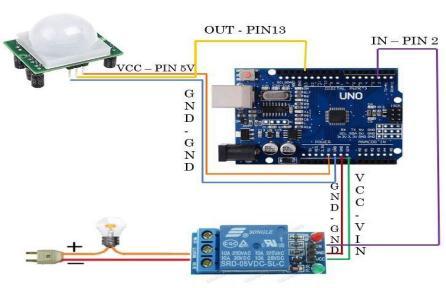
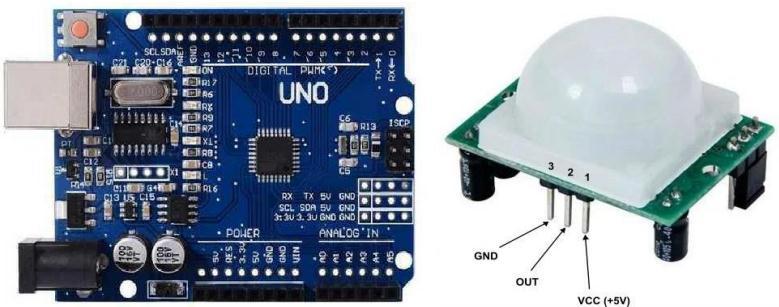
The circuit for the proposed system consists of Arduino UNO, PIR Sensor, Relay and LED. Figure 5.1, the Arduino UNO is a microcontroller board using the ATmega328 as the microcontroller. This microcontroller is developed with some basic parts that can ease in utilization. These basic parts are 14 digital I/O pins,6 analog inputs,16 MHz crystal oscillator, a USB connection, a power jack, an ICSP header, and a reset button. The most common ways to connect the microcontroller with computer using the USB cable. Besides that, it tends to be power up with a battery ortheAC-toDCadapter.ThePIRsensorisimplementedin the system is shown in figure 5.2 The figure shows the image of the PIR sensor and the function of module pin outs, controls, and indicators. The VCC, Gnd and Out are connected to the Arduino UNO board to detect objects. ThisconnectionenablesthePowerLEDtosenseobjects.If there is an object within the range of the IR Emitter LED, the PIR Emitter LED will send the rays from the object body surface to the PIR Receiver. At the same time, the obstacleLEDwouldbeon.
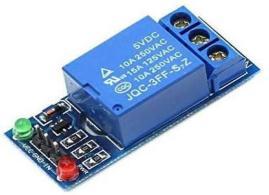
A Relay is an electromechanical device that can be used to make or break an electrical connection. It consists of a flexible moving mechanical part which can be controlled electronicallythroughanelectromagnet,basically,arelayis justlikea mechanical switchbut youcan control it withan electronicsignalinsteadofmanuallyturningitonoroff
SensorsFigure5.1ArduinoUNOFigure5.2PIRsensorLED usedinthissmartlighting systemtorepresentthelight in thelibraryisasperfigure5.3Showthecircuitdiagram.In thatcircuitdiagramshowstheoverallconnectionbetween ArduinoBoard,PIRSensor,RelayandLight.
Electricity energy conservation: - Due to the system's complete automation, unnecessary electricity or energy wasteisprevented.
Library lights automatically turn off and on: - The IOTBased Library Light Management System's Automatic Library Lighting can be used to automate the lighting in a roomsothatitturnsonwhensomeonecomesandturnsoff whentheydepart.
Save money: - Unexpectedly frequently, people enter a room,turnonthelight,andthenforgettoturnitoffbefore leaving. Our power bill is reduced thanks to the occupancy sensors on the lights, which turn on when someone enters the building and switch off when no one is present. Unlike us,lightsensorsdonotforget.
Easy to maintain and more reliable
We are making decisions in this system based on human presence, but we can also interface LDR (Light Dependent Resistor) Sensor and Temperature sensor for better systemoperationandenergysavings.Thissystemcanalso be linkedtoaBluetoothmodule,allowingustocontrolthe entire system from the mobile phone. Our device's applicationsarelistedbelow.
1.Itcanbeusedinbusinesses,colleges,andschools(Turn oflightsandfanswhennooneisthere)
2.Itcanalsobeinstalledatthefrontdoorofthehousefor homesecuritypurposes.
3. It can be utilized to create intelligent street lighting systemsthateffectivelyconserveenergy.
4. It can also be used to create smart signal poles, which canhelptoreducetrafficandtheamountoftimeittakes tomanuallyclearthetraffic.
Once this project is ready with all the functionality it is expected from the system that project should, whenever a person enters in library for searching a book in bookshelf the light in the top of bookshelf is automatically on and person takethe book from bookshelfandleave the library the light is automatically off. The Smart Intelligent Library Lighting system helps in providing minimal power consumption in library. The low cost of maintenance and thedecreasedpowerusageinthemodernworldmakeitan importantcallatthishour.
Inthefuture,wewillupgradethissystemwithaBluetooth module. The user is automatically notified anytime a light bulb is blown, and they may easily replace the fuse bulb. For the purpose of adjusting the light intensity in accordance with the brightness intensity of the room, we canalsoaddanLDRsensortothissystem.
[1] Chitra Batumalai, Xin Rou Kong , Malathy Batumalay “Smart Lighting System for Library Using IoT Technology” InternationalUniversity(2019)Intijournal.newinti.edu
[2] Anurag Yadav .N. Gayathri “Application of Iot with Motion Sensor for Smart Learning Environment" (IJRTE) ISSN:22773878(may-2020).
[3] K. Vignesh, M. Sakthivel, K. Priya Princymol Josep A Study on “IoT based Smart Street Light Systems” ISSN:2278-0181 (IJERT)Published by, www.ijert.org ECLECTIC-2020.
[4] Sikhinam Nagaman, Janga Manohar, Reddy, Guntupalli Lavanya, Achanta Lakshmi Hari Chandana “Smart Street Light Management System Using Internet of Things” IEEE Part Number: CFP19K34- ART; ISBN: 978-1-5386-8113-8 (2019).
[5] M. Caroline Viola Stella Mary, G. Prince Devaraj, D. Joseph Pushpara, T. Anto Theepak “Intelligent Energy Efficient Street Light Controlling System based on IoT for Smart City” (ICSSIT 2018)IEEE Xplore Part Number: CFP18P17-ART;ISBN:978-1-5386-5873-4(2018).
[6] Siddarthan Chitra Suseendran, Nanda Kishore B, Josephus Andrew, M.S.Bennet Praba “Smart Street lighting System”ICSSIT2018)IEEEXplorePartNumber:CFP18P17ART;ISBN:978-1-5386-5873-4(2018)
[7] Dr.P.Arjun, Mr.S.Stephenraj , Mr. N.Naveen Kumar, Mr. K.Naveen Kumar “A Study on IoT based Smart Street Light Systems” ICCES 2018)IEEE Xplore Part Number: CFP18AWO-ART;ISBN:978-1-5386-4765-3(Year2019).
[8] Subashini, Vigash Dharrsan, Christo Immanuel, Deepak “Smart Light Using PIR Sensor” 2018 IJRTI Volume 3, Issue 10ISSN:2456-3315.
[9] Pinak Desai, Nilesh Modi “IoT Based Smart Lighting SystemusingPIRSensors,ArduinoUnoanThingspeakcloud + Chat Bot and Dashboard to Monitor Home Remotely” nternational Journal of Engineering and Advanced Technology(IJEAT)ISSN:2249–8958,Volume-8,Issue-5S3 July2019.
[10]FrancisJesmarP.Montalbo,ErwinL.Enriquez“AnIoT SmartLightingSystemforUniversityClassrooms”IEEEDOI 10.1109/ISET49818.2020.00011.
[11] Badamasi, Y. A. (2014, September). The working principle of an Arduino. In 2014 11th International Conference on Electronics, Computer and Computation (ICECCO).19
[12] Castro, M., Jara, A. J., & Skarmeta, A. F. (2013, March). Smart lighting solutions for smart cities. In 2013 27th International Conference on Advanced Information Networking and Applications Workshops (pp. 1374-1379). IEEE.
[13] Gageik, N., Benz, P., & Montenegro, S. (2015). Obstacle detection and collision avoidance for a UAV with complementary low-cost sensors. IEEE Access, 3, 599-609. [14] Liu, J., Zhang, W., Chu, X., & Liu, Y. (2016). Fuzzy logic controllerforenergysavingsinasmartLEDlightingsystem considering lighting comfort and daylight. Energy and Buildings,127,95-104.
[15] Mironichev, S. Y., & Alpatov, P. (2012). U.S. Patent ApplicationNo.13/158,25.