AI Personal Trainer Using Open CV and Media Pipe
Kriti Ohri1, Akula Nihal Reddy2, Sri Soumya Pappula3, Penmetcha Bhargava Datta Varma4, Sara Likhith Kumar5, Sonika Goud Yeada61 Assistant Professor, Dept. of Computer Science and Engineering, VNR Vignana Jyothi Institute of Engineering and Technology, Hyderabad, India

2,3,4,5,6 Student, Dept. of Computer Science and Engineering, VNR Vignana Jyothi Institute of Engineering and Technology, Hyderabad, India ***
Abstract - Recently, a lot of people are facing many health issues due to the lack of physical activity. During the pandemic, with social distancing being the major factor, so many workout centers were closed. So people started training at home in the absence of a trainer. Training without a trainer often leads to serious internal and external injuries if a specific workout is not properly done. Our project offers multiple features that can benefit the users to attain their ideal body by providing them with a personalized trainer with a personalized workout and a customized diet plan. We also help our users to connect with people who have similar workout goals because the motivation behind working out increases if we have a workout partner. To achieve this, we are using OpenCV and Media Pipe to identify the user’s posture and analyze the angles and the geometry of the pose from the real-time video, and we are using Flask to develop the front end of the webapplication.
Key Words: BlazePose, Media Pipe, Open CV, COCO Data Set, Open Pose.
1. INTRODUCTION
We are all aware of how important exercise is to our overall health. Additionally, it is crucial to exercise correctly. Exercising too frequently can result in major damage to the body, including muscletears, and can even reducemuscularhypertrophy.Nowadays,homeworkouts are more popular. Additionally, it saves time and is quite convenient.
Also at that time of the pandemic, we understood how important is fitness and how such situations can let us workoutinourhomes.Sometimespeoplecannotafford a gym membership and are sometimes shy to work out in the gym and use weights. On the other hand, sometimes people can afford gym and trainers but because of tight schedules and inconsistency, they are not able to spend timeontheirbodyandfitness.
Atthatpoint,AIpersonaltrainersstartedtoappear.Since therearealreadysomanydigitalfitnessprogrammersand
digitalcoaches,theterm"AIpersonaltrainer"isnolonger afreshone.
Tobegin,let'sdefineanAIpersonaltrainerforthosewho are unfamiliar with it. "AI personal trainers are artificial intelligence-powered virtual trainers who assist you in achieving your fitness goals. The computerized personal trainer may provide you with tailored training and diet regimens after gathering a few facts such as body measurements,currentfitnesslevel,fitnessobjectives,and more."
Nowadays, Every person needs a customized trainer, which takes time and money to provide. Artificial Intelligencetechnology,thereforebeusedtospeedupthe customizing process by determining the best exercise regimenforacertainstudent'sdemandsorpreferences.
Therefore, our goal is to create an AI-based trainer that will enable everyone to exercise more effectively in the comfort of their own homes. The aim of this project is to buildanAIthatwillassistyouinexercisingbycalculating the quantity and quality of repetitions using pose estimation. This project is intended to make exercise easier and more fun by correcting the posture of the human body and also by connecting with people having similarworkoutgoals.
This study presented an objective discussion of the usage of AI technology to select a suitable virtual fitness trainer basedonuser-submittedattributes.
2. RELATED WORK
Initially, it started with body posture detection proposed by Jamie Shotton et al., [1] who used the Kinect Camera, which produces 640x480 images at a frame rate of 30 frames per second with a few centimeters of depth resolution. The depth image characteristics show that pixelsarebeingidentified.Thesecharacteristicsworkwell together in a decision forest to distinguish all trained sections even though individually they merely provide a weak indication of which region of the body the pixel is
located. However, the examples demonstrate a failure to recognize minute adjustments in the images, like crossed arms.
Later on, Sebastian Baumbach et al., [2] introduced a system that applies several machine learning techniques and deep learning models to evaluate activity recognition forsportingequipmentincontemporarygyms.Intermsof machinelearning models,Decision trees, Linear SVM, and Naive Bayes with Gaussian kernel are used. For our exercise recognition (DER), they presented a DeepNeural network with three hidden layers with 150 LSTM cells in each layer. 92% of the time was accurate. The biggest issue, however, is the overlap of workouts for the same body component, such as the Fly and Rear delt as well as thePullDown,LatPullandOverheadPress.
To improvise the system proposed previously, Steven Chen et al., [3] used deep convoluted neural networks (CNNs) to label RGB images. They made advantage of the trained model, Open-Pose, for pose detection. The model consists of multiple-stage CNN with two branches: one branch is used to learn the part affinity fields, while the otherbranchisusedtolearntheconfidencemappingofa key point on an image. But this model has its own drawbackstoo,i.eitworksonlyforpre-recordedvideos.
In order to provide real-time detection CE ZHENG et al., [4] suggested a model that is categorized into 3 different models,theyarekinematic,planar,andvolumetric.For2d HPE, to ensure that there is only one person in each croppedarea,theinputimageisfirstcropped.Regression approachesandheatmap-basedmethodsarethetwomain categories for single-person pipelines that use deep learning techniques. Regression approaches use an endend framework to learn a mapping from the input image to body joints or characteristics of human body models. Predicting approximate positions of body parts and joints that are supervised by heatmap representation is the aim ofheatmap-basedalgorithms.Thismodelreliesonmotion capturing systems, which are difficult to set up in a random setting and are required for high-quality 3D ground truth posture annotations. Additionally, person detectorsintop-down2DHPEapproachescouldbeunable torecognisetheedgesofheavilyoverlappingimages.
This problem of system failure to identify the boundaries of largely overlapped images, Anubhav Singh et al., [5] used a hereditary convolutional neural network can be created as a solution to the human posture estimation problem using a convolutional neural network and a regressionapproach.theCNNmethodforextrapolating2D human postures from a single photograph. Many methodologies and procedures have recently been developed for the evaluation of human postures that use
postures from physiologically driven graphic models. Using CNN, the arrangement of image patches is used to discover the positioning of the joints in the picture. This method achieves both the joint recognizable proof, which determines if an image contains freeze body joints, and also the joint constraint in an image plot indicates the proper location of joints. These joint limitation data are then pooled for posture surveying. In contrast to nearby locators, which are constrained to a specific part overlapped human bodies, CNN has the advantage of acceptingtheentiresceneasaninfomotionforeachbody point.
To increase the prior models’accuracy,Amit Nagarkoti et al., [6] suggested a system that attacks the issue using methods from vision-based deep learning. To create a fixedsizevectorrepresentationforaparticularimage,the networkfirstemploysthestartingtenlayersoftheVGG19 network. Thereafter, two multi-step branches of CNN and OpenCV for optical flow tracking are used. However this systemworksonlyformotionalong2dimensions.
Sheng Jin et al., [7] thought that since there are currently no datasets with whole-body annotations, earlier approaches had to combine deep models that had been independently trained on several datasets of the human face,hand,andbodywhilecontendingwithdatasetbiases andhighmodelcomplexity.Theyintroduced COCO-Whole Body, an extension of the COCO dataset that adds wholebody annotations, to close this gap. The hierarchy of the entire human body is taken into account using a singlenetwork model called Zoom Net in order to address the scalevarianceofvariousbodysectionsofthesameperson. On the suggested COCO-Whole Body dataset, Zoom Net performs noticeably better than the competition. The robust pre-training dataset COCO-Whole Body can be utilized for a variety of applications, including hand keypoint estimation and facial landmark identification, in addition to training deep models from scratch for wholebodyposeestimation.
And after years, this methodology has been upgraded by classifying the human body into various keypoints. Valentin Bazarevsky et al., [8] used a detector tracker setup which, in real time, excels at a wide range of jobs., including dense face and hand landmark prediction. They have a pipeline with a network of pose tracking at the beginning and a light body pose recognition at the end. Thetrackerpredictsafine-grainedzoneofinterestforthe present frame, the person's presence on the present frame, and the coordinates of important points. All 33 of the person's important points are predicted by the system'spose estimatecomponent. They used a heatmap, offset, and regression strategy all at once. Blaze Pose performs 25-75 times faster than the Open Pose and a t
the same time the performance of Blaze Pose is slightly worsethantheOpenPose.
Danish Sheikh et al., [9] abstracted the technique of exploitation create estimationabstract thought out-put as input for associate LSTM classifier into a toolkit referred toasAction-AI.Forvideoprocessdemo,Open-CVsuffices. For create estimation they used Open-pose enforced with in style deep learning frameworks like Tensor-flow and Py-Torch.Theusercanstart,stop,pause,andrestartyoga by utilising the voice interface, which uses the Snips AIR voice assistant. This model produced good results with highprecision,butincertaincases,whenimportantpoints arerotated,anglesdonotchange.
Gourangi Taware et al., [10] used java script, node js, and manylibraries,includingopencv,alibrarythatutilisesML techniques in addition to various arithmetic and algorithms. This strategy employs an effective two steptracker machine learning method. The location of the activity or posture in the live video is determined while utilisingthetracker.Itthenforecaststhecrucialmoments in the targeted area using the input from most recent video frame. But it's important to keep in mind that the tracker is only activated at the start or when the model fails to recognise the body key points in the frame. However, in the real-time system, the programme is unabletocatchnumerouspeopleintheframe.
Shwetank Kardam et al., [11] To make their detections possible,firstlytheyrecoloredtheimagesbecauseOpenCV renderstheRGBimagetoBGRcolorformatbut for Media Pipe to work, they need to convert our BGR image back to RGB. Lastly, change the color format back to BGR formatasOpenCVrunsonBGRformat,andthen
they started the detections. There are 33 landmarks in total, starting from index 0. These represent the different joints within the pose. For instance, if they want to calculate the angle for our Right hand’s bicep curl, they will requirethe joints ofshoulder, elbowand wrist which are12,14and16respectively.
Shiwali Mohan et al., [12] designed an intelligent coach. The coach has a sophisticated long-term memory that keeps records of their encounters with the trainee in the
3. PROPOSED METHODOLOGY
From the above information, we can say that AI can be usedforcreatingagoodpersonaltrainerbecausebyusing AI we can not only suggest the exercises but also correct the posture of the person each and every time he poses a wrongposture.
past as well as how they did on activities the coach had previously suggested. A relational database called POSTGRESQL and objective-Ccodeareused to create this memory,whichsavesdatagleanedfromuserinteractions. The model is immutable. If the initial capability is grossly overstated, the coach may never be able to correct the mistake.
Neeraj Rajput et al., [13] suggested a set of Python bindings to address problems in computer vision. This library makes use of NumPy, and all the structures of arrays easily change between NumPy arrays and other formats. This implies that combining it with other Python libraries, such as SciPy and Matplotlib, won't be challenging.(thesemakeuseofNumPy).Inordertoobtain thecorrectpointsandthedesiredangles,theymadeuseof the CPU's posture estimate. Based on these angles, a variety of actions are then found, such as the quantity of biceps curls. With just one line of code, they were able to calculatetheanglesbetweenanythreelocations.Butsome pose estimation algorithms that performs the 2D detectionsdon’thaveenoughaccuracy.
From the previous models, it was clearly understood that the use of OpenCV, key points for the human body and implementing the COCO dataset has delivered great accuracies, so Harshwardhan Pardeshi et al., [14] tracked thenumberofuserperformedexercisesandspotflawsin the yoga position They used the basic CNN network, the OpenPose Python package, and the COCO datasets. This model performed very well regarding the accuracy and performance but there is no variations in different Depending on their age category, there are categories for men,women,andkids.
Recently, Yejin Kwon et al., [15] a programme that estimates the posture of real-time photos to direct the content of the training (squats, push-ups), the number of workouts, and OpenCV and Media Pipe. Media Pipe simulates the real-time analysis and this model delivered excellentaccuracyandperformance,buttheonlyproblem with this model is there is no real-time support for the users if they have any queries and also there maybe a chance when user lacks the motivation of working out alone.
So we are proposing a system that overcomes the important disadvantage of not being able to work out at home and at any time without guidance. The system provides us the opportunity to work out anywhere, anytime with guidance so we can do effective workouts. Mainly,Thissystemovercomesthedisadvantageoflackof real-time support to answer their queries and also this connects the users having similar workout goals so that they can workout together which improves their
motivation. So, this System uses computer vision technology to execute the functions of our system. The system uses state-of-the-art pose detection tool known as “Blaze Pose” from “Media Pipe” to detect the form of the user’s body during the workout. OpenCV is used to mark anexoskeletonontheuserbodyanddisplayrepscounton the screen. We are using Flask to develop the Front-end for the We also have chatbot that answers user's queries whichweimplementbyusingChatterBot.
For extracting the data points There are 33 landmarksintotal,starting fromindex0.Theserepresent the different joints within the pose. For instance, if we wanttocalculatetheangleforourRighthand’sbicepcurl, we would require the joints of the shoulder, elbow, and wrist which are 12, 14, and 16 respectively as referred to inthebelowfigure.
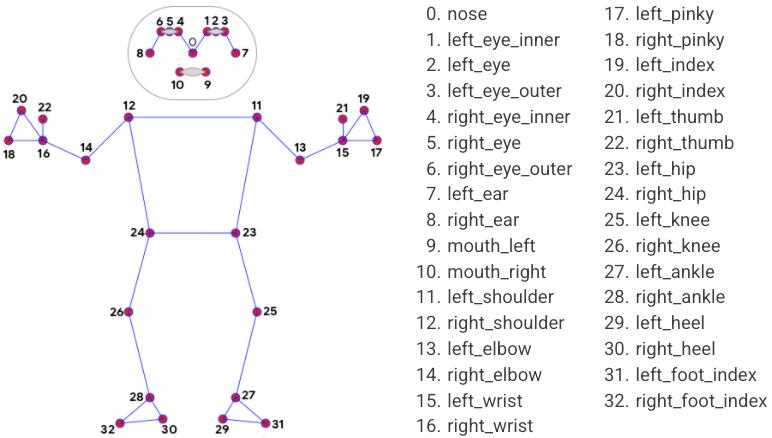
To calculate the angle between joints first, We obtain the threejoints'coordinates, whichare necessarytocalculate the angle. Then, using NumPy, we can determine the slopes of the joints. Angles are measured in radians and canbetranslatedintodegrees.

4. CONCLUSIONS
We conducted extensive research for this paper on AI Personal Trainer, looking at a wide range of research publicationsonPersonaltrainerathome.Welearnedthat mostofthemodelswerenotabletoprovidethereal-time interactionswiththeuser.Weunderstoodthatthereisno such platform where users can interact with others who have similar workout goals which can improve the efficiencyandmotivationoftheuser.
Additionally,wehavelearnedaboutseveralproposedand existingsystemsthroughresearchpublications,whichhas helped us develop a new model that would make translationmuchmoreefficient.
ACKNOWLEDGEMENT
Specialthankstoourteamguide,Mrs.KritiOhri,forallof her support and direction, which helped the literature survey portion of the project be successfully completed andyieldpositiveresultsattheend.
REFERENCES
[1] Swarangi, Ishan, Sudha.(2022). Personalized AI DietitianandFitnessTrainer
https://www.ijraset.com/research-paper/personalizedai-dietitian-and-fitness-trainer
[2] Ce Zheng,Wenhan Wu,Chen Chen,Taojiannan Yang,Sijie Zhu,Ju Shen,Nasser Kehtarnavaz,Mubarak Shah(2020). Deep learning based human pose estimation.https://arxiv.org/abs/2012.13392
The modules/packages which we are using for thisprojectareNumpy,MediaPipe,Flask,ChatterBot,and OpenCV.
[3] Jamie Shotton,Andrew Fitzgibbon,Mat Cook,Toby Sharp,Mark Finocchio,Richard Moore Alex Kipman,Andrew Blake(2011). Real-Time Human Pose RecognitioninPartsfromSingleDepthImages.
https://www.microsoft.com/en-us/research/wpcontent/uploads/2016/02/ BodyPartRecognition.pdf
[4] ValentinBazarevsky,IvanGrishchenko,Karthik Raveendran,Tyler Zhu,Fan Zhang,Matthias Grundmann(2020).BlazePose: On-device Real-time Body Posetracking.
https://arxiv.org/pdf/2006.10204.pdf
[5] Sheng Jin, Xu,Lumin Xu,Can Wang,Wentao luo,Chen Qian,Wanli ouyang(2020).Whole-Body Human Pose Estimation in thr wild. https://dl.acm.org/doi/abs/10.1007/978-3-030-585457_12
[6] GourangiTaware,RohitAgrawal,PratikDhende, Prathamesh Jondhalekar, Shailesh Hule(2021).AI Based WorkoutAssistantandFitnessGuide.
https://www.ijert.org/ai-based-workout-assistant-andfitness-guide
[7] Aarti, Danish Sheikh , Yasmin Ansari , Chetan Sharma , Harishchandra Naik(2021).Pose Estimate Based Yoga Trainer.AI-based Workout Assistant and Fitness guide–IJERTz
[12] Ali Rohan,Mohammed Rabah,Tarek Hosny,sungHo Kim(2019) .Human Pose Estimation Using ConvolutionalNeuralNetworks
https://ieeexplore.ieee.org/document/9220146
[13] Shwetank Kardam,Dr.Sunil Maggu(2021). AI PersonalTrainerusingOpenCVandPython.
http://www.ijaresm.com/
[14] Sherif Sakr, Radwa Elshawi, Amjad Ahmed, Waqas T. Qureshi, Clinton Brawner, Steven Keteyian, Michael J. Blaha, Mouaz H. Al-Mallah(2018). Using machine learning on cardiorespiratory fitness data for predicting hypertension: The Henry Ford ExercIse Testing . https://journals.plos.org/plosone/article?id=10.1371/jou rnal.pone.0195344
[15] Alp Güler, R., Neverova, N., Kokkinos, I(2018).DensePose: dense human pose estimation in the wild.
https://scholar.google.com/scholar?hl=en&q=Alp+G%C3 %BCler%2C+R.%2C+Neverova%2C+N.%2C+Kokkinos%2 C+I.%3A+DensePose%3A+dense+human+pose+estimatio n+in+the+wild.+In%3A+Proceedings+of+the+IEEE+Confe rence+on+Computer+Vision+and+Pattern+Recognition+ %28CVPR%29+%282018%29
[8] Harshwardhan Pardeshi, Aishwarya Ghaiwat, Ankeet Thongire,Kiran Gawande, Meghana Naik(2022).Fitness Freaks: A System For Detecting DefiniteBodyPostureUsingOpenPoseEstimation.
https://link.springer.com/chapter/10.1007/978-981-195037-7_76
[9] Yeji Kwon,Dongho Kim(2022).Real-Time Workout PostureCorrectionusingOpenCVandMediaPipe.
https://www.researchgate.net/publication/358421361_R ealTime_Workout_Posture_Correction_using_OpenCV_and_ MediaPipe
[10] Steven Chen,Richard R. Yang(2018). Pose Trainer: Correcting Exercise Posture using Pose Estimation.
https://arxiv.org/abs/2006.11718
[11] Amit Nagarkoti,Revant Teotia,Amith K. Mahale,Pankaj K. Das(2019).Real-time Indoor Workout AnalysisUsingMachineLearning&ComputerVision.
https://ieeexplore.ieee.org/document/8856547
[16] Burgos-Artizzu, X.P., Perona, P., Dollár, P(2013) Robust face landmark estimation under occlusion. https://openaccess.thecvf.com/content_iccv_2013/html/ BurgosArtizzu_Robust_Face_Landmark_2013_ICCV_paper.html
[17] Cao,Z.,Simon,T.,Wei,S.E.,Sheikh,Y(2017).Realtime multi-person2Dpose estimationusingpartaffinity fields. https://openaccess.thecvf.com/content_cvpr_2017/html/ Cao_Realtime_Multi-Person_2D_CVPR_2017_paper.html
[18] Gomez-Donoso, F., Orts-Escolano, S., Cazorla, M.Large-scalemultiview3Dhandposedataset
https://arxiv.org/abs/1707.03742
[19] Gross, R., Matthews, I., Cohn, J., Kanade, T., Baker, S(2010). Multi-pie. In: Image and Vision Computinghttps://www.sciencedirect.com/science/articl e/pii/S0262885609001711
[20] Insafutdinov EPishchulin LAndres BAndriluka MSchiele BLeibe BMatas JSebe NWelling M(2016).DeeperCut: a deeper, stronger, and faster multiperson pose estimation mode. https://link.springer.com/chapter/10.1007/978-3-31946466-4_3
[21] Hidalgo, G(2019). Single-network whole-body pose estimation.
https://openaccess.thecvf.com/content_ICCV_2019/html/ Hidalgo_Single-Network_WholeBody_Pose_Estimation_ICCV_2019_paper.html
[22] Jin, S., Liu, W., Ouyang, W., Qian, C(2019).Multiperson articulated tracking with spatial and temporal embeddings.
https://openaccess.thecvf.com/content_CVPR_2019/html
/Jin_MultiPerson_Articulated_Tracking_With_Spatial_and_Temporal_ Embeddings_CVPR_2019_paper.html