Effect of Addition of Rice Husk Ash and Super Plasticizer on Pervious Concrete
Swatantra Porwal2 Assistant Professor, Dept. of Civil Engineering, Kali charan Nigam Institute of Technology, Banda, U.P., (India),

3 Assistant Professor, Dept. of Civil Engineering, Kali charan Nigam Institute of Technology, Banda, U.P., (India),
4 Assistant Professor, Dept. of Civil Engineering, Kali charan Nigam Institute of Technology, Banda, U.P., (India),
5
Abstract - In this paper, we have carried out detailed experimental studies of the partial replacement of cement by rice husk ash (15% by the weight of cement), by adding super plasticizers (0.10% & 0.20%) and varying size of aggregates. The tests performed on pervious concrete includes slump test for workability. In this test maximum size of aggregate used is 38mm, compressive test on cube for size (150 x 150 x 150 mm) at 7, 28 and 56 days of curing as per IS: 516 1959, Flexural strength on beam (150 x 150 x700 mm) at 28 days of curing as per IS: 516 1959 and split tensile strength on cylinder (150 mm ø x 300mm) at 28 days of curing as per IS: 5816 1999. It has been observed from experimental results that the mechanical properties of pervious concrete increased by using small size aggregates (4.75 mm to 10 mm) in comparison to large size (10 mm to 20 mm) and all-in aggregates ( 4.75 mm to 10 mm & 10 mm to 20 mm). The pervious concrete has low strength as compared to conventional concrete.
Key Words: Fly Ash, Rice husk Ash, Flexural Strength, Admixture, Compressive Strength, Split Tensile Strength
1. INTRODUCTION
Pervious concrete is a unique and effective solution to reduce the runoff from paved areas and recharging the ground water. Pervious concrete also naturally acts like a filter;itfilterswaterfromrainfallorstormandcanreduce pollutantloadsenteringintostreams,pondsandrivers.on the use and utilization of industrial, agricultural and thermoelectricplantsresidueintheproductionofconcrete. Different materials with pozzolanic properties such as fly ash,condensedsilicafume,blast-furnaceslagandricehusk ashhaveplayedanimportantpartintheproductionofhigh performanceconcrete.[1]Inthispavementsystem,a 150–300mm pervious concrete (PC) layer with a high air void contentisplacedonahighlyvoidedstonebedasthebase layer,toallowforarapidinfiltrationofrunoffthroughthe pavement system. Many research organizations are doing extensiveworkonwastematerialsconcerningtheviability andenvironmentalsuitability.Therefore,themainobjective ofthisstudyistouseRiceHuskAshmaterialstodevelopa pervious concrete mixture proportion and to check the
workability,compressivestrengthandflexuralstrengthand flexuraltensilestrengthofperviousconcrete.
2. EXPERIMENTAL MATERIALS
Theworkpresentedhascarriedoutdetailedexperimental studiesofthepartialreplacementofcementbyricehuskash (20%bytheweightofcement),byaddingsuperplasticizers (0.15%&0.25%)andvaryingsizeofaggregate.Theeffects of RHA and FA on concrete properties were studied by means of the mechanical properties of concrete i.e. workabilitycompressivestrength,splittensilestrength,and flexuralstrength.
2.1 CEMENT
TheOrdinaryPortlandCementof43gradeUltratech CementconformingtoIS:12269-1987isbeenused.
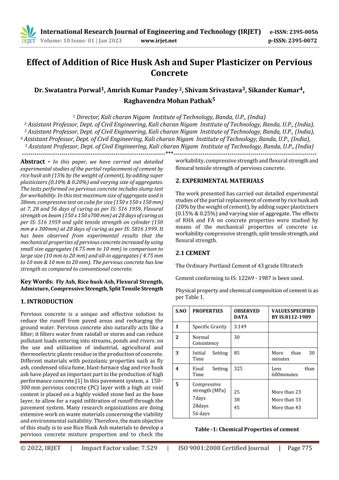
Physicalpropertyandchemicalcompositionofcementisas perTable1.
S.NO PROPERTIES OBSERVED DATA VALUESSPECIFIED BY IS:8112-1989
2.2 RICE HUSK ASH
Thericehuskisanagriculturalwastewhichisobtainedfrom milling process of paddy and approximately 20% of the weight of paddy is rice husk.The process produces about 25%ashcontaining85%to90%amorphoussilicaplusabout 5% alumina, which makes it highly pozzolanic. “Study conducted by Mehta indicated that concrete with RHA required more water for a given consistency due to its absorptivecharacterofthecellularRHAparticles.
2.5 WATER
Waterisanessentialcomponentofconcrete,asitactually participatesinthechemicalreactionwithcement.Becauseit helpstoincreasethestrengthofthecementgel,thequantity andthequalityofthewaterneedstobestudiedindepth.
3. EXPERIMENTAL PROGRAM
Specimenscorrespondingtovariousperviousconcretemix proportionsweresubjectedtodestructivetestingtoevaluate theinfluenceofricehuskash(10%bytheweightofcement) and super plasticizers (0.15% & 0.25%) on the various mechanicalpropertiesoftheconcretesuchascompressive strength, split tensile strength, flexural strengthandbond strength.ResultsofeachtesthavebeenmentionedinTables4.1 to4.5.Thevariationofworkability,compressivestrength,split tensile strength and flexurestrength of different concrete mixwithagehavebeenchecked.
3.1 WORKABILITY
Table -2: Chemical Properties of Rice Husk Ash
2.3 SUPER PLASTICIZER
TomaintainthehighworkabilityofconcretemixwithASTM C494typeA,highrangewater-reducingadmixtureR1000 super plasticizer was used, which is a dark brown, watersoluble,chloridefreesulphatednaphthaleneformaldehyde. Accordingtothemanufacturer,ithas40%solidcontentwith specificgravityof1.2.Anumberofaspectsareusuallythe result of the addition of super plasticizers, taking into accountthedurabilityandtheresistanceforthelong-term maintenance.Water-reducingadditivesrestrainconcreteto be permeated with fluidsandsolutions. Ithas beenfound that the provision of a high plasticity and initial and final strengths are advantages of plasticizers involved in prefabricatedconcretes.
2.4 COARSE AGGREGATES
The fine aggregate used was mining sand passing by 4.75 mm sieve. The coarse aggregate was crushed granite with size of4.75 – 19 mm. Thespecificgravityandthe standardofthetestsforboththecoarseandfineaggregate wereconductedasspecified inASTMC127-88andASTM C128-97,respectively..Thesieveanalysistwodifferentsizes arelistedbelow:
a. Aggregatewith100%passing20mmsieveand 100%retainedon10mmsieve.
b. Aggregatewith100%passing10mmsieveand 100%retainedon4.75mmsieve.
Theworkabilityoftheconcretemixwasmeasuredbyslump test. The slump of the concrete mix decreased with the additionofsilicafume(5%ofcement) and0.12%ofsuper plasticizers. Theworkabilityimprovedwiththeadditionof 0.15%&0.25%ofsuperplasticizers SlumpforM4,M5and M6hasbeendecreasedby31%,34%&37%incomparison to M1, M2 and M3 respectively. The slump of pervious concretemixM7,M8andM9decreasedby17%,19%&5% respectivelyw.r.t.M1,M2andM3andincreasedby21%,23% & 43% respectively w.r.t. Mi4, M5 and M6. The slump of concrete M10, M11 and M12 decreased by29%, 22% and 14%respectivelyw.r.t.M1,M2andM3andincreasedby6%, 17%and37%respectivelyincomparisontoM4,M5andM6 respectively
Table-3:
Chart-1 Slump variation with different pervious concrete mix proportions.
3.2 Compressive strength
Compressivestrengthtestswereperformedoncompression testing machine using cube samples. Three samples per batch were tested and the average strength of the values given in this paper. For this test concrete cube (150mmX150mmX150mm)orcylindricalspecimen(150mm diameter,300mmlength)
Results of compressive strength of cubes of all mix proportionswithwater-cementratio0.34havebeenshown inTable4.2.andfig.4.
Chart-2 compressive strength variation of various pervious concrete mix proportions at different age.
ThecompressivestrengthofM1,M4,M7andM10wasmore than M3, M6, M9 and Ml2 and M2, M5, M8 and M11 comparativelybecauseperviousconcretemadewithsmall sizesaggregateshashighstrengthincomparisontopervious concrete made with all-in-aggregates and with large size aggregates. The compressive strength of all the mix proportion withconstant water cement ratio 0.34at 7,28 and 56 days has been shown in fig.4.5 to 4.8.The compressive strength of M1 is maximum and minimum at M5.ThecompressivestrengthofperviousconcreteofMix4, M7 & M10 decreased by 15% ,7% & 11% respectively in comparison to M1 .The compressive strength of pervious concrete of M5, M8 & M11 decreased by 19%, 5% & 14% respectivelyw.r.t.M2.Thecompressivestrengthofpervious concrete of M6, M9 & M12 decreased by 12% , 5% & 8% respectivelywithrespecttoM3.Compressivestrengthwas maximumatM1andminimumatM5.
3.3 SPLIT TENSILE STRENGTH
This test also termed as Brazilian test. This test is more accurate than other tensile strength test to determine tensile strength of concrete. In this test cylindricalconcretespecimenis usedtofindtensile strength. Results of split tensile strength of various pervious concrete mix proportions have been shown in Table4.3.AndFig.4.9
4. CONCLUSIONS
SlumpforM4,M5andM6hasbeendecreasedby31%, 34% & 37% in comparison to M1, M2 and M3 respectively.TheslumpofperviousconcretemixMix7, M8andM9decreasedby17%,19%&5%respectively w.r.t.M1,M2andM3andincreasedby21%,23%&43% respectivelyw.r.M4,M5andM6.Theslumpofconcrete Mix10,Mix11andMix12decreased by29%,22%and 14%respectivelyw.r.t.M1,M2andM3andincreased by6%,17%and37%respectivelyincomparisontoM4, M5andM6respectively.
The compressive strength of M1 is maximum and minimumatM5.Thecompressivestrengthofpervious concreteofM4,M7&M10 decreased by15%,7%& 11% respectively in comparison to M1 .The compressivestrengthofperviousconcreteofM5,M8& M11decreasedby19%,5%&14%respectivelyw.r.t. M2.Thecompressivestrengthofperviousconcreteof M6, M9 & M12 decreased by 12% , 5% & 8% respectively with respect to Mix3. Compressive strengthwasmaximumatM1andminimumatM5.
ThesplittensilestrengthofM4,M7,M10decreasedby 26%,14%and20%respectivelywithrespecttoMix1. ThesplittensilestrengthofM5,M8&M11decreased
by 14%, 4% and 7% respectively w.r.t. M2.The split tensilestrengthofM6,M9&Ml2decreasedby12%,3% &5%respectivelyincomparisontoM3.Thesplittensile strengthwasmaximumatM1andminimumatM5
REFERENCES
[1] Dale P. Bentz, Max A. Peltz, John Winpigler 2009, The influenceofwater-to-cementmassratio(w/c)onearly-age propertiesofcement-basedmaterialsisinvestigatedusinga variety of experimental techniques. ASCE Journal of MaterialsinCivilEngineering,21(9),512-517,2009
[2] P.K.Mehta, Properties of blended cements made from ricehuskash.PdfACIMater.J.,74(74)(1977),pp.440-442. M.Young,TheTechnicalWriter’sHandbook.MillValley,CA: UniversityScience,1989.
[3]GodwinAkekeA.,MauriceEphraimE.,AkoboI.Z.S,and Ukpata Joseph O., “Structural Properties of Husk Ash Concrete”,InternationalJournalofEngineeringandApplied Sciences,ISSN2305Volume3,No3,May2013.
[4] Kulkarni Makarand Suresh, Mirgal Bodhale Prajyot Prakash,S.N.Tande,“EffectofRiceHuskAshonPropertiesof Concrete”,JournalofCivilEngineeringandEnvironmental Technology,ISSN:2349-8404,Volume1,Number1,August 2014,PP2229.
[5]DaoVanDong,PhamDuyHuu,NguyenNgocLan,2008, The3rdACFInternationalConference,2008.
[6]IS456-2000,CodeofPracticeforPlainandReinforced Concrete,BureauofIndianStandards,NewDelhi,India.
[7]IS10262-1982,RecommendedGuidelinesforConcrete MixDesign,BureauofIndianStandards,NewDelhi,India.
[8] IS 8112:1989, 43 Grade Ordinary Portland Cement Specification (First Revision), IS 8112:1989, Bureau of IndianStandards,NewDelhi.