International Research Journal of Engineering and Technology (IRJET) e-ISSN: 2395-0056

Volume: 10 Issue: 01 | Jan 2023 www.irjet.net p-ISSN: 2395-0072
International Research Journal of Engineering and Technology (IRJET) e-ISSN: 2395-0056
Volume: 10 Issue: 01 | Jan 2023 www.irjet.net p-ISSN: 2395-0072
1Student, Department of Computer Engineering, Zakir Husain College of Engineering and Technology, Aligarh Muslim University, Aligarh
2 Student, Department of Civil Engineering, Zakir Husain College of Engineering and Technology, Aligarh Muslim University, Aligarh
3Student, Department of Computer Science, Aligarh Muslim University, Aligarh ***
Abstract - The proposed work is a decentralized blockchainbased donation tracking system that is designed to incorporate transparency, authenticity and verifiability in an online donation process. The system provides transparent accounting of operations for donors for direct access to the intended beneficiaries in the form of charitablefoundations or individual recipients. Smart contracts are written and stored using the Solidity programming language on the Ethereum public blockchain which is programmed to run automatically when described conditions are met.
In our model, we also present the novel idea of storing the donated amount in an escrow contract which releases the amount only for use by an authorized payment gateway. Once the payment is processed, the details of the transaction are visible to both parties.
Key Words: Blockchain, Ethereum, Smart Contracts, Transparency, Security, Decentralized.
1. INTRODUCTION
The current charity and donation processes are opaque. Due to improper record keeping and the involvement of somedishonestindividualswithintheorganization,people have lost trust in organizations that work towards social causes since the donors are unaware of how well their contributionsarebeingused.Thesuggestedsystemenables social organizations to manage various projects for social causesinatransparentmannerwithouttheinvolvementof third parties, using a smart contract that helps to confirm their impact, and at the same time, is open to everyone. Donors may easily track an organization’s transactions, helpingthemreclaimtheirfaithinsuchsocialgroups.The system assures that the donation reaches the intended recipient while lowering overall administration expenses andincreasingadministrationspeedand efficiency.It will alsoassisttofosterconfidenceamongdonorsandrecipients involved in the charitable process. Our proposed method triestoimplementthefollowingkeyfeaturesinthecurrent donationprocesses:
1. Transparent
2. Global
3. Decentralized
4. Secure
AsEthereumisadecentralized,open-sourceblockchain withsmartcontractfunctionality,itallowstheparticipation of any individual, and all the transactions are stored in a public ledger which can be viewed by any donor of that specificcampaign.Asallthetransactionsareavailabletothe participants,oursystemiswhollytransparentandprevents misusebyintermediateparties.
1.2 Global
Duetothepeer-to-peernatureofthenetwork,fundscan be delivered instantly to any location in the world (given that they are a participating node), which, in the case of conventionalinternationalbanktransferservices,isahassle
Since there is no centralized authority controlling transactions on a blockchain, they happen quickly. Transactionsinvolvingtraditionalcurrenciesmustpassvia numerousmiddlemenandcentralizedexchanges,etc.
The funds need to be safer as they grow in size. Epayments are still vulnerable to hackers despite having rigorous security measures in place, like symmetric/asymmetric encryption. Despite strict security measuresbeinginplace,e-paymentsarestillsusceptibleto hackers.
Numerous crowdfunding frauds have come to light, with somestillawayfromthespotlight.Thereisnowaytokeep track of how the donations are being used. To prevent financial theft, we wanted to make the entire cash flow visibleateverylevel.
Various proposals in relation to donation systems supportedbydifferentmultipleblockchainsystemsexist.In E.Shaheen et al ,anewtrackdonationmodelwasproposed whichintroducedseveralnewparticipantsthatcontrolthe
processofdonationandremovesuspicionofthecharity.All donationscouldbetrackedtoBlockchain,allowingdonorsto know where and how their money is being used. The proposed model was implemented using Hyperledger composer[1].In[2]theauthorsproposeasystemconsisting of users that play a major role which is classified as the donor/beneficiary,NGOandtheGovernmententity.These userswillbeaccountholdersintheblockchainnetworkand each of them can be uniquely identified in the network throughtheir160-bitaccountaddress.Theycanaccesstheir accounts,andperformandsigntransactionsusingtheir256bitprivatekey.
In [3], the author suggests that traceability management is a major field which is influenced by BlockchainTechnologyandsharesitsexperienceofbuilding OriginChain.Tracingthesourceoftheproductsacrossthe supplychainsisimportant,inordertoverifytheauthenticity ofproductsandsupplyasourceoftrustwithintheproduct to the purchasers. The blockchain uses a smart contract whichisasetofrulesdefinedtocarryoutanytransactions. Thesmartcontractkeepstrackofalltransactionsoccurring andstoresthemwithintheblockchainasstatetransitions, forthispurposeEthereumblockchainisemployed.So,thisis often helpful in tracking the varied products within the supplychain.Theauthorclaimsthattheproposedsystem thatisOriginChain,isamoresecuretraceabilitysystemfor productsascomparedtothephysicalsystemwhichincluded ateamofmembersperformingqualitycheckstoverifythe merchandise.Theyhaveusedblockchaintechnologywhich stores the transactions in a distributed ledger. The distributed ledger database technology is spread across several nodes (devices) on a peer-to-peer network, and wheneverthereisanupdateinanydataitisstoredasastate transition of a transition. This permits the blockchain to traceanytransactionwhenrequired.
In Proceedings of the Future Technologies Conference(FTC)2020,Volume2[4],Sergey et.al proposea systemwheredonationsandmovementsofcharitablefunds will haveto be registeredthroughtheRESTAPI. Also,the Telegrambotisincludedinthesystem,whichinteractswith theuserwhentheycreateanewdonation.Thisbotreceives fromtheusertheamountthattheywanttodonatetocharity andgivestheIDforadonation.Thentheusercanenterthis IDandgetdetailedinformationaboutthedonationonthe websiteorintheTelegram bot totrack whereexactlythe fundswerespent.Thefunctionalityofthisbotissimilarto thefunctionalityofthewebsite.
Thereexistnumerousdeployedapplicationswhich are currently running online using decentralized or distributedblockchainnetworks.OneofthemisAidChain[5] whichprovidesablockchain-basedcrowdfundingplatform. It allows donors to make a traceable charity donation via blockchain technology and provides its own crypto coin knownasAidCointomakedonations.AnotherisBitGive[6]
whichisthefirstBitcoinandBlockchaintechnology-using organization,fornonprofitsandhumanitarianwork.Ituses the platform for nonprofits to provide transparency and accountability to donors by sharing financial information and direct project results in real time. NGOs like Save the Children,CodetoInspireandHeiferInternationalhaveall partneredwiththem.
However,thewidestandmostrecognizableuseof blockchain for donation was seen by the World Food Programmewhichemployedablockchainnetworknamed ‘Building Blocks’ which is currently the world’s largest implementationofblockchaintechnologyforhumanitarian assistance; currently assisting 1 million people in BangladeshandJordan,enablingthemtosecurelyaccessand receive multiple forms of assistance from different organizations via one access point. [7] The technical blockchaininfrastructuretooperatethenetworkisbasedon open-source software and is freely accessible to participating organizations. The applications deployed on theBuildingBlocksnetworkarealsoavailableforfreetothe network members. Fundamentally, Building Blocks is a collectionofblockchainnodeswhicharecomputerservers independentlyoperatedbyeachparticipatingorganization. Together,theyconnecttoformahumanitarianblockchain network that provides a neutral space to collaborate, transactandsecurelyshareinformationinareal-time.The network is neutral without a hierarchy of ownership: all memberorganizationsare100percentequalco-owners,cooperators,andco-governorsofthenetworkandallmembers playanequalroleinitsupkeep.
Blockchaintechnology bypassesthecentral systemand connects each block to every person. The implementation presents a novel technique for leveraging blockchain technologyinanexistingcontributionsystem.Intheexisting system, the donor has no notion or estimate of whether his/hermoney,whichwasdesignatedforacertainpurpose,is beingutilisedforthatcauseandnotbeingdivertedforother purposes. Furthermore, cryptocurrency donations (for example,EtherfortheEthereumBlockchain)maybeeasily cashedoutforanynationalcurrency,renderingthepayments untraceable.Inthisscenario,wecanresolvetheissuebyusing blockchain,whichallowsthedonortoseehowthemoneyis usedand allows everyone toview theaccount history. To createablockchain-basedvirtualfundraisingbox,thedonor transfersmoneytothereceiver,whichisfirstkeptintheform ofanescrowcontract.Whenthetermsoftheescrowcontract are satisfied, the money is released to the receiver. Furthermore,weensurethatalltransactionsareprocessed through a single, authorised payment gateway to better facilitate and trace these transactions. The donations are managed through a secure and transparent blockchain mechanisminthissuggestedscheme.
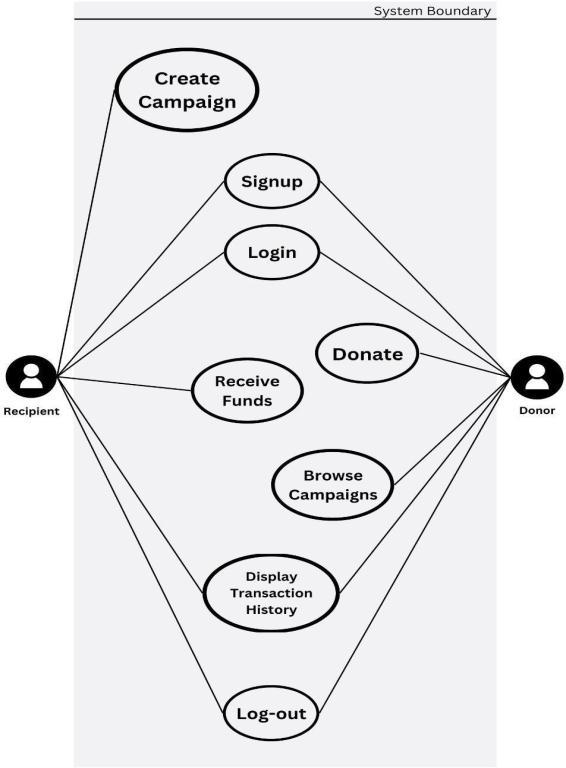
Theusecasediagrambelowdescribesthefunctionalities in control and taskswhichareneededtobeperformedby bothactors;thedonorandtherecipient. (Figure 4.1)
The organization or the individual who wants to requestfundsfromthedonorswouldfirstneedto register themselves on the application. On similar grounds, the donorswhoneedtobrowseavailablecampaignstodonateto would register themselves by entering their email identificationandcreatinganewpassword.
Minimumacceptabledonation.
Theircontactdetails.
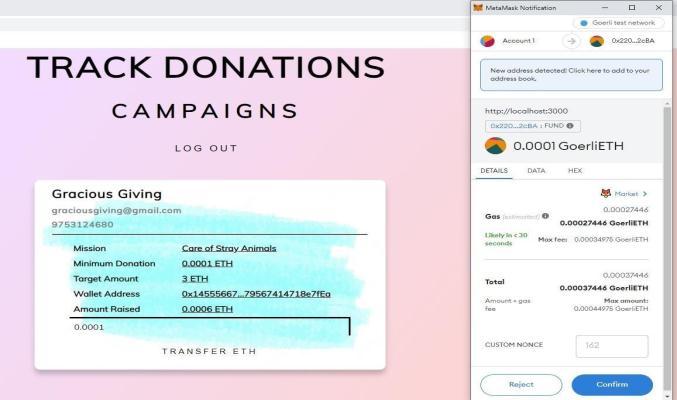
Oncethedonorhasregisteredandloggedintohis/her account,theycanbrowsefromtheavailablelistofcampaigns and select the one they want to donate to. The details providedbytherecipientswhilecreatingthecampaignare displayedhere.
5.2.2.
Thedonorafterselectingthecampaignoftheirchoice pressesthefundcampaignbuttontoentertheamountthey wishtodonateinETHcurrency.Theyarethenpromptedto logintotheirMetamaskaccountusingtheirprivatekey.Once loggedin,theEthereumwalletautomaticallyshowsthetotal amountofETHgoingtobedonatedalongwiththeaddedgas fees.After finalizing the payment, a successful payment messageisdisplayedonthescreen.
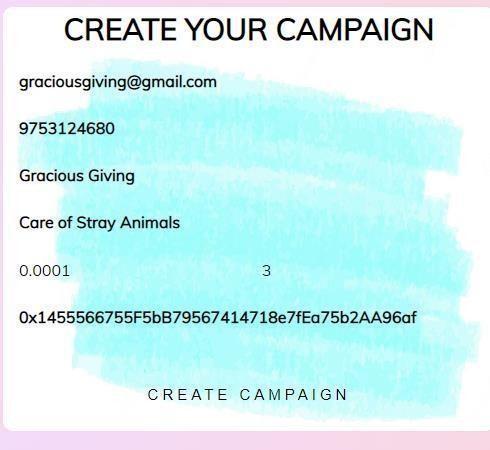
Oncetheorganizationortheindividualhasloggedin, theycanaccessthe‘CreateCampaign’
Tabtoinitializeanewcampaign.Forregistrationofanew campaigntherecipientsareaskedtoprovide:
TheMetamask-linkedwalletaccountaddress
Thetargetamount.
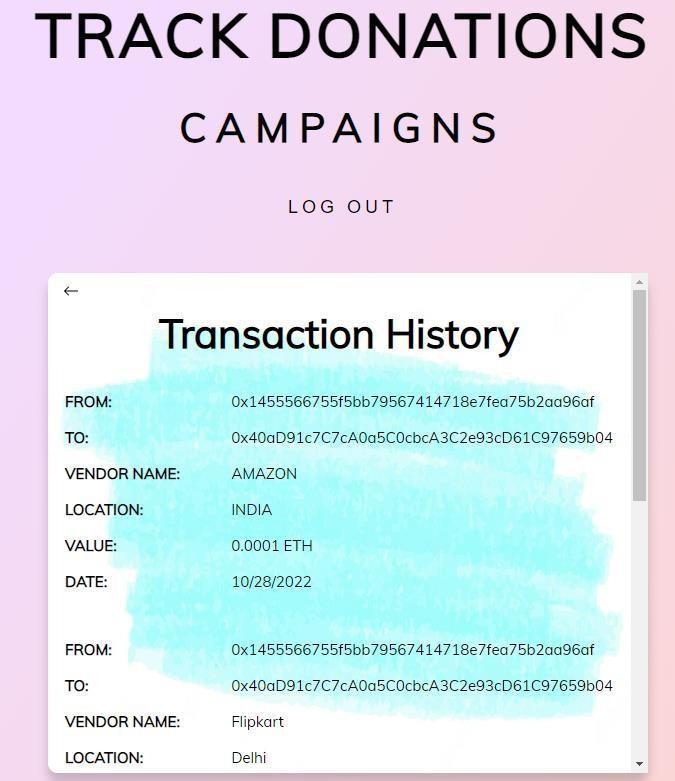
After donating, the donor can access the transaction historyofthecampaign.Tobenotedthatonlythedonorsofa campaigncanaccessits’transactionhistory.Ifanon-donor tries to access the campaigns’ transaction history, an alert saying“notadonor”appears.Thisfeatureisenabledbythe smart contractthat powers the platform. It has a function whichmaintainsamappingwhichmapsthecampaignwallet addresstothedonor’swalletaddress.Thismappingreturns true if the donor has donated to the campaign. The transactionhistorydisplaysthefollowingdetails:
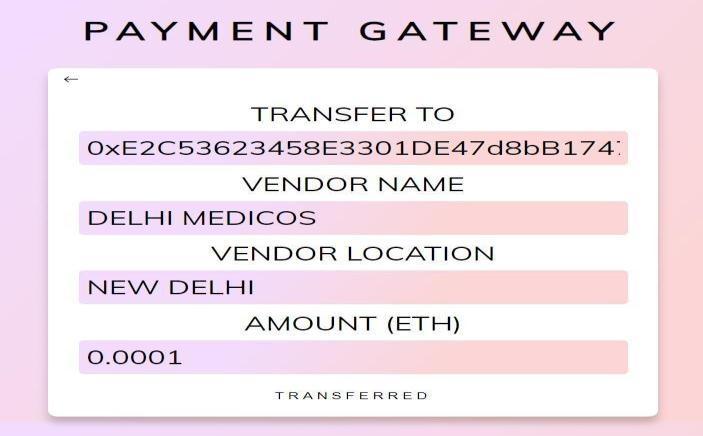
The smart contract has a function “pay (receiver address, vendoraddress,amount)”whichtransferstheamounttothe vendor’swallet,anddeductsthisamountfromthebalanceof the campaign. Before transferring, the campaign has to providethefollowing:
From TransferTo Vendor’sWalletAddress VendorName NameoftheVendor Vendor Location LocationoftheVendor Amount The Amount to be Transferred
Campaign’s Wallet
Address
These details will be pushed onto the blockchain and are displayed when the donor requests thetransaction history of the campaign. After providing the details, the campaign-admin must click on the “TRANSFER ETH” button,orelsethetransactionwillnotproceedfurther.After clickingonthe“TRANSFERETH”button,ametamaskpop-up promptingthecampaign-admintoapprovethetransaction appears. The campaign-admin must “confirm” these transactions.Thestatusofthetransactionissignalledbythe textofthe“transfereth”button,whichshows“transferred” after thesuccessful completion of thetransaction. The gas feesofthetransactionaredeductedfromthewalletbalance of the campaign. However, the vendor receives the full “amount”.Thesamechangewillbereflectedinthe“current balance”ontheprofilepageofthecampaign.
Thefundsthatthedonordonatestothecampaigndonot godirectlyintothecampaign’s walletaddress.Instead,they areheldinescrowbythesmartcontract.Thesmartcontract hasamappingwhichmapsthecampaign'swalletaddressto thetotaldonationreceivedsofar.Thesefundsarenotwalletaccessible.Tousethesefunds,thecampaignhastousethe paymentgatewaywhichis providedbythesmartcontract.
betweentheendpartiesengagedinthetransactiondirectly withouttheinterventionofathirdparty.Thesystemaccepts donations in the form of ETH. Because each transaction is distinct,itissimpletomonitoritalongtheblockchain.Ahigh degree of transparency and integrity in such systems may offer people trust and cooperation, encouraging them to donateandenhancethereputationofgenerousgiving.
[1] E. Shaheen et al., “A Track Donation System Using Blockchain.’ 2021 International Conference on ElectronicEngineering(ICEEM),2021,pp.1-7,doi: ICEEM52022.2021.9480649
[2] A.Singh,R.Rajak,H.MistryandP.Raut,"Aid,Charityand DonationTrackingSystemUsingBlockchain," 2020 4th International Conference on Trends in Electronics and Informatics (ICOEI)(48184), 2020, pp. 457-462, doi: 10.1109/ICOEI48184.2020.9143001.
[3] Lu, Q., & Xu, X, (2017), Adaptable blockchain-based systems: A case study for product traceability, IEEE Software,34(6),21-27
[4] Avdoshin, Sergey & Pesotskaya, Elena. (2021). BlockchaininCharity:PlatformforTrackingDonations. 10.1007/978-3-030-63089-8_45.
[5] https://tracxn.com/d/companies/aidchain.co
[6] https://www.bitgivefoundation.org/
[7] https://innovation.wfp.org/project/building-blocks