Traditional, Alternative & Solar Drying methods for producing spices: A Review
1 Assistant Professor, Dept. of hotel management, Jaipur national university, Rajasthan, India

2 Assistant Professor, Dept. of hotel management, Gna University, Punjab, India
3 Assistant Professor, Dept. of hotel management, Auro University, Gujarat, India ***
Abstract - For farmers, producers, and consumers, conventional spice production involves a variety of hygiene issues that canbe extremely dangerous. Moreover, a gooddiet significantly impacted as well. There are just a few conventional processes for cleaning spices, but some of their uses, like ethylene oxide fumigation, are regulated or even prohibited by EU law. The creation of novel technology is therefore required for the manufacturing of premium spices. The main issues with traditional spice productionareoutlined inthis article, along with asummaryofrecentdevelopmentsin alternative methods.
Key Words: RedChilli,Processing,SolarDrying,Storage
1. INTRODUCTION
Spicesandherbshavebeenutilizedformedicalandcosmetic purposes as well as flavoring and food preservation since antiquity. The off-flavor or rotting of some foodstuffs was evendisguisedusingspicesinsomeinstances.Theyusedto beverysought-afterandfrequentlycomparedtogoldand precious stones. Thereisa hugedemand for spices today, althoughtheyarenolongerconsideredluxurygoods Their significance is still expanding. The amount of spices imported globally climbed steadily from 209,293 tons in 2000 to 226,910 tons in 2004, for a trade value of 625 million US dollars (FAOSTAT, 2005) [1-4]. India is the world's greatest producer and exporter of spices, chiefly pepper.Othertopproducersandexportersofspicesinclude Capsicum fruits, turmeric, ginger, cardamom, seed spices, currypowders,andspiceoilsandoleoresins.Duetothefact that they are natural products, spices and herbs could include a variety of microorganisms, including some pathogenicspecies Spicesarenon-perishablegoodsdueto theirlowmoisturecontent,butoncetheycomeintotouch withfoodsthatarehighinwater,microbialpopulationsmay swiftly grow. Particular when adding spices to prepared foodsthathavenotundergoneadditionalheattreatments, caremustbeused Europeannationsinvariouscountries, the number of food-borne illnesses and spice-related intoxicationshasincreasedthroughoutthelastdecadeofthe 20thcentury.Asignificantfood-bornediseaseinparticularis salmonellosis. Germany experienced a widespread salmonellosisoutbreakbetweenAprilandSeptember1993, which was linked to tainted paprika and paprika-dusted
potatochips.Alongwiththeestimated1000casesofdisease resulted in enormous financial losses and catastrophic reputationaldamagefortheorganization,demonstratingthe necessity of good production practices to increase the overall and in particular the hygienic value of the raw materialsandthegoodsdevelopedtherefrom Severalprior publications have already addressed the production of differentkindsofingredientsinvariousareasoftheworld, elements of microbiological contamination, as well as sanitationtechnology[5-13]
1.1 CONVENTIONAL SPICE PRODUCTION
Spices are made from a wide range of plant parts, including rhizomes, barks, leaves, fruits, seeds, etc. Processing techniques vary to some extent and call for specialized knowledge in various activities because of the rawmaterialsstrongvariability.Thesearefrequentlyusedto describethebulkofspices,higharecoveredinthefollowing. However,thereareafewfundamentalstokeepinmind[1420]
1.2 Freshly harvested or partly dried(on the plant) raw
Conventional process for the production of spices (steps indotted lines are optional)
Preliminary Treatment
Parching
Remove dirt
Crush
Fill up/Ware House
Microorganism Depollution
2. Crop and after picking treatments
Growingtechniquesandrawmaterialripenesslevel,aswell as other variables like climate, are crucial aspects for the manufactureofhighgradeseasonings.Humanorautomated harvesting is done, or ought to be carried out when the amountofeffectivesubstancesisgreatest[21,22]
Various reply practices, including curing and pounding of capsicumfruits,areusedbeforedryinginordertoenhance
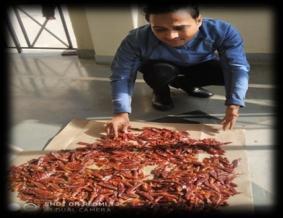
colorcharacteristics,reducetransitandstoragevolume,and quicken the drying process. Additionally, per acetic acid fogging and other chemical processes using hypochlorite, sulphur,andhydrogenIncardamomandginger,peroxideis sometimes used to enhance color qualities and manage microbiological & pest problems. However, inside the EuropeanUnion,manyproceduresarenolongerused,are constrained, or even illegal. The sun drying of chilies is showninFig.1.
Microbial decontamination
Theshelf-lifeoffinishedmealscanbesignificantlyshortened by spice compounds, which are used in almost all food productsinvariousEuropeanandnon-Europeannationsare advisedtoavoidpollution(DGHM,2006;ICMSF,1986).Asa result,anumberofcleaningstrategieshavebeencreatedto lowerthemicrobialburdensofseasonings[32]
The use of ethylene oxide for fumigation

Whenexposedtoatmosphericcircumstances,ethanequickly interactstosaltwhiledissipatingfromfumigatedgoods&to produce the mutagenic and cancerous compounds, and bromide.
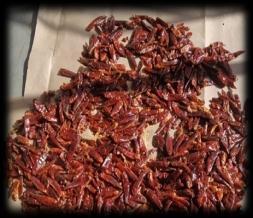
Cosmological technologies are a promising new high technologythatisbecomingmoreandmoresignificantfor thedehydrationofseasoningsbecausemechanicaldryingis primarilyutilizedinindustrializednationsaswellasisnot relevanttotinyfamilyfarmsinrisingnations[23-36].Direct sunlight is still the most common approach, despite the limitedavailabilityofsolarorartificialdryers(Fig.2)
Due to their higher persistence than that of the immense effect,2-chloroethanoland2-bromoethanol. Asaresult,the European Union forbids the utilization of ethane for insecticide.Moreover,owingtothelowpowerrequired to extract the sanitation chemical, volatile chemicals are destroyedinadditiontoscentandcolorchanges.It'sbeen demonstratedthatethanedramaticallylowersthebacterial load[33-39]
Irradiation
It has recently been demonstrated that radiotherapy, includingtheuseofelectromagneticwaves,electronbeams, andX-rays,isasuccessfulwayforspicedisinfection.Sections of3e10kGy
Improvedthemicrobiologicalsafetyofspicesgoodsandwas proventojustbetrustworthy.
Thetasteingredientsarepreservedmosteffectivelyatthe temperatures lower. Cryogenic milling also offers other benefits.Comparedtotraditional grindingmethods,which are detailed by Pruthi (1980) and not considered in this study. Although Freezer milling is region in industrialized countries,itsuseisconstrainedbythehighexpenseofthe potentialforfurtherdevelopment[27-30]
Packaging and storage
The spices are typically held for one to 90 days post manufacturing, before even being distributed to the merchantsortheprocessingsector.Inadditiontothedrying process,storeroomisa different crucial control point, and maintaining, right humidity and heat levels is essential to preventingharmtothespicematerial[31]
Dried Fragrant herbs, ingredient or vegetable condiments may be irradiated with only a maximal total average consumeddosesoftenkgtodecontaminationthem.Despite being a productive, energy-saving, ecofriendly, and maybe evenpermittedtechnique,ionizingirradiationisseldomused because of weak social acceptability. Small alterations in tactile and antioxidant skills were also discovered. Additionally,irradiatingingredientsarecommonlypackaged toprotectsecondarybacterialgrowthfactorsthatpotentially or non-volatile low volume radiologists goods that are releasedfromofthepacking.Thesecouldbedangerousor couldcausefoodpoisoning,affectingtheflavor[40]
Steam treatments
TheusageofsteamdistillationiswidespreadintheEuropean seasoning sector as ethylene oxide use has been outlawed and radiotherapy really hasn't gained favor with buyers. Whenusingthismethod,entireseasoningsareoftensteamed atahotaltitudebeforeevenbeingground.Postpretreatment, itisnecessarytowipeawayanymoisturethathascollected just on surface of nanoparticles to stop fungus formation.
Thatmakestheimplementationofthismethodchallenging, especiallywhenusedongroundspices,whereasuccessful disinfection is connected with discolor or a decrease in essentialoilslevels[41-47]
High hydrostatic pressure
VegetablesorFruitProductscanbenefitfromadministering highhydrostaticforcesofHundredtoThousandMPasince they are store shelves and microbial contamination acceptable.Butontheotherhand,wateractioniscrucialfor thedeactivationofmicrobes.Savoryflavorcollectionsand moisturecontentunder0.66didnotrevealadecreaseinthe amountofmicrobespresent.Problemsassociatedwithspice production(Aflatoxinpollutionandgreaterbacterialrates) The warm and humid weather, the straightforward, unsophisticated operational circumstances, and lengthy humidity,orfrequentlyinsufficientdirectionsfromthefarm ownersresultinsignificantsanitaryandpuritydifficultiesor mayresultinlossesofupto50percentagepointsoftheyield. Sinceseasoningsareexposedtopestslikemice,pigeons,and mosquitoes as well as pollutants like flue gas, heating and radiation from the sun are special things that are most significantinthedevelopmentofspices.Dependingonthe stems and leaves utilized, their origin, or the ecological, harvested, handled, stockpiled, and transit scenarios, considerabletinynumbersintherawresourcesofupto108 colonizationpowerunits/gmayalsobediscovered.Thebulk ofgermsaremicrobe,mesophilicbacteria,fungi,andyeasts. Theseorganismsalsocontaindangerousandvegetaltaxaas Pathogen,Coli,Bacillus,Listeria,andStaphylococcus.Dueto their capacity to produce aflatoxin, fungus development mostly affects the production of paprika, chiles, cilantro, mace, Gingembre, and Safran des Indes ginger. Various aflatoxinshaveindeedbeenlabeledasexcitotoxic,transgenic, andcancergenicinadditiontotheiracutetoxicity[48-51]. Globallyregulationsgovernthelimitvalueaflatoxinlevelsin foodandfeed.Thefumonisinsinparticularexhibitgreathigh thermal stability. In order to avoid and early suppress growth of microorganisms and lower the risk of aflatoxin generation, the administration of fungicides during blossomingandthequickparboiloftherawresourcesare thebesteffectivemethods.
Losses of valuable compounds due to endogenous enzyme activities
The body naturally of the plant products continues postyield, so oxidation enzymes are extremely active at this period. This is in additional to microbes. Some of these alterationsincludemoistureloss,lostopportunitiesforscent andcolor,calming,andbreakdown.Evaporationreducesthe water potential, which limits but does not completely inactivate the enzymes' action. The enzyme's activity resumesafterfoodproductsarerehydratedandwhenspices arestoredmoistly.Thiscouldhaveanegativeimpactonthe coloring,aroma,andtextureofspicesaswellasfoodstuffs
asawhole.Inordertoproducesuperiorseasonings,spoilage organism’s enzymes must be completely and immediately inactivated[52-55].
Losses of valuable compounds due to conventional processing
and storage
Otherthantheessentialelementsbeingdegradedwiththe help of enzymes, aroma and flavor chemicals, which are relatively constant in the whole plant cells, grow hypersensitivewhiletreatmentandstorage.Inspecifically, static friction generated during in the milling accelerates coloration and high oil degradation from evaporating or oxidizing processes. Among the numerous factors that change the genuine impressions of events include air, environments that encourage oxidation, sunlight, and extreme temperatures. The lack of chemical reactivity in preserved dried seasoning products is indeed a big commercialproblemsobecausegoodstakealongtimeto approachthebuyer.
Innovative spice processing
Different techniques for producing spices also have previously been devised, minimizing the fore mentioned drawbacks or issues associated traditional seasoning processing.
Spice oils and oleoresins
Inthepast,peoplehavepreparedfoodusingspiceblends. Fooddelightshavebeenimprovedthroughtheuseofhydro distillationbyfoodtechnologiststorecreatethefragranceof seasonings.Theessentialoils,whichareconcentratedforms ofthearomaticelements.Paralleltosomethinglikethis,the exploitationofthegroundspicesandsubsequentdryingof thesolutionledtotheproductionofvividlycolored,liquid oil that included both the concentration volatile flavoring compounds and the specific aromatic attributes of the seasoning, like the pungent elements of ginger and chilly. Spiceoilsandoilshaveproventobeasuccessfuloptionfor foodflavoringsintermsofhygieneproblems,howeverboth set of techniques are very vulnerable to sunlight, temperature, and oxygen and demonstrate poor storage stability.Tostopthedegradationofnecessary[56-58]
Alternative process for the production of spice powders
Recenttimes,abrand-newmethodforproducingpremium spices was created. Deteriorating components can be instantlyheatinactivatedthxtothenovelapproach.Social mediaalsoplayasignificantroleinthisfield
Theincorporationofenzymeandbacteriainfarmfreshraw materialshasbeenshowntobeessentialforproducingspice commodities with top standard and sanitary status; early fungus prevention reduces mycotoxin generation. To
illustrate the usefulness of this strategy, green pepper, coriander,chilli,andotherplantsectionsatvariousstagesof developmentwereselected.Afterbeinggathered,themass productionwaspromptlyblanched,madeintothepaste,and dehydrate. Instead, mincing was used before the heat treatment.Theprocessingtechniquesaretypicallychanged. Thepreparationtechniquesemployedaretypicallyadapted againfromfoodbusiness,whichmakesiteasiertoinnovate thistechniqueandexecuteitinunderdevelopednations.The goods were often distinguished by much less bacterial burdens than traditional ingredients. The residual search term,peroxide,andpolyphenoloxidaseactivityfoundinred andchilligoodsshowedthatspoilageorganism’senzymes hadbeeninactivatedbecausethespicepowdersdisplayed vibranthuesthatwereespeciallynoticeableingreenpepper powder. These ingredients may also be used to avoid alteringdelicatefoodslikeprocessedmeatorquicksoupsin terms of their taste and textural aspects. Unavoidable volatileoilevaporationdidnotappeartobeimpactedbythe temperatures or time frames tested. Consequently, these reductions were primarily attributable to the ultimate pasteurizationratherthantheinitialheatprocessing.
Future research activities
Amongthefoodmanufacturingprocesseswiththehighest increaseinrecentyearsisextrusion.Becausetothedecrease in bacterial loads, aflatoxin pollution is avoided. Unique offering enhances the security and grade of finished and intermediate goods through suppression of enzymatic degradation.Numerousinventionfilingsthatmentionthis ground-breakingmethodforcleaningspicesalreadyexist.To thegreatestofourknowledge,however,itsapplicationinthe spiceprocessingbusinesshasyettobeproven,aswellasno publishedstudiesthatshowhowwellthequalityofspices mightbeimproved.Covid19alsoplayaroleandimpacton economicloss
Optimization of the alternative process for the production of spice powders
Giventhattheinnovativeproductionprocessdetailedunder thisstudywas notable to stopthedegradationofvolatile oils, future research should look into alternate drying methodstoimprovetheprotectionofvolatilecompounds. The evaporating substances could be collected and then addedbackasadifferenttactic.Thealternatemethod,after adjustment,complieswithcompletefoodsecurity.Programs withGAP,GMP,andHACCPcomponentsthatisappropriate for making spice powders with low bacterial loads, vivid colors,andhighlevelsofflavoringcompounds(Chandeletal. 2016). Future manufacture of unique, hygienically sound spice goods with a diversity of sensory attributes is also made possible by manufacturing various plant parts or pluckingatvariousstagesofmaturity
Enzyme-assisted liquefaction of spice materials
Anothernovelmethodinspiceproductioninvolvestheuse ofcellularmembranesdissolvingenzymes.Planttissueacid hydrolysis is used for a variety of objectives, including improving juice yields, stimulating secondary metabolite releaseinplantstorecoverimportantfoodcomponents,and skinning.Acidhydrolysisofcellmembranescouldbeutilized as a substitute to chilly grinding, which is both costly and technically challenging Artifical intelligence also useful in thisfield[21].
CONCLUSION
Despite the fact that spices have been used through centuries, little advancement has taken place in spice manufacturing.Tocreateeasy,healthy,andsecureproducts with improved shelf life, breeder, growers, dieticians, and marketers must work together closely. Overall quality of latesttechniquesanditemswilleventuallybedeterminedby buyer approval, which itself is regarded as the most importantissue.Becausetheinnovativeprocedureprovided inthisstudy’sprocessingtechniquesiswelldevelopedinthe food industry, the items created are quite likely to gain approval by customers. Secondly, novel procedures can makeasignificantcontributiontoHazardsanalysiscritical control pointideas in the food business. They serve as a foundationforfutureresearchinvestigationsandeffortsto reduce the incidence of food-borne illness spread by ingredients,soensuringfoodsecurity.
REFERENCES
[1]Piratical, M., Radic, B., Lucic, A., & Pavlovic, M. (1999). Toxiceffectsofmycotoxinsinhumans.BulletinoftheWorld HealthOrganization,77,754e766.
[2].Purseglove,J.W.,Brown,E.G.,Green,C.L.,&Robbins,S. R.J.(1981a).Spices,Vol.1.London:Longman.
[3]Guerrero-Beltran,J.,Barbosa-Canovas,G.,&Swanson,B. (2005). High hydrostatic pressure processing of fruit and vegetable products. Food Reviews International, 21, 411e425.
[4] Shaikh, J., Bhosale, R., & Singhal, R. (2006). Microencapsulation of black pepper oleoresin. Food Chemistry,94,105e110.
[5] Bacillus cereus and Bacillus thuringiensis isolated in a gastroenteritis outbreak investigation. Letters in Applied Microbiology,21,103e105.
[6]Subbulakshmi,G.,&Naik,M.(2002).Nutritivevalueand technologyofspices:currentstatusandfutureperspectives. JournalofFoodScience&Technology,39,319e344.
[7] Marku´ s, F., Daood, H. G., Kapitany, J., & Biacs, P. A. (1999).Changeinthecarotenoidandantioxidantcontentof spice red pepper (paprika) as a function of ripening and sometechnologicalfactors.JournalofAgriculturalandFood Chemistry,47,100e107.
[8]https://doi.org/10.1016/j.tifs.2007.01.005
[9] Schweiggert, U., Schieber, A., & Carle, R. (2005b). Inactivation of peroxidase, polyphenoloxidase, and lipoxygenaseinpaprika and chilipowder afterimmediate thermaltreatmentoftheplantmaterial
[10] Das, P., & Sarma, S. K. (2001). Drying of ginger using solarcabinetdryer.JournalofFoodScience&Technology, 38,619e62
[11]Cabezudo,M.D.(2003).Influenceofdryingontheflavor quality of spearmint (Mentha spicata L.). Journal of AgriculturalandFoodChemistry,51,1265e1269.
[12] Schweiggert, U., Schieber, A., & Carle, R. (2005b). Inactivation of peroxidase, polyphenoloxidase, and lipoxygenaseinpaprika and chilipowder afterimmediate thermaltreatmentoftheplantmaterial
[13]Barceló´, A. R., & de Ca´ceres, F. M. (1993b). Dihydrocapsaicin oxidation by Capsicum annuum (var. annuum)peroxidase.JournalofFoodScience,58,611e613.
[14] Butz, P., Heimlich, O., & Tauscher, B. (1994). Hydrostatic high pressure applied to food sterilization III: application to spices and spice mixtures. High Pressure Research,12,239e24
[15] Bera, Shrivastava, Singh, Kumar, & Sharma, 2001; Duxbury,1991;Pesek&Wilson,1986;
[16] Pesek,Wilson,&Hammond,1985).
[17] Peter,K.V.,Indira,P.,&Mini,C.(2003).Thecultivation and processing of Capsicum in India. In A. Krishna (Ed.), Capsicum, Vol. 33 (pp. 139e143). London: Taylor and Francis.
[18] DGHM(2006).VeroffentlichtemicrobiologischeRichtundWarnwertezurBeurteilungvonLebensmittelneStand Mai2006.
[19]Leistritz,W.(1997).Methodsofbacterialreductionin spices.InS.J.Risch,&C.T.Ho(Eds.),Spices:flavorchemistry andantioxidantproperties.ACSSymposiumSeries,Vol.660 (pp.7e10).
[20] Fowles,J.,Mitchell,J.,&McGrath,H.(2001).Assessment of cancer risk from ethylene oxide residues in spices importedtoNewZealand.FoodandChemicalToxicology,39, 1055e1062.
[21] Jindal,H.,Kumar,D.,Ishika,Kumar,S.and Kumar, R. (2021),“RoleofArtificial IntelligenceinDistinctSector: A Study”,AsianJournalofComputerScienceandTechnology, Vol. 10 (1), pp. 1-12. https://doi.org/10.51983/ajcst2021.10.1.2696
[22] Farkas,J.,&Adrassy,E.(1988).Comparativeanalysisof spices decontaminated by ethylene oxide or gamma irradiation.ActaAlimentaria,17,77e94.
[23] Goga, G. and Kumar S. et al. (2022), “Heat Transfer Enhancement in Solar Pond Using Nano Fluids”, Material Today proceeding, https://doi.org/10.1016/j.matpr.2022.12.238.
[24] Khanna, V., Singh, K., Kumar, S., Bansal, S., Channegowda, M., Kong, I, Khalid, M. and Chaudhary, V. (2022), “Engineering electrical and thermal attributes of two-dimensional graphene reinforced copper/aluminium metalmatrixcompositesforsmartelectronics”,ECSJournal of Solid State Science and Technology, Vol. 11, 127001. https://doi.org/10.1149/2162-8777/aca933
[25] Chytiri, Goulas, Badeka, Riganakos, & Kontominas, 2005;Krzymien,Carlsson,Deschenes,&Mercier,2001.
[26] Almela, Nieto-Sandoval, & Ferna´ndez-Lo´pez, 2002; Modlich&Weber,1993;Schneider,1993.
[27]Guerrero-Beltran,Barbosa-Canovas,&Swanson,2005; Manas&Pagan,2005.
[28] Butz, P., Heimlich, O., & Tauscher, B. (1994). Hydrostatichighpressureappliedtofood sterilizationIII: application to spices and spice mixtures. High Pressure Research,12,239e243
[29] Buckenhu¨skes, 1998; Gerhardt, 1990; Pruthi, 2003; Subbulakshmi&Naik,
[30] Buckenhu¨skes, H. J., & Rendlen, M. (2004). Hygienic problemsofphytogenicrawmaterialsforfoodproduction withspecialemphasistoherbsandspices.FoodScienceand Biotechnology,13,262e268.
[31] Banerjee & Sarkar, 2004, 2003; Baxter & Holzapfel, 1982;Burow&Pudich,1996;Candlishetal.,2001;McKee, 1995;Nieto-Sandovaletal.,2000.
[32] Fazekas, Tar, & Kovacs, 2005; Jorgensen, 2005; Thirumala-Devietal.,2001.
[33] Eaton & Gallagher, 1994; Peraica, Radic, Lucic, & Pavlovic,1999;Stark,2005;Walker&Larsen,2005
[34] FAO(2004).Worldwideregulationsformycotoxinsin foodandfeedin2003.In:FAOFoodandNutritionPapers, 81.FAO.(pp.9)etseq.
[35] Bernaletal.,1993a,1993b;Carle,Knodler,&Mu¨ller, 1998; Jare´n-Gala´n & Mı´nguez-Mosquera, 1999; Va´mosVigya´zo´,1981.
[36] Bosland, P. W., & Votava, E. J. (1999). Peppers: Vegetable and spice capsicums. Wallingford: CAB International.pp.135e146.
[37] Bera,M.B.,Shrivastava,D.C.,Singh,C.J.,Kumar,K.S.,& Sharma,Y.K.(2001).
[38]Developmentofcoldgrindingprocess,Packagingand storage of cumin powder. Journal of Food Science & Technology,38,257e259.
[39] Chytiri,S.,Goulas,A.E.,Badeka,A.,Riganakos,K.A.,& Kontominas, M. G. (2005). Volatile and non-volatile radiolysisProductsinirradiatedmultilayercoextrudedfoodpackagingfilmscontaining a buriedlayerofrecycledlowdensitypolyethylene.
[40] Goulas, A. E., Riganakos, K. A., & Konotminas, M. G. (2004).Effectofionizingradiationonphysicochemicaland mechanical properties of commercial monolayer and mulitlayersemirigidplasticspackagingmaterials.Radiation PhysicsandChemistry,69,411e417.
[41]Kumar,R.,andKumarS.,(2017),“ImpactofEucalyptus Oil and Diesel Mixture on Engine Performance in a Four Stroke Single Cylinder Engine Operation”, International JournalforScientificResearch&Development,Vol.5(3),pp. 2288-2293.
[42] Kumar, S., Chandel, R., and Kumar, R., (2016), “PerformanceandEmissionCharacteristicsofEucalyptusoil and Diesel Blend in Four Stroke Single Cylinder Diesel Engine” International Journal of Engineering Sciences and ResearchTechnology,Vol.5(2),pp.710-720.
[43] Chandel, R., Kumar, S. and Kumar, R., (2016), “Performance and Emission Characteristics in a Diesel EngineUsingCottonSeedOilandDieselBlend”International Journal of Enhanced Research in Science Technology and Engineering,Vol.5(2),pp.78-88.
[44] Carle, R., Kno¨ dler, S., & Mu¨ ller, R. (1998). Technologicalimportanceofphosphatesactivityintreated and untreated wheat flours and roux. Getreide, Mehl und Brot,52,310e314.
[45]Castells,M.,Marı´n,S.,Sanchis,V.,&Ramos,A.J.(2005). Fate of mycotoxins in cereals during extrusion cooking: A review.FoodAdditivesandContaminants,22,150e157.
[46] Schweiggert, U., Schieber, A., & Carle, R. Effects of processingandstorageonthestabilityoffreeandesterified carotenoidsofredpeppers(CapsicumannuumL.)andhot
chilli peppers(Capsicum frutescens L.). European Food ResearchandTechnology,
[47]Kumar,S.,Handa,A.,Chawla,V,Grover,N.KandKumar, R. (2021), “Performance of thermal-sprayed coatings to combathotcorrosionofcoal-firedboilertubeandeffectsof process parameters and post coating heat treatment on coatingperformance:areview”, SurfaceEngineering,Volume 37(7),pp.833-860.DOI:10.1080/02670844.2021.1924506
[48] Tuli, B., Jyoti, Gautam, N. and Kumar, S. (2022B), “Overview of Electronic Commerce (E-Commerce)", imanager'sJournalonInformationTechnology(JIT),Vol.11 (2),pp.1-14
[49]Tuli,B.,Jyoti,Gautam,N.andKumar,S.(2022),“Impact of social media on student life”, i-managers Journal on InformationTechnology,Vol.11(1),pp.41-53.
[50 ]Freese, S., & Binnig, R. (1993). Enzymic extraction of spicearomas.Gordian,93,171e176.
[51] Ibrahim, H. M. A., Ragab, G. H., & Moharram, H. A. (1997).Paprikacolorquality:effectofairandnaturaldrying treatments.GrasasyAceites,48,200e206.
[52]Guerrero-Beltran,J.,Barbosa-Canovas,G.,&Swanson,B. (2005). High hydrostatic pressure processing of fruit and vegetable products. Food Reviews International, 21, 411e425.
[53]Eaton,D.L., &Gallagher,E. P.(1994). Mechanisms of aflatoxin carcinogenesis. Annual Review of Pharmacology andToxicology,34,135e172.
[54] Almela,L.,Nieto-Sandoval,J.M.,&Ferna´ndez-Lo´pez,J. A. (2002). Microbial inactivation of paprika by a hightemperature short-X time treatment. Influence on color properties. [52] [55] Journal of Agricultural and Food Chemistry,50,1435e1440.
[55]Singh,H,Kumar,S.andKumar,R.(2021),“AStudyon Novel CoronaVirus Disease (COVID-19)”, Asian Journal of EngineeringandAppliedTechnology”,Vol.10(1),pp.29-37. https://doi.org/10.51983/ajeat-2021.10.1.2801.
[56] Chandel, R., and Kumar, S., (2016), “Productivity Enhancement Using DMAIC Approach: A Case Study”, International Journal of Enhanced Research in Science, Technology&EngineeringISSN:2319-7463,Vol.5Issue1, pp.112-116.
[57]http://dx.doi.org/10.1016/j.solener.2013.10.019
[57]Tuli,B.,Bhawna,Bhardwaj,B.,Kumar,S.andGautam,N. (2022), “An extensive overview on human-computer interaction (HCI) application”, I-manager’s Journal on SoftwareEngineering,Vol.17(1l),pp.24-37.
[58]Jindal,H.,Garg,Y.,Kumar,S.,Gautam,N.,andKumar,R. (2021),“Socialmediainpoliticalcampaigning:AStudy”,Imanager's Journal on Humanities &SocialSciences, Vol. 16(1), 49-60. https://imanagerpublications.com/article/18266/
[59] Singh, M. and Kumar, S (2021), “Impacts of novel COVID-19onVariousSectors:AStudy”, I-manager’sJournal onFutureEngineeringandTechnology(JFET),Vol.16(4), pp.17-25.