International Research Journal of Engineering and Technology (IRJET) e-ISSN: 2395-0056

Volume: 10 Issue: 01 | Jan 2023 www.irjet.net p-ISSN: 2395-0072
International Research Journal of Engineering and Technology (IRJET) e-ISSN: 2395-0056
Volume: 10 Issue: 01 | Jan 2023 www.irjet.net p-ISSN: 2395-0072
1 National Institute for Space Research (INPE), Eusébio, Ceará, Brazil 2 Fortaleza University (UNIFOR), Fortaleza, Ceará, Brazil ***
Abstract - This article presents estimates of the performance of a π⁄3-BPSK demodulator when affected by ionospheric scintillation. This demodulator is a subsystem of a regenerative transponder to be part of new Brazilian nanosatellites, aiming to modernize the Brazilian Environmental Data Collection System (SBCDA). In previous work,theproject ofthe demodulatorwas detailedforAWGN channel. In this work, the amplitude and phase fluctuations similar to those caused by ionospheric scintillation are discussed. The work shows also the block diagram of the computational system for simulations of the space communication links taking into account the discrete-time model for the π⁄3-BPSK signal and respective effects from scintillationand AWGNatthedemodulator. The simulations provided estimates of the performance in terms of carrier acquisition time and bit errors rate obtained at different intensities of scintillation In previous work, the measures showed that for AWGN channel the π⁄3-BPSK architecture satisfies the specifications of the system for both synchronization and bit error rate. However, this work shows that when affected by ionospheric scintillation the performanceofthedemodulatorcandegradenoticeably.
Key Words: Transionospheric channel, scintillation, performance of π⁄3-BPSK demodulator, regenerative transponder, nanosatellites, CDTs, SBCDA, space links, symbol synchronism, carrier recover, UHF-band, amplitudeandphasefluctuations.
The Brazilian Environmental Data Collection System (SBCDA) using satellite is composed by the earthbound hundredsofDataCollectionTerminals-DCTsoperatingin theUHFband(401MHz)plusthesatellitesSCD1(NORAD ID 22409) and SCD2 (NORAD ID 25504). These satellites, havingnon-regenerativetransponders,receivethesignals from the DCTs individually in the UHF band using π⁄3BPSK modulation and retransmit using PM (Phase Modulation)thedatafrommanyDCTsinSband[1-3].The π⁄3-BPSK is a variant of BPSK modulation with modulation index π⁄3 in which the carrier is not suppressed[2-4],seethespectrumonFigure4.17in[4].
Apart from the DCT satellites, the system also includes satellite CBERS (NORAD ID: 40336) which, in the data collection mission, receives data from DCTs in the UHF
bandandretransmitsinSband[1,2].Afterthedataarrive attheearthboundstationsofINPE,thedataareformatted and sent to the distribution center Coordenação Espacial do Nordeste-COENE, where the information becomes availabletotheendusers[2,3].
ToincreaseandmodernizetheSBCDA,INPEisdeveloping newregenerativetransponderstobeputinnanosatellites [3].Differently from non-regenerative transpondersthese new transponders do on the satellite the following processing: a) demodulation π⁄3-BPSK of the signals received from the many DCTs during the sweep of the satellite; b) processing CRC of the received packets to recover the valid data from all DCTs; c) discarding the invaliddata;d)newpackagingofallvalidreceiveddata in a single frame; e) transmission of this frame to the earthboundreceiveraspresentedin[3].
However, due to the specificities of the dynamics of the ionosphere over the Magnetic Equator [5-7] it is recommended that the development of new orbital receiversortransponders,especiallywhenoperatingover Brazil using frequencies bellow C-band, take into account estimation of the performance in links with ionospheric scintillation [5-10]. Therefore, this work aims to show estimatesoftheeffectsofscintillationontheperformance of π⁄3-BPSK demodulator [3] as subsystem of a new regenerative transponder to be onboard the satellites of SBCDA.
In the version of the π⁄3-BPSK demodulator as shown in [3] the results of the computational simulations taking into account only the AWGN channel demonstrated that the solutions used for carrier recovery and symbol synchronism allow synchronization of the system in shorter time than that specified for a new transponder. Besides there is little impact on the ratio (see Figures 6and7in[3]).However,thepresentworkshows thatwhentheeffectsofionosphericscintillationaretaken into account, one can observe noticeable degradation of thesystemaspresentedinsectionIII.
Apart from presenting new performance results of error bit rate, the tests in this work also show the transitory effects while tracking the carrier during specific scintillation situations. Due to the fluctuations in amplitude and phase, it can be observed that, differently
International Research Journal of Engineering and Technology (IRJET) e-ISSN: 2395-0056
Volume: 10 Issue: 01 | Jan 2023 www.irjet.net p-ISSN: 2395-0072
than links with only AWGN channel as shown in [3], here is shown that, even in low S4 levels of scintillation, the performance of π⁄3-BPSK demodulator can degrade strongly.
Inthiswork,theexperimentsintheformofcomputational tests were defined by different link sceneries simulated using a simulation system adapted from [7, 11]. The results, taking into account the fluctuations in amplitude and phase caused by scintillation, shows that the performanceofthedemodulatorintermsofbiterrorrate and time for acquisition of the carrier can degrade noticeablywhencomparedtoresultsshownin[3].
The main contributions of this work are the estimation of the effects of ionospheric scintillation on UHF links between the DCTs and the satellites of SBCDA, referring some levels of S4 supported by the π⁄3-BPSK demodulator[3],aimingmainlytoincreasetheQoSofthe SBCDA and improvement of the DCTs localization service usingsatellites[12,13].
This work should also contribute to emphasize the importance of evaluating the ionospheric scintillation effects in new demodulator projects operating in UHF space links. This approach, even if uses simulation, can help the development of new techniques to decrease the effects of scintillation in space links and/or increase the robustnessofthereceiverbeforethedefinitionofthefinal modelandrespectiveimplementationinhardware.
Thisworkisorganizedasfollows:inSectionIIisdescribed the scenery of π⁄3-BPSK communication links, using a signalmodelwithgenerationofscintillationforsimulation by a Matlab/Simulink Platform. In Section III are shown the results of performance using computational simulations including discussions. In Section IV are presented the conclusions of this work and future perspectives.
Thearchitectureofthedemodulatorandtheπ⁄3-BPSKlink sceneriesusingAWGNchannel intermsofblock diagrams and respective equations were presented in [3]. To generatesceneries containinglevelsofscintillationsimilar to those found in the ionosphere and study the impact of scintillation events on the performance of the future transponder based on π⁄3-BPSK modulation [3] the simulationsystemusedinthisworkisnextdescribed.
The scintillation generator used to simulate the transionospheric channel in 401MHz is adapted from the statistical generators of scintillation presented in [7, 11]. This simulator can generate I/Q signals with different levelsofamplitudeandphasesimilartothoseobservedin
ionospheric phenomena, which correspond to levels of scintillationdenominatedasS4 and Theindexes S4 and ,respectively,theintensityandphaseofscintillation,are definedbythefollowingexpressions:
√〈 〉 〈 〉 〈 〉 (1)
where〈 〉 istheaverageofvalueI,intensityofthesignal, andthephaseindexofthescintillationisobtainedfrom:
( ) (2) where isthedetrendedphaseerror[14]
ToanalyzethesynchronismprocessinaDPLL,onecan model the fluctuation in phase and amplitude due to the ionospheric scintillation as a random process ( ) defined as[11]:
( ) ( ), (3)
where A is the constant proportional to the amplitude of thesignalwhicharrivesatthereceiverdirectlythroughthe line-of-sight, isa randomvariableuniformlydistributed between �� and +�� and ( ) is the multipath component duetothepartofthesignalthatisdispersed,modelledasa zero-mean stationary Gaussian process with autocorrelation ( ) [ ( ) ( )].
Inthiswork,itisassumedthatthemagnitudeof ( )in Eq. (3) has Rice distribution [11], with parameter √ ( √ ). It is also assumed that the autocorrelation function of the process ( ) is given by ( ) ( | |⁄ ) * ( ⁄ ) ( | |⁄ )+, that corresponds the passage of a white Gaussian noise through a second-order Butterworth filter. Taking into account that the decorrelation time of channel is definedasthevalueof τ forwhich ( ) ( )= ,then thecut-offfrequencyofthisfilterisproportional to [11]. Thereforeforanalysiswhen thebandwidth Bd dueto τ ofthislow-passfiltercanbeapproximatedby:
√ , (4)
wherethevalueof dependsonthesignalfrequencyand for theUHF band equatorial scintillationduring night[15] canbedeterminedusingtheexpression: (5)
where f is the frequency of signal in MHz. For the case in study, ,oneobtains
2022, IRJET | Impact Factor value: 7.529 | ISO 9001:2008 Certified
International Research Journal of Engineering and Technology (IRJET) e-ISSN: 2395-0056
Volume: 10 Issue: 01 | Jan 2023 www.irjet.net p-ISSN: 2395-0072
The signals transmitted by the DCTs are a carrier with π⁄3-BPSK modulation, bit rate 400 bps, frequency ~401MHzandbandwidth60kHz.Takingintoaccountthe original parameters for AWGN channel used in the design of the modulator π⁄3-BPSK [3], the satellites receive the signals coming from the DCTs with noise whose power spectral density is -173 dBm/Hz, maximum Doppler shift 9KHzandpowerintherange-108to-126dBm[2,3],see expression(1)in[3].
However, when taking into account the transionospheric channel the discrete-time model for the signal with modulation and respective effects from scintillation and AWGN at the input of the demodulator canbeexpressedinthefollowingway:
[ ] √ [ ] ( [ ]) ( [ ]) [ ] (6)
where is the amplitude of the transmitted carrier, is the amplitude of the scintillation, representsthediscretefrequencyofthecarrier, [ ]isthe signal in baseband, [ ] [ ] isthe phase ofthereceivedcarrier, isanunknownphasecausedby possible frequency and phase deviation resulting from space link, [ ]is the phase of the scintillation, represents a residual of the Doppler frequency coming fromfrequencyestimatorofthetransponder [2,3],which has a maximum value of 5 Hz, and [ ] is the AWGN withvariance
The demodulator architecture proposed in [3] implements the optimal receiver for the AWGN channel. However,duetoerrorsoftheestimatesoftheparameters of synchronism, as shown in [3], there is a small loss, in terms of bit error rate, when compared with the ideal receiver.Inadditiontothemodelandresultspresentedin [3], here, in section III, are shown also the effects of fluctuation of amplitude and phase and the increase in severity of the losses in the performance of the demodulatorsubmittedtotheeffectsofscintillation
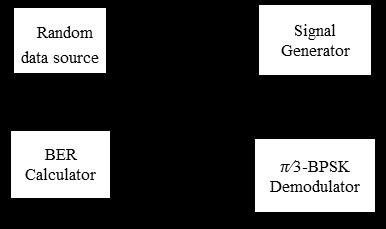
Figure 1 presents the generator of the sceneries concerning modelling of simulated links using functional blockdiagramofthefollowingsubsystems:a)astreaming generator of Matlab/Simulink [16] for random bit generation to be transmitted; b) a generator of π⁄3-BPSK signal,adapted from[4],takingintoaccountthe effects of
value:
scintillation adapted from [7, 11]; c) a π⁄3-BPSK demodulator presented in [3]; and d) a BER (Bit Error Rate)measurerfromMatlab/Simulink[16].
TheschemeofthesimulationsystemshowninFigure1 allows to define the setups for several link scenarios, including different conditions of scintillation intensities, andtomeasurepossibleimpairmentsinthesubsystemsof theπ⁄3-BPSKdemodulator.
Inthiscontext,theSignalGeneratorinFigure1receives the streaming T_data from the Random data source and generates the r[n] signal, Eq. 6, which is sent to the demodulator π⁄3-BPSK. On its turn, the demodulator delivers the streaming R_data to the BER Calculator and, lastly, using as entries the T_data and R_data, the BER Calculatorshowsthebiterrorrate.
The values of the main parameters used in the simulationsaresummarizedinTable1:
Table -1: Parameters used in the simulations for the testingtheπ⁄3-BPSKdemodulator[3].
Carrierfrequency: kHz;
Symboltax: bps;
Samplingfrequency: kHz;
Bitenergypernoisedensity: dB dB;
Carrieracquisitiontime 160ms
Operatingfrequency 401MHz.
Thesectionpresents performanceresults oftheproposed π⁄3-BPSK demodulator presented in [3], here taking into accountthefluctuationsinamplitudeandphase,obtained bycomputationalsimulation.
International Research Journal of Engineering and Technology (IRJET) e-ISSN: 2395-0056
Volume: 10 Issue: 01 | Jan 2023 www.irjet.net p-ISSN: 2395-0072
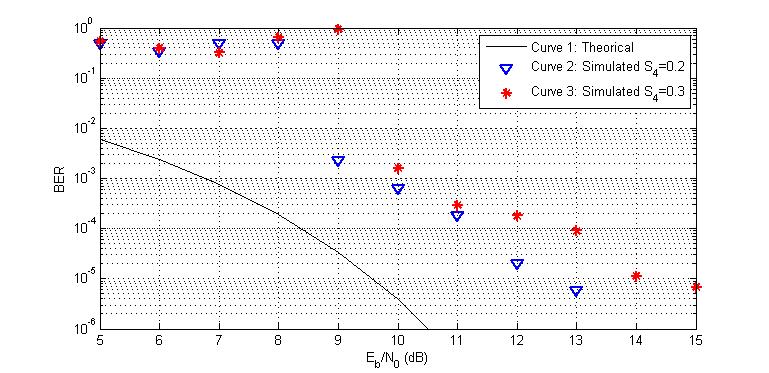
Some curves of the bit error rate (BER) of the π⁄3BPSKdemodulatorinAWGNchannelareshowninFig.6in [3].Inthiswork,inFig.2,Curve1indicatesthetheoretical performance of the BPSK demodulation. Curve 2 corresponds to the simulated scenery of transionospheric channel with scintillation intensity S4=0.2, while Curve 3 shows the BER of the demodulator submitted to scintillationS4=0.3.
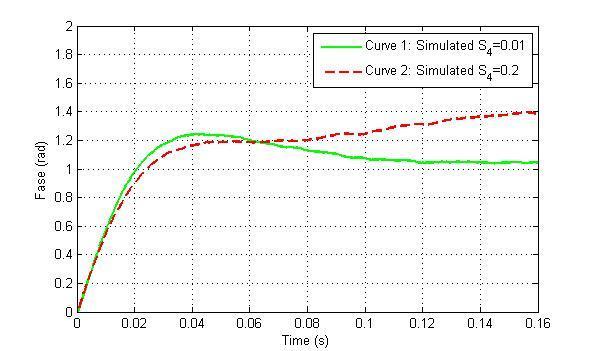
Fig -3:Transitoryresponseoftheloopon ̂ ,outputofthe discrete-timefilterinFig.3in[3],foraphasesteptaking intoaccounteffectsofscintillationforS4=0.01andS4=0.2.
Apart from the results presented in Figures (2) and (3), many other tests were made using dB dB. In the experiments taking into account effects of scintillation, there were no cycle slips for S4 0.4 using dB dB. However, there were cycle slips forS4 0.5and dB.
Fig -2:Curvesofthebiterrorrateofthedemodulator submittedtoscintillationintensitiesS4=0.2andS4=0.3.
In the experiments of this work with condition of bit error rate equal to 10-4, the response of the demodulator proposed in [3] compared to the theoretical response suffered a loss of ~3.2 dB for S4=0.2 and ~4.6 dB for S4=0.3.NotethatforS4=0.2 therewerecycleslipsforthe interval 5 dB ≤ ≤ 8 dB, while for S4=0.3 there were cycle slips for the interval 5 dB ≤ ≤ 9 dB in the test timeintervalt≥60s.
Although the results of the BER and synchronization time tests using only AWGN channel (see Figures 6 and 7 in [3]) or S4 0.0 are within expected, these new experimentsshowthatthesystemcanbecompromisedby the acquisition of the carrier as seen in Fig. 3, even when the intensity of scintillation is low (for example S4=0.2). Notice that the recovery time of the carrier in links using that demodulator π⁄3-BPSK [3] is one of the critical parameters of the transponder (see carrier acquisition timeinTab.1).
In this article, some estimates of possible degradation in performance of the coherent π⁄3-BPSK demodulator [3] due to distortions caused by the simulated scintillation werepresented.
The results of the simulations without scintillation presented in [3] shown that, for the AWGN channel, the solutions used for carrier recovery and symbol synchronizer allow synchronization of the system in smallertimethanthatwhichwasspecified andprovoking small impact on the relation. However, the new experiments, when the effects of ionospheric scintillation are taken into account, show that the scintillation can cause noticeable degradation in the performance of the demodulatorasseeninsectionIII.
In the worst operational situation without scintillation evenwhenthereisfrequencyoffsetandsymbol delaythe error of the proposed demodulator [3] in terms of BER is smaller than 1.0 dB when compared to the theoretical limit in the condition BER=10-4. However this article shows that when scintillation is present the loss of the demodulatorcanreach~4.6dBforS4=0.3inthecondition BER=10-4.NotethatforS4≥0.5therewerecycleslipseven in conditions of =30 dB. Besides, even taking into accountalowintensityofscintillation,forexampleS4=0.2, theacquisitionofthecarriercanbecompromised.
The architecture of the demodulator π⁄3-BPSK [3] is inspiredontheQPSKdemodulator[17,18] Assumingthe hypothesis presented in [3], taking into account only the AWGN channel, robustness is observed when α is smaller
International Research Journal of Engineering and Technology (IRJET) e-ISSN: 2395-0056
than π/10, see expressions (6), (7) and (8) presented in [3],orα≪1,appliedtoexpression(12),aboutDPLLonFig. 3in[3].However,inthiswork,accordingtotheresultsof the experiments and analysis during the simulations, it was noted that π⁄3-BPSK demodulator [3] when there is scintillation could also suffer noticeable perturbation in termsofcycleslipsandcarrieracquisition
Therefore,althoughtheoriginaldesignofthedemodulator demonstratesthatthearchitectureproposedin[3]shows good performance operating in AWGN channel, before embarkinganewtransponderonthesatellitenewstudies are being made aiming improvements of the architecture proposed in [3] taking into account the effects of ionosphericscintillation.
The authors hope that the development of possible strategies to decrease the effects of ionospheric scintillation applied to a new version of the demodulator may also benefit designs of other receivers or transponders, for example those presented in [7, 8, 15] andinresearchappliedtotheGNSS[19].
[1] A.Tikami,C.A.Ferrari,M.V.CisottoeW.Yamaguti,“O desempenho do processador de coleta de dados versão III nas estações de recepção do Sistema Brasileiro de Coleta de Dados”, XVI Simpósio Brasileiro de Sensoriamento Remoto - SBSR, 13 a 18 abril2013.
[2] J. C. Pécala, “Detector de Sinais para os satélites Do Sistema Brasileiro de Coleta de DadosusandoAnálise EspectralDigital,”SãoJosédosCampos,2005.
[3] Vasconcelos, F. M.; Lucena, A. M. P. & Silva, F.A.T.F. Nova Arquitetura de Demodulador π⁄3-BPSK para os Satélites do Sistema Brasileiro de Coleta de Dados. 10.14209/sbrt.2018.40. Available at: http://plutao.sid.inpe.br/col/sid.inpe.br/plutao/2018 /12.15.00.53.50/doc/maia_nova.pdf
[4] Silva,F.A.T.F.;Filho,P.M.;Moreira,N.A.;Rios,C.S.N.; Oliveira,P.D.L.;Camurca,P.J.;Lucena,A.M.P.(2015). Modelagem matemátia em microeletrônica reconfigurável: Estudo de caso sobre moduladores BPSK. Relatório de Pesquisa INPE, repository: sid.inpe.br/mtc-m21b/2015/05.28.17.26-RPQ, 2015. Available at: http://mtcm21b.sid.inpe.br/col/sid.inpe.br/mtcm21b/2015/05.28.17.26/doc/publicacao.pdf
[5] De Paula, E. R., et al. "Equatorial anomaly effects on GPS scintillations in Brazil." Advances in Space Research31.3(2003):749-754.
[6] Aquino, M. “Countering Ionospheric Disturbances AffectingGNSSinBrazil”.GPSWorld,2015.
[7] DELUCENA,A.M.P.;DASILVA,F.DEA.T.F.;daSilva, A. S. Scintillation Effects in S-band Telemetry Link of INPE´s Earth Station in Cuiaba-Brazil. Radio engineering,v.30,p.739-748,2021.
[8] FERREIRA, Paulo Victor R.; WYGLINSKI, Alexander M. Performance analysis of UHF mobile satellite communication system experiencing ionospheric scintillation and terrestrial multipath fading. In: 2015 IEEE 82nd Vehicular Technology Conference (VTC2015-Fall).IEEE,2015.p.1-5.
[9] MORAES, Alison de Oliveira; PERRELLA, Waldecir João. Performance evaluation of GPS receiver under equatorial scintillation. Journal of Aerospace technology and Management, v. 1, n. 2, p. 193-200, 2009.
[10] YE, Zhong; SATORIUS, H. Channel modeling and simulationformobileuser objectivesystem(MUOS) part 1: flat scintillation and fading. In: IEEE International Conference on Communications, 2003. ICC'03.IEEE,2003.p.3503-3510.
[11] HUMPHREYS, Todd E. et al. Simulating ionosphereinduced scintillation for testing GPS receiver phase tracking loops. IEEE. Journal of Selected Topics in SignalProcessing,v.3,n.4,p.707-715,2009.
[12] CELESTINOCC,SOUSACT, YAMAGUTIW&KUGAHK. 2007. Evaluation of Tropospheric and Ionospheric Effects on the Geographic Localization of Data Collection Platforms. Mathematical Problems in Engineering–MPE,volume2007,ArticleID32514,11 pages,doi:10.1155/2007/32514.
[13] CELESTINOCC,SOUSACT, YAMAGUTIW&KUGAHK. 2008.ErrorsduetotheTroposphericandIonospheric Effects on the Geographic Location of Data Collection Platforms. Proceedingsof the 6 thIAA Symposiumon Small Satellites for Earth Observation. International AcademyofAstronautics(IAA),2008,Berlin,CD-ROM.
[14] Van Dierendonck, A.J., Klobuchar, John, Hua, Quyen, "Ionospheric Scintillation Monitoring Using Commercial Single Frequency C/A Code Receivers". Proceedings of the 6th International Technical Meeting of the Satellite Division of The Institute of Navigation (ION GPS 1993), Salt Lake City, UT, September1993,pp.1333-1342.
[15] KULLSTAM, Per A.; KESKINEN, Michael J. Ionospheric scintillation effects on UHF satellite communications. In: MILCOM 2000 Proceedings. 21st Century Military Communications. Architectures and Technologies for
Volume: 10 Issue: 01 | Jan 2023 www.irjet.net p-ISSN: 2395-0072 © 2022, IRJET | Impact Factor value: 7.529 | ISO 9001:2008 Certified Journal | Page5
International Research Journal of Engineering and Technology (IRJET) e-ISSN: 2395-0056
Volume: 10 Issue: 01 | Jan 2023 www.irjet.net p-ISSN: 2395-0072
Information Superiority (Cat. No. 00CH37155). IEEE, 2000.p.779-783.
[16] MATLAB/SIMULINK.Matlabdocumentation,available in:
https://la.mathworks.com/help/pdf_doc/matlab/sim ulink/index.html?s_tid=CRUX_lftnav. Accessed in November2022.
[17] M. Oerder. e H. Meyr, “Digital filter and square timing recovery”,IEEETransactionsoncommunications,vol. 36,nº5,pp.605-612,1988.
[18] A. M. P. Lucena et al. “Fully digital BPSK demodulator for satellite supressed carrier telecommand system”, International Journal ofSatelliteCommunicationsand Networking,vol.35,nº4,pp.359-374,2012.
[19] VILA-VALLS, J., et al. Survey on signal processing for GNSS under ionospheric scintillation: Detection, monitoring, and mitigation. NAVIGATION, Journal of theInstituteofNavigation,2020,vol.67,no.3,p:511–536.
Francisco A. Tavares F. da Silva received the B.S. in electrical and electronic engineering from Federal University of Campina Grande (UFCG), Campina Grande, Paraíba, Brazil, in 1986, the M.Sc. in electronic and computer engineering from Aeronautics Institute of Technology (ITA), São José dos Campos, São Paulo, Brazil, in 1993 and the D.Sc. degree from National Institute for Space Research (INPE) São José dos Campos-SP, Brazil, in 1998. Since 1986 he has worked at INPE andcurrentlyconductsresearchin digital signal processing applied to pattern recognitionandspacecommunications.
Antonio Macilio Pereira de Lucena received the B.Sc. degree in electronics engineering from Technological Institute of Aeronautics (ITA), São José dos Campos-SP, Brazil, in 1980, the M.Sc. degree in space telecommunications and electronics from National Institute for Space Research (INPE), São José dos Campos-SP, Brazil, in 1986, and the D.Sc. degree in teleinformatics engineering from Federal University of Ceara (UFC), Fortaleza-CE, Brazil, in 2006. He is with INPE since 1983 where he has been involvedinvariousprojectsintheareasof satellite communications, electronics, and radio-astronomy. Since 2007, he is also
professor at University of Fortaleza (UNIFOR), Fortaleza-CE, Brazil. His present research interests include modulations, space communications, signal processing, and communication theory.“
AlexandreGuirlandNowosadreceivedthe B. Sc. degree in electronics engineering from Federal University of Rio de Janeiro (UFRJ), Rio de Janeiro-RJ, Brazil, in 1987, the M.Sc. degree in Electrical Engineering from NYU, USA, in 1988, and the D.Sc. degree from National Institute for Space Research (INPE) São José dos Campos-SP, Brazil,in2001.Since1988hehasworked at INPE in signal processing applications in meteorology, environmental science andspacecommunications.
2022, IRJET | Impact Factor value: 7.529 | ISO 9001:2008 Certified Journal