
International Research Journal of Engineering and Technology (IRJET) e-ISSN: 2395-0056
Volume: 13 Issue: 06 | Jun 2026 www.irjet.net p-ISSN: 2395-0072

International Research Journal of Engineering and Technology (IRJET) e-ISSN: 2395-0056
Volume: 13 Issue: 06 | Jun 2026 www.irjet.net p-ISSN: 2395-0072
Sakshi Waghe1 , Prof. D. B. Raut2 , Pratap Pawar3 , Priyanka Sapkal4 , Saurabh Shivankar5
1,3,4,5 Student, Department of Computer Engineering, SVPM’s College of Engineering, Malegaon BK, Maharashtra, India
2 Assistant Professor, Department of Computer Engineering, SVPM’S College of Engineering Malegaon BK, Baramati, Maharashtra, India
Abstract - The rapid demand for blood in emergency situations often faces challenges due to the lack of timely availability, inefficient management, and limited communication between hospitals, donors, and blood banks. Jeevandan – The Blood Portal is an intelligent, full-stack web application designed to streamline the process of blood donation,requestmanagement,anddonorsearch.Thesystem bridgeshospitals(doctors),bloodbanks,anddonorsthrougha single digital platform that ensures quick and reliable access to blood when needed. It integrates geolocation services to identify nearby blood banks and donors and uses the Haversine and TOPSIS algorithms to efficiently locate and rank suitable donors based on proximity, health conditions, anddonationeligibility.Authenticationanddatasecurity are handledusingJWTandbcrypt.js, whilereal-timenotifications are managed through integrated messaging APIs. The portal also features automated reminders to encourage repeat donations after three months of the last donation, enhancing donor engagement and availability. By automating communication,donorselection,andinventorymanagement, Jeevandancontributestoreducingresponsetimeandbridging the critical gap between blood demandand supply in medical emergencies.
Key Words: Blood Donation, Blood Bank Management System, Jeevandan, Haver sine Algorithm, TOPSIS Algorithm, Geolocation, Donor Search, Emergency Blood Request, JWT Authentication, Bcrypt.js, Twilio API, Automated Notification, Web Application, Healthcare Technology
JEEVANDAN-TheBloodPortalisawebapplicationintended forthelinkageofblooddonors,receivers,andbloodbanks withinonesystem.Theprimarypurposeofthissystemisto develop an efficient platform for handling blood donation and availability. This system helps individuals to convenientlyregisterthemselvesasblooddonors,findout aboutbloodavailability,andgetintouchwithnearbydonors or blood banks in case of emergency. This portal will not onlyhelpindividualstosavetheirprecioustimebutwillalso make sure that the blood required by them would be availableattherightplaceandattherighttime.Thissystem
acts as a medium to link up blood donors and seekers. It ensures efficiency and precision of blood donation. JEEVANDANadvocatesvoluntaryblooddonationandhelps in the development of a self-reliant blood management system.Thisprojectbecomesverysignificantandessential insavinglives.
Thereisnoorganizationinthecurrentsystem,whichdelays the search for suitable donors during emergencies.
JEEVANDAN-TheBloodPortalwilldevelopawebportalto linkthedonor,recipient,andbloodbankinordertofacilitate theavailabilityofbloodatanytime.
EfficientBloodManagementSystemshavebeenrequired for many years now, particularly in developing countries where traditional means of blood management such as manual record keeping could lead to wastage of many valuable lives. Several recent studies have come up with sometechnologicaladvancesregardingbloodmanagement. However,mostofthesetechnologieshavefailedtoscaleup and provide features such as real time synchronization, donorverificationandintelligenthandlingofrequests.
Earlier, some applications were developed to manage bloodbanks.Suchapplicationswerebasicallymeanttostore and manage donor details, blood stock and other information locally. They lacked features such as blood request automation, matching donor to hospital by geolocationandrealtimeinformationupdates.Also,these older blood management systems failed to provide the optionforcollaborationbetweenhospitals,bloodbanksand donors.
Web based Blood Donation Management Systems are another development in this field. These applications allowed the user to register himself as a donor and view bloodstockavailable.However,thesesystemshadseveral shortcomings, including heavy dependency on manual validation,lackofgeolocationfeaturesandinabilitytoselect donorsusingintelligentalgorithm.
International Research Journal of Engineering and Technology (IRJET) e-ISSN: 2395-0056
Volume: 13 Issue: 06 | Jun 2026 www.irjet.net p-ISSN: 2395-0072
The current developments in GIS and AI technologies provide an opportunity to optimize the process of blood management systems through recent techniques. The majorityofmethodsintegratelocationalservicesinorderto locatetheclosestdonorsorbloodbanksthroughtheuseof the Haversine formula, which calculates the shortest distancebetweentwogeographicalpoints.Nevertheless,the currenttechniquesconsideronlythefactorofgeographical closeness without taking into consideration other crucial parametersfor effective bloodtransfusions suchasdonor eligibility,dateofthelatestdonation,andhealthconditionof theindividual.
A few techniques have already adopted ranking algorithms together with Multi-Criteria Decision Making approach in order to increase the accuracy of donor selection. The most efficient algorithm for evaluation is Technique for Order Preference by Similarity to Ideal Solution(TOPSIS),whichusesseveralweightedparameters such as blood compatibility, hemoglobin content, donor's weight, geographical closeness, and date of the previous donation.Despitetheefficiencyofthisalgorithm,thereare onlyafewmodelsthatutilizeitalongwithlocationfiltering.
The other innovative solution was the development of automatedcommunicationtechnologythatincludedtheuse ofSMSAPIsandcloud-basednotificationservices.Although suchsolutionshaveenhancedresponsetimes,theygenerally do not guarantee the continued interaction between the donorsandthehospitalsafterthedonationprocess,leading toreducedretentionratesinthelongrun.
Thethirdresearchareathathasgainedtractionlatelyhas been related to the investigation into blockchain-based transparency initiatives, use of mobile applications for managingdonors,aswellasIoT-basedtechnologiesforrealtime monitoring of the blood bags. Nonetheless, such approaches are relatively complicated and expensive to implementinsmall-tomedium-sizedhealthcarefacilities.
Based on this assessment, one may notice that the previously mentioned systems greatly contributed to the digitalization of the blood donation procedure. Yet, they failed to incorporate smart prioritizing of the donors, geospatialprecision,automatedreminders,andcoordinated activities of the physicians, blood banks, and donors. The identified limitations make a solid ground for developing "Jeevandan–TheBloodPortal"system.
Reasons for designing “JEEVANDAN– The Blood Portal” include the development of an effective and dependable portalthroughwhichonecanconnectwithblooddonorsand receivers.Often,therearemanyemergencieswhenpeople fail to locate blood donors because of the lack of relevant information. With this portal, individuals will be able to connect with blood donors and make requests regarding
blooddonationseasilyandeffectively.Thus,thisportalwill help to promote blood donation and ensure that those in needreceivetimelyhelpfromvolunteers.
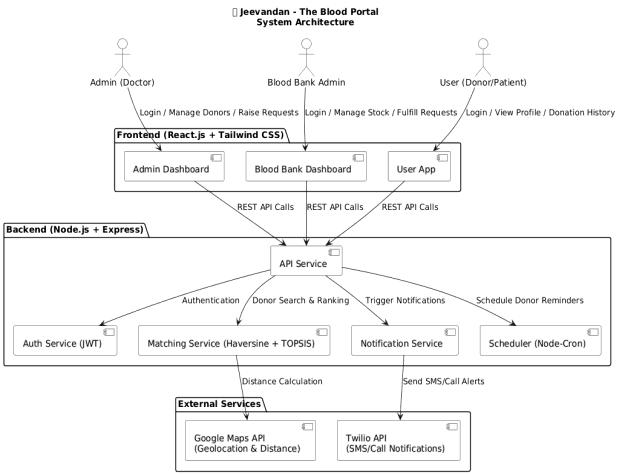
1.UserRegistration&Authentication:Users(Doctors,Blood BankAdmins,andDonors)securelyregisterandloginusing JWT-basedauthentication.
2.BloodRequestGeneration:Doctorsraisebloodrequests byprovidingrequiredbloodgroupandquantitydetails.
3 Geolocation-BasedSearch:ThesystemusesGoogleMaps APIandtheHaversineAlgorithmtofindnearbybloodbanks andeligibledonors.
4. Donor Ranking: The TOPSIS Algorithm evaluates and ranksdonorsbasedonbloodcompatibility,distance,health status,andlastdonationdate.
5.Request Prioritization: Blood requests are prioritized according to urgency, patient condition, and blood availability.
6 NotificationService:TwilioAPIsendsSMSandcallalerts toselecteddonorsandbloodbankadministrators.
7. Automated Reminders: Node-Cron automatically sends reminders to donors after 90 days, encouraging regular blooddonation.
8 BloodRequestFulfillment:Bloodbanksapproverequests, updateinventory,andcompletethebloodsupplyprocess.
9.Result&Monitoring:Thesystemdisplaysrequeststatus, donor details, and blood stock information through dashboardsforefficientmonitoringandmanagement.
International Research Journal of Engineering and Technology (IRJET) e-ISSN: 2395-0056
Volume: 13 Issue: 06 | Jun 2026 www.irjet.net p-ISSN: 2395-0072
Algorithm 1– Haversine Distance Algorithm (Blood Bank & Donor Location)
Haversine Distance Algorithm helps in calculating the shortestpossibledistancebetweentwopointsonEarth.This algorithmworksonthebasisoflatitudesandlongitudesof the geographical locations. This algorithm helps in determiningthenearestbloodbanksorblooddonorstothe patient.
Explanation of Haversine Distance Algorithm:
1. Input: The current location of the user (latitudes & longitudes)isprovidedbytheuser.Locationdataofvarious registered blood banks or donors are also stored in the database.
2. Gathering Coordinates: Thelatitudesandlongitudesof the user and different blood banks/donors are extracted fromthedatabase.
3. Distance Calculation: Thedistancebetweenthe user’s location and that of each blood bank/donor is calculated usingtheHaversineformula.
4. Comparison of Distances: The system compares the distances of all blood banks and donors that have been calculated.
5. Shortest Distance Selection: It selects the shortest distance between the user and either a blood bank or a donor.
6. Recommendations:Itprovidesrecommendationsabout the closest blood banks and donors arranged from the nearesttothefarthesttotheuser.
Algorithm 2– TOPSIS Algorithm (Donor Ranking System)
TOPSIS stands for Technique for Order Preference by SimilaritytoIdealSolution,whichisanapproachemployed in making decisions where several criteria need to be consideredinrankingdifferentoptions.Thecriteriainvolved in choosing the best donor in the Blood Bank & Donor Ranking System include distance, availability of blood, donationshistory,responsetime,andreliability.
Explanation of TOPSIS Algorithm:
1.Input: Information related to donors like their blood group, distance from the patient, availability status, last donation time, response time, and reliability are taken as input.
2. Creation of Decision Matrix: Allthedonorinformationis put into a decision matrix wherein each row denotes one donor,whilethecolumnsdenotecriteriaforchoosing.
3. Normalizing Data: This step involves normalization of data so that values belonging to each criterion can be compared.
4. Weight Assignment: Assigningweighttoeachcriterion accordingtoitsimportancelevelinmakingdecisions.Some examples of more important criteria could be blood availability,anddistance.
5. Identifying Ideal Solutions:
•PositiveIdealSolution:Valuesofbestcasesforallcriteria.
•NegativeIdealSolution:Worstcasevaluesforallcriteria
6. Calculation of Rank Scores: Foreachindividualdonor,a closenessscoreisdetermined.Ifadonorhasascorethatis moreclosetothesolution,thenitgetsahigherscore.
7. Final Ranking of Donors: Alldonorsarearrangedinthe orderoftheirscore,whichmeansthosehavinghighscores arerankedfirst.
8. Results: Patientscancontactthemostappropriatedonors easilyfromthelistdisplayedbythesystem.
Node Cron is a library used to schedule the execution of certainactionsataspecifictimeorperiodically.InaBlood BankSystem,NodeCroncanbeusedtoscheduletaskslike sendingreminderstodonors,updatingthebloodinventory, andverifyingdonoreligibility.
1. Input: Thesystemcreatesaschedule(timeanddateor timeperiod)fortheexecutionoftheparticularaction.
2. Schedule Creation: A schedule is generated using the cronexpression.
3. Register Task: Registering the task with Node Cron scheduler.
4. Scheduled Task Execution: Node Cron continuously checks the current time and schedules the action accordingly.
5. Process Task: Therequiredtaskisperformedaccording tothescheduledtime.
6. Output: Thescheduledtaskisautomaticallyexecuted.
International Research Journal of Engineering and Technology (IRJET) e-ISSN: 2395-0056
Volume: 13 Issue: 06 | Jun 2026 www.irjet.net p-ISSN: 2395-0072
Geolocation Filtering Algorithm can be used to filter and show the users, donors, or blood banks by geographically locating them. This algorithm is useful in Blood Bank Management System to locate nearby blood donors and bloodbanksinaspecificradius.
Explanation of Geolocation Filtering Algorithm:
1. Input: The system gets the input data that includes latitude,longitude,anddesiredradius.
2. Retrieval of Location Information: Locations of all donors/banks of blood registered in the database are retrieved.
3. Measurement of Distance: The system measures the distancebetweenuser'slocationanddonor/bankofblood.
4. Applying Filter: Onlydonors/banksofbloodlyingwithin thedesiredradiusareconsidered.
5. Sorting:Thesortedlocationsofblooddonors/banksare arrangedfromneartofarlocations.
6. Output: Listofavailableblooddonorsandbloodbanksin thevicinity.
RequestPrioritizationAlgorithmisemployedtoselectthe mostimportantrequestsfortreatmentfirst.TheBloodBank ManagementSystemusesthisalgorithmtoprioritizecases that need urgent attention depending on several aspects, includingtheimportance,availabilityofblood,andthestatus ofthepatient.
Explanation of Request Prioritization Algorithm:
1. Input: Bloodrequestsreceivedbythesystemcomefrom hospitals/patients.
2. Priority Assignment: A priority level is given to each requestdependingupontheurgencyofthesituation.
3. Sorting Requests:Requestsaresortedfromhighpriority tolowpriority.
4. Processing: Emergency and urgent requests are given preference.
5. Output: Thesystemguaranteesthatbloodrequestswith higherprioritiesgetattention.
7. METHODOLOGY
Jeevandan–TheBloodPortalisanewlydevisedsystemfor bloodmanagement,whichmakesuseofartificialintelligence
toensurethattheprocessofmanagingblooddonationsis moreefficient.Thisapplicationmakesuseofgeolocationand ranking algorithms to automate the process of blood management.
I. User Authentication
• The doctors, blood bank administrators, and donors registerthemselves.
• Authentication and logging into the platform uses JWT authenticationwithbcryptpasswordhashing.
II. Blood Request Creation
• Doctors initiate bloodrequestsspecifyingtheamount of bloodanditstype.
•Adatabaserecordiscreatedforthesameandsenttoblood banksnearby.
III. Geographical Information System (GIS)
• The location data is obtained by Google Maps API for donorsandbloodbanks.
•TheHaversineAlgorithmisusedtodeterminethedistance ofnearbydonorsandbloodbanks.
IV. Donor Priority Using TOPSIS
•Theeligibilityofdonorsisdeterminedbasedonfactorslike blood compatibility, distance, health status, hemoglobin level,weight,andlastdonateddate.
•UsingTOPSIS,donorsarerankedbasedontheirpriority.
V. Priority of Requests
•Bloodrequestsareprioritizedbasedontheiremergency, healthofpatients,andavailabilityofblood.
• Emergency requests take precedence over normal requests.
VI. Notification System
•SMSandvoicemessagesaresenttodonorsselectedand administratorsofbloodbanksthroughTwilioAPI.
VII. Automated Reminder for Donors
•Node-Cronautomatedremindersystemremindsthedonor after90daysofhislastdonation.
•Thishelpsensureregularinvolvementfromthedonor.
VIII. Blood Request Satisfied
•Therequestissatisfiedeitherbydonorapprovalorbythe bloodbank'sapproval.
•Automatedupdatingofbloodstockanddonordatabases takesplaceinthedatabase.
International Research Journal of Engineering and Technology (IRJET) e-ISSN: 2395-0056
Volume: 13 Issue: 06 | Jun 2026 www.irjet.net p-ISSN: 2395-0072
• The status of requests, donors, and blood stock levels is displayedviathedashboard.
• The administrator can monitor all the activities in realtime.
8. RESULTS
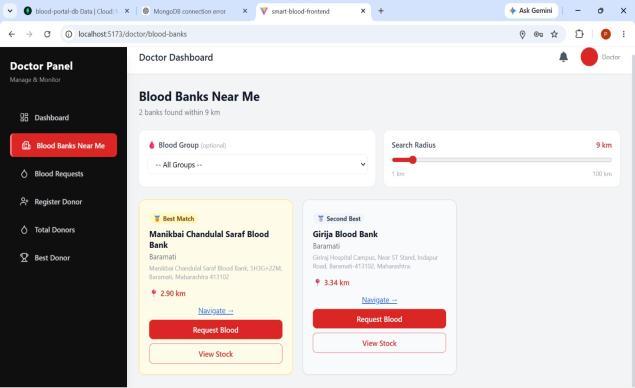
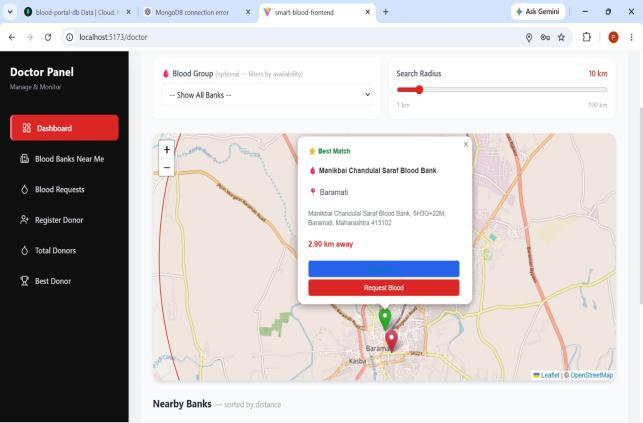
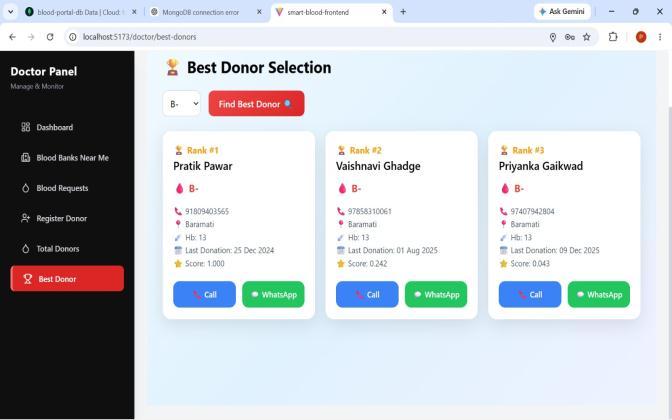
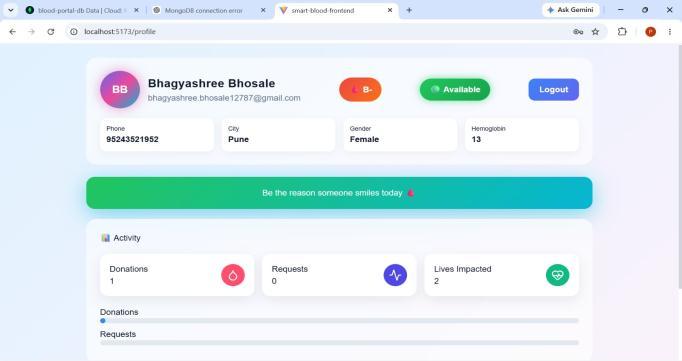
Thesuggestedsystem,Jeevandan–TheBloodPortal,offers anintelligentandeffectiveapproachtoblooddonationand bloodbanksmanagement.Thesystembringstogetherthe hospital,bloodbank,andthedonorsintooneplatformthat facilitates real-timecommunicationandbetter emergency responseinblooddonations.IncorporationoftheHaversine Algorithm for finding the closest donor and the TOPSIS Algorithmforrankingthepotentialdonorsleadstoafaster andmoreaccurateidentificationofthedonor.Notifications throughtheTwilioAPI,aswellasdonorreminderschedules withNode-Cron,contributetoincreaseddonorengagements. In terms of security, the system uses JSON Web Tokens (JWT)andbcrypt.jsforprotectionofsensitiveuserdata.
[1]P.Gupta,S.Sharma,andR.Jain,“RaktFlow–BloodBank ManagementandDonationSystem,”InternationalJournalof AdvancedResearchinComputerScience,vol.13,no.2,pp. 125–130,2023.
[2]N.Pawar,A.Vaidya,andS.Suryawanshi,“Computerized Central Blood Bank Management System (CCBBMS),” International Journal of Research and Analytical Reviews (IJRAR),vol.9,no.1,pp.45–50,2022.
[3]P.SharmaandR.Patil,“BloodBankManagementSystem: EnhancingSecurityandTransparencyinBloodDonation,” IEEEAccess,vol.11,pp.11234–11240,2023.
[4]S.Jadhav,M.Kale,andA.Bhonsle,“BloodLink:ABlood Donation Web Application with Geo-Spatial Route Scheduling and Transformer-Based Recommendation Systems,” International Journal of Computer Applications, vol.181,no.6,pp.52–59,2024.
[5]R.K.MehtaandD.Singh,“RAKTAMITRA:AnAlert-Centric Blood Donation Initiative,” International Journal of InnovativeResearchinScience,EngineeringandTechnology (IJIRSET),vol.12,no.4,pp.215–221,2023.