
International Research Journal of Engineering and Technology (IRJET) e-ISSN:2395-0056
Volume: 12 Issue: 05 | May 2025 www.irjet.net p-ISSN:2395-0072
International Research Journal of Engineering and Technology (IRJET) e-ISSN:2395-0056
Volume: 12 Issue: 05 | May 2025 www.irjet.net p-ISSN:2395-0072
Jayesh Kavekar
E&TC Engineering MVPS’s KBTCOE Nashik,India
Yogita Kavade
E&TC Engineering MVPS’s KBTCOE Nashik,India
Abstract The Internet of Things (IoT) is taking great hold in today's technology since it facilitates comfortable and remote monitoring of machines using sensors. On the other hand. Single Phase Induction motors are most widely used in industry as well as home applications. Monitoring and controlling it is a very crucial task. This project is about monitoring several parameters such as the current, voltage, temperature, and speed of an induction motor, and controlling its speed by IOT, the faults are sensed using sensors and are stored in the cloud thereby enabling one to monitor the machine with reduced manual intervention. If the engine has a faulty state (current), the user will be notified of this issue via the mobile application Speed sensors are required for the control of induction motors and temperature sensors are required to find excessive thermal stress. These sensors reduce the sturdiness of the system and make it expensive. Therefore, a drive system without sensors isrequired.
Key words: IOT, Atmega328, Induction Motor, Remote Monitoring,Sensor.
General purpose of motors are increasing widely in our surrounding from household equipment’s to machine tools in industrial applications. It is a necessary and indispensablesourceofpowerinmanyindustries.Inmany applications the speed control plays a vital role which can be done using many control strategies The purpose speed controller of a motor is to take signal representing the demanded speed and to drive a motor at that speed. Generallyspeedcontrolofthemotorcanbecanbedoneby varying the motor parameters of the induction motor such as current, voltage, frequency etc. this can be achieved by different methods such as field control method, armature controlmethodetc.Inthisprojectspeedcontrolisdoneby ZCD technique and the parameters are monitored and displayedinLCDbyAtmega328microcontrollerandshared tomobileusingIOTthroughNodeMCUWi-Fimodulewhich makesthewholesystemflexibleanduserfriendly.Withthe help of IOT through NodeMCU the required speed is given as input to ZCD through Atmega328 microcontroller thus
Minakshi Kasav
E&TC Engineering MVPS’s KBTCOE Nashik,India
varying the speed of induction motor. Present industry is increasingly shifting towards automation. Two principle components of today’s industrial automations are programmable controllers and robots. In order to aid the tedious work and to serve the mankind, today there is a generaltendencytodevelopanintelligentoperation.
Induction motors are integral to various industrial processes, yet traditional speed control methods are often limited by fixed operations and manual adjustments, leading to inefficiencies, increased energy consumption, and higher operational costs. Thelackofreal-timemonitoringmakesitchallenging to adapt motor performance to varying load conditionsandoperationalrequirements,resultingin suboptimal performance and potential equipment failures. The challenge is to develop an IoT-based speed control system that enables control of inductionmotors.
The primary objective of this project is to design and implement an IoT-enabled control mechanism that enhances the efficiency, reliability, and flexibility of inductionmotoroperations.
Developasystemthatenablescontinuousmonitoringof induction motor parameters, such as speed, and temperature,usingIoTsensors.
ImplementanIoT-basedcontrolmechanismthatallows forreal-timeadjustmentsofmotorspeedbasedonuserdefinedparametersandloadconditions.
Design the system to be scalable, allowing for the additionofmoremotorsorsensorsasoperationalneeds evolve
International Research Journal of Engineering and Technology (IRJET) e-ISSN:2395-0056
Volume: 12 Issue: 05 | May 2025 www.irjet.net p-ISSN:2395-0072
As global energy prices continue to rise and sustainability becomes a core industrial priority, industries are increasingly driven to adopt innovative technologies that reduce energy consumption and operational costs. One of the most effective strategies to achieve this is through the implementation of IoT-based speed control systems for inductionmotors.Thesesystemsofferintelligent,real-time adjustments to motor speed based on load demand, significantly improving energy efficiency and contributing to substantial cost savings over time. Furthermore, the growing emphasis on smart manufacturing and the principles of Industry 4.0 have created a pressing need for moreadvanced,automatedcontrolsystems.IntegratingIoT technologies into motor control infrastructures aligns seamlessly with these modern industrial trends, enabling greater system intelligence, adaptability, and responsiveness.IoTsolutionsprovidetheaddedadvantage of remote monitoring and control, allowing operators, technicians, and plant managers to access real-time motor performance data from any location. This not only improves operational flexibility but also facilitates faster responsetoanomaliesorshiftingproductionrequirements, minimizing downtime and enhancing overall process efficiency. Ultimately, the transition to IoT-enabled motor control systems represents a forward-thinking approach that combines technological advancement with practical industrial benefits, paving the way for smarter, greener, andmorecost-effectiveoperations.
Numerous studies have focused on the control and monitoring of induction motors using embedded systems andIoTtechnologies.Traditionalmethodsofspeed control often involved manual intervention and lacked real-time monitoring capabilities. With the advancement of microcontrollers and IoT platforms, modern systems now provideautomation,precision,andremoteaccessibility.
Researchers have explored TRIAC-based phase angle control for regulating the speed of single-phase induction motors.ThefiringangleoftheTRIACisadjustedtocontrol the effective voltage supplied to the motor, thereby controlling its speed. Accurate triggering of the TRIAC is achieved using Zero-Crossing Detection (ZCD) circuits, which synchronize the switching operation with the AC mains.
Microcontrollers such as ATmega328 have been widely used for implementing the firing angle control algorithm due to their timing accuracy. Additionally, NodeMCU (ESP8266)isincreasinglyusedforIoTapplicationsbecause
of its built-in Wi-Fi capabilities, allowing for real-time data transmissionandremotecontrolviacloudplatforms.
Several projects have integrated voltage and current sensors (e.g., ZMPT101B and ACS712) to monitor the operational status and performance of induction motors. These sensors help in detecting anomalies, preventing damage, and improving energy efficiency. The collected data can be transmitted wirelessly to IoT dashboards for live monitoring anddatalogging.
This project builds upon these existing technologies by integrating voltage and current sensors, a ZCD circuit, a TRIAC-based firing control system, ATmega328 for control logic, and NodeMCU for IoT connectivity. The system enables efficient speed control and real-time monitoring of a singlephase AC induction motor, demonstrating an effective combinationofpowerelectronicsandIoT.
The proposed system is designed to control and monitor the speed of a single-phase AC induction motor using TRIACbased phase angle control, with real-time data monitoring through an IoT platform. The architecture integrates both hardware and software components to enable automated, accurate,andremoteoperation.
Thesystemiscomposedofthefollowingmaincomponents:
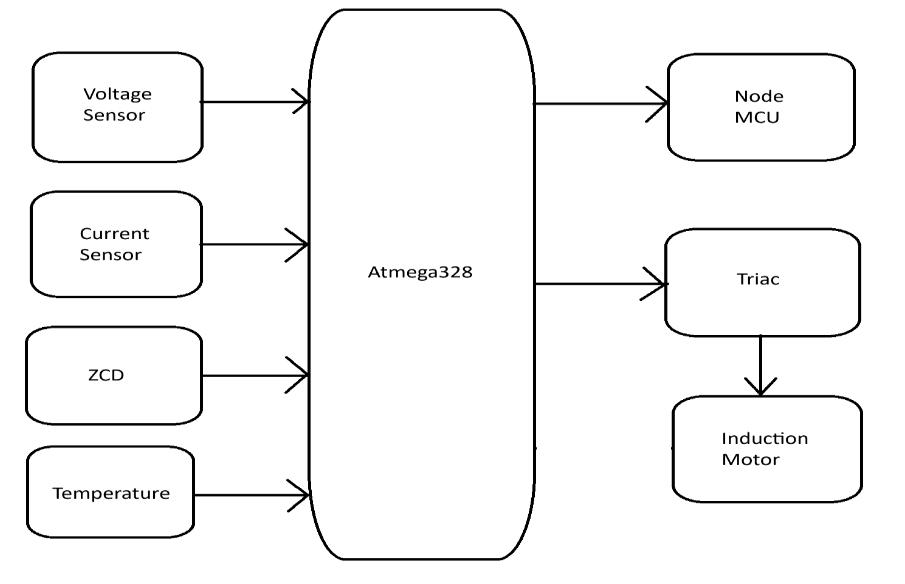
Fig.1.SystemArchitecture
International Research Journal of Engineering and Technology (IRJET)
Volume: 12 Issue: 05 | May 2025 www.irjet.net
System Flow
1. ACMainsInput→ZCDCircuit:
o TheZCDdetectsthepointatwhichtheAC signal crosses zero and sends a timing pulsetotheATmega328.
2. Microcontroller(ATmega328):
o Uses ZCD pulse to determine the correct delayforTRIACfiring.
o Adjusts firing angle based on input from IoTplatform.
o Reads voltage, current, and temperature sensordata.
3. TRIACCircuit(MOC3021+BT136):
o Triggered by the ATmega328 after a calculateddelay.
o Regulatespowertothemotorbyadjusting theconductiontimeofACwaveform.
4. SensorFeedback→NodeMCU:
o ATmega328 sends sensor data to NodeMCUviaserialcommunication.
o NodeMCU uploads data to an IoT cloud platform and can also receive user commands.
5. IoTCloudPlatform(Blynk/ThingSpeak):
o Displaysreal-timeparameters.
o Allowsremoteuserstoadjustmotorspeed throughamobileapporwebinterface.
6. OutputtoMotor:
o The motor operates with variable speed basedonthecontrolledACpowerinput.
1. Communication Architecture
ATmega328↔NodeMCU(UART):Exchangeofsensordata andcontrolinstructions.
NodeMCU ↔ Cloud (Wi-Fi): Remote monitoring and control.
e-ISSN:2395-0056
p-ISSN:2395-0072
User ↔ Mobile/Web App: Live control and data viewing throughthecloud.
2. Safety and Power Supply
Opto-Isolator (MOC3021): Ensures electrical isolation betweencontrolandpowercircuits.
7805 Regulator: Converts unregulated DC to a stable 5V for microcontrollerandsensors.
3. User Interface
LCD Module (16x2): Displays motor voltage, supply voltage, current,andtemperature.
Mobile App (e.g., Blynk): Allows remote speed control and livedatamonitoring.
The implementation of the IoT-based speed control and monitoringsystemforaninductionmotorwascarriedoutusinga modular and structured approach. The hardware was developed first by constructing the zero-crossing detector (ZCD) circuit to detecttheexactpointwheretheACwaveformcrosseszero,which is essential for accurate phase angle control. The ATmega328 microcontroller was programmed to calculate the appropriate firing delay after each zero crossing and to trigger the TRIAC through an opto-isolator (MOC3021), which provides electrical isolation between the microcontroller and the high-voltage AC circuit. The TRIAC (BT136) was used to control the power deliveredtothemotor,enablingvariablespeedoperation.
Twovoltagesensorswereusedinthisproject onetomeasure the input supply voltage and another to monitor the voltage across the motor after phase control. Additionally, a current sensor (ACS712) and a temperature sensor (DS18B20) were integrated to monitor the motor’s electrical load and operating temperature in real time. All sensor readings were collected by the ATmega328 and transmitted to the NodeMCU (ESP8266) using UART serial communication. The NodeMCU was programmed to connect to a Wi-Fi network and communicate with a cloud-based IoT platform such as Blynk or ThingSpeak. This enabled remote monitoring of motor parameters and allowed users to control the motor speed through a mobile application.
The software for both the microcontroller and the NodeMCU was developed using the Arduino IDE. The ATmega328 was programmed inembedded C to manage TRIAC firing and sensor interfacing,whiletheNodeMCUhandlednetworkcommunication and cloud integration.A 16x2 LCDdisplaywasadded toprovide
International Research Journal of Engineering and Technology (IRJET) e-ISSN:2395-0056
Volume: 12 Issue: 05 | May 2025 www.irjet.net p-ISSN:2395-0072
local feedback by displaying real-time values of voltage, current, and temperature. After successful integration, the system was tested and calibrated to ensure accuracy and responsivenessundervariousloadconditions.
1. The methodology adopted for this project involves the combination of phase angle control, sensor-based monitoring,andIoTcommunicationtoachieveefficientand remote speed control of a single-phase induction motor. Initially,aZeroCrossingDetector(ZCD)circuitwasdesigned toidentifytheexactpointswheretheACwaveformcrosses zero volts. These points are essential for synchronized TRIACtriggering,whichisusedtovarythephaseangleand control the amount of power delivered to the motor. The ATmega328 microcontroller receives the zero-crossing signal and calculates the firing delay based on user input, whicheffectivelycontrolsthemotor’sspeed.
2. Tomonitorthesystem’sperformance,varioussensorswere integrated. Two voltage sensors (ZMPT101B) were used one to measurethe supplyvoltage andanother tomeasure the voltage reaching the motor after control. A current sensor (ACS712) was used to measure the motor’s load current, and a temperature sensor (DS18B20) monitored themotor’ssurfacetemperaturetopreventoverheating.All sensor data were collected by the ATmega328 and sent to theNodeMCU(ESP8266)viaserialcommunication.
3. The NodeMCU acts as a bridge between the local system and the internet. It connects to a cloud platform (such as BlynkorThingSpeak)usingWi-Fi,allowingreal-timedatato be uploaded and displayed on a mobile application. Users can monitorthe motor’s voltage, current, and temperature, and can also control the speed remotely using the app interface. The system is powered using a regulated DC supply derived from a 7805 voltage regulator, and an LCD displayisusedtoshowlivereadingslocally.
4. The entire system was built, tested, and calibrated in stages, starting with individual component testing and ending with full integration. Special attention was given to electricalisolation,protectioncircuits,andsoftwarelogicto ensure the system is reliable, safe, and responsive. This structuredmethodologyallowedsuccessful implementation ofasmart,IoT-basedinductionmotorcontrolsystem.
IoTIntegrationforRemoteControl
– Unlike earlier systems that relied on manual speed adjustment, our system enables remote speed control through a mobile application using the NodeMCU (ESP8266)andWi-Ficonnectivity.
DualVoltageMonitoring
– We use two voltage sensors to monitor both the input supply voltage and the controlled motor-side voltage, whichoffersbettervisibilityintopowerqualityandTRIAC performance an improvement over single-sensor systems.
ComprehensiveParameterMonitoring
– In addition to voltage, our project monitors current and temperature, giving users a complete overview of motor health previous designs often neglected these parameters.
TRIACControlwithZero-CrossingSynchronization
–Oursystemusesazero-crossingdetector(ZCD)toensure phase-aligned TRIAC triggering, achieving smoother and more accurate speed control compared to crude firing circuitsusedinearliermethods.
BidirectionalCommunication
– Unlike many projects that only display data on an LCD, ourdesignsupportsbidirectionalcommunication,allowing users to both monitor and control the motor in real-time viatheinternet.
Cloud-BasedDataLogging
– Our system uploads data to a cloud platform (such as ThingSpeakor Blynk),enablingremoteaccesstohistorical performance data, which most traditional systems do not support.
ImprovedSafetyandIsolation
– We incorporate opto-isolators (MOC3021, PC817) and regulatedpowercircuitstoenhancesafety,protectingboth theuserandmicrocontrollerfromACpowerfaults.
User-FriendlyInterface
– The mobile app interface makes the system more accessible and intuitive than conventional knob- or dialbasedspeedcontrollers.
CompactandModularDesign
–Ourprojectisdesignedtobecompact,scalable,andeasily modifiable for different motor capacities or industrial use cases.
SmartAlertsandThresholdDetection
–Thesystemcanbeconfiguredtoalertuserswhenvalues (e.g., current or temperature) exceed predefined thresholds anintelligentfeaturemissinginoldersystems.
International Research Journal of Engineering and Technology (IRJET) e-ISSN:2395-0056
Volume: 12 Issue: 05 | May 2025 www.irjet.net p-ISSN:2395-0072
TheproposedIoT-basedspeedcontrolandmonitoringsystemfor a single-phase induction motor successfully combines microcontroller-based TRIAC control with real-time sensing and cloud connectivity. By using voltage, current, and temperature sensors, the system ensures safe and efficient motor operation. The integration of NodeMCU enables remote monitoring and control via a mobile application, enhancing user convenience. Zero-crossingdetectionensuresprecisephasecontrol,resultingin smooth speed regulation. The dual-voltage monitoring adds reliability to the system’s feedback loop. This project demonstratesasmart,low-costsolutionsuitableforindustrialand agricultural applications. Future enhancements can include overload protection and integration with AI-based predictive maintenance.
References
1) N. Kumar, D. Singh, “IoT Based Smart Speed Control of InductionMotor,”IJERT,Vol.9,Issue5,2020.
– This paperpresentsasimilarIoT-based speed control system using microcontrollers and cloud platforms, offeringinsightsintoreal-timemonitoring.
2) A. M. Trzynadlowski, Introduction to Modern Power Electronics,Wiley,2ndEdition,2010.
– This book provides foundational concepts in power electronics,includingTRIAC-basedACpowercontroland motordrivetechnologies.
3) M. H. Rashid, Power Electronics: Circuits, Devices and Applications,PearsonEducation,4thEdition,2013.
–Astandardreferenceforunderstandingthetheoryand design of TRIAC control, zero-crossing detectors, and phasecontrolofACmotors.
4) S. A. Bhosale, R. J. Funde, “Speed Control of Induction Motor Using Microcontroller and TRIAC,” IJERT, Vol. 4, Issue5,2015.
– Discusses the use of microcontroller-based TRIAC firing for speed variation, similar to your implementation.
5) A. Patel, K. Pandya, “Speed Control of Single Phase Induction Motor Using Android Application,” IJERA, Vol. 7,Issue5,2017.
– Explores Android-based remote control of induction motors using Bluetooth, contrasting with your cloudbasedIoTapproach.
6) EspressifSystems, NodeMCU(ESP8266)Datasheet
– Official datasheet detailing the specifications, pin configuration,andnetworkcapabilitiesoftheNodeMCU usedinyourproject.
7) AtmelCorporation, ATmega328P Datasheet,Availableat: https://www.microchip.com/enus/product/ATmega328P
– Provides detailed information on the microcontroller used for TRIAC firing control, sensor interfacing, and communicationwithNodeMCU.
8) ThingSpeak IoT Platform Documentation, Available at: https://thingspeak.com/docs/
–Referenceforunderstandinghowtosetup,visualize,and uploadsensordatatotheThingSpeakcloudplatform.
9) Blynk IoT Platform Documentation, Available at: https://docs.blynk.io
–Offersguidanceondevelopingmobileappstocontroland monitorhardwaredeviceslikeNodeMCUinrealtime.
10) A.M.Galadanci,etal.,“SpeedControlofACInductionMotor Using TRIAC and Microcontroller,” IJSER, Vol. 9, Issue 3, 2018.
– Explores motor control using TRIACs and microcontrollers, useful for designing your zero-cross and TRIACfiringcircuits.
11) N. R. Patel, P. Shah, “Design and Implementation of Smart MotorControlUsingIoT,”IEEEInternationalConferenceon IoT,2019.
– HighlightsIoT-based monitoringand controlsystemsfor AC motors, supporting the integration aspect of your project.
12) ACS712 Current Sensor Datasheet, Allegro MicroSystems, Available at: https://www.sparkfun.com/datasheets/BreakoutBoards/0 712.pdf
– Details electrical characteristics and usage instructions for the ACS712 current sensor module used for load monitoring.