
International Research Journal of Engineering and Technology (IRJET) e-ISSN: 2395-0056
Volume: 12 Issue: 05 | May 2025 www.irjet.net p-ISSN: 2395-0072
International Research Journal of Engineering and Technology (IRJET) e-ISSN: 2395-0056
Volume: 12 Issue: 05 | May 2025 www.irjet.net p-ISSN: 2395-0072
*Prof. Amruta Chaudhari, Gaurav Tayade, Aishwarya Mahankar, Shamal Kherde
*Professor of Department of Electronics and Telecommunication Engineering, DRGITR Amravati, Maharashtra Student of Department of Electronics and Telecommunication Engineering, DRGITR Amravati, Maharashtra ***
Abstract - Today, parking has become a major problem due to the rising usage of cars everywhere. We are introducing an Internet of Things (IoT)-enabled parking system that allows users to view and book parking spaces. For security purposes, we have an RFID reader placed at the entry gate. Making it easier for consumers to determine whether parking spots are available at an excessive parking area prior to coming is the primary goal of this project. All parking system issues are significantly reduced as a result of the more clever and efficient parking mechanism that is produced. Every slot has a sensor that continuously checks its condition and updates the data to the cloud platform and application, which allows users to verify parking availability and reserve a spot.
Key words: IoT, sensors, cloud platform, smart parking, secured parking, etc.
The Internet of Things (IoT) uses the internet to link differentphysicalitemsanddevicesworldwide.TheInternet ofThings(IoT)isasystemthatlinkscomputers,machines, etc. that have been assigned unique identities (UIDs). It allowsdatatobesentacrossanetworkwithouttheneedfor communicationbetweentheobjects[1-4].IoTisessentially an extension of Internet-based services [5-8]. In order to collect and share data over a network without requiring human-to-human or human-to-computer interaction, the InternetofThings(IoT)isanetworkofphysicalobjects,such as instruments, devices, and other items embedded with electronics, circuits, software, sensors, and network connectivity[9–11].TheInternetofThingsmakesitpossible to remotely sense and control objects over an existing networkinfrastructure.alsocreatingopportunitiesformore directintegrationofthephysicalworldintocomputer-based systems,andleadingtoimprovedefficiencyandaccuracy
Component Description
ESP8266 The project's brain is a Wi-Fi module (NodeMCU). It manages other parts and establishesaconnectionwiththeinternet.
3.7VCell Thesystemispoweredbyarechargeable battery,suchasaLi-ion18650.
7805Voltage Regulator Transforms3.7Vto5Vregulatedoutputfor LCDandservocomponents.
IRSensor Detectsthepresenceofavehicle(entranceor exit).
ServoMotor regulatestheopeningandclosingofaparking gateorbarrier.
LCD(16x2) showstheparkingstatus(e.g.,"SlotFull"or "SlotAvailable").
JumperWires utilizedforallelectricalconnections.
CellHolder attachesthe3.7Vcelltothecircuitandholds itfirmly.
Table -1: ComponentDescription
2. BLOCK DIAGRAM
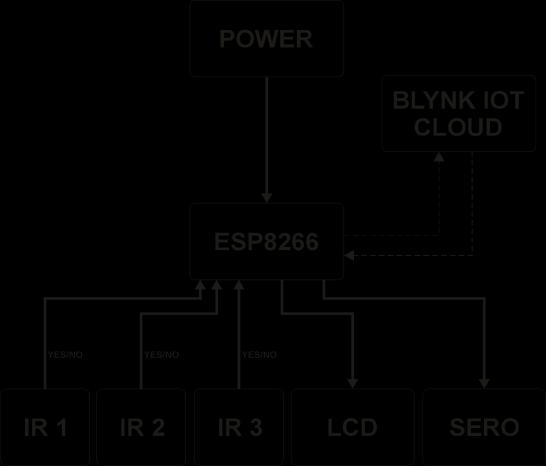
Fig.1: Proposedsystemblockdiagram
Todeterminewhethertherearecarsinparkingspaces,the ESP8266NodeMCU,theprimarycontrolleroftheInternetof Things-based smart parking system, gets data from IR sensors(IR1,IR2,andIR3).TheESP8266usessensorinput tocontrolaservomotorthatopensorclosestheentrygate and shows the parking status in real time on an LCD. Additionally,ittransmitsreal-timeparkingdatatotheBlynk IoTCloud,enablinguserstoUseasmartphonetoverifythe slots'availabilityremotely.Theentiresystemispoweredby adedicatedpowersource.
Volume: 12 Issue: 05 | May 2025 www.irjet.net p-ISSN: 2395-0072
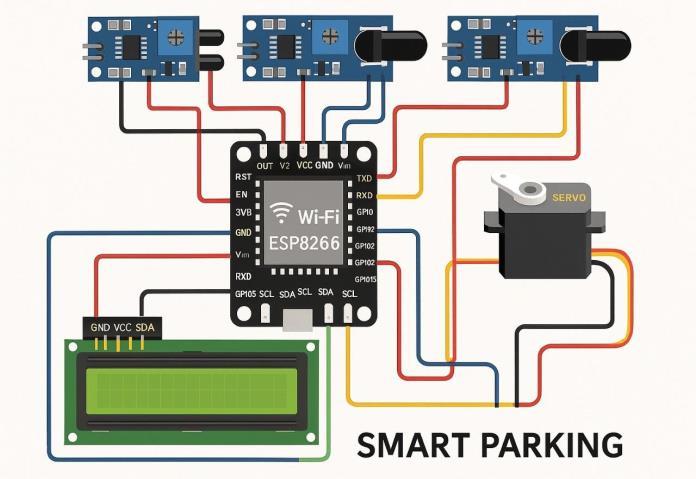
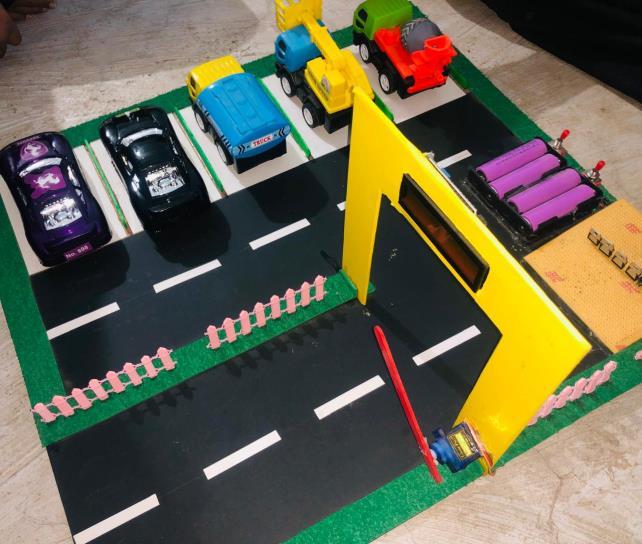
Fig.2:
Threeinfraredsensors,anLCDscreen,andaservomotorare all connected to the circuit's ESP8266 NodeMCU, which serves as its primary controller. When cars are found in parkingspaces,theIRsensorsrelaysignalstotheESP8266 viadigitalpins.TheESP8266continuouslyrefreshestheLCD displaytoindicateslotavailabilitybasedonsensorinputs. Additionally,itmanagesaservomotorthatopensorcloses the parking gate automatically when a space becomes available.Furthermore,thesystemusestheESP8266'sbuiltinWi-Fitoconnecttotheinternetandtransmitsreal-time parkingdatatotheBlynkIoTCloud,enablingcustomersto verifyslotstatus remotelythrougha mobileapp.TheVCC and GND pins on the NodeMCU provide power to every component.
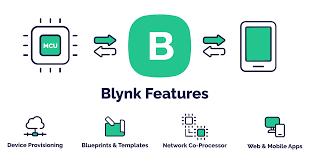
Fig.3: Blyink
An IoT-Based Smart Parking System using the ESP8266 NodeMCUmakesuseoftheBlynkIoTplatform.Blynkmakes itpossibleforthemicrocontrollerandauser'ssmartphone orwebapplicationtocommunicateseamlessly.Anetwork co-processorforreliablecloudconnectivity,blueprintsand templates for effective project design, and device provisioningforafastandsecurehardwareconnectionare
some of the key features. Additionally, the technology supportsbothonlineandmobileapps,givingusersreal-time gate access control and remote parking space availability monitoring. The system is intelligent, easy to use, and availablefromanylocationthankstoitsconnection.
A7805voltageregulatortransformsthe3.7VLi-ionbattery that powers the Smart Parking System into the steady 5V output needed by parts like the LCD display and servo motor. As the main controller, the ESP8266 (NodeMCU) managesthesystem'slogic.Inordertoidentifycarsasthey comeorgo,itinterruptstheinfraredbeamafterprocessing informationfromanIRsensorattheparkingentrance/exit. TheESP8266triggersaservomotortoraiseagate,lettinga carpasswhenparkingspacesbecomeavailable.Theservo closes the gate after a brief pause. The 16x2 LCD display, which indicates parking status (such as the number of availableslotsor"SlotFull"),isupdatedconcurrentlybythe ESP8266. An I2C module connects to the LCD, simplifying wiringandloweringthenumberofpinsneeded.Thesystem mayremotelymonitorparkingavailabilitybysendingdata toaninternetserverorappwithoptionalWi-Ficonnectivity. Jumper wires are used to arrange the complete system, whichmakesmaintenanceandtroubleshootingsimple.
IoT-based smart parking systems based on ESP8266 NodeMCU can increase productivity, enhance user experience,andautomateparkingoperations.Futurescope includes advanced features like AI-powered navigation, automatedbilling,andseamlessintegrationwithsmartcity infrastructure.Thissystemcanspeeduptheentireparking process, from finding available spots to paying and departing, thanks to automated gate operations and realtimeparkingavailabilityupdates.
International Research Journal of Engineering and Technology (IRJET) e-ISSN: 2395-0056
Volume: 12 Issue: 05 | May 2025 www.irjet.net p-ISSN: 2395-0072
Inthepastfewyears,great strideshavebeenmadeinthe realizationofsmartcities.AscloudandInternetofThings technologies have advanced, there are now more possibilitiesforsmartcities.Intelligentparkingstructures and traffic management systems have long been the cornerstonesofcreatingsmartcities.Inthisstudy,wetackle theparkingissueandpresentanInternetofThings-based cloud-integrated smart parking system. Our suggested solution provides up-to-date data on parking lot space availability.Usersfromdistantlocationscanbookaparking spot for themselves using our smartphone application. Enhancing a city's parking infrastructure is the aim of the workdescribedinthisarticleinordertoimprovethequality oflifeforitsresidents.
[1]S. K.Nookala Venu(2022).IJFANS,11 (1),2323-2330. Machine Learning Application for Medicine Distribution ManagementSystem.
[2] S. W. Nookala Venu (2022). A Deep Learning-Based Wearable Drug Recognition System for Visually Impaired Individuals.12(1),IJFANS,2340-2348.
[3]ResearchandExperimentalAnalysisonFBMCandOFDM byDr.Nookala,VenuandSoujanya,NamojuandGoud,Burra Megamala and Bhavani, Thakur Yuktha and Rajashekar, Appidi(July2022).InnovativeEngineeringandManagement ResearchInternationalJournal(IJIEMR)
[4]Venu,AmruthaandDr.Nookala,SandhyaandKatti,Sai KrishnaandAnanthula,RaniB,UtilizingIoTtoTrackthe NearestGasPumpsandMonitorVehicleFuelLevel(July 2022).InnovativeEngineeringandManagementResearch InternationalJournal2022,
[5] A, Shiva and U, Krishnaveni and Priya R, Face Mask Detection System Using Python Open CV by Supriya and Tahseen, Anjum and Dr. Nookala, Venu (July 2022). Innovative Engineering and Management Research InternationalJournal2022,
[6]Raffiudhin,AlcoholDetectionandEngineLockingSystem, Dr.Nookala,VenuandM,VamshiandV,AkhilandK,Deepika andK,PrashanthandM(July2022).InnovativeEngineering andManagementResearchInternationalJournal2022.