
International Research Journal of Engineering and Technology (IRJET) e-ISSN: 2395-0056
Volume: 13 Issue: 02 | Feb 2026 www.irjet.net p-ISSN: 2395-0072
International Research Journal of Engineering and Technology (IRJET) e-ISSN: 2395-0056
Volume: 13 Issue: 02 | Feb 2026 www.irjet.net p-ISSN: 2395-0072
Rahul Burange1, Rutvik More2, Riya Deshpande3,Yash Bisen4,Mayur Bawane5,Rutuja Madewar6
1Assistant professor, Dept of Electronics and Telecommunication, KDK College of Engineering, Maharashtra, India 23456UG student, Dept of Electronics and Telecommunication, KDK College of Engineering, Maharashtra, India
Abstract - The Internet of Things (IoT) is playing a transformative role in upgrading traditional educational campuses into intelligent, automated, and data-centric environments. An IoT-enabled Campus Management System integrates smart sensors, embedded devices, wireless networks, and cloud platforms to support core institutional functions such as attendance automation, energy optimization, security monitoring, environmental tracking, and facility management. By collecting and analyzing continuousreal-timedata,IoTsystemsimproveadministrative efficiency, reduce unnecessary resource utilization, enhance safetymechanisms,andenableinformeddecision-making.As academicinstitutionsgrowinsizeandoperationalcomplexity, IoT solutions offer centralized visibility and scalable coordinationacrossmultiplecampusdomains.Theintegration ofcloudanalyticswithedgecomputingfurtherenablesrapid responses,predictivemaintenance,occupancyforecasting,and proactivefaultdetection.Additionally,IoT-drivenapplications promote sustainability by lowering energy consumption, improving water management, and reducing waste. Despite these advantages, issues such as interoperabilityconstraints, privacy concerns, cybersecurity threats, and high implementationcostsremainbarrierstowidespreadadoption. This review evaluates existing IoT-based smart campus frameworks, highlights their benefits and challenges, and discusses emerging opportunities for designing efficient, secure, andsustainablecampus infrastructures.
Key Words: IoT, Smart Campus, Automation, Cloud Computing, Energy Management, Smart Security, WSN, Environmental Monitoring, Resource Optimization.
TechnologicaladvancementsintheInternetofThings(IoT) have significantly reshaped modern digital ecosystems by enablingseamlesscommunicationamongphysicaldevices, computational systems, and human users. Educational campuses ranging from schools to multi-building university environments are increasingly implementing IoT-based solutions to enhance operational efficiency, improve service delivery, and support sustainability initiatives. Campus environments are inherently complex, involving academic tasks, administrative coordination, facility operation, energy management, and security supervision. Traditional manual approaches often lead to inefficiencies,higheroperationalcosts,andlimitedaccessto real-timeinformation.
IoT-enabled Smart Campus Management Systems aim to overcometheselimitationsbydeployingdistributedsensors, embeddedcontrollers,wirelessnetworks,andcloud-based analytics to automate and optimize campus processes. Sensorscontinuouslymonitorclassroomoccupancy,energy usage, environmental conditions, equipment status, water utilization, and movement patterns. This real-time data supports data-driven decision-making and enables administrators to improve resource allocation and detect abnormalsituations.
RFID systems and biometric devices simplify attendance management,whileoccupancy-basedsensinghelpsregulate lightingandHVACusagetoreduceenergyconsumption.IoTdriven environmental monitoring ensures healthy indoor conditions, and intelligent surveillance systems improve campus security through live alerts and automated event detection. These capabilities demonstrate how IoT can transform conventional campuses into adaptive and intelligentecosystems.
Smart campus models also align with sustainability objectives, as educational institutions consume significant energy and water. IoT-based monitoring helps identify inefficiencies and supports predictive maintenance strategies. Mobility solutions such as smart parking, shuttle tracking, and traffic analytics further reduce congestion and environmental impact. Cloud–edge computing integration enhances scalability, real-time responsiveness,andsecureremoteaccessibility.
However, despite its potential, IoT deployment faces challenges such as device incompatibility, cybersecurity threats,highinstallationcosts,andconnectivitylimitations acrosswidecampusareas.Additionally,theheavyreliance oncloudprocessingmayaffectlatencyduringtime-critical operations.
Overall, IoT represents a vital technological evolution for educational institutions seeking efficiency, safety, sustainability,andsmartresourcemanagement.Thisreview examines current research in IoT-based campus systems, identifies gaps, and proposes an integrated architecture suitablefornext-generationsmartcampusenvironments.
International Research Journal of Engineering and Technology (IRJET) e-ISSN: 2395-0056
Volume: 13 Issue: 02 | Feb 2026 www.irjet.net p-ISSN: 2395-0072
a)Cavusetal.(2022) –ComprehensiveIoTSmartCampus FrameworkCavusetal.conductedasystematicreviewofIoT applicationswithinsmartcampusecosystems,focusingon areassuchasenvironmentalmonitoring,smartclassrooms, energymanagement,andresourcegovernance.Theirwork emphasizes the importance of reliable communication technologies(e.g.,Wi-Fi,Zigbee,LoRaWAN)andhighlights challengeslikeinteroperability,privacyrisks,andnetwork instability. Their findings establish a solid foundation for designing scalable and unified campus management frameworks.
b) Pooja et al. (2016) – IoT-Integrated Smart Campus Prototype Pooja and colleagues designed a low-cost prototypeintegratingRFID-basedattendancetracking,PIRbased lighting automation, robotic cleaning, and drone monitoring. The prototype showed improved surveillance andreducedenergyconsumptionbutfacedissuesrelatedto hardwaredurability.Nevertheless,itdemonstratesthateven inexpensive IoT setups can significantly enhance campus automation.
c)Vermaetal.(2015)–IoTforWaterResourceMonitoring Vermaetal.developedanIoT-enabledwatermanagement system using tank-level sensors and sub-GHz communicationtomanagewaterresourcesininstitutional campuses. Automated pump control and real-time monitoring reduced water waste and improved planning, demonstratingIoT’simpactonsustainability.
d)Villegas-Chetal.(2020)–AdministrativeIoTDashboard Their work presents a centralized dashboard integrating occupancy metrics, energy consumption, environmental data, andnetwork performance.Thedashboardimproved decision-making,minimizedreportingerrors,andenhanced responsivenesstoabnormalconditions,demonstratingthe valueofintegratedcampusanalytics.
e)Islametal.(2019)–SmartClassroomAutomation Islam etal.integratedRFID,motionsensors,andcloudanalyticsto automateattendancesystemsandcontrolHVACoperations based on occupancy. Their system effectively recognized usagepatternsandreducedelectricitywastage.
f)Alietal.(2020)–IoT-DrivenSurveillanceandSafetyAli andcolleaguesdevelopeda surveillancemodel combining cameras, intrusion sensors, and emergency alert mechanisms.Cloudanalyticsenabledreal-timemonitoring andrapidresponse,thoughtheauthorsemphasizedtheneed forstrongerprivacyandsecurityprotections.
g) Raman et al. (2021) – Smart Mobility and Transport ManagementRamanetal.introducedanIoTmobilitysystem withGPS-basedshuttletracking,smartparking,andtraffic analytics.Theirmodelreducedcongestionandwaitingtimes, improvingtransportationefficiencyoncampus.
h) Gupta et al. (2020) – Smart Waste and Hygiene Management Their IoT system used ultrasonic sensors to monitorwaste-binfilllevels,reducingunnecessarymanual inspectionsandpreventingoverflow.Thisstudyhighlights IoT's value in improving cleanliness and operational workflows.
i) Padmanaban et al. (2018) – Energy-Efficient Smart BuildingsTheauthorsimplementedanIoT-poweredenergy managementsystemfeaturingsmartmetersandautomated controls. Their results showed significant reductions in electricityusageacrosscampusbuildings.
j)Chatterjeeetal.(2021)–EnvironmentalIoTMonitoring System This study developed an IoT system measuring temperature, humidity, air quality, and CO₂ levels. Automated alerts enabled better ventilation management andensuredhealthyclassroomconditions.
IoT-enabled campus systems have shown considerable success in automating routine tasks, improving energy efficiency, and enhancing safety. Previous studies demonstrate effective implementations of attendance automation,smartenergyregulation,environmentalsensing, and real-time surveillance. These findings confirm that continuous sensor-driven data collection combined with cloudanalyticscansignificantlyenhancecampusoperations.
However,severallimitationspersist.Deviceinteroperability remains a major concern due to varying communication standards across manufacturers. Security and privacy risks suchasunauthorizedaccessordatabreaches pose serious threats, given the sensitive nature of campus information. High implementation and maintenance costs limit adoption in smaller institutions. Furthermore, many existing systems function independently, lacking a centralizedcampus-wideintegrationframework.
Another gap lies in the heavy reliance on cloud-based computation,whichmaycauselatencyduringemergencies. Additionally,predictiveanalytics essentialforforecasting occupancy patterns, equipment failures, or abnormal behavior remainsunderutilizedincurrentsystems.
Thus, future research must address the need for secure, interoperable,cost-efficient,andanalyticallyadvancedIoT architecturesforfullyintelligentcampusenvironments.
TheproposedIoT-basedSmartCampusArchitecture(Fig.1) outlinesamulti-layermodeldescribingtheflowofdatafrom sensing devices to automated campus applications. Each layer contributes to continuous monitoring, efficient data handling,andintelligentdecision-making.
International Research Journal of Engineering and Technology (IRJET) e-ISSN: 2395-0056
Volume: 13 Issue: 02 | Feb 2026 www.irjet.net p-ISSN: 2395-0072
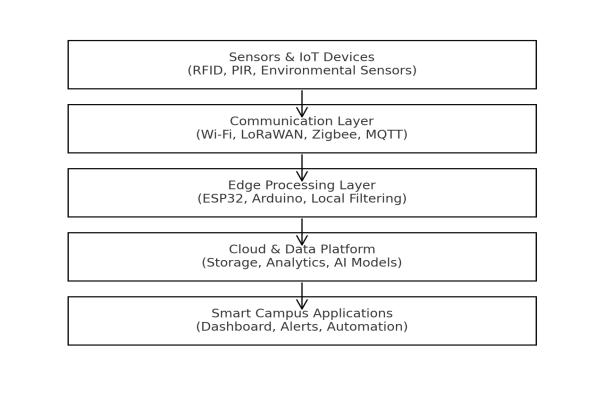
-1:IoT-BasedSmartCampusManagementSystem Architecture.
A. Sensing and Data Acquisition Layer This foundational layerincludesa networkofIoTsensorsdistributedacross thecampus.DevicessuchasRFIDmodulesforattendance tracking, PIR sensors for occupancy detection, environmental nodes for temperature and air-quality monitoring, and ultrasonic sensors for water-level measurement collect continuous operational and environmentaldata.Thesesensorsconvertphysicalsignals into digital information, which forms the input for subsequentprocessinglayers.
B.CommunicationLayerDatageneratedbythesensinglayer is transmitted via wireless communication technologies including Wi-Fi, Zigbee, LoRaWAN, and MQTT-based messaging systems. These protocols support efficient, reliable, and energy-conscious data transfer across classrooms, administrative buildings, hostels, and open spaces. Long-range technologies such as LoRaWAN are especiallysuitedforlow-powerapplicationslikewaste-bin monitoringorremotewater-tankmeasurement.
C.EdgeProcessingLayerMicrocontroller-basednodessuch as ESP32 and Arduino operate as edge-processing units responsible for initial data refinement. Tasks at this level include signal filtering, compression, noise removal, and simple rule-based decision-making. By performing preliminaryprocessinglocally,thesystemreducesnetwork congestion and enables rapid responses for time-critical events such as intrusion detection or automatic lighting control.
D. Cloud and Data Management Layer The cloud infrastructureactsastheprimarycomputationalbackend, supportingextensivedatastorageandadvancedprocessing. This layer handles visualization, long-term analytics, machinelearning–basedpredictions,anomalydetection,and historical data evaluation. Secure interfaces and APIs connectthecloudservicestouserdashboardsandcampus applications, ensuring reliable access to processed information.
E. Application and Automation Layer This layer delivers actionable insights and automated operations to campus administrators. Key functionalities include automated attendance recording, intelligent energy regulation, realtime security alerts, facility scheduling, and indoor environmentalmanagement.Usersaccessdashboardsand reportsthatprovidesituationalawarenessandsupportdatadrivendecision-making.
F.SystemWorkflowSummaryTheoverallsystemworkflow beginswithsensornetworkscapturingreal-timedatafrom various campus domains. Edge processors refine and forwardthisdatathroughsecurecommunicationprotocols to the cloud. Cloud platforms analyze the incoming informationandtransformitintomeaningfulinsights.These insights are visualized via dashboards and subsequently triggerautomatedactions,suchaspoweringdownunused equipment or issuing alerts when abnormal patterns are detected. This structured workflow ensures reliable monitoring, responsive automation, and efficient campus administration.
The proposed IoT-enabled Smart Campus Management System presents a unified framework that enhances operational efficiency through real-time monitoring, intelligent analytics, and automated decision support. By integratingdiverseIoTdeviceswithrobustcommunication networks, the system ensures improved visibility into critical parameters such as security, environment, and energyusage.Thecombinationofedgeandcloudcomputing balances fast responsiveness with large-scale analytical capabilities.
Itsmodulararchitectureenablesscalabilityandseamless integrationofindependentsubsystems,supportingevolving campus requirements. By reducing operational costs, improvingresourceutilization,andpromotingsaferlearning environments,thesystempositionseducationalinstitutions for a smarter and more sustainable future. Further advancements involving AI, digital twins, and predictive maintenance can enhance the performance of nextgenerationsmartcampusecosystems.
[1] Xiao Nie, “Constructing Smart Campus Based on the CloudComputingPlatformandtheInternetofThings,” ICCSEE,pp1576–1578,China,2013
[2] M.HamalainenandP.Tyrvainen,"AframeworkforIoT service experiment platforms in smart-city environments," 2016 IEEE International Smart Cities Conference(ISC2),Trento,Italy,,pp.1-8,2016
[3] Jaegeol Yim , Jaehun Joo , Gyeyoung Lee and Kyubark Shim,“DesignandImplementationofaSmartCampus
International Research Journal of Engineering and Technology (IRJET) e-ISSN: 2395-0056
Volume: 13 Issue: 02 | Feb 2026 www.irjet.net p-ISSN: 2395-0072
GuideAndroidApp”,Appl.Math.Inf.Sci.8,No.1L,pp4753,2014
[4] G. N. Cristina, G. V. Gheorghita and U. Ioan, "Gradual Development of an IoT Architecture for Real World Things," 2015 IEEE European Modeling Symposium (EMS),Madrid,Spain,pp.344-349,2015
[5] M.Caţă,"Smartuniversity,anewconceptintheInternet of Things," 2015 14th RoEduNet International Conference - Networking in Education and Research (RoEduNetNER),Craiova,,pp.195-197,2015
[6] A.Alkhamisi,M.S.H.NazmudeenandS.M.Buhari,"A cross-layerframeworkforsensordataaggregationfor IoT applications in smart cities," 2016 IEEE International Smart Cities Conference (ISC2), Trento, Italy,pp.1-6,2016
[7] P. Vermaet al., "Towards an IoT based water management system for a campus," Smart Cities Conference (ISC2), 2015 IEEE First International, Guadalajara,pp.1-6,2015
[8] N.Kaur;S.K.Sood,"AnEnergy-EfficientArchitecturefor theInternetofThings(IoT),"inIEEESystemsJournal, vol.PP,no.99,pp.1-10
[9] J. Chin and V. Callaghan, "Educational Living Labs: A NovelInternet-of-ThingsBasedApproachtoTeaching and Research," Intelligent Environments (IE), 9th InternationalConferenceon,Athens,pp.92-99,2013
[10] J. Zhou, J. Riekki, ”Context-Aware Pervasive Service Composition”, International Conference on Intelligent Systems,ModellingandSimulation(ISMS),pp437-442, 2010
2026, IRJET | Impact Factor value: 8.315 | ISO 9001:2008