
International Research Journal of Engineering and Technology (IRJET) e-ISSN: 2395-0056
Volume: 13 Issue: 04 | Apr 2026 www.irjet.net p-ISSN: 2395-0072

International Research Journal of Engineering and Technology (IRJET) e-ISSN: 2395-0056
Volume: 13 Issue: 04 | Apr 2026 www.irjet.net p-ISSN: 2395-0072
Dr. Shah Fateh Azam1, Anshuman Singh2, Harsh Yadav3, Pappu Prajapati4, Aman Srivastava5
1Assistant Professor and HOD, Department of Mechanical Engineering 2,3,4,5Undergraduate Researchers, Department of Mechanical Engineering
KIPM College of Engineering and Technology, Gorakhpur Uttar Pradesh, India ***
Abstract: This research paper presents the design and development of an IoT-based motorized hydraulic jack system for vehicle lifting applications. In the modern era, automation has become an essential part of engineering to improve efficiency, accuracy, and ease of operation. Traditional hydraulic jacks require significant manual effort and are time-consuming, which makes them inconvenient, especially during emergency situations or for physically weak users.
The proposed system integrates mechanical, electrical, and IoT technologies to develop a smart lifting mechanism. It uses an ESP32 microcontroller, relay module, DC motor, and hydraulic pump. The ESP32 enables wireless communication through WiFi, allowing users to control the system remotely via a mobile application or web interface.
The working principle of the system is based on Pascal’s law, where pressure applied to a confined fluid is transmitted equally in all directions. The DC motor drives the hydraulic pump, which creates pressure inside the cylinder, resulting in the upward movement of the piston and lifting of the vehicle.
This system significantly reduces human effort, saves time, and improves operational efficiency. It also enhances safety and convenience, making it highly suitable for automobile workshops, service centers, garages, and roadside assistance. The project demonstrates the practical implementation of IoT in mechanical systems and highlights its potential for future smart automation solutions.
Keywords: IoT,HydraulicJack,ESP32,Automation,VehicleLifting,SmartSystem
Vehicleliftingisanessentialprocessinautomobilemaintenance,repair,andservicingoperations.Inworkshops,garages, andservicecenters,hydraulicjacksarecommonlyusedtoliftvehiclesforinspectionandrepairwork.However,traditional hydraulicjacksrequiresignificantmanualeffortandtime,whichcanbeinconvenientandphysicallydemandingforusers.
With the rapid advancement of technology, automation has become a key aspect of modern engineering systems. The integrationofIoT(InternetofThings)withmechanicaldevicesprovidesnewopportunitiesfordevelopingsmart,efficient, anduser-friendlysystems.IoTenablesremotemonitoringandcontrol,reducingtheneedformanualintervention.
ThisprojectfocusesonthedesignanddevelopmentofanIoT-basedmotorizedhydraulicjacksystem.Thesystemcombines mechanicalcomponentswithelectroniccontrolusinganESP32microcontroller.TheESP32allowswirelesscommunication viaWi-Fi,enablingtheusertooperatethesystemremotelyusingamobileinterfaceorwebapplication.
Themotorizedmechanismreplacesmanualeffortwithelectricaloperation.ADCmotorisusedtodrivethehydraulicpump, whichgeneratespressureinthefluid.AccordingtoPascal’slaw,thispressureistransmittedequally,causingthepistonto moveupwardandliftthevehicle.
Thissystemis particularly useful inemergency situations, roadside assistance, and for individualswho may findmanual liftingdifficult.Itimprovesefficiency,reduceshumaneffort,andenhancesoperationalsafety.
TheprojectdemonstrateshowIoTtechnologycanbeeffectivelyintegratedwithmechanicalsystemstocreateinnovative
International Research Journal of Engineering and Technology (IRJET) e-ISSN: 2395-0056
Volume: 13 Issue: 04 | Apr 2026 www.irjet.net p-ISSN: 2395-0072
and practical solutions for real-world problems. It also opens the door for further advancements in smart automation systemsintheautomobilesector.
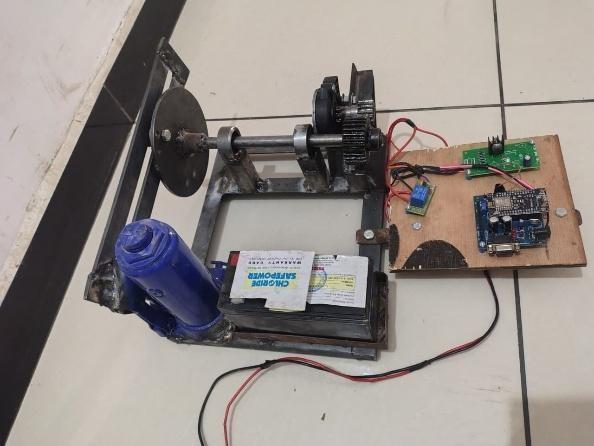
Traditional hydraulic jacks are widely used in automobile workshops, garages, and servicestationsforliftingvehicles during maintenanceandrepairwork.Although these jacks are simple in design and commonly available, they have several limitations that reduce their efficiency and usability in modern applications. One of the major drawbacks of traditionalhydraulicjacksisthattheyrequiresignificantmanualeffortto operate. The user has to continuously apply forcetoliftthevehicle,whichcanbephysicallyexhaustingandtime-consuming.
In real-life situations, especially during roadside emergencies such as vehicle breakdowns or tire punctures, using a manualjackbecomesevenmoredifficult.Theusermaynothaveenoughstrengthorproperconditionstooperatethe jackefficiently.Thiscreatesinconvenienceanddelaysinhandlingemergencysituations.Moreover,traditionaljacksare notsuitableforelderlypeopleorindividualswhoarephysicallyweak,makingthemlessuser-friendly.
Anothermajor limitation is theabsence of automation and remote-controlfunctionality. Conventional hydraulic jacks requiredirecthumaninteractionforoperation,whichincreaseseffortandreducesconvenience.Intoday'sworld,where automation and smart systems are becoming increasingly popular, there is a strong need for advanced solutions that minimizehumaninterventionandimproveeaseofuse.
Safetyisalsoasignificantconcernwhenusingmanualhydraulicjacks.Improperhandling,unevensurfaces,orsudden pressurereleasecanleadtoaccidentssuchasslippingofthejackorinstabilityoftheliftedvehicle.Thiscancausedamage tothevehicleaswellasseriousinjurytotheuser.Thelackofsafetyfeaturesintraditionalsystemsmakesthemunreliable incertainconditions.
Additionally,traditionaljacksdonotprovideanymonitoringorcontrol mechanismtoensuresafeoperation.Theuser must rely completely onmanual judgment, whichmay not always be accurate. This increases the risk of operational errors.
Therefore,thereisastrongneedtodevelopanadvancedandefficientsystemthatreduceshumaneffort,improvessafety, andprovidesremotecontrolcapability.TheintegrationofIoT(InternetofThings)withamotorizedhydraulicmechanism canoffer a smart solution to these problems. Such a system can automate the lifting process, allow remote operation throughamobileinterface,andenhanceoverallperformanceandreliability.Thisprojectaimstoaddresstheseissuesby developinganIoT-basedmotorizedhydraulicjacksystem.
International Research Journal of Engineering and Technology (IRJET) e-ISSN: 2395-0056
Volume: 13 Issue: 04 | Apr 2026 www.irjet.net p-ISSN: 2395-0072
The primary objective of this project is to design and develop an efficient and user-friendly IoT-based motorized hydraulicjacksystemforvehiclelifting.Thesystemaimstoreducemanualeffort,improvesafety,andenhancetheoverall performanceofconventionalliftingmechanisms.
One of the main objectives is to automate the vehicle lifting process by replacing manual operationwitha motorized mechanism.Thiswillhelpinreducingthephysicaleffortrequiredbytheuserandmakethesystemmoreconvenientand accessibleforallindividuals,includingelderlyandphysicallyweakusers.
Another important objective is to integrate IoT (Internet of Things) technology into the system. By using an ESP32 microcontroller,thesystemcanbeconnectedtoaWi-Finetworkandcontrolledremotelyusingamobileinterfaceorweb application.Thiswillallowuserstooperatethehydraulicjackfromasafedistance,improvingconvenienceandsafety.
Theprojectalsoaimstoimprovetheefficiencyandspeedofthe liftingoperation.TheuseofaDCmotorandhydraulic pumpensuressmoothandcontrolledmovementofthepiston,resultinginfasterliftingcomparedtomanualmethods.
Enhancingsafetyisanotherkeyobjectiveofthissystem.Byprovidingcontrolledmotoroperationthrougharelaymodule, theriskofsuddenmovementsoraccidentscanbeminimized.Thesystemisdesignedtoprovidestableandreliablelifting underproperconditions.
In addition, the project focuses on developing a cost-effective solution that can be easily implemented in real-life applications such as automobile workshops, garages, and roadside assistance services. The system should be simple design,easytomaintain,andreliableinoperation.
Finally,theprojectaimstodemonstratethepracticalapplicationofIoTtechnologyinmechanicalsystemsandhighlight thepotentialforfutureadvancementsinsmartautomationsystemsfortheautomobileindustry.
Themethodologyofthisprojectinvolvestheintegrationofmechanical,electrical,andIoT-basedsystemstodevelopa smartvehicleliftingmechanism.Thesystemisdesignedtoautomatetheliftingprocessusingamotorizedhydraulicjack controlledthroughwirelesscommunication.
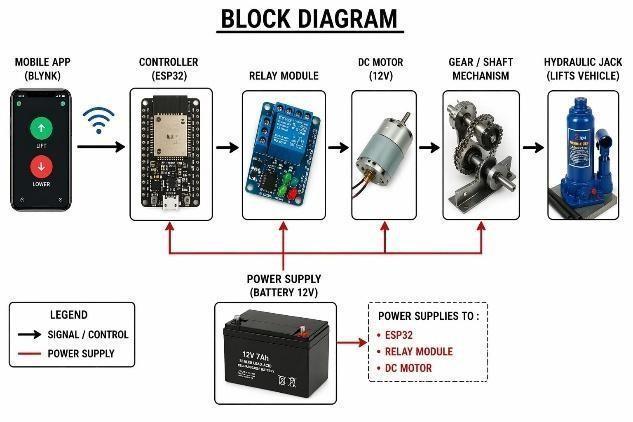
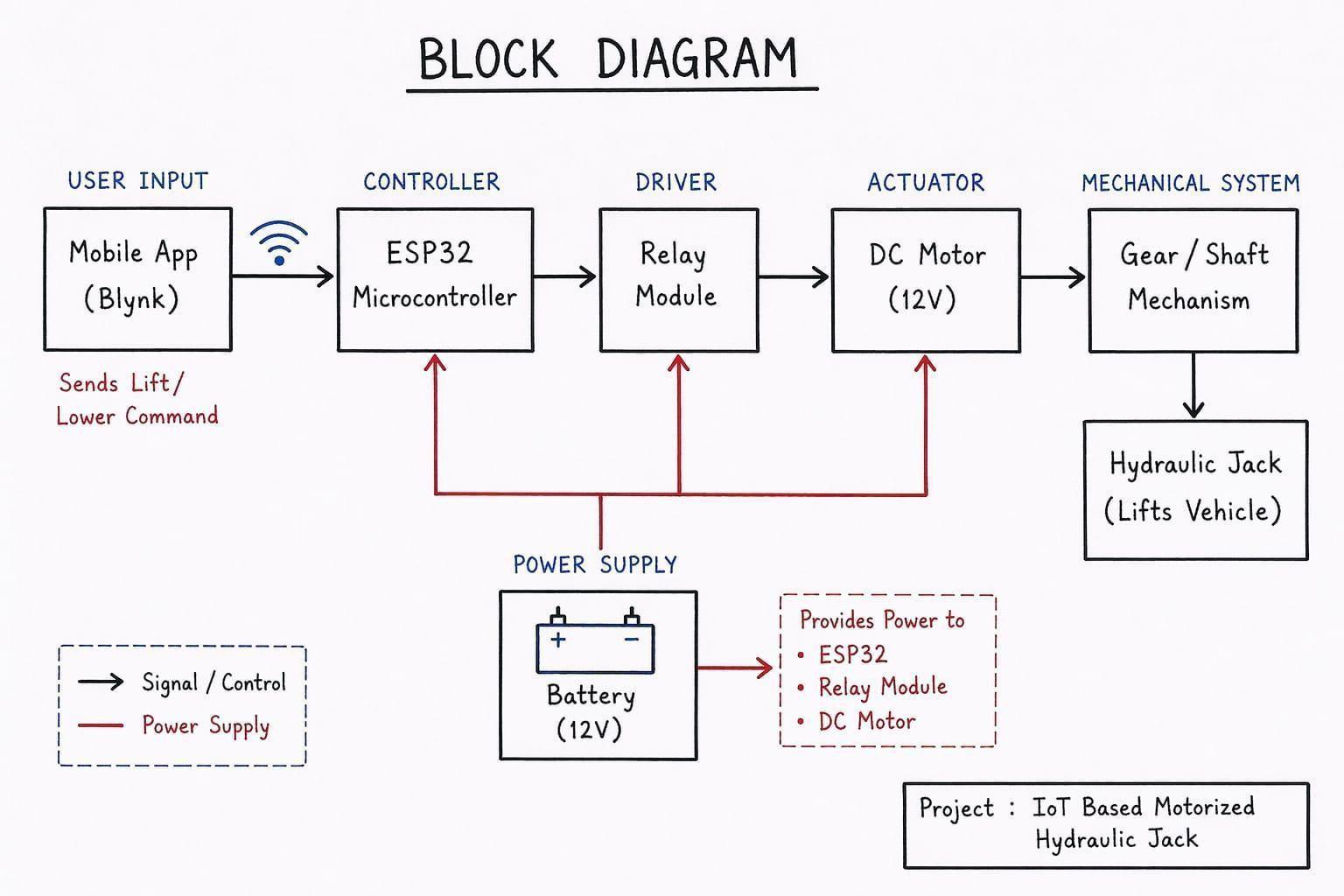
Theoperationofthesystembeginswiththeuserinterface,whichcanbeamobileapplicationoraweb-basedplatform. TheusersendsacommandsuchasONorOFFthroughtheinterface.ThiscommandistransmittedviaaWi-Finetwork totheESP32microcontroller,whichactsasthecentralcontrolunitofthesystem.
The ESP32 receives the signal and processes it according to the programmed instructions. Based on the received command,theESP32sends acontrolsignaltothe relaymodule.The relayactsasanelectricallyoperatedswitchthat allowsthelow-powersignalfromtheESP32tocontrolthehigh-powerDCmotor.
Whentherelayisactivated,itcompletesthecircuitandallowscurrenttoflowtotheDCmotor.Themotorstartsrotating anddrivesthehydraulicpump.Thehydraulicpumppushesoilintothecylinder,creatingpressurewithinthesystem.
AccordingtoPascal’slaw,thepressureappliedtoaconfinedfluidistransmittedequallyinalldirections.Thispressure causesthepistoninsidethehydrauliccylindertomove upward.Asthepistonmovesupward,thejackliftsthevehicle smoothlyandsteadily.
Theentireprocessiscontrolledremotely,whichreducesmanualeffortandincreasesconvenience.Thesystemensures smoothoperationbymaintainingpropersynchronizationbetweenelectricalandmechanicalcomponents.
International Research Journal of Engineering and Technology (IRJET) e-ISSN: 2395-0056
Volume: 13 Issue: 04 | Apr 2026 www.irjet.net p-ISSN: 2395-0072
In addition to the basic work, the system also ensures controlled and safe operation through proper coordination betweenallcomponents.Therelaymoduleplaysacrucialroleinmaintainingsafetybycontrollingtheswitchingofthe motor.Itpreventsdirecthighcurrentflowthroughthemicrocontroller,therebyprotectingthesystemfromelectrical damage.
ThepowersupplyunitprovidesthenecessaryelectricalenergyrequiredfortheoperationoftheESP32,relaymodule, andDCmotor.Astableandreliablepowersourceisessentialtoensuresmoothfunctioningofthesystem.Anyfluctuation inpowercanaffecttheperformanceofthemotorandtheliftingmechanism.
TheIoT-basedcontrolsystemenhancestheusabilityoftheprojectbyallowingremoteaccess.Theuserdoesnotneed tobephysicallypresentnearthejacktooperateit.This featureisparticularlyusefulinemergencysituationswhere quickactionisrequired.
The system also allows easyON and OFF control of the motor, which directly affects the lifting and lowering of the vehicle.Whenthe motoristurnedOFF,thehydraulic pressuregraduallyreleases,andthe pistonmovesdownward, loweringthevehiclesafely.
The design of the system is kept simple to ensure ease of use and maintenance. All components areconnectedina structuredmannertoachieveefficientperformance.Thecombinationofmechanicalandelectronicsystemsmakesthe projectinnovativeandpractical.
This methodology demonstrateshow moderntechnology such as IoTcan beintegrated with traditional mechanical systemstoimproveefficiency,safety,anduserconvenience.Itprovidesastrongfoundationforfurtheradvancements inautomationandsmartvehiclemaintenancesystems.
International Research Journal of Engineering and Technology (IRJET) e-ISSN: 2395-0056
Volume: 13 Issue: 04 | Apr 2026 www.irjet.net p-ISSN: 2395-0072
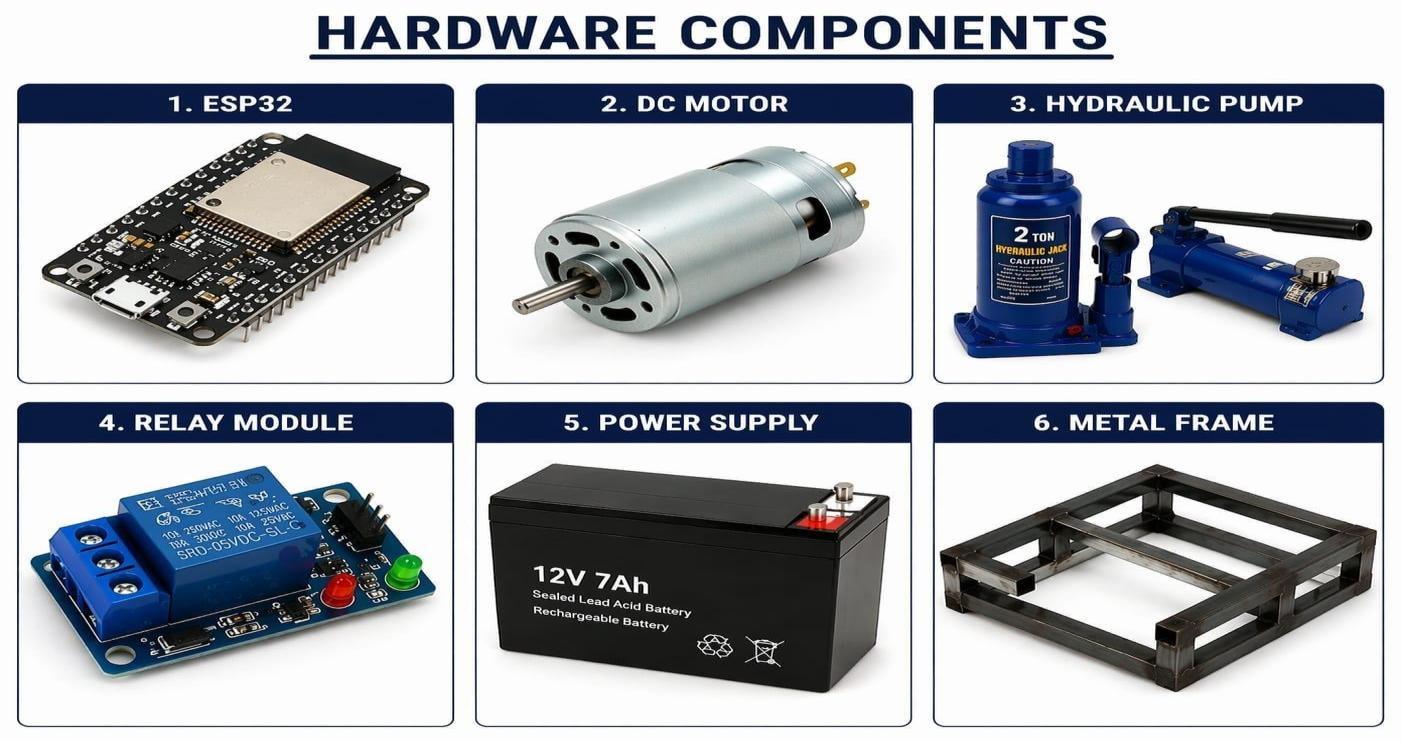
The hardware components used in this project play a vital role in the proper functioning of the IoT-based motorized hydraulic jack system. Each component is carefully selected to ensure efficiency,reliability,andsmoothoperationofthe system.Theintegrationofthesecomponentsenablesthesystemtoperformautomatedliftingwithminimalhumaneffort.
Themaincomponentofthe systemistheESP32microcontroller.Itactsasthebrainofthesystemandisresponsiblefor controlling all operations. The ESP32 has built-in Wi-Fi capability, which allows it to receive commands from a mobile applicationorwebinterface.Itprocessesthesecommandsandsendssignalstoothercomponentsaccordingly.
AnotherimportantcomponentistheDCmotor.Themotorisresponsibleforconvertingelectricalenergyintomechanical energy. It drives the hydraulic pump, which generates pressure required forlifting the vehicle. The performance ofthe systemlargelydependsontheefficiencyandpowerofthemotorused.
TherelaymoduleisusedtocontroltheoperationoftheDCmotor.Itactsasaswitchingdevice thatallowsthelow-power signalfromtheESP32tocontrolthehigh-powermotorcircuit.Thisensuressafeandefficientoperationwithoutdamaging themicrocontroller.
Thehydraulicpumpisakeymechanicalcomponentthatcreatespressureinthefluid.Itpushesoilintothehydrauliccylinder, whichresultsinthemovementofthepiston.Thismovementisresponsibleforliftingthevehicle.Theproperfunctioningof the pump is essential for smooth lifting operation. A stable power supply is required to provide electrical energy to all components.Thesystemrequiresconsistentvoltageandcurrenttooperateeffectively.Anyfluctuationinthepowersupply canaffecttheperformanceandreliabilityofthesystem.
Themetalframeprovidesstructuralsupporttotheentiresetup.Itensuresstabilityandstrengthwhileliftingthevehicle.The design of the frame is important to maintain balance and prevent accidents during operation All these hardware components work together in coordination to achieve the desired output. Thecombinationofelectronicandmechanical componentsmakesthesystemefficient,reliable,andsuitableforreal-worldapplications.
International Research Journal of Engineering and Technology (IRJET) e-ISSN: 2395-0056
Volume: 13 Issue: 04 | Apr 2026 www.irjet.net p-ISSN: 2395-0072
The software and IoT implementation play a crucial role in making the hydraulic jack system smart andautomated.The integration of software with hardware components allows the system to be controlled remotely and efficiently. In this project,ArduinoIDEisusedastheprimarysoftwareplatformforprogrammingtheESP32microcontroller.
TheESP32isprogrammedusingembeddedClanguagethroughArduinoIDE.Thecodeincludesinstructionsforreceiving signalsfromtheWi-Finetworkandcontrollingtherelaymoduleaccordingly.Themicrocontrollercontinuouslymonitors incomingcommandsandexecutesactionsbasedonuserinput.
IoTfunctionalityisachievedthroughaweb-basedinterfaceormobileapplication.TheESP32connectstoaWi-Finetwork usingpredefinedcredentialssuchashotspotnameandpassword.Onceconnected,itcommunicateswiththeuserinterface throughtheinternet.Theusercanopenaweblinkormobiledashboardtocontrolthesystem.
WhentheuserpressestheONbuttonontheinterface,asignalissenttotheESP32.Themicrocontrollerprocessesthissignal andactivatestherelay,whichinturnstartswiththeDCmotor.Similarly,whentheOFFbuttonispressed,themotorstops, andtheliftingoperationishaltedorreversed.
TheuseofIoTtechnologyallowsreal-timecontrolandmonitoringofthesystem.Iteliminatestheneedformanualoperation andprovidesconveniencetotheuser.Thesystemcanbeoperatedfromasafedistance,reducingtheriskofaccidents.
AnotheradvantageofusingESP32isitsfast-processingspeedandbuilt-inWi-Ficapability,whichmakesitsuitableforIoTbased applications. The software is designed to be simple and efficient, ensuring smooth communication between all components.
Overall, the software and IoT implementation enhance the functionality of the system by providing automation, remote access, and improved user experience. It demonstrates how modern technology can be used to improve traditional mechanicalsystems.
International Research Journal of Engineering and Technology (IRJET) e-ISSN: 2395-0056
Volume: 13 Issue: 04 | Apr 2026 www.irjet.net p-ISSN: 2395-0072
ThemotorizedmechanismisoneofthemostimportantpartsoftheIoT-basedhydraulicjacksystem.Itisresponsiblefor convertingelectrical energyinto mechanical energyand driving the hydraulicsystemto liftthe vehicle.This mechanism replacesthetraditionalmanualeffortwithanautomatedandefficientprocess.
Inthissystem,aDCmotorisusedtodrivethehydraulicpump.WhentheusersendsacommandthroughtheIoTinterface, theESP32microcontrollerprocessesthesignalandactivatestherelaymodule.Therelaythenallowscurrenttoflowtothe DCmotor,causingittorotate.
The rotating motor shaft is connected to the hydraulic pump. As the motor rotates, it drives the pump, which pushes hydraulicoilintothecylinder.Thiscreatespressureinsidethecylinder,whichactsonthepiston.AccordingtoPascal’slaw, thepressureappliedtothefluidistransmittedequallyinalldirections,resultingintheupwardmovementofthepiston.
Asthepistonmovesupward,thehydraulicjackliftsthevehiclesmoothlyandsteadily.Themotorensurescontinuousand controlledmotion,whichmakestheliftingprocessfasterandmoreefficientcomparedtomanualoperation.
International Research Journal of Engineering and Technology (IRJET) e-ISSN: 2395-0056
Volume: 13 Issue: 04 | Apr 2026 www.irjet.net p-ISSN: 2395-0072
WhentheuserstopsthemotorusingtheOFFcommand,thehydraulicpressureisgraduallyreleased,andthepistonmoves downward.Thisallowsthevehicletobeloweredsafelywithoutsuddenjerksorinstability.
Themotorizedmechanismimprovestheoverallperformanceofthesystembyprovidingsmoothoperation,reducinghuman effort,andincreasingefficiency.Italsoenhancesuserconveniencebyenablingremotecontrolandeliminatingtheneedfor manualpumping
Proper selection of the motor is important to ensure sufficient torque and power for lifting heavy loads. The system is designedtooperatewithinsafelimitstopreventoverheatingordamagetothemotor.Overall,themotorizedmechanism playsacrucialroleinmakingthesystemautomated,reliable,anduser-friendly.
TheIoTcontrolworkflowdescribesthecompleteprocessthroughwhichtheuserinteractswiththesystemandcontrolsthe hydraulicjackremotely.Thisworkflowplaysacrucialroleinensuringsmoothcommunicationbetweentheuserinterface andthehardwarecomponentsofthesystem.
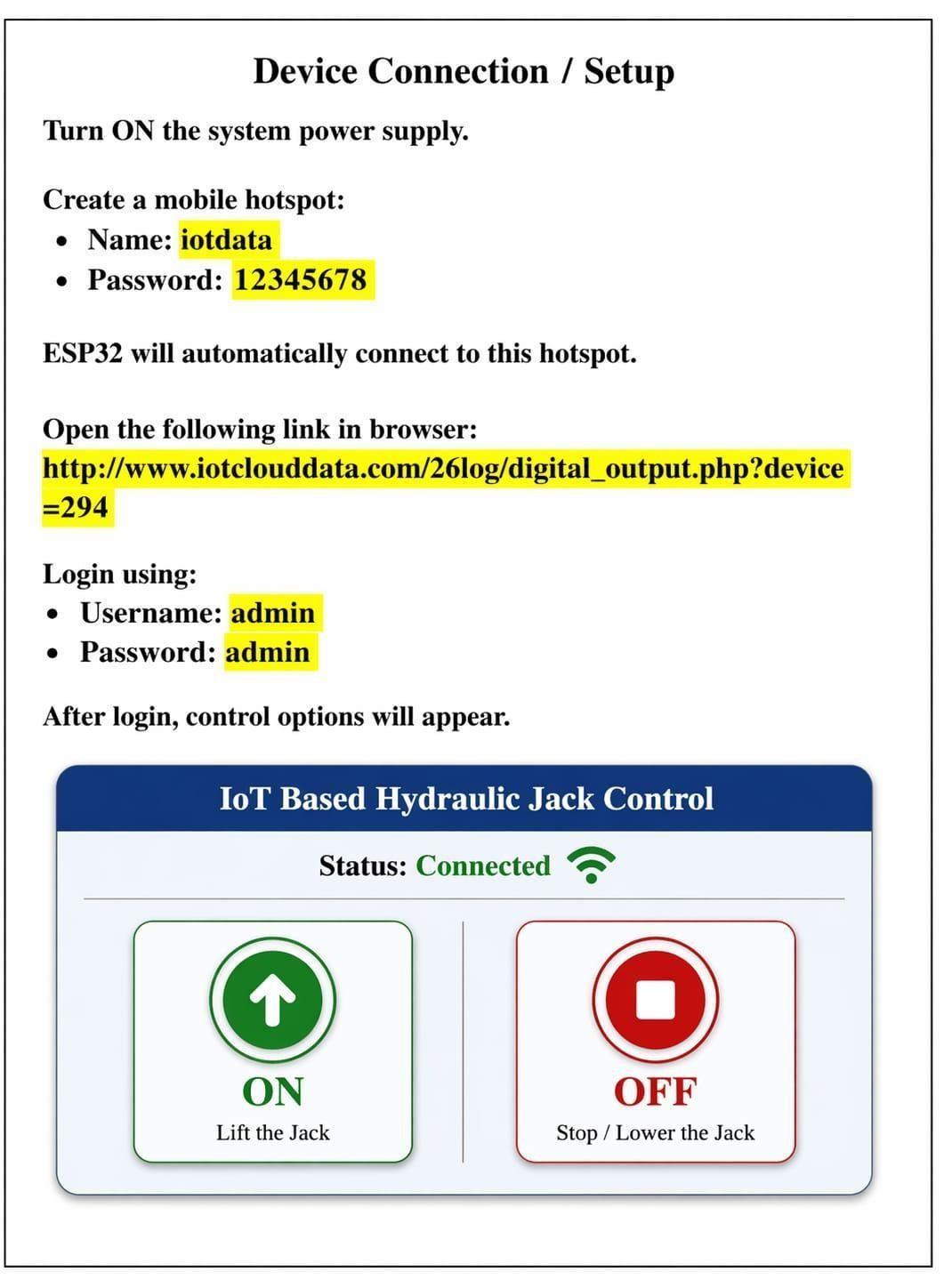
The process begins when the user turns ON the system power supply. Once the system is powered, the ESP32 microcontrollerinitializesandstartssearchingforthepredefinedWi-Finetwork.Inthissystem,amobilehotspotiscreated withaspecificnameand password.TheESP32automaticallyconnectstothishotspotusingtheprogrammedcredentials storedinitsmemory.
Aftersuccessfullyconnectingtothenetwork,theuseropensawebbrowserontheirmobiledeviceorcomputerandenters thespecifiedURL.ThisURLredirectstheusertoacontrolinterfacethatallowsinteractionwiththesystem.Theinterface includes aloginpagewherethe user must enter valid credentials such as username and password to access the control panel.
Oncelogged in, the control optionsaredisplayed on the screen. Theseoptions includebuttons such as ON and OFF that controltheoperationofthehydraulicjack.WhentheONbuttonispressed,asignalistransmittedovertheinternettothe ESP32microcontroller.TheESP32processesthissignalandactivatestherelaymodule,whichallowscurrenttoflowtothe DCmotor.Asaresult,themotorstartsanddrivesthehydraulicpump,liftingthevehicle.
Similarly,whentheOFFbuttonispressed,thesignalissenttostopthemotor.TherelaymoduleturnsOFF,cuttingthepower supplytothemotor.Thehydraulicpressureisgraduallyreleased, and the piston moves downward, lowering the vehicle safely.
Thisworkflowensures reliable andefficient communication between the userandthesystem.It eliminatesthe needfor manualoperationandenhancessafetyandconvenience.TheIoTcontrolworkflowmakesthesystemmodern,efficient,and suitableforreal-worldapplications.
TheIoT-basedmotorizedhydraulicjacksystemoffersseveraladvantagesovertraditionalmanualhydraulicjacks.Oneof themajoradvantagesisthereductioninhumaneffort.Thesystemeliminatestheneedformanualpumpingandallowsthe usertooperatethejackusingamobileinterface.
Anotherimportantadvantage istimeefficiency.The motorizedmechanismenablesfasterlifting ofvehicles comparedto manualoperation.Thisisparticularlyusefulinemergencysituationswherequickactionisrequired.
ThesystemalsoprovidesremotecontrolfunctionalitythroughIoTtechnology.Theusercanoperatethesystemfromasafe distance,whichimprovesconvenienceandreducestheriskofaccidents.
International Research Journal of Engineering and Technology (IRJET) e-ISSN: 2395-0056
Volume: 13 Issue: 04 | Apr 2026 www.irjet.net p-ISSN: 2395-0072
Improvedsafetyisanotherkeybenefitofthesystem.Thecontrolledoperationofthemotorthrougharelaymoduleensures smoothliftingandloweringofthevehicle.Thisreducesthechancesofsuddenjerksorinstability.
Thesystemisuser-friendlyandeasytooperate.Evenindividualswithlesstechnicalknowledgecanusethesystemwithout difficulty.Thesimpleinterfacemakesitaccessibletoawiderangeofusers.
In addition, the system is suitable for various applications such as automobile workshops, garages, service centers, and roadside assistance. It can also be used in smart garage systems for automated vehicle maintenance. Overall,thesystem enhancesefficiency,safety,andconvenience,makingitabetteralternativetotraditionalhydraulicjacks.
Despiteitsadvantages,theIoT-basedmotorizedhydraulicjacksystemhascertainlimitationsthatneedtobeconsidered. Oneofthemajorlimitationsistherequirementofacontinuouspowersupply.Thesystemdependsonelectricalenergyto operatethemotorandcontrolcomponents.Intheabsenceofpower,thesystemcannotfunction.
Anotherlimitationisthedependenceoninternetconnectivity.SincethesystemusesIoTtechnology,itrequiresastableWiFiconnectionforcommunicationbetweentheuserandtheESP32microcontroller.Poornetworkconnectivitycanaffectthe performanceofthesystem.
Thesystemcurrentlylacksadvancedsafetyfeaturessuchasautomaticloaddetectionandemergencycut-offmechanisms. Thismeansthatmanualmonitoringisstillrequiredduringoperationtoensuresafety.
Thecostofthesystemishighercomparedtotraditionalmanualhydraulicjacks.Theinclusionofelectroniccomponentssuch asESP32,relaymodule,andmotorincreasestheoverallcost.Thismaylimititsadoptioninlow-budgetapplications.
Additionally, the system requires proper maintenance of both mechanical and electronic components. Any failure in the componentscanaffecttheperformanceofthesystem.
Despite these limitations, the system provides a strong foundation for future improvements and can be enhanced with additionalfeaturestoovercomethesechallenges.
ThedevelopedIoT-basedmotorizedhydraulicjacksystemwassuccessfullytestedundervariousconditionstoevaluateits performanceandreliability.Thesystemdemonstratedefficientandsmoothoperationduringtheliftingandloweringofthe vehicle.
The motorized mechanism effectivelyreducedthe manual effort required for lifting.The DC motor was abletodrivethe hydraulicpumpsmoothly,generatingsufficient pressuretoliftthe vehicle without any difficulty. The lifting process was fastercomparedtotraditionalmanualmethods.
TheIoTcontrolsystemalsoperformedwellduringtesting.TheESP32microcontrollersuccessfullyconnectedtotheWi-Fi network and responded accurately to the commands sent by the user. The ON and OFF controls worked as expected, providingreliableoperation.
Thesystemshowedgoodstabilityandcontrolduringoperation.Therewerenosuddenjerksorinstabilityobservedwhile liftingorloweringthevehicle.Therelaymoduleensuredsafeswitchingofthemotor,preventingelectricalissues.
Overall,theresultsindicatethatthesystemisefficient,reliable,andsuitableforpracticalapplications.Itsuccessfullymeets theobjectivesofreducinghumaneffort,improvingefficiency,andenablingremotecontroloperations
International Research Journal of Engineering and Technology (IRJET) e-ISSN: 2395-0056
Volume: 13 Issue: 04 | Apr 2026 www.irjet.net p-ISSN: 2395-0072
The cost analysis of the IoT-based motorized hydraulic jack system is an important aspect to evaluate its feasibility and practicalimplementation.Theprojectisdesignedtobecost-effectivewhilemaintaininggoodperformanceandreliability. Thecomponentsusedinthesystemareeasilyavailableinthemarketandarereasonablypriced.
ThemajorcomponentofthesystemistheESP32microcontroller,whichcostsapproximately ₹300.Itisalow-costyetpowerfuldevicewithbuilt-inWi-Ficapability,makingitsuitableforIoTapplications.
The DC motor used in the system costs around ₹800. The motor plays a crucial role in driving the hydraulic pump and providingthenecessarymechanicalpowerforliftingthevehicle.
The hydraulic system, which includes the hydraulic jack and pump, is one of the most expensive components, costing approximately₹1500.Itisresponsibleforgeneratingthepressurerequiredforliftingthevehicle.
Othercomponentssuchastherelaymodule,connectingwires,powersupply,andsupportingmaterialscostaround₹300. Thesecomponentsareessentialforproperelectricalconnectionsandsystemstability.
The total cost ofthe systemis approximately ₹3000to ₹4000. Thismakes the system affordable compared to advanced automatedliftingsystemsavailableinthemarket.
Overall,theprojectdemonstratesthatanefficientandautomatedhydraulicliftingsystemcanbedevelopedatareasonable cost. With further optimization and large-scale production, the cost can be reduced even more, making it accessible for widerapplications.
TheIoT-basedmotorizedhydraulicjacksystemhasgreatpotentialforfuturedevelopmentandimprovement.Althoughthe currentsystemperformsefficiently,thereareseveralenhancementsthatcanbeimplementedtomakeitmore advanced andreliable.
Oneofthemajorimprovementsthatcanbemadeistheadditionofsafetysensors.Sensorssuchasloadsensorsandposition sensors can be used to monitor the lifting process and prevent overloading or unsafe conditions. This will significantly improvethesafetyofthesystem.
Anotherimportantimprovementisthedevelopmentofafullyautomaticsystem.Thecurrentsystemrequiresuserinputto operate,butitcanbeupgradedtoperformautomaticliftingandloweringbasedonpredefinedconditions.Thiswillfurther reducehumanintervention.
Thesystemcanalsobeintegratedwithsolarpowertomakeitenergy-efficientandenvironmentallyfriendly.Thiswillallow thesystemtooperateinareaswhereelectricitysupplyislimited.
Voicecontrolisanotherfeaturethatcanbeaddedtothesystem.Byintegratingvoicerecognitiontechnology,theusercan controlthesystemusingvoicecommands,makingitmoreconvenientandmodern.
The systemcanalsobe developedintoa smartgarage systemwhere multiple devicesare interconnectedand controlled throughIoT.Thiswillenableautomationofvariousvehiclemaintenanceoperations.
Overall,the futurescopeof thisprojectisvast,and withfurther researchanddevelopment,itcan be transformedintoa highlyadvancedandintelligentsystem.
International Research Journal of Engineering and Technology (IRJET) e-ISSN: 2395-0056
Volume: 13 Issue: 04 | Apr 2026 www.irjet.net p-ISSN: 2395-0072
The IoT-based motorized hydraulic jack system is an innovative solution that combines mechanical and electronic technologiestoimprovevehicleliftingoperations.Thesystemsuccessfullyreducesmanualeffortandprovidesaconvenient methodforliftingvehiclesusingremotecontrol.
TheintegrationofIoTtechnologyallowstheusertooperatethesystemfromadistance,enhancingsafetyandeaseofuse. Themotorizedmechanismensuressmoothandefficientlifting,whilethehydraulicsystemprovidesthenecessaryforceto liftheavyloads.
Theprojectdemonstrateshowtraditionalmechanicalsystemscanbeimprovedusingmoderntechnology.Ithighlightsthe importanceofautomationinengineeringanditsroleinincreasingefficiencyandsafety.
Theresultsobtainedfromtheprojectshowthatthesystemisreliable,efficient,andsuitableforreal-worldapplications.It meetstheobjectivesofreducinghumaneffort,savingtime,andimprovinguserconvenience.
Overall,theprojectisasuccessfulimplementationofanIoT-basedautomationsysteminthefieldofmechanicalengineering. Itprovidesastrongfoundationforfutureadvancementsinsmartvehiclemaintenancesystems.
15. References
1. ArduinoOfficialWebsite–www.arduino.cc
2. ESP32Datasheet–EspressifSystems
3. IoTBasedResearchPapers–GoogleScholar
4. HydraulicSystemsandComponents–EngineeringBooks
5. BasicsofFluidMechanics–StandardTextbooks