International Research Journal of Engineering and Technology (IRJET) e-ISSN: 2395-0056
Volume: 12 Issue: 12 | Dec 2025 www.irjet.net p-ISSN: 2395-0072
International Research Journal of Engineering and Technology (IRJET) e-ISSN: 2395-0056
Volume: 12 Issue: 12 | Dec 2025 www.irjet.net p-ISSN: 2395-0072
P Yashwanth1 , Y Deepika2 , Shivakumara S3, Dr. Mohamed Saleem4
123UG Student, Dept. of Robotics and Artificial Intelligence, Bangalore Technological Institute, Karnataka, India 4Professor and Head of department, Dept. of Robotics and Artificial Intelligence, Bangalore Technological Institute, Karnataka, India ***
Abstract – EchoPaw is a design of quadruped robotic system developed to connect human-robot interaction using offline voicecommands, servo drivenlocomotionandAIbased communication. The design is integrated with esp32 microcontroller, PCA9685 servo driver, sg90 continuous rotation servos, ultrasonic sensor and DFRobot offline voice recognition moduletoperformactions. ABluetoothspeakeris integrated in design where it can communicate with humans using LLM’s live voice chat. it performs basic actions like sitting, walking, standing and waving hand. The design is developed in low cost, modular hardware and smooth locomotion. The developed design results reliable voice recognition, smooth locomotion and obstacles detection. This work highlights the potential of EchoPaw as an educational and research-oriented mini quadruped robot.
Key Words: QuadrupedRobot,VoiceRecognition,ESP32, Obstacle Detection, PCA9685, Servo Control, Human Robot Interaction.
Robotsarealsobeingusedtoserveasassistance,learning and interactions. Among the various robots the most commonly used robots are quadruped robots where the design we developed similarly looks like dog. Most of the roboticdogsavailablenowrequirescontrolsviatheinternet orvoiceassistance.TheEchoPawincludesthefunctionality torespondtoverbalcommands,carryoutthedoglikeaction and communicate with the user by give human like voice. Thedesigndevelopedinlowcostcomponentsrespondsto humanvoiceasresponse.
This project is relevant because it is centered on developinganinteractiverobotthatislowcostwithoffline control. In recent years, there has been a rising need for roboticcompanionsandintelligentassistants.Theproblem withmostmodernrobotsisthattheyarecostlytoimplement. TheuseofEchoPawrobotisasensiblealternativebecauseit employs components that are readily available, such as ESP32,servosandsensors.
The implementation of offline voice recognition means that the robot is reliable even when there is no internet connection.Thisisparticularlyusefulinaclassroomsetting,a laboratory or even indoors. The project is useful for
educating students on the concept of embedded systems, roboticsaswellasinteractionswitharobot.
1. Technical feasibility: its uses commonly available componentsESP32,SG90servos,ultrasonicsensorsand servodriver.Allthesemodulesareeasytoprogramand integrateinthesystemweopt.
2. Economic feasibility: all thecomponentsusedinthe designislowcostandaffordableforstudentprojects.
3. Operational feasibility: the design is used in indoor only.it gives a stable performance due to offline recognitionmoduleandsafelyoperatedduetoobstacle detection
1. Paper Title: Speech Interaction with an Emotional Robotic Dog
Author: Christian M. Jones, Andrew Deeming
Abstractandrelevance:Inthefuture,consumerelectronics will be aware of how people feel in order to create experiences that will be more natural, engaging, entertaining, and productive. This paper describes a emotionallyresponsiveroboticdog.Thedogcantellhowits userfeelsbylisteningtosoundsandthenactsinresponse.It explains how the acoustic emotion recognition works and howitisusedinsidetheroboticdog.
2. Paper Title: On the Robustness of Speech Emotion Recognition forHuman-RobotInteractionwith Deep Neural Networks
Author: EgorLakomkin,M.A.Zamani,CorneliusWeber,Sven Magg,StefanWermter
Abstract and relevance: The area of Speech Emotion Recognition(SER)iscriticalinhuman-robotcollaboration. Furthermore, SER has attracted a lot of research interest. Thispaperinvestigateshownoisefromdifferentreal-world environments affects advanced neural networks used for SER,specificallythroughuseoftheiCubRobot. Thestudy concludedthatbothrobotegonoiseandroomacousticshad anegativeeffectontheaccuracyofSERmodels.Inaddition, thestudyshowedthattheapplicationofdataaugmentation
International Research Journal of Engineering and Technology (IRJET) e-ISSN: 2395-0056
Volume: 12 Issue: 12 | Dec 2025 www.irjet.net p-ISSN: 2395-0072
methods,includingaddingbackgroundnoiseandloudness variation to the input data, increased both model performanceanditsabilitytoadapttoreal-worldsituations.
3. Paper Title: Emotion Detection for Social Robots Based on NLP Transformers and an Emotion Ontology
Author: Wilfredo Graterol, Jose Diaz-Amado, Edmundo Lopes-Silva, Yudith Cardinale, Cleia Santos-Libarino, Irvin Dongo
Abstract and relevance: To create robots that can socially interactwithhumans,theserobotsmustrecognizetheuser's emotional state. This requires gathering various types of datafromtheuser,includingtext,speech,images,andvideo. By doing this, the robots can perform emotional state recognition and identification. The robots use machinelearning or NLP techniques to determine the user's emotionalstateandevaluateit.
This research will build a framework using EMONTO,anexistingemotionalontology.EMONTOincludes conceptual models for recognizing emotional states and semanticstorageforidentifiedemotionalstates.Aprototype framework has been created as a guide for museum tour robots. It determines the user's emotional state through voicerecognitionoftext,thenappliesNLPmodelsandstores that information in ontology. This approach can achieve performance levels that meet or exceed those of the best modelscurrentlyavailable.
4. Paper Title: Multimodal Emotion Recognition using Transfer Learning from Speaker Recognition and BERT-based models
Author:SaralaPadi,SeyedO.Sadjadi,DineshManocha,Ram D.Sriram
Abstract and relevance: Automatic Emotion Recognition (AER) enhances Human-Computer Interaction (HCI) by enabling AI systems to have an "emotional intelligence" component.WepresentamultimodalAERframeworkthat applieslatefusiontocombineaspeech-basedResNetmodel and a text-based BERT model. The results of this work demonstrate the use of transfer learning and data augmentation techniques to optimize the performance of AERsystemsandmaximizetheirabilitytogeneralizetonew datasets. The study also used the IEMOCAP dataset to evaluate the performance of the multimodal approach for AER.
3. EXISTING AND PROPOSED SYSTEM
3.1 Existing System
Typically, the devices use remote control or Internet basedvoiceassistanceapplicationstocontrolrobots.Mostof therobotsarelimitedintheirmovementandarenotcapable
ofintelligentinteraction.Mostoften,robotsdonotinclude anti-collision/safetyfeatures,andassuch,robotscancrash orsustaindamage.
3.1.1 Disadvantages of Existing System
Dependenceoninternetorsmartphoneapplications
Limitedinteractionandintelligence
Lackofautonomoussafetyfeatures
Highcostforadvancedroboticpets
3.2 Proposed System
EchoPawisaminirobotdogthatcanperformdifferent taskssuchaswalking,turning,sitting,andstandingbasedon voice commands. It uses ultrasonic sensors to detect obstacles and stop on its own. It can also interact with its user by responding through a Bluetooth speaker. This system is valuable for education because it teaches in an interactiveandsafeway.
4.1 Objective
Todesignaminiquadrupedroboticdog
Toimplementofflinevoice-basedcontrol
Toensuresafeoperationusingobstacledetection
To provide interactive communication through voiceresponses
Tobuildalow-costandeasy-to-useroboticsystem
4.2 Methodology
The project starts by choosing the right hardware components, including ESP32, servo motors, and sensors. First,therobot'smechanicalstructureisputtogether.Then, theservomotorsareprogrammedtodobasicmovements. We train voice commands and link them to robot actions withanofflinevoicerecognitionmodule.Weaddultrasonic sensingforobstacledetection.Finally,wetestandvalidate Bluetooth-basedconversationinteraction.
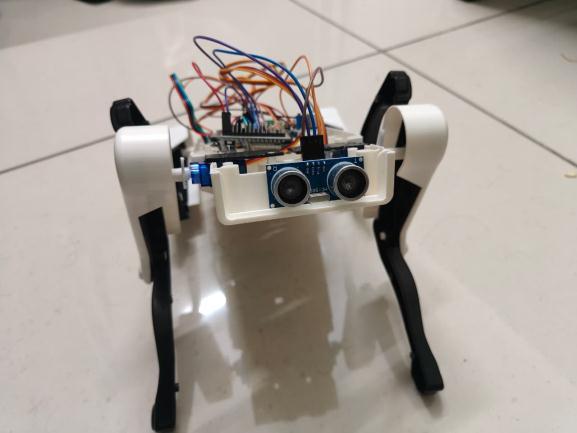
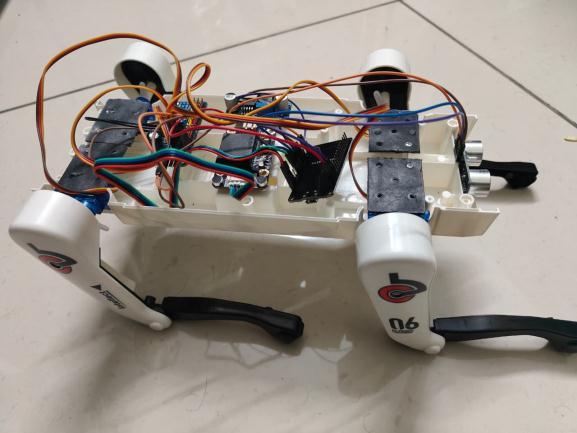
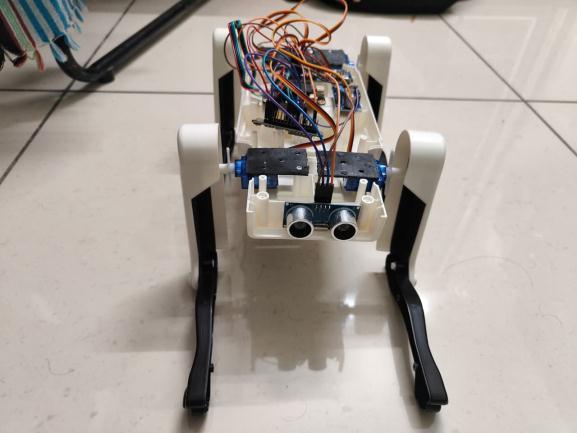
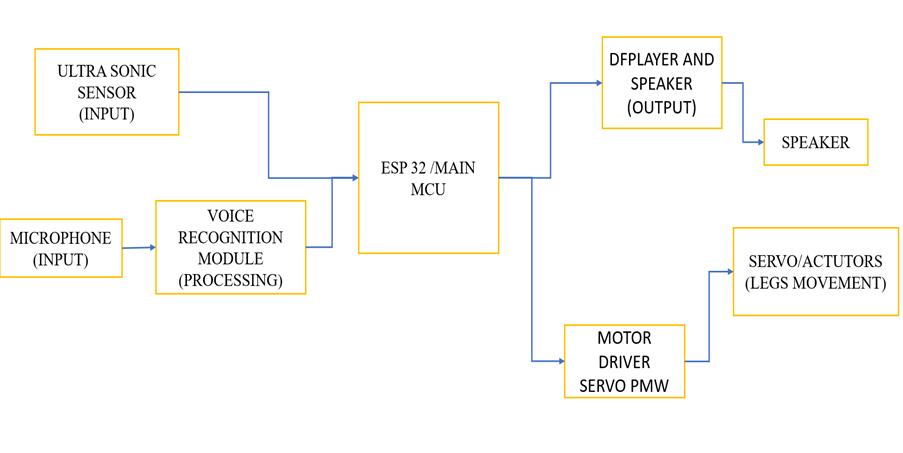
ThedesignofEchoPawemphasizessimplicity,balance, and safety. Four servo motors control the legs, enabling stablequadrupedmovement.Anultrasonicsensorislocated atthefronttodetectobstaclesearly.PowercomesfromaLiionbatterywithabuckconverterthatkeepsastablevoltage. The system is set to stop immediately when it detects an obstacleorreceivesastopcommand.
International Research Journal of Engineering and Technology (IRJET) e-ISSN: 2395-0056
Volume: 12 Issue: 12 | Dec 2025 www.irjet.net p-ISSN: 2395-0072
6. MATERIAL IDENTIFICATION AND SPECIFICATION
Table -1: ComponentsandSpecification
Component Specification Purpose
ESP32 Dual-coreMCUwith Bluetooth Maincontroller
PCA9685 16-channelPWM driver Servocontrol
SG90 Servo 360°continuous rotation Legmovement
Ultrasonic Sensor 2–200cmrange Obstacle detection
Voice Module Offlinevoice recognition Commandinput
Battery Li-ionwithbuck converter Powersupply
EchoPaw mainly operates through voice commands. Whenausergivesacommand,theofflinevoicerecognition modulepicksitupandsendsittotheESP32.Thecontroller activates the servo motors to carry out the necessary movement. While the robot is in motion, the ultrasonic sensorconstantlychecksforobstacles.Ifitdetectsanobject within a safe distance, the robot stops right away. At the same time, a Bluetooth speaker delivers voice responses using ChatGPT Live, making the robot interactive. Safety monitoringisactiveinalloperatingmodes.
8. RESULTS AND DISCUSSION
The robot responded successfully to all trained voice commands. Its movements, including walking, turning, sitting, and waving, were smooth and stable. Obstacle detectionwaseffective,whichhelpedpreventcollisions.The interactive voice responses increased user engagement. Overall,theperformancewasreliableinindoorsettings.And fewsupportedcommandsare
Supportedcommandsare:
HelloRobot
Moveforward
Movebackward
Sitdown
Standup
Turnleft
Turnright
Wavehand
Stop
EchoPawisasmallroboticdogthatusesvoicecontrol, moves on four legs, detects obstacles, and allows for interactive communication. The system works well with offline voice commands and keeps safety in mind while moving. Although the robot is still being developed, it successfully meets the project goals and offers a solid foundationforfutureimprovements.
Addingcamera-basedvision
Improvingwalkingpatterns
Introducingemotionalexpressions
Enablingautonomousnavigation
Enhancingpowermanagement
[1] C.M.JonesandA.Deeming,“SpeechInteractionwithan Emotional Robotic Dog,” Proc. Interspeech Conference, vol.1,no.1,pp.1757–1760,2008.
[2] E. Lakomkin, M. A. Zamani, C. Weber, S. Magg, and S. Wermter, “On the Robustness of Speech Emotion Recognition for Human–Robot Interaction with Deep NeuralNetworks,” Proc. ACM/IEEEInt. Conf.onHuman–Robot Interaction,vol.3,no.1,pp.27–35,2018.
[3] A.Chakravarty,J.K.Tripathy,S.Chakkaravarthy,andA. K. Cherukuri, “e-Inu: Simulating a Quadruped Robot with Emotional Sentience,” International Journal of Robotics and Intelligent Systems,vol.10,no.2,pp.145–158,2023.
[4] S. Padi, S. O. Sadjadi, D. Manocha, and R. D. Sriram, “Multimodal Emotion Recognition Using Transfer Learning from Speaker Recognition and BERT-Based Models,” IEEEAccess,vol.10,no.1,pp.118450–118462, 2022.
[5] W.Graterol,J.Diaz-Amado,E.Lopes-Silva,Y.Cardinale, C.Santos-Libarino,andI.Dongo,“EmotionDetectionfor Social Robots Based on NLP Transformers and an EmotionOntology,” Sensors (MDPI),vol.21,no.18,pp. 1–22,2021.
International Research Journal of Engineering and Technology (IRJET) e-ISSN: 2395-0056
Volume: 12 Issue: 12 | Dec 2025 www.irjet.net p-ISSN: 2395-0072
Appendix- photographs of prototype