
International Research Journal of Engineering and Technology (IRJET) e-ISSN: 2395-0056
Volume: 13 Issue: 01 | Jan 2026 www.irjet.net p-ISSN: 2395-0072
International Research Journal of Engineering and Technology (IRJET) e-ISSN: 2395-0056
Volume: 13 Issue: 01 | Jan 2026 www.irjet.net p-ISSN: 2395-0072
Chaitali Mahale1, Vaishnavi Deore2, Komal Jadhav3, Payal Sable4, Ms.M.B.Shinde5, Mr.P.R.Sali6
1,2,3,4, Students of Computer Technology Department 5, Guide, Lecturer at Computer Technology Department of Shri Hiralal Hastimal (Jain Brothers, Jalgaon) Polytechnic, Chandwad, Dist. - Nashik, Maharashtra 6HoD of Computer Technology Department at Shri Hiralal Hastimal (Jain Brothers,Jalgaon) Polytechnic, Chandwad, Dist. - Nashik, Maharashtra ***
Abstract - India a country heavily reliant on agriculture requires efficientfarMingpractices. Dropirrigationsystemis widely used, but existent system consumes excessive energy andwater,leadingto resourcewastageandpoorcrop health. This Project develops an IoT-enabled automated drip irrigation system using an ESP32 microcontroller, soil mois true sensor, and DHT22 temperature and humidity sensor. A photo voltaic- power éd batteries providers a renewable energy source. When soil moisture levels fall below a predetermined threshold, the system actuates a pump via a relaymodule,facilitatingprecision irrigation.An LED display provides real-time status updates and notifications. A webbased application offers real-time monitoring and notificationsof motorstatus,soilmoisturelevels,andambient temperature. This enables farmers to monitor the irrigation system, minimizing water waste and optimizing crop yields. The proposed system promotes sustainable agricultural practices and enhances irrigation system efficiency
Keywords: DHT22 Sensor1, ESP322, LED Display3, Relay module4, Soil moisture sensor5, Solar Panel6
The Automatic Drip Irrigation System (ADIS) is a cuttingedgetechnologicalinnovationdesignedtorevolutionizethe agriculturalirrigationsectorbyprovidingaprecise,efficient, andautomatedwateringsolution.ByleveragingtheInternet ofThings(IoT)andadvancedsensortechnologies,theADIS enablesreal-timemonitoringandcontrolofdripirrigation systems,ensuringthatcropsreceivetheoptimalamountof water and nutrients necessary for healthy growth and development.
At the heart of the ADIS is a network of sensors that continuouslymonitorsoilmoisturelevels,temperature,and humidity,providingreal-timedatathatistransmittedtoa central control unit. This data is then analyzed using advancedalgorithmsthatautomaticallyadjusttheirrigation scheduletoensurethatcropsreceivethepreciseamountof water needed. This not only helps to conserve water and reducewastebutalsopromoteshealthyplantgrowthand development.
OneofthemostinnovativefeaturesoftheADISisitsability tosendlivenotificationstofarmersviaamobileapp.This
enablesfarmerstomonitortheirrigationsystemandreceive critical alerts and updates on soil moisture levels, temperature, and humidity. This allows farmers to make data-drivendecisionsandtakepromptactiontoaddressany issues that may arise, thereby reducing the risk of crop damageandimprovingoverallyields.
TheADISisascalableandflexiblesolutionthatcanbeeasily integratedintoexistingirrigationsystems,makingitanideal solutionforfarmersandagriculturalproducersofallsizes. By providing a precise, efficient, and automated watering solution, the ADIS has the potential to transform the agriculturalirrigationsector,enablingfarmerstoimprove crop yields, reduce water consumption, and promote sustainableagriculturalpractices.
Drip irrigation is a current, efficient, and environmentally friendly technique of crop irrigation that promises water without delay to the roots of flora, lowering evaporation, runoff, and soil erosion. This innovative generation has revolutionizedthewaycropsareirrigated,offeringseveral benefits over conventional flood irrigation methods. Throughofferingflorawithspecificamountsofwaterattopof-the-line intervals, drip irrigation systems sell healthful plantincrease,reducewaterconsumption,anddecreasethe environmentalimpactofirrigation.
The goal of an automated Drip Irrigation device with live NotificationsviaacellAppistodecoratewaterperformance andprecisioninfarmingviaautomatingirrigationbasedon real-timeenvironmentalconditions.Thedevicecontinuously videodisplayunitsoilmoisture,temperature,andhumidity usingIoTsensorsand transmits stayinformation toa cell utility. This permits farmers to acquire immediately notifications and remotely control irrigation, ensuring vegetation receive greatest water levels. With the aid of leveragingreal-timeinformationandsmartautomation,the deviceminimizeswaterwastage,reducesguidehardwork, andimprovescrophealth.Additionally,integratingclimate forecasts permits the device to make smart selections, stoppingover-irrigationor beneath-watering.Thecellular app presents an intuitive interface for monitoring and
International Research Journal of Engineering and Technology (IRJET) e-ISSN: 2395-0056
Volume: 13 Issue: 01 | Jan 2026 www.irjet.net p-ISSN: 2395-0072
controllingirrigationremotely,improvingconvenienceand operationalefficiency.Inthelongrun,thissolutionpromotes sustainableagriculture,conservesresources,andincreases productivenesswiththeaidofmakingsurecropsobtainwell timed and adequate irrigation primarily based on precise environmentalconditions.
This investigation's results align with extant research on sensible irrigation systems, exhibiting sizeable enhancementsinhydricefficiency,precisionirrigation,and electricityintake.TheutilizationofIoT-basedarchitectures, wi-fisensornetworks,andmicrocontrollersconstitutesanot unusualthreadinboththisinvestigationandthepertinent literature. However, discrepancies exist in the device architecture,sensingparameters,andirrigationscheduling algorithms hired within the research. This investigation's emphasisonacloud-basedtotallyIoTsystemwithactualtimemonitoringandcontroldivergesfromtheliterature's awarenessonwifesensornetwork-basedstructureswithan emphasis on soil moisture and crop water pressure. Nonetheless, both studies display the efficacy of clever irrigationstructuresinoptimizinghydricresourceusageand reducing energy consumption. The findings of this investigation, which screen a 30-50% discount in hydric consumption and good-sized upgrades in precision irrigation, align with the literature's emphasis at the importanceofcleverirrigationsystemsincurrentagronomy. Inprecis,thisresearchcontributestotheexistingcorpusof know-how on wise irrigation systems by means of demonstrating the efficacy of cloud-primarily based IoT architectures in optimizing irrigation practices. The investigation's findings are congruent with the literature, andtheusageofIoT-basedtotallysystems,wirelesssensor networks,andmicrocontrollersconstitutesacommonplace subjectinboththisinvestigationandtheliterature[5].
Theliteraturesurveyoftheresearchpaper “SmartIrrigation System Using IoTandCloud “affords anoutlineof diverse studies that have explored IoT-primarily based irrigation structures for green water management. Several studies havetestedtheintegrationofIoTgeneration,sensors,and cloudcomputingtooptimizeirrigationmethods.Kavithaand Kumar (2020) investigated a clever irrigation device utilizing soil moisture sensors that communicate with a cloud server to decide superior watering schedules. Their findingsindicatedapotential40%reductioninwaterintake whilst maintaining crop yield. Further, Li et al. (2021) proposed an IoT-based totally irrigation device incorporatingmachinestudyingalgorithmstoareexpecting soil moisture ranges and irrigation necessities. other research, which include those via Saini et al. (2018) and Gupta et al. (2018), centered on growing sensor-based totally clever irrigation systems that leverage actual-time environmental facts to automate water distribution. Patil and Suryawanshi (2020) carried out a assessment of IoT-
basedirrigationtechnologies,highlightingtheirbenefitsin phrasesofusefulresourceconservationandperformance. Recent advancements in clever irrigation additionally containthemixingofcloudcomputingandfacetcomputing, as mentioned through Zhang et al. (2020). Their system utilizedIoTandareacomputingtobeautifydecision-making for specific irrigation control. Furthermore, Taha et al. (2021)emphasizedtheroleofdevicegainingknowledgeof in optimizing water usage and improving agricultural sustainability.Typical,theliteratureshowsthatIoT-enabled smart irrigation systems appreciably decorate water efficiency, reduce manual intervention, and make contributions to precision agriculture. the combination of actual-timesensorinformation,cloud-basedanalytics,and automation facilitates premier water distribution, selling sustainabilityandenhancingcropyields[12].
The research on IoT and Cloud-Based Sustainable Smart IrrigationSystemshighlightstheinefficienciesoftraditional irrigationmethodsandthe needforautomationusingIoT andcloudcomputing.Smartirrigationsystemsintegratesoil moistureandenvironmentalsensorswithmicrocontrollers like Node MCU to enable real-time monitoring and automatedwatermanagement.Cloud-basedplatformsallow remote access, optimizing water use through predictive analytics and weather forecasts. Studies by Kavitha and Kumar (2020) and Li et al. (2021) demonstrate that IoTbased irrigation can reduce water consumption by up to 50% while improving crop yields. Zaman et al. (2020) emphasize automation’s role in sustainability. These advancements address water scarcity by enhancing efficiency, reducing waste, and promoting precision agriculture[11].
Thestudiespaper“Anoverviewofsmartirrigationsystems using IoT " discusses the mixing of IoT-based clever irrigation structures in sustainable agriculture. It emphasizeshowcomputerizedirrigationstructuresmakea contribution to water conservation, optimize irrigation schedules,andalignwithSustainabledevelopmentdesires (SDGs),especiallySDG6(cleanwaterandsanitation).The havealookathighlightsthefunctionofIoT-enabledsensors, consisting of soil moisture and climate sensors, in monitoring actual-time agricultural conditions. Those systemsmakeuseofwirelessconversationtechnologylike LoRa,GSM,andMQTTforrecordstransmission,makingan allowance for faraway tracking and manage. Cloud computing similarly complements performance by using storing and analyzing sensor information, allowing predictive irrigation control. Previous research indicates that IoT-based totally irrigation considerably improves water-use efficiency. Researchers have established device gaining knowledge of algorithms optimizing irrigation schedules based on climate forecasts and soil conditions, maintoadiscountinwaterwastage.Moreover,automation reduces human intervention, making irrigation extra sustainableandfee-powerful. Demandingsituationsalong
International Research Journal of Engineering and Technology (IRJET) e-ISSN: 2395-0056
Volume: 13 Issue: 01 | Jan 2026 www.irjet.net p-ISSN: 2395-0072
with information safety, excessive initial charges, and integration complexities remain obstacles to large-scale implementation.But,risingtechnologieslikeAI,blockchain forrecordssafety,andsolar-poweredirrigationstructures are paving the way for more advantageous efficiency and sustainability.ThestudiesconcludethatIoT-drivenclever irrigationisapromisingsolutionforprecisionagriculture, ensuringaidconservationandprogressedcropyieldswhilst mitigatingenvironmentaleffect[13].
The research paper “IoT-Based Solar Powered Smart Irrigation System “gives a sophisticated irrigation version integrating IoT and solar strength for optimized water utilization in agriculture. It highlights the vital function of water conservation and technological improvements in mitigating water scarcity demanding situations. The proposed system employs a PIC16F877A microcontroller, c084d04ddacadd4b971ae3d98fecfb2amodule(ESP8266), andmultiplesensors(moisture,temperature,andvoltage)to reveal discipline situations in real time. The device harnessessunstrengththroughphotovoltaicpanels,storing powerinexternalbatteriestoensurecontinuousoperation. The moisture sensor detects soil situations, triggering the irrigationmotorwhilenecessary.TheIoTmoduletransmits sensordatatocloudplatformslikeADAFRUITIO,permitting farmers to remotely reveal and manipulate irrigation activities via net or mobile programs. Additionally, an automated water-degree control mechanism prevents excessive water accumulation inside the discipline. In comparisontostandardirrigationtechniques,thisIoT-based totally device substantially reduces water wastage at the sametimeasimprovingcropyield.Theintegrationofactualtime tracking and automation complements agricultural wireless,aligningwithsustainabilitydesires.Theresearch underscorestheprice-effectivenessandscalabilityofsolarpoweredcleverirrigationsystems,makingthemafeasible solutionforpresentdayprecisionagriculture[15].
The literature survey from the supplied studies paper outlinesdiverseadvancementsinIoT-basedsmartirrigation systemsandtheirpositioninprecisionagriculture.Ananthi etal.(2017)addedanIoT-enabledsoiltrackingmachineto enhanceagriculturalproductivitythroughofferingreal-time informationonsoilconditions.Mathetal.(2018)explored IoT packages in drip irrigation, enabling specific water controlthrusoilmoisturetracking.SarafandGawali(2017) designed an IoT-based totally smart irrigation tracking device,optimizingwaterusageviareal-timesoilassessment. SushanthandSujatha(2018)targetedonIoTintegrationin agriculture, leveraging sensors and verbal exchange networks to beautify productiveness. Kumar et al. (2013) proposed an smart irrigation system incorporating smart sensors for water conservation. Shiraz Pasha and Yogesh (2014) evolved a microcontroller-based totally computerized irrigation gadget, improving irrigation performance. Pernapati (2018) provided a low-cost IoTbasedcleverirrigationdevice,contributingtocost-effective
precision farming answers. Atayero and Alatishe (2015) designed an automatic irrigation system using microcontrollers, providing insights into green water management. Ghodake and Mulani (2018) delivered a microcontroller-primarily based computerized drip irrigation machine, improving water distribution performance.Choudharyetal.(2020)exploredautomation in agriculture, addressing evolving farming desires. Bwambaleetal.(2022)reviewedsmartirrigationtracking andmanipulatestrategiesforprecisionagriculture.Abbaet al.(2019)designedalow-priceindependentsensorinterface forIoT-primarilybasedirrigationmonitoring.Dasguptaetal. (2019) proposed an IoT-primarily based irrigation monitoringsystem,showcasingimprovementsinirrigation era. Vaishali et al. (2017) added a cellular-included IoT irrigation management device for faraway control. Ultimately, Kurundkar et al. (2023) evolved a clever pumpingsystemtoautomatetheirrigationprocess.Those researchtogetherspotlighttheevolutionofsmartirrigation systems, specializing in IoT integration, automation, and precisionfarmingforoptimizedwaterusageandagricultural productivity[10].
The literature evaluation highlights improvements in IoTbased clever irrigation systems for precision farming. Previous studies emphasize IoT's position in optimizing water use, automating irrigation, and improving crop productiveness.Traditionalirrigationtechniquesconfronted in wireless sciences because of guide operation and poor resource management. research display IoT-enabled systems, using ESP32 microcontrollers and soil moisture sensors, extensively lessen water intake (through 35%) whilstimprovingplantgrowth.wi-ficonversationprotocols like ZigBee, c084d04ddacadd4b971ae3d98fecfb2a, and Bluetoothallowreal-timemonitoringthrusystemslikething talk.nomatterupgrades,demandingsituationslikesensor calibration and strength wi-fi performance continue to be keyregionsforfutureresearch[2].
The literature survey makes a specialty of sensor-based totallyirrigationsystems,emphasizingthe wantforgreen water management in agriculture. Conventional irrigation techniquesregularlycausewaterwastage,makingsensorbasedtotallystrategiesimportantforoptimizingirrigation schedules.Studiesspotlighttheuseofsoilmoisturesensors, wireless sensor networks (WSNs), and IoT-based totally automation to beautify water use efficiency. Cutting-edge sensorslikeTimeareaReflectometry(TDR),Frequencyarea Reflectometry(FDR),anddielectrictechniquesallowrealtimetracking.Studiesindicatethatautomatedirrigationcan enhance crop yield, lessen water intake via as much as forty%, and minimize human intervention. Despite those improvements, demanding situations consisting of calibration accuracy and deployment expenses stay key areasforfurtherresearch[1].
International Research Journal of Engineering and Technology (IRJET) e-ISSN: 2395-0056
Volume: 13 Issue: 01 | Jan 2026 www.irjet.net p-ISSN: 2395-0072
The literature survey makes a specialty of clever drip irrigationsystemstheusageofIoTforwirelesswatercontrol inagriculture.Conventionalirrigationmethodsareinferring wireless client, leading to excessive water wastage. IoTprimarily based answers combine soil moisture sensors, temperaturesensors,andreal-timemonitoringviainternet structurestooptimizewaterusage.Researchspotlightusing microcontrollerslikeRaspberryPiandArduinotoautomate irrigationscheduling.wi-fiverbalexchangeviaZigbee,GSM, andc084d04ddacadd4b971ae3d98fecfb2acomplementsfar offgetadmissiontoandmonitoring.Superiorfunctionslike climateforecasting,leakagedetection,andliveareatracking furtherimprovegadgetWi-Ficogencywireless.Theresearch underscoresIoT'sroleinreducingwaterintake,increasing yield,andminimizingguidelabor,eventhoughdemanding situationslikeconnectivityandsensoraccuracystay[8].
Dripirrigationisaespeciallyefficientirrigationtechnique that supplies water immediately to plant roots, reducing wastageandoptimizingwateruse.Recentimprovementsin net of factors (IoT) generation and renewable electricity sources,includingsolarelectricity,havebroughtaboutthe development of smart irrigation systems that decorate agriculturalproductivenesswhilstkeepingassets.Numerous studies have explored diverse components of those technologies. A examine conducted in Pattaya, Thailand, targeted on a sun-powered drip irrigation machine for rainfed and off-grid areas. However, it required manual operation, proscribing its performance. Another observes delivered a sensor-based sun tracker device for moisture detection and automobile-irrigation, in which a microcontroller activated the water pump upon detecting lowsoilmoisture.However,thisdevicedependedonGSMbased totally notifications, which limited real-time monitoringabilities.similarlystudiesonIoT-based totally irrigation structures proposed real-time monitoring the usageofsoilmoisturesensors,storingrecordsforanalysis, andshowingresultsonaphone.Despiteitsimprovements, the gadget lacked actual-photograph tracking, relying alternatively on coloration detection of plant health. Additionally, a Zigbee-primarily based smart irrigation deviceturnedintodeveloped,usingArduinoATMEGA328to transmitmoisturerecordstoacloudserver.but,thisdevice required an intermediate device for information transmission, increasing complexity. The proposed drip irrigationdeviceinthereferencedobserveimprovesupon thoseobstaclesbymeansofintegratingIoTwithNodeMCU ESP8266fordirectfactstransmission,acameramodulefor real-timephotographseize,andasunpanelforsustainable energysupply.Thedeviceautomaticallycontrolsirrigation primarilybasedonsoilmoisturelevelsandtransmitsactualtimefactsonsoilpH,moisture,andgardenconditionstoa cell phone software. Those advancements provide a extra autonomous, efficient, and person-pleasant answer for presentdayagriculture[4].
The literature survey of the paper “Experimental performanceofsmartIoT-enableddripirrigationmachine usingandcontrolledviainternet-primarilybasedpackages" highlights advancements in IoT-primarily based clever irrigation structures. Numerous research recognition on sensor-basedtotallyautomation,wi-ficommunique(Zigbee, GSM,WSN),and‘’AI-drivenchoice-making(ANN,fuzzygood judgment,deepgainingknowledgeof)foroptimizingwater usageinagriculture.Researchershaveexploredcloud-based IoT systems’’ for real-time records tracking and irrigation manage. Notwithstanding those improvements, the integrationofIoTwithinternet/androidprogramsforrealtimecleverirrigationremainsconstrained.[3].
The literature survey of the paper "automatic smart IrrigationgadgetusingIoT"exploresimprovementsinIoTprimarily based clever irrigation structures. Various research emphasizes sensor-based automation, wireless verbalexchange(Zigbee,GSM,WSN),andAI-pushedchoicemaking(ANN,fuzzycommonsense,deepgainingknowledge of)tooptimizewaterusageinagriculture.Researchershave evolvedcloud-primarilybasedIoTstructuresforreal-time informationmonitoringandirrigationcontrol.Conventional irrigation strategies are afflicted by over-irrigation or beneath-irrigation,affectingcropproductiveness.Thestudy addresses this hole with the aid of offering an automated IoT-enabledirrigationmachinethatvideodisplayunit’ssoil moisture and temperature to optimize water deliver, decreasingmanualeffort,preservingwater,andimproving performanceinagriculturalfields[6].
Theliteraturesurveyofthepaper"IoT-basedtotallyclever Irrigation gadget" explores improvements in automated irrigation using IoT. Research highlight sensor-based irrigation,wi-ficommunique(GSM,Bluetooth,Zigbee,WSN), andAI-pusheddecision-makingtooptimizewateruse.IoTprimarily based structures screen soil moisture and environmental situations, reducing water wastage and improvingefficiency.Notwithstandingtheseadvancements, challengescontinuetobeinscalability,powerdependency, andprice-effectiveness.ThistakealookatproposesanIoTenabledautomatedirrigationsystemthatensurespremier water utilization, actual-time tracking, and progressed agriculturalproductivity[7].
International Research Journal of Engineering and Technology (IRJET) e-ISSN: 2395-0056
Volume: 13 Issue: 01 | Jan 2026 www.irjet.net p-ISSN: 2395-0072
Sensors (Temperature
,Soil Moisture, Humidity)
Microcontroller (ESP32)
PowerSupply(SolarPower)
DC
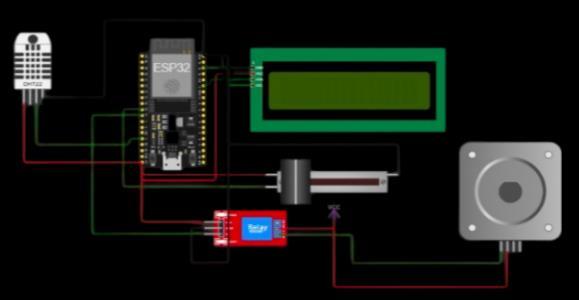
Fig -2: CIRCUIT
Thiscircuitdiagramrepresentsatemperaturetrackingand motor manage gadget. The machine includes numerous additives,inclusiveofaDHT11temperatureandhumidity sensor, an ESP32 microcontroller, an lcd display, a relay module,amotor,andadiode.TheDHT11sensormeasures theambienttemperatureandhumiditythatisthenreadvia theESP32microcontrollerforfactsprocessing.
An automatic drip irrigation system consists of several components that work together to maintain the water systemefficiently.Thesystemstartswithsensorsthatcollect environmentaldatasuchastemperature,soilmoisture,and humidity. These sensors send the collected data to the microcontroller,thecentral processingunitofthesystem. This logic determines when irrigation is needed, and the microcontroller controls other components accordingly. Solar power supply provides the energy needed for the operatingsystem,makingitself-stableandsustainable.The DCpumpisresponsibleforthedistributionofwatertothe plants through a drip irrigation system. If the microcontroller determines that irrigation is required, it activatestherelaythatturnsontheDCpump.
Thesystemalsoincludesmobiledevicesthatallowremote monitoring and control. In this way, users can check the systemstatus,adjusttheconfigurationremote,andprovide an additional level of convenience and flexibility. During operation,thesensorscontinuouslymonitorenvironmental conditions, and the microcontroller analyzes this data to determine when irrigation is required. Mobile devices provideuserswithreal-timeupdatesandsystemcontrol.
The ESP32 microcontroller plays a critical role inside the machine,asitreadsthesensorrecords,techniquesit,and controls the relay module. The relay module acts as a transfer,allowingthelow-voltageESP32tomanipulatethe highervoltagecircuitofthemotor.Themotoristheoutput devicethatisactivatedordeactivatedbytherelaybasedat the temperature reading. The lcd display suggests the temperature and humidity readings, as well as other reputationrecords.
In operation, the machine works as follows. The DHT11 sensor measures the ambient temperature, which is then examined through the ESP32 microcontroller. If the temperatureexceedsacertainthreshold,theESP32turnson therelaymodule,whichinflippowersthemotor.Theliquid crystaldisplayindicatesthetemperaturestudying,making anallowanceformonitoringandmanipulate.Thediode,in alllikelihoodaflybackdiode,protectstherelaymodulefrom voltagespikeswhilstthemotorisswitchedoff.
Theautomateddripirrigationmachinestartsoffevolvedby sending a notification to the farmer indicating that the "devicebegin"hasbeeninitiated.Themachinethenteststhe electricity deliver from the sun panel. If the electricity is sufficient,themachineproceedstostudythesoilmoisture stage.but,iftheelectricityisinsufficient,thesystemwaits tilltheelectricityisrestored.oncethesoilmoisturestageis examine, the gadget compares it to a predetermined threshold.Ifthesoilmoisturelevelisunderneaththeedge, the device activates the drip irrigation technique. Upon activation, the gadget sends a notification to the farmer, impartingstatisticsonthemodern-daymoisture,humidity, temperature ranges, and the fame of the relay module. as
International Research Journal of Engineering and Technology (IRJET) e-ISSN: 2395-0056
Volume: 13 Issue: 01 | Jan 2026 www.irjet.net p-ISSN: 2395-0072
soonastheirrigationmethodiswhole,themachineendsits cycle.Conversely,ifthesoilmoisturelevelisnotunderthe threshold,thedevicereturnstothestepwhereitreadsthe soilmoisturelevel,developinganon-stoplooptillirrigation isneeded.
Start
SendMessagetofarmer“SystemStart”
CheckSolarPanelPower
IfPowerOk
WaitingforPower
ReadSoilMoisture
SoilMoisture< Threshold
ActiveDripIrrigation
SendNotificationtoFarmer(Moisture,Humidity, Temperature,RelayModule)
IrrigationComplete
End
FIG -3: FLOWCHART
1. Sensor statistics collection:
Soilmoisture,temperature,andhumiditysensorsarelocated withinthefieldtomonitorenvironmentalsituations.those sensors accumulate real-time records and send it to a microcontroller(e.g.,Arduino,ESP8266,orRaspberryPi).
2. Statistics processing & selection making:
The microcontroller approaches the acquired sensor information. Primarily based on threshold values, it determines whether irrigation is required. If the soil moisturestagefallsundertherequiredthreshold,thedevice turnsonthewaterpump.
3. Computerized Watering via Drip system:
While irrigation is wanted, the microcontroller triggers a relay module to show at the water pump. Water is then supplied to flora via a drip irrigation gadget, ensuring wirelesswaterutilization.Assoonaswaftedmoisturestage isreached,themachineroboticallyturnsoffthepump.
4. IoT Connectivity & Cloud Integration:
The microcontroller is hooked up to the net thru c084d04ddacadd4b971ae3d98fecfb2aorGSMmodule.The gatheredsensorfactsisdispatchedtoacloudserverorIoT platform(whichincludesBlynk,Firebase,orThingspeak) foractual-timetracking.
5. Mobile App stays Notifications:
The farmer receives stay updates on soil moisture, temperature,andhumiditythroughacellularsoftware.The appalsonotifiestheconsumerwhileirrigationisactivated orstopped,enablingfaroffmonitoringandmanipulate.
6. Far flung control & manual Override:
Viathecellularapp,farmerscanmanuallybeginorprevent irrigation if needed. This option provides flexibility; permittingfarmerstotakemanagewhilevital.
DHT221,ESP322,LEDDisplay3,Relaymodule4,Soilmoisture sensor5, Solar Panel6, DC pump7, rechargeable lithium-ion battery186508
International Research Journal of Engineering and Technology (IRJET) e-ISSN: 2395-0056
Volume: 13 Issue: 01 | Jan 2026 www.irjet.net p-ISSN: 2395-0072
Sr no Name of Component/ Module
01. DHT22
07. DCPump
Specification
-OperatingVoltage:33V–5V DC
-TemperatureRange:-40°Cto +80°C
-HumidityRange:0–100%RH
-Accuracy: ±05°C(temperature), ±2-5%RH(humidity)
-OutputSignal:Digital(1-wire protocol)
-SamplingRate: 05Hz(1reading every2seconds)
-OperatingVoltage:33V
-Processor:Dual-coreTensilica XtensaLX6(240MHz)
02. ESP32
03. LED1602 Display
-WiFi&Bluetooth: Wi-Fi802.11 b/g/n,Bluetooth42BLE
-FlashMemory:4MB
-GPIOPins:34(someconfigurable asPWM,ADC,DAC,UART,SPI, I2C)
-PowerConsumption:Lowpower mode(5µAindeepsleep)
-OperatingVoltage:3.3V–5V
-DisplayType:OLED(128x64 pixels)orLCD(16x2characters)
-Interface:I2C(forOLED)or Parallel/I2C(forLCD)
-PowerConsumption:Low (typically<100mW)
-ViewingAngle:Wide(forOLED)
-OperatingVoltage:5Vor12VDC
04. Replay Module
-*RelayOutputVoltage:250VAC/ 30VDC
-CurrentRating:10Amax
-TriggerSignal:33V/5Vlogic
-Isolation:Optocouplerfor protection
-OperatingVoltage:3.3V–5V
-OutputSignal:AnalogorDigital
05. SoilMoisture Sensor
-MeasurementRange:0%–100% moisturelevel
-Accuracy:±5%
-ResponseTime:<1second
-Lifespan:Capacitivesensorslast longerastheyresistcorrosion betterthanresistivesensors
-OutputVoltage:12VDC
06. SolarPanel
-PowerRating:10W–20W (dependingonsystem requirements)
-Efficiency:~18-22%
-ChargingCurrent:1A–2A
08. rechargeable Lithium-ion battery 18650
-OperatingVoltage:12VDC
-*FlowRate:3L/min–10L/min (dependingonmodel)
-PowerConsumption:5W–20W
-MaxLiftHeight:~2m–5m
-VoltageRating:3.7Vnominal (4.2Vfullycharged)
-Capacity:2000mAh–3000mAh
-DischargeCurrent:5A–15A (dependingonbatterytype)
-ChargingCycleLife:300–500 cycles
-ProtectionCircuit:BMS(Battery ManagementSystem)requiredfor safety
4.1
Theprimarysoftwareofthisdeviceisincleveragriculture, whereinitautomatesirrigationbyusingmonitoringactualtime soil moisture, temperature, and humidity. This guarantees most advantageous water deliver to crops, decreasingguideeffort,maintainingwater,andenhancing crop yield. The device is specifically useful in big-scale farming, greenhouse cultivation, and drought-susceptible regions, wherein specific water control is vital for sustainability and productivity. Moreover, it supports remotemonitoringandcontrolthruacellularapp,allowing farmers to manipulate irrigation efficaciously from everywhere
1. Smart Agriculture:
Helpsfarmersautomateirrigation,ensuringultimatewater supplybasedtotallyonreal-timesoilconditions,lowering laborandwaterwastage.
2. Land-Scale Farming:
Appropriateforcommercialagriculturewhereinhugefields requiregreenwatercontrolandfarflungmonitoring.
3. Greenhouse Farming:
Keeps particularmanageoverhumidity,temperature,and soil moisture, which is critical for high-yield greenhouse cultivation.
1. Water Conservation:
Reduces water wastage with the aid of providing unique amountsprimarilybasedonsoilmoistureSTAGES.
International Research Journal of Engineering and Technology (IRJET) e-ISSN: 2395-0056
Volume: 13 Issue: 01 | Jan 2026 www.irjet.net p-ISSN: 2395-0072
2. Automation & remote control:
Getsridofmanualexertionsandpermitsfarmerstogovern irrigationthroughacellularapp.
3 real-Time monitoring:
Constantlytrackssoilmoisture,temperature,andhumidity forefficientwatercontrol.
4.stepped forward Crop Yield:
Guarantees premier soil conditions, main to healthier plantsandimprovedproductivity.
5. power efficiency & cost savings:
Makes use of sun electricity and automatic pumps, reducingenergyandoperationalcosts.
4.3 RESULT
The implementation of the IoT-based computerized Drip Irrigation gadget has proven good sized improvements in water efficiency,automation,and cropyield.The machine successfully video display units real-time soil moisture, temperature, and humidity using sensors and transmits information to a microcontroller, which procedures it to makewiseirrigationdecisions.Viaautomatingtheirrigation technique,waterconsumptionisreducedbymeansofupto 30-50% as compared to conventional irrigation methods. Thecombinationofcloud-basedtotally statisticsgarageand mobilesoftwareindicatorsguaranteesthatfarmersreceive live notifications approximately environmental situations andirrigationreputation,enablingfarflungmonitoringand guide manipulate if required. The device additionally complementspowerefficiencybyactivatingthewaterpump bestwhilstessential,loweringpowerexpenses. Moreover, integrating climate forecasting into the choice-making mannersimilarlyoptimizesirrigationschedules,preventing over-irrigation and preserving assets. Typical, the gadget complements agricultural productivity, reduces manual labor,andpromotessustainablefarmingpractices,makingit afeasibleanswerforcontemporaryprecisionagriculture
This paper has offered an IoT-enabled computerized drip irrigation system that optimizes hydric useful resource allocation and enhances crop productivity. The proposed systemleveragesasynergisticcombinationofsoilmoisture sensors, temperature and humidity sensors, and photovoltaic-powered strength harvesting to offer a sustainableandrenewablestrengthsource.atthesametime asthedevice'sinitial implementationpricesandtechnical complexity may additionally gift limitations, its ability packages in selling sustainable agricultural practices are
substantial. Future studies directions may consist of investigating the device's scalability, interoperability, and financial viability,aswell asexploringitsintegrationwith otherIoT-enabledagriculturaltechnologies.
We would like to express our sincere gratitude to [Maharashtra State Board of Technical Education /SNJB’s Shri Hiralal Hastimal (Jain Brothers, Jalgaon) Polytechnic] forprovidinguswiththenecessaryresourcesandsupportto developthisIoT-enabledautomateddripirrigationsystem.
We would also like to thank [M.B.Shinde Mam] for their guidanceandexpertisethroughoutthisproject.
Additionally,weacknowledgethecontributionsof[Mahale Chaitali,DeoreVaishnavi, JadhavKomal,SablePayal]who assistedinthedevelopmentandtestingofthissystem.
This project was made possible through the collaboration andsupportofvariousindividualsandorganizations,andwe aregratefulfortheircontributions.
[1] Priyamitra Munoth, Rohit Goyal, Kuldeep Tiwari "The traditionalirrigationsystemsprovideunnecessaryirrigation toonepartofafieldwhileleadingtoalackofirrigationin other parts. Changing environmental conditions and shortageofwaterhaveledtotheneedforasystemwhich efficientlymanagesirrigationoffields.“volume4
[2]VinodKumarS,ChandraDeepSingh|K.V.RamanaRao, Mukesh Kumar, Yogesh Annand Rajwade "Precision irrigation scheduling using real-time sensors has the potential to boost water use efficiency while maximizing resourceutilization.Toovercomeafarmer'sefforts,anIoTbaseddripirrigationsystemwasdevelopedandtestedfor systemperformance."24September2022,doi:10.1002/ml 2797
[3] Drashti Bhavsar, Bhargav Limbasia, Yash Mori, Mohmmadali Imtiyazali Aglodiya, Manan Shah. “Irrigation has a huge impact on crop productivity, but traditional irrigationsystemscanbereplacedwithAdvancedandSmart irrigationtechniques,whichcanenhanceproductionyield evenmore.”August15,doi: https://doi.org/10.1016/j.atech.2023.100303
[4] Aisyah Rahma Kholifah , Kelvin Islami Albar Sarosa , RurinFitriana,InnaRochmawati,MoechammadSarosa”The purposeofthisprojectistodesignadripirrigationsystem that could be controlled via Internet of Things (IoT) technology to raise the efficiency of water usage in plantationsusingsolarpanelenergy.Designusedinthisdrip irrigationsystemconsistsofhardwareandsoftwaredesign,
International Research Journal of Engineering and Technology (IRJET) e-ISSN: 2395-0056
Volume: 13 Issue: 01 | Jan 2026 www.irjet.net p-ISSN: 2395-0072
including system development.”February 10,2020 doi:https://doi.org/10.1109/ICIC47613.2019.8985886
[5] Chaowanan Jamroen, Preecha Komkum, Chanon Fongkerd, Wipa Krongpha “Agricultural Irrigation Developments Have Gained Attention To Improve Crop Yields And Reduce Water Use. However, Traditional Irrigation Requires Excessive Amounts Of Water And Consumes High Electrical Energy To Schedule Irrigations. doi:https://doi.org/10.1109/ACCESS.2020.3025590
[6] premalatha. chinnasamy"Automatic Smart Irrigation SystemUsingIOT",DepartmentofInformationTechnology, SriRamakrishnaengineeringCollege,CoimbatoreVolume-7, Issue.1,pp.1-5,February(2019) doi:https://doi.org/10.26438/ijsrcse/v7i1.15
[7] Srishti Rawal"IOT based Smart Irrigation System",The proposed system can be used to switch on/off the water sprinkler according to soil moisture levels thereby automatingtheprocessofirrigationwhichisoneofthemost time consuming activities in farming. Volume 159 – No 8, July22,2019 doi:10.5120/ijca2017913001
[8]AnushreeMath,LayakAli,PruthvirajU"Developmentof Smart Drip Irrigation System Using IoT", The system is completelyautomaticwhichturnonthesolenoidvalveusing arelayfortwohoursinadaybasedonthetime.
[9]TalhaAmanAli,MohdUmerAhmedKhan,AnasAhmed, PradeepKumar,"SMARTIRRIGATIONSYSTEMUSINGIOT ANDSOLAR",Volume:07/Issue:01/January-2025
doi:https://www.doi.org/10.56726/IRJMETS66399
[10]SangeetaKurundkar,PranavDhandar,ManojLahudkar, LalitChaudhari,UtkarshKandare,RohanBoge,"IoT-Enabled Smart Irrigation System for Precision Farming using Microcontroller",DepartmentofElectronics& TelecommunicationEngineering,VishwakarmaInstituteof Technology,Pune,India
doi:https://doi.org/10.56155/978-81-955020-2-8-80
[11] V. Sreelatha Reddy, S. Harivardhagini, and G. Sreelakshmi"IoT and Cloud Based Sustainable Smart IrrigationSystem"CVRCollegeofEngineering,Mangalpalli, Telangana,India
doi:https://doi.org/10.1051/e3sconf/202447201026
[12]Prof.RohiniRanjeetGore,Prof.SomanathKisanChikane "SmartIrrigationSystemUsingIoTandCloud"Department of E &TC Engineering, VP’s Polytechnic Indapur, Pune, Maharashtra,IndiaVolume11,Issue7,May-June-2024
[13]KhaledObaideen,BashriaA.A.Yousef,MaryamNooman AlMallahi,YongChaiTan,MontaserMahmoud,HadiJaber, Mohamad Ramadan, "An overview of smart irrigation systemsusingIoT"25July2022
doi:https://doi.org/10.1016/j.nexus.2022.100124
[14]M.SafdarMunir,ImranSarwarBajwa,M.AsifNaeem andBushraRamzan,"DesignandImplementationofanIoT SystemforSmartEnergyConsumptionandSmartIrrigation inTunnelFarming"DepartmentofComputerScience&IT, TheIslamiaUniversityofBahawalpur,Bahawalpur63100, Pakistan,6December2018 doi:10.3390/en11123427
[15] P K Devan,Arun K, Arvindkumar N H, Aravind R, and Dinesh Kumar ,"IoT based solar powered smart irrigation system" Mechanical Engineering, RMK College of Engineering&Technology, Puduvoyal,Chennai601206.doi: 10.1088/1742-6596/2054/1/012074





Mahale Chaitali: Sheisadiplomastudent in Computer Technology at Shri Hiralal Hastimal Polytechnic, Chandwad. She is currently pursuing her diplomawithafocusonIoT-basedprojects and web page development. Email:mahalechaitali84@gmail.com
Deore Vaishnavi: Sheisadiplomastudent in Computer Technology at Shri Hiralal Hastimal Polytechnic, Chandwad. Her technical interestslieinIoT-basedapplicationsand web development. Email:vaishnavideore14@gmail.com
Jadhav Komal: Sheisadiplomastudentin Computer Technology at Shri Hiralal Hastimal Polytechnic, Chandwad.SheiskeenlyinterestedinIoTbasedprojectsandwebpagedevelopment. Email:komaljadhav4173@mail.com
Sable Payal: She is a diploma student in Computer Technology at Shri Hiralal Hastimal Polytechnic, Chandwad. Her academic pursuits focus on IoT-based applications and web development.
Email:payalsable93@gmail.com
Ms.M.B. Shinde: She is a lecturer in the Computer Technology Department at Shri Hiralal Hastimal Polytechnic, Chandwad. She holds a BE in Computer Engineering and specializes in guiding diploma students in computer technology. Email: shinde.mbpoly@snjb.org
International Research Journal of Engineering and Technology (IRJET) e-ISSN: 2395-0056
Volume: 13 Issue: 01 | Jan 2026 www.irjet.net p-ISSN: 2395-0072

Mr.P.R. Sali: He is the Head of the ComputerTechnologyDepartmentatShri Hiralal Hastimal Polytechnic, Chandwad. Heholdsan MEin ComputerScienceand Engineeringandhasresearchinterestsin computer networks and database managementsystems.
Email:saliprpoly@snjb.org